Historical and Technological Advances in Ancient and Modern Civilizations
 Call Kai
 Learn
Learn Practice Test
 Spaced Repetition
 Match
Match Flashcards
 Knowt Play
1/62

There's no tags or description
Looks like no tags are added yet.
Name | Mastery | Learn | Test | Matching | Spaced | Call with Kai | Chat |
|---|
No analytics yet
Send a link to your students to track their progress
63 Terms
What roles do science and technology play in society?
They are crucial for everyday life and have boosted sectors like energy, physical sciences, and information and communication.
What is the driving force behind the progress of science and technology?
The desire to raise the quality of life of the people.
What were some reasons for travel in ancient times?
To search for food, find better locations for settlements, and trade surplus.
Why was communication essential in ancient societies?
It facilitated trade and helped manage possible conflicts.
How did weapons and armors contribute to ancient societies?
They established alliances and were necessary for protection against invasions.
What role did science and technology play in the conservation of life?
They were crucial in discovering cures and preventing illnesses.
How did architecture and engineering impact ancient civilizations?
They allowed for the construction of protective structures and larger infrastructures.
What was significant about the Sumerian civilization?
It emerged around 4000 B.C. and was organized around city-states ruled by a priesthood.
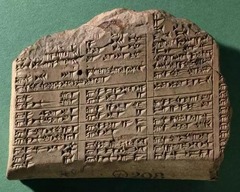
What is cuneiform?
The first writing system developed by the Sumerians, using word pictures and triangular symbols.
What was Uruk City known for?
It became a powerhouse of technology, architecture, and culture, considered the first true city.
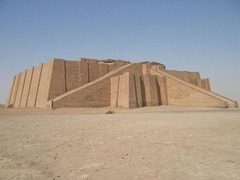
What was the Great Ziggurat of Ur?
A sacred place for the chief god, built similarly to Uruk City.
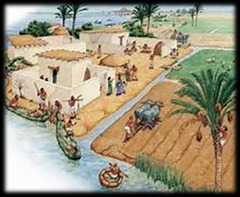
What engineering works did the Sumerians create for irrigation?
They built dikes and irrigation canals to control flooding and bring water to farmlands.
What was the main mode of transportation for the Sumerians?
Sailboats, which facilitated trade and cultural exchange.
What was the original purpose of the wheel invented by the Sumerians?
Initially used for farm work and food processing, not for transportation.
How did the plow change agriculture in ancient times?
It allowed farmers to cultivate larger parcels of land more efficiently.
What innovation did the Sumerians develop for travel?
They were the first to develop roads, improving traffic flow and organization.
What was Babylon known for?
It became a city of beautiful buildings and advanced engineering, founded over 4,000 years ago.
What are the Hanging Gardens of Babylon?
One of the Seven Wonders of the Ancient World, built by King Nebuchadnezzar II for his wife, featuring tiered gardens.
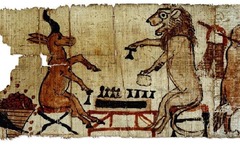
What materials were used to construct the Hanging Gardens?
Mud bricks and a variety of trees, shrubs, and vines.
What was the significance of the Sumerian social structure?
It was organized around cooperation and a desire for advancement in science and technology.
How did ancient societies address the challenges of natural disasters?
Through advancements in architecture and engineering to build protective structures.
What was the impact of technological advancements on food production?
They led to increased food production and improved agricultural efficiency.
What was the relationship between science, technology, and society in ancient times?
They were interdependent; society drove the need for technological advancements.
What challenges did ancient civilizations face that science and technology helped overcome?
Illnesses, resource scarcity, and the need for efficient food production.
What role did trade play in the development of ancient societies?
It facilitated cultural exchange and the spread of technology.
What was the significance of navigation in ancient societies?
It was essential for travel, trade, and exploration of new territories.
What is the origin of the name 'Egypt'?
The name 'Egypt' comes from the Greek Aegyptos, which was the Greek pronunciation of the ancient Egyptian name 'Hwt-Ka-Ptah'.
What was Memphis in ancient Egypt?
Memphis was the first capital of Egypt and a significant religious and trade center.
What plant was used to create papyrus?
Papyrus is made from the plant Cyperus papyrus, which once grew abundantly in the Egyptian Delta.
How did Egyptians contribute to writing?
Egyptians developed a system of writing using symbols known as hieroglyphics, which was believed to be provided by their gods.
What was the purpose of kohl in ancient Egypt?
Kohl was used around the eyes to prevent and cure eye diseases and was believed to protect against evil.
What was the function of wigs in ancient Egypt?
Wigs were worn for health and wellness, protecting the shaved heads of wealthy Egyptians from the sun.
What is a water clock?
A water clock is a timekeeping device that utilizes gravity to control the flow of water from one vessel to another.
What is Greece known for in terms of civilization?
Greece is known as the birthplace of western philosophy and made significant contributions to science and technology.
What was the function of the alarm clock in ancient Greece?
An alarm clock in ancient Greece used water that dropped into drums to signal the start of activities, such as lectures.
What is a water mill?
A water mill is a device used in agricultural processes, such as milling grains, and was preferred over animal-powered mills.
What is the significance of Rome in ancient history?
Rome is considered one of the mightiest and most influential civilizations, known for its contributions to politics and governance.
What were 'Gazettes' in ancient Rome?
'Gazettes' were the first newspapers containing announcements of the Roman Empire, made before the invention of paper.
What is a codex?
A codex is an early form of a book, with covers originally made of wax and later replaced by animal skin.
What are Roman numerals?
Roman numerals are a numeral system developed by the Romans, consisting of symbols that represent numbers.
What is the significance of silk in Chinese civilization?
Silk, produced by silk worms, was developed by the Chinese and became a major trade product, facilitating cultural exchanges.
What is tea production in Chinese culture?
Tea production involves pouring hot water over dried tea leaves and was first consumed by a Chinese emperor.
What was the Great Wall of China constructed for?
The Great Wall was built to keep out foreign invaders and control China's borders.
How long is the Great Wall of China?
The total length of all sections of the Great Wall ever built is about 21,196 kilometers (13,171 miles).
What is the most well-preserved section of the Great Wall?
The section constructed during the Ming dynasty is about 8,850 kilometers (5,499 miles) long.
What is the length of the most well-preserved section of the Great Wall constructed during the Ming dynasty?
About 8,850 kilometers (5,499 miles) long.
How was gunpowder invented in ancient China?
It was invented accidentally by mixing high levels of nitrate in the mixture.
What characterized the start of the Medieval Ages?
Massive invasions and migrations, along with prevalent wars.
Who invented the printing press?
Johann Gutenberg.
What significant development in microscopy began in the Middle Ages?
The use of plano-convex lenses as reading stones to magnify manuscripts.
Who is often credited with the invention of the telescope?
Galileo, although there is confusion with Hans Lippershy.
What was the magnification capability of Galileo's telescope?
It magnified 10 times what could be seen without it.
What was a major demand in modern times due to the booming world population?
The need for more goods to be produced at a faster rate.
What is pasteurization?
A process that treats food with mild heat to eliminate pathogens and extend shelf life.
Who invented kerosene and established the petroleum refinery industry?
Samuel M. Kier.
What is the purpose of a petroleum refinery?
To transform crude oil into more useful products like gasoline and diesel fuel.
Who developed the telephone and when was it patented?
Alexander Graham Bell in 1876.
What impact did modern calculators have on technology?
They paved the way for more complex processing machines like computers.
What is the significance of the Salamander Amphibious Tricycle in the Philippines?
It can cross flooded streets and rivers, addressing flooding issues.
What is the Sustainable Alternative Lighting (SALt) lamp?
An environment-friendly light source that runs on saltwater, invented by Aisa Mijeno.
Who is credited with the invention of the incubator and jaundice relieving device?
Fe Del Mundo, the first Asian at Harvard's School of Medicine.
What is the Mosquito Ovicidal Trap System?
A trap made of natural ingredients that is lethal to mosquitoes but safe for humans and the environment.
What was the first project accomplished by PhUV in the Philippines?
A utility vehicle that included an internal combustion engine from China.