AIS Chapter 11
 Call Kai
 Learn
Learn Practice Test
 Spaced Repetition
 Match
Match Flashcards
 Knowt Play
1/51

There's no tags or description
Looks like no tags are added yet.
Name | Mastery | Learn | Test | Matching | Spaced | Call with Kai |
|---|
No analytics yet
Send a link to your students to track their progress
52 Terms
Code of Ethics
Ethical behavior prompted by a code of ethics can be considered a form of INTERNAL CONTROL
Sarbanes Oxley
- Requires public companies registered with the SEC & their auditors to annually and report on design & effectiveness of ICFR
- Established by the PCAOB to provide independent oversight of public accounting firms
PCAOB Auditing Standard No. 5 (AS 5)
encourages auditors to use risk-based, top-down approach to ID key controls
Corporate Governance
A set of processes and policies in managing an organization with sound ethics, internal and external control mechanisms to safeguard the interests of its stakeholders
Control Concepts
Processes implemented to provide assurance that the following objectives are achieved:
Safeguard assets
Maintain sufficient records
Provide accurate and reliable information
Prepare financial reports according to established criteria
Promote and improve operational efficiency
Encourage adherence with management policies
Comply with laws and regulations
Preventive controls
deter problems from occurring (Authorization)
Detective controls
discover problems that are not prevented (Bank reconciliations and monthly trial balances)
Corrective controls
correct and recover from the problems that have been identified (Backup files to recover corrupted data)
General controls
pertain to enterprise-wide issues (controls over accessing the network, developing and maintaining applications, etc.)
Application controls
specific to a subsystem or an application to ensure the validity, completeness and accuracy of the transactions
COSO Internal Control Framework
- Widely accepted authority on internal control
- Provides baseline for evaluating, reporting, and improving internal control
Committee of Sponsoring Organizations of the Treadway Commission (COSO)
- AAA (American accounting Association)
- AICPA (American Institute of Certified Public Accounts)
- FEI (Financial Executive International)
- IIA (Institute of Internal Auditors)
- IMA (Institute of Management Accountants)
COSO Cube
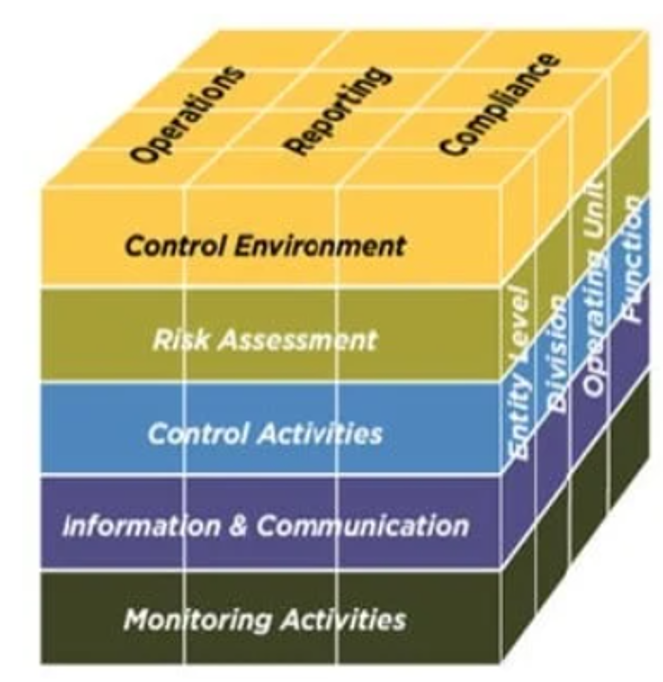
Objectives of COSO
Operations (effectiveness and efficiency of a firm’s operations)
Reporting (reliability of reporting)
Compliance (adherence to applicable laws and regulations)
Components of COSO
Control Environment
Risk Assessment
Control Activities
Information & Communication
Monitoring Activities
Control Environment
Management’s philosophy, operating style
Commitment to integrity, ethical values, and competence
Internal control oversight by Board of Directors
Organizing structure
Methods of assigning authority and responsibility
Human resource standards
Risk Assessment
Identifying and analyzing a firm’s risks from external and internal environments.
Allows a firm to understand the extent to which potential events might affect corporate objectives.
Risk is assessed from two perspectives:
Likelihood
-Probability that the event will occur
Impact
-Estimate potential loss if event occurs
Control Activities
A firm must establish control policies, procedures, and practices that ensure the firm’s objectives are achieved and risk mitigation strategies are carried out.
Occur throughout a firm at all levels and in all functions.
Information and Communication
Supports all other control components by communicating effectively to ensure information flows within the firm
Down
Across
Up
To interact with external parties and inform them about related policy positions
customers
suppliers
regulators
shareholders
Monitoring Activities
The design and effectiveness of internal controls should be monitored by management in an ongoing basis.
Findings should be evaluated, and deficiencies must be communicated in a timely manner.
Necessary modifications should be made to improve the business process and the internal control system
Control Environment Principals (COSO 2013)
1.Demonstrates commitment to integrity and ethical values
2. Exercises oversight responsibility
3. Establishes structure, authority, & responsibility
4.Demonstrates commitment to competence
5. Enforces accountability
Risk Assessment Principals (COSO 2013)
6. Specifies suitable objectives
7. Identifies & analyzes risk
8. Assesses fraud risk
9. Identifies & analyzes significant change
Control Activities Principals (COSO 2013)
10. Selects & develops control activities
11. Selects & develops general controls over technology
12. Deploys through policies & procedures
Information and Communication Principals (COSO 2013)
13. Uses relevant information
14.Communicates internally
15. Communicates externally
Monitoring Activities Principals (COSO 2013)
16. Conducts ongoing and/or separate evaluations
17. Evaluates & communicates deficiencies
Enterprise Risk Management
Identifies potential events that may affect the firm
Manages risk to be within the firm’s risk appetite.
Provides reasonable assurance regarding the achievement of the firm’s objectives.
Expands the COSO Internal Control framework to provide a broader view on risk management to maximize firm value
COSO Enterprise Risk Management Cube
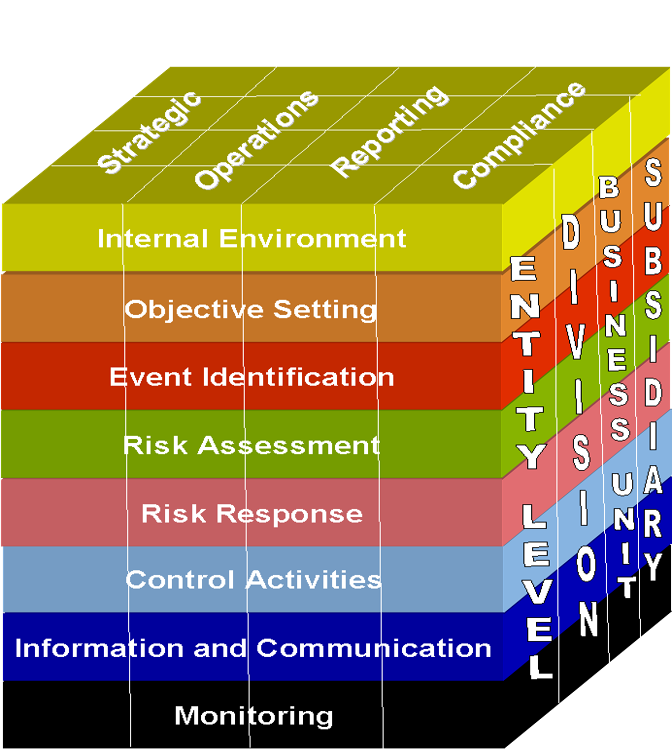
COSO Enterprise Risk Management Objevtives
Strategic — high-level goals, aligned with and supporting the firm’s mission and vision
Operations — effectiveness and efficiency of operations
Reporting — reliability of internal and external reporting
Compliance — compliance with applicable laws and regulations
What additional info are in ERM vs COSO
Objective setting
Event identification
Risk assessment
Risk response
Control activities
Objective Setting
strategic level, establishing a basis for operations, reporting and compliance
Event Identification
Identifying incidents both external and internal to the organization that could affect the achievement of the organization's objectives must distinguish between risks and opportunities
Risk Assessment
First step to n developing an audit plan to meet the mandate of SOX Section 404
Inherent risk
exists already before plans are made to address it
Control risk
the threat that errors or irregularities in the underlying transactions will not be prevented, detected and corrected by the internal control system
Residual risk
the product of inherent risk and control risk (risks that is left over after controlling it)
Risk Response
(1) Reduce risks: implement effective internal control
(2) Share risks: buy insurance, outsource, or hedge
(3) Avoid risks: do not engage in the activity
(4) Accept risks: Do nothing, accept likelihood and impact of risk
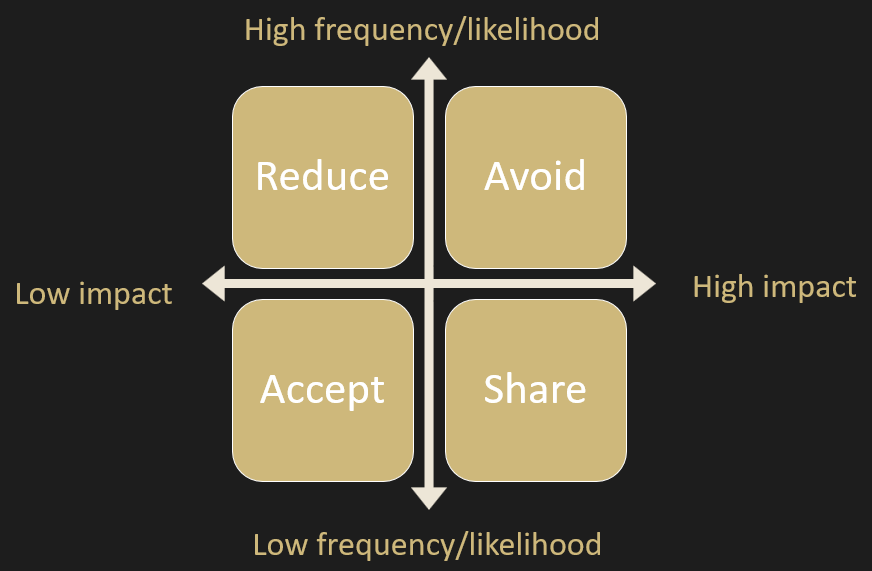
Cost and benefit analysis
Expected benefit of an internal control
=Impact * Decreased Likelihood
=Estimated impact of a risk times * decreased likelihood if the control is implemented
Physical Control
mainly manual but could involve the physical use of computing technology
+ proper authorization of transactions and activities
+ segregation of duties
+ project development and acquisition controls
IT Controls
Provide assurance for information and help to mitigate risks associated with the use of technology
IT general controls (ITGC)
Enterprise-level controls over IT
+ IT control environment
+ Access controls
+ Change management controls
IT application input controls
field checks, size checks, range checks, validity checks
IT application processing controls
pre-numbered documents, sequence checks, batch totals
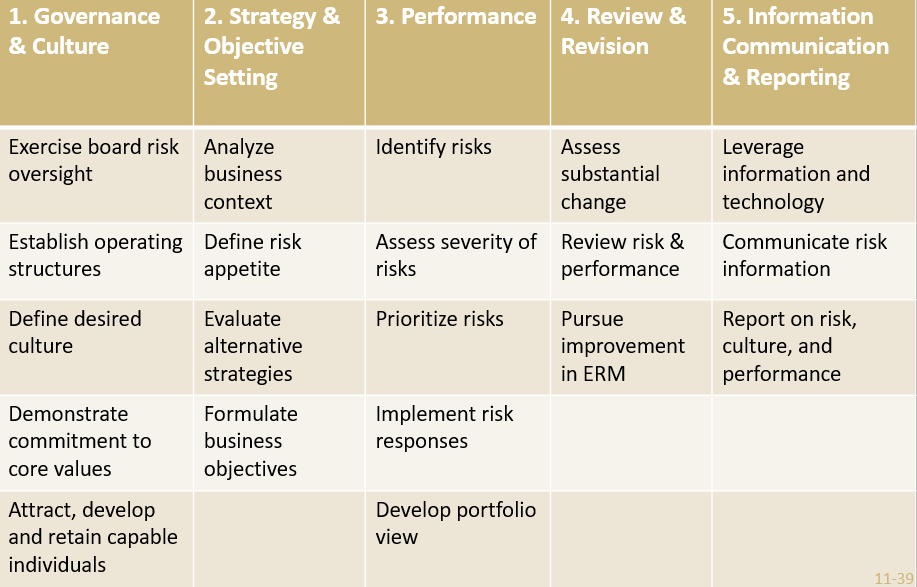
COSO ERM 2017
defined ERM as “the culture, capabilities, and practices that organizations integrate with strategy-setting and apply when they carry out that strategy, with a purpose of managing risk in creating, preserving, and realizing value.”
COBIT (Control Objectives for Information and related Technology)
a generally accepted framework for IT governance and management
COBIT Framework
Provides a business focus to align business and IT objectives
Defines the scope and ownership of IT process and control
Is consistent with accepted IT good practices and standards
Provides a common language with a set of terms and definitions that are generally understandable by all stakeholders
Meets regulatory requirements by being consistent with generally accepted corporate governance standards (e.g., COSO) and IT controls expected by regulators and auditors.
Key Criterias for COBIT Framework
Effectiveness – relevant and timely
Efficiency – produced economically
Confidentiality – protection of sensitive information
Integrity – valid, accurate and complete
Availability – available when needed
Compliance – complying with the laws and regulations
Reliability – reliable for daily decision making
ITIL (Information Technology Infrastructure Library)
ITIL’s value proposition centers on providing IT service with an understanding the business objectives and priorities, and the role that IT services has in achieving the objectives.
It is a de facto standard in Europe for the best practices in IT infrastructure management and service delivery.
ITIL adopts a lifecycle approach to IT services and organizes IT service management into five high-level categories.
ITIL 5 high-level categories
•Service Strategy (SS)
•the strategic planning of IT service management capabilities and the alignment of IT service and business strategies
•Service Design (SD)
•the design and development of IT services and service management processes
•Service Transition (ST)
•realizing the requirements of strategy and design, and maintaining capabilities for the ongoing delivery of a service
•Service Operation (SO)
•the effective and efficient delivery and support of services, with a benchmarked approach for event, incident, request fulfillment, problem, and access management.
•Continual Service Improvement (CSI)
•ongoing improvement of the service and the measurement of process performance required for the service.
ISO (International Organization for Standardization) 27000 Series
address information security issues.
have become the most recognized and generally accepted sets of information security framework and guidelines.
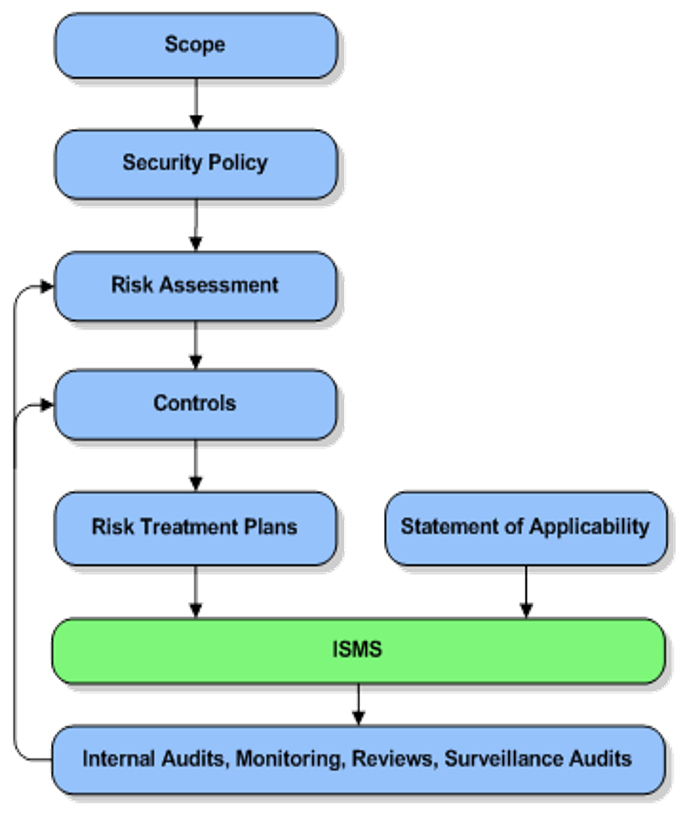
The main objective s to provide a model for establishing, implementing, operating, monitoring, maintaining, and improving an Information Security Management System (ISMS) using a “process approach
Steps to SIO 27000 Series