DNA Structure and Function I
 Call Kai
 Learn
Learn Practice Test
 Spaced Repetition
 Match
Match Flashcards
 Knowt Play
1/44

There's no tags or description
Looks like no tags are added yet.
Name | Mastery | Learn | Test | Matching | Spaced | Call with Kai | Chat |
|---|
No analytics yet
Send a link to your students to track their progress
45 Terms
DNA stands for ___, which is composed of two long polymers of nucleotides (‘strands’)
deoxyribonucleic acid
Each DNA strand has four types of __
nucleotides
a nucleotide has a ___, ___, and ___base
phosphate, sugar, nitrogenous
the two strands of DNA are held together by __ bonds between base pairs. (bases by covalent)
hydrogen
the two strands have polarity and are ___ to each other (5’ to 3’ and 3’ to 5’)
anti-parallel
Ribose and Deoxyribose are __(5 C-atoms) sugars!
Pentose
Each number of the sugar is followed by a ___ , therefore one speaks of 5’, 4’, 3’ carbon.
prime mark
Bases are Nitrogen-containing Ring Compounds of either ___ or ___
Pyrimidines (uracil, cytosine, thymine) or Purines (adenine and guanine)
__ and __: Purine (2 rings)
Adenine and Guanine
___ and ___: Pyrimidine (1 ring)
Cytosine and Thymine
Chargaff postulated that in any DNA strand:
Number of __ bases (A,G) = the number of __bases (T,C).
Number of Thymine = Adenosine Guanine = Cytosine
purine = pyrimidine
However the relative __ of AT pairs to GC pairs for each species can be different!
ratio
purines pair with pyrimidines through hydrogen bonds between __ and __ groups
amino and carbonyl
__ bonds (strong covalent) link nucleotides together
Phosphodiester
the 5’ phosphate (-PO4) links to the 3’ __ (-OH)
hydroxyl
the helix contains two grooves:
major and minor

DNA encodes information in the sequence of __
nucleotides
A, C, G and T is a four-letter alphabet encoding ___
proteins
the 4 nucleotides encode for the __ amino acids of proteins, which is known as the _
20 , genetic code
the complete set of information of an organism’s DNA is called its ___
genome
eukaryotic DNA is packed into __ to help conserve space (and to help nuclei divide during mitosis/meiosis)
discrete chromosomes
humans have two sets of 23 chromosomes containing ___ base pairs
3.2 x 10^9 (3 billion)
the DNA in combination with the organization proteins is called __
chromatin
in humans, chromosome pairs (maternal and paternal) are called __ chromosomes
homologous
__ chromosomes in males (XY) are the only non-homologs
sex
A __is an artificial arrangement of chromosomes
karyotype
chromosomes are different sizes and have varying __ positions (see red lines)
centromere
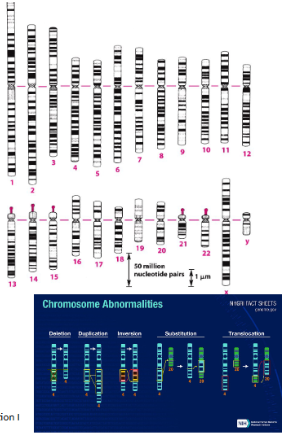
a __ is a segment of DNA that contains instructions (the code) for making a protein
gene
the number of genes in an organism roughly correlates to its relative __
complexity

___ genes in humans
25,000
In general, the more “ complex” an organism, the larger its __, but there are lots of exceptions
genome
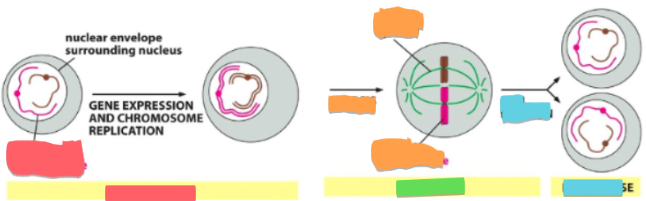
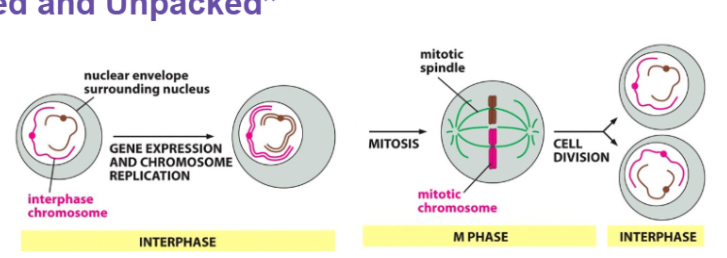
Interphase: chromosomes are “ __ ” to allow for gene expression
unpacked
M ( __ ) Phase: chromosomes are “packed” to allow orderly distribution to daughter cells
mitotic
When cells are NOT actively replicating, their DNA is less compacted and are called the __ chromosomes
interphase
During cell replication, the chromosome is condensed and compacted, turning into a __ chromosome
mitotic
Human chromosome 22 contains __ base pairs (bp), which would extend about 1.5 cm
48 million
During mitosis, chromosome 22 is only 2 μm in length (__ more compact)
10,000X
Two types of proteins that aid in compaction are called __ and non-__
histones
The protein and DNA combination is called __
chromatin
__ histones form a protein “__“
8 : bead
DNA coils around these beads, forming a ___, which is the most fundamental level of chromatin packing
nucleosome
The ___ is __charged, enabling it to bind to the negatively charged sugar-phosphate DNA backbone
histone octamer : positively
Why the core histone proteins have a high portion of positive charged amino acids?
Each of the core histones has a N-terminal amino acid “__ “
Modifications at the tail control __
tail
chromatin structure
__ use ATP hydrolysis to slide DNA around a histone
Chromatin-remodeling complexes