L09 Intelligence: Measuring Mental Performance
 Call Kai
 Learn
Learn Practice Test
 Spaced Repetition
 Match
Match Flashcards
 Knowt Play
1/37

There's no tags or description
Looks like no tags are added yet.
Name | Mastery | Learn | Test | Matching | Spaced | Call with Kai | Chat |
|---|
No analytics yet
Send a link to your students to track their progress
38 Terms
What Is Intelligence?
Intelligence goes beyond just IQ - has some biological component but also influenced by environmental factors (not a single definition)
most definitions focus on problem solving abilities, abstract thinking, adaptation
1. Psychometric approach: Focus on measuring intelligence through standardized tests.
2. Information-processing/Piagetian approach: Emphasizes how intelligence develops and cognitive processes.
Key Difference: Product-oriented (what we can measure) vs. Process-oriented (how we solve problems).
Psychometric approach
Intelligence is viewed as a set of measurable traits that vary among individuals
IQ tests do not measure potential/underlying capacity, more of performance )e.g., IQ tests, SAT)
does not measure creativity, emotional intelligence, cultural knowledge
Psychometric Views on Structure of intelligence
Singular-component theory: Proposes intelligence is one unified trait.
Multicomponent theories: Intelligence involves multiple abilities (combination of them). - how can we identify abilities that may correlate w each other?
Factor analysis: (statistical method) Identifies distinct cognitive abilities that correlate together. (using tasks)
correlation = association b/w 2 variables, but here we are grouping highly correlated variables into fewer broader categories
common underlying ability if grouped together..
Psychometric: Singular-component theory of intelligence
Binet + Mental Age
Binet = father of intelligence testing → one of earliest measures to test intelligence → to identify those who needed more support or with intellectual disabilities
developed tasks relevant to population
he believed intelligence isn’t fixed, but can be improved w intervention (rationale for creating this measure)
he introduced the idea of mental age, level at which a child functions intellectually (different from biological age)
Psychometric Perspective: Multicomponent theories of intelligence
Spearman & Thurstone
Spearman among first researchers to use factor analysis to explore if intelligence is one or many abilities
positive manifold - regardless of type of test, they are positively correlated
g = like general intelligence that influences all tasks
e.g., if excelling in math + verbal reasoning, this suggests that child is influenced general mental factor
special abilities, s = task-specific skills (strength only in verbal tasks, defining words + sentences at certain speed or skill, weak in reasoning = special ability in verbal tasks)
Thurstone - verbal comprehension = ability to define words, word fluency, number facility (add + subtract mentally), spatial visualization (mentally rotate 3d shape), associative memory (remembering friend’s bday because it falls on holiday), perceptual speed (ability to spot differences b/w similar picture in short amount of time), and reasoning (e.g., solving puzzles, or 2,4,6,8, what comes next) (equivalent to Spearman’s g)
argued these skills independent
current research = still correlated in some ways → Spearman’s g
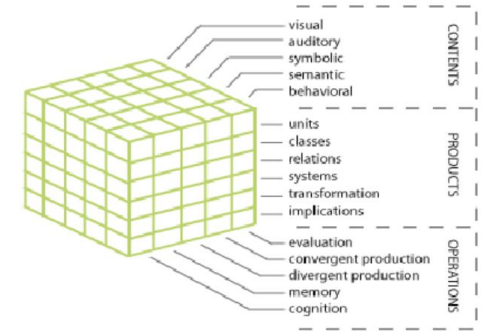
Guilford & Cattell and Horn
Guilford’s structure-of-intellect model Classified intelligence into 180 primary mental abilities based on content, operations, and products.
proposed that intelligence can be understood in 3 dimensions (operations, content, products), which each has subskills = 180 distinct intellectual abilities → more theoretical, didn’t gain much attention (not strongly supported w empirical evidence)
later researchers found that abilities correlated instead of as independent constructs → not 3 distinct dimensions, can be correlated
Cattell and Horn: Distinguished between (important work for developmental psych)
Fluid Intelligence (Gf); problem-solving in new situations
using reasoning rather than previous knowledge to solve problems (e.g., pattern recognition, abstract reasoning, puzzles, rules) → less influenced by education + culture (peaks in early adulthood, declines w age)
Crystallized Intelligence (Gc); knowledge from past experiences (acquired thru education + life experiences).
vocab, general knowledge → as experiences increase w age, knowledge increases (knowledge remains stable until later adulthood)
Hierarchical Models and Carroll’s three Stratum theory
Hierarchical models of intelligence - proposes that intelligence can be broken down to broad general abilities + neuro-specific abilities organized into specific structure
Carroll’s three-stratum theory of intelligence organizes these abilities in a hierarchy.
One general factor (g) (of intelligence)
PLUS broad abilities - hierarchical model tells us that Spearman was right - cognitive abilities are correlated and reflect general factor g
PLUS narrow specific skills - but model also tells us that thurstone was also right in that intelligence has multiple distinguishable abilities
Intelligence seen as layers - combining both g and specific skills → hence also called integration model
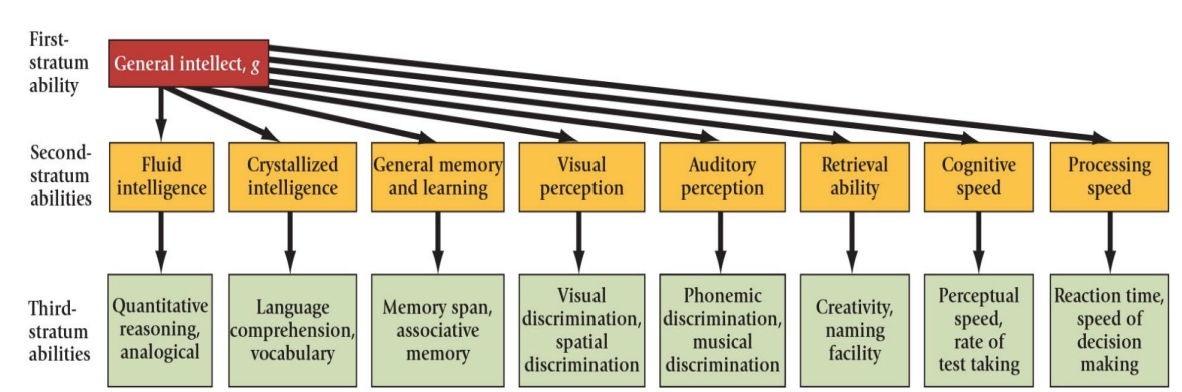
Hierarchical Models and Carroll’s three Stratum theory
g = overall mental ability influencing performance across all tasks
second = broad cog abilities - fluid + crystallized intelligence, etc.
not all broad relate to g, fluid intelligence greatly related to g, but auditory perception + processing speed are more specialized → John Carroll’s three-stratum hierarchical model of intelligence. Second-stratum abilities are arranged from left to right in terms of their decreasing correlation with g. So fluid intelligence and the reasoning it supports (e.g., quantitative reasoning) are more closely associated with general mental ability g than are auditory perception, cognitive speed, and the third-stratum skills that these abilities support.
third = specific abilities making up each broad abilities
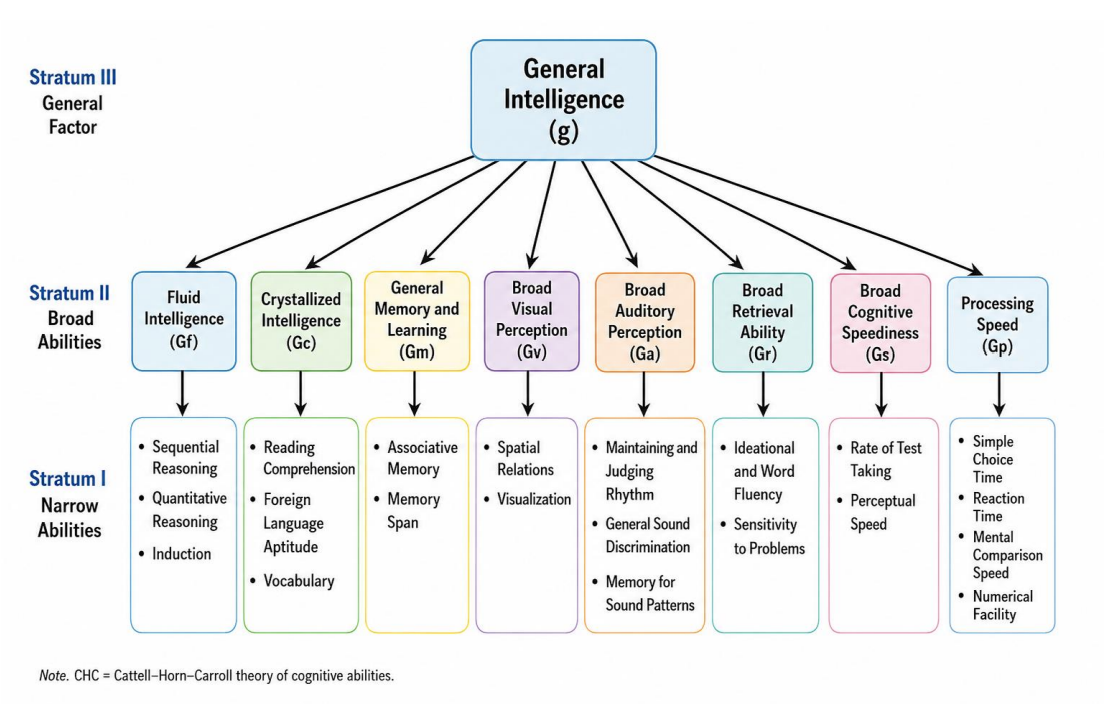
CHC Theory (Cattell-Horn-Carroll): CHC Theory: The Modern Hierarchical Model
Builds on Carroll’s Three-Stratum theory
Carroll - overall structure of intelligence
g, broad, specific
Integrates Cattell & Horn’s Fluid (Gf) & Crystallized (Gc) model
id + describing broad abilities especially the distinction b/w fluid abilities + crystalized intelligence
CHC combines these 2 perspectives, kept hierarchal structure but includes both fluid + crystalized
Retains hierarchical structure: – g (general intelligence) – Broad abilities – Narrow skills ▪
Currently the dominant framework in intelligence testing → considered a standardized test + most widely used
Information-processing perspective
psychometric views → criticized for being too narrow → only tells us what children know + doesn’t tell how knowledge is acquired, retained → how is known information used in problem solving
traditional IQ tests do not measure traits associated w intelligence (common sense, social competence - knowing to deal w cultural context, emotional intelligence, creativity etc)
this gave rise to information-processing perspective → focuses cog processes underlying intelligence (how child approach task, strategies used, efficiency of info processing over the outcome) → “how intelligence develops”
Sternberg’s Triarchic Theory
Gardner’s Theory of Multiple Intelligences
Sternberg’s triarchic theory - proposed 3 components of inteliigence
a. Contextual Component: Practical intelligence; adapting to, shaping or selecting environments. (streets smarts)
intelligence depends on context, and may vary across cultures
reflects a real-world ability, not testable (e.g., punctuality in NA meetings would be respectful + professional; in social gatherings - more flexibility for lateness + wouldn’t make difference for the event, like Latin cultures)
b. Experiential Component: Response to novelty and automatization.
how experience would influence task performance
two types of performance: responses to novelty (new tasks require active + conscious reasoning), automation(is this the word)? (how efficient at familiar task, less conscious effort needed)
for intelligence tests, it must be equally familiar/unfamiliar across all cultural groups to be fair to avoid bias (otherwise reflects familiarity over ability)
c. Componential Component: Information-processing skills used in problem-solving.
argued must examine mental processes used to generate answers
how problem was analyzed, strategies used, etc (e.g., math problem - lose points for process not just for answer)
Gardner’s theory of multiple intelligences
argued that intelligence is not only one general ability, but rather people display 9+ distinct intelligences
Linguistic - language use + meaning (poets, writers, lawyers → to express, to defend)
Logical-mathematical - reading recognizing patterns, solving mathematical problems (IQ/standardized test emphasizes this)
Spatial - ability perceive spatial problems (manipulate images) (e.g., architects, engineers, artists)
Musical - sensitive to pitch, rhythm, melody
Body-kinesthetic - ability to use body in skillful way to achieve goals/express ideas (gymnasts, athletes, even surgeons for fine motor skills)
Interpersonal - ability to understand others
Intrapersonal - being aware of internal states (strengths, weaknesses)
Naturalist - sensitivity to patterns in nature (plants, animals) (biologists, anthropologists)
Existential - sensitivity to deep life, death, meaning questions
Individuals may display relative strengths and weaknesses across intelligences
also abilities are separate enough that they can be developed separately
Evidence for Multiple Intelligences
Savant syndrome - extraordinary ability in a specific area but not others
Selective brain injuries - damage may affect language but not other areas
How Is Intelligence Measured?
Early goal: Identify children needing academic support.
First tests focused on mental age.
Modern tests use norms and deviation IQ. (instead of using Binet + Simon’s mental age) - comparison w others of same age
Intelligence tests continue to evolve. - more difficult to obtain measure that would test all abilities (working towards measuring beyond intelligence)
Stanford-Binet Intelligence Scale
Revised from Binet & Simon’s original test - for American students
Introduced IQ (Stern, 1912): IQ = (Mental Age ÷ Chronological Age) × 100
IQ of 100 → mental age ~ chronological age
Modern versions use deviation IQ → compare individual scores to others of same age in representative sample
Measures verbal reasoning, quantitative reasoning, visual–spatial reasoning, short-term memory → measures abilities key to academic success
The Wechsler scales
test developed b/c earlier tests relied too heavily on verbal skills (disadvantage to those who speed language as second language, intellectual disabilities, hearing issues)
Wechsler Preschool and Primary Scale of Intelligence - Fourth Edition (WPPSI-IV). For younger children, from 2 years 6 months to 7 years 7 months.
Wechsler Intelligence Scale for Children - Fifth Edition (WISC-V). For older children, specifically those aged 6 years to 16 years 11 months.
Includes both verbal and nonverbal (performance) subtests
Provides Full-Scale IQ + index scores: verbal comprehension, Perceptual reasoning, Working memory, Processing speed
The Kaufman Assessment Battery & Dynamic Assessment
Newer approaches to intelligence testing reflect modern theories
The Kaufman Assessment Battery for Children (K-ABC):
Based on information-processing theory.
Emphasizes understanding cognitive processes (to process info) rather than just intelligence outcomes. → more emphasis on fluid intelligence + tasks measuring measures simultaneous & sequential processing, planning, learning.
Dynamic assessment:
Linked to Vygotsky’s Zone of Proximal Development → Evaluates learning potential (how well children learn when given guidance/scaffolding)
Pre-test → Guided instruction → Post-test
intervention model → views intelligence not as fixed ability (review)
The Bayley Scales of Infant Development
Assessing infant intelligence (2 to 30 months)
Motor scale (e.g., gross and fine motor skills) - sitting, walking; fine - grasping
Mental scale (e.g., cognitive, language social skills) - reaching hidden object, ability to respond to name when called
Behavior Rating Scale (attention, emotion, regulation, engagement during testing)
Provides Developmental quotient (review)
DQ is a poor predictor of later IQ
Stability of IQ Across Childhood
How stable are IQ scores across childhood? → IQ score at age 8 correlates with IQ scores at age 18 (0.70). (but doesn’t mean IQ is fixed)
Stability increases after early childhood.
Many children show meaningful fluctuations.
Changes are often systematic, not random.
Environment plays a major role. (children raised in intellectually stimulating + supportive envs correlated w higher IQs (w/ poverty - decline in IQ over time)
Cumulative deficit hypothesis:
Long-term exposure to disadvantaged environments can progressively lower intellectual performance → (even minor) chronic env disadvantages, effects accumulate + gradually weaken intellectual development
performance shaped by environments we are exposed to
Cultural Influences on Intelligence
Cultural Influence:
Intelligence is not defined the same way across cultures. (standardized intelligence tests developed in western may not capture norms of intelligence across diff culture)
Different cultures emphasize different cognitive skills.
Examples (just know what is discussed in lec)
In Kenya, children with greater practical knowledge (e.g., navigating social situations and solving real-life problems) is more emphasized as a marker of intelligence compared to abstract reasoning
herbal medicine to treat illness → children didn’t score highly on traditional academic tests
practical knowledge + academic intelligence were found to be weakly correlated → intelligence depends on environmental demands + support (supports Sternberg idea, intelligence not just focused on practical knowledge)
In certain Indigenous Australian communities, visual-spatial memory may be more developed due to the importance of navigating large territories without traditional maps.
strength in visual memory → can navigate environments well, showing how culture shapes which cognitive abilities that become well developed
Standardized Western IQ tests may not fully capture these abilities. (since they emphasize verbal, mathematical reasoning over spatial skills)
SES and Cognitive Development
Socioeconomic Status (SES):
SES strongly influences cognitive development (Access to education, language exposure, healthcare, and enrichment matters varies with SES; although resilient children may sometimes excel in harsh conditions)
Differences can widen over time
Example (UK study):
At age 2: Low-SES children scored by 6 IQ points lower.
By age 16: The gap nearly tripled
Flynn Effect:
IQ scores rose by 3 points per decade across generations.
Linked to improved education, nutrition, and cognitive stimulation.
Testing Bias and Language
Language and Testing Bias
Traditional IQ tests reflect Western, middle-class values.
Verbal tests may disadvantage bilingual or non-English-speaking children (may perform low on verbal IQ test → doesn’t mean child is intelligent but they are not proficient in language enough to understand + perform well at tasks, lead to non-verbal assessments)
Non-verbal Assessments, such as pattern recognition, spatial reasoning, and analogical reasoning, are dependent on language.
Kaufman’s Brief Intelligence Test (K-BIT)
The Raven’s Progressive Matrices
Monolingual vs. Bilingual: Bilingual students may show cognitive flexibility advantages, but verbal tests can underestimate their ability
What Do IQ Tests Predict?
Academic achievement (r = 0.50 - 0.66) → moderately correlated, meaning it does partially explains grade variability, but there are many factors such as motivation, habits, personality, family support, among others, which affect IQ scores
Educational attainment
Occupational status (moderate relationship)
Not perfect predictors of life success (physical health, lifestyles, etc. but not happiness / success)
IQ predicts performance - not destiny.
Gifted Programs: Identification and Equity
Giftedness historically defined as IQ ≥ 140 (Terman) → genetic studies of genius (followed children who have such IQ) (stereotype that are socially awkward, weak → incorrect they are outgoing + healthy) (but high IQ doesn’t correlate w great achievements because it depends on creativity, motivation, etc. .. acceptable achievements)
Today: High IQ + domain-specific talents (music, art, science, leadership)
Identification methods:
Standardized IQ tests (e.g., WISC, NNAT - measures reasoning w visual patterns to reduce influence of language proficiency)
WISC looks at Academic performance, Teacher recommendations
Multiple measures/universal screening → assess everyone rather than specific children to make testing more equitable
Programs: enrichment, acceleration, specialized classes
Challenges: (concerns about equity (those in gifted programs often come from high SES + have more opportunities for gifted screening) → may underidentify more resilient, marginalized children who have less opportunity to show their strengths)
SES and cultural bias in identification
Access to private testing
Underrepresentation of minority and low-SES students
Social-emotional concerns (perfectionism, isolation)
Intelligence in Children with Special Education Needs
learning + intellectual disabilities
mental health disorders
Learning Disabilities:
Uneven cognitive profiles → e.g., individual w dyslexia may have excellent problem solving abilities but struggle w reading due to phonological processing difficulties
May show strengths in some domains
Intellectual Disabilities
IQ < 70 + deficits in adaptive functioning (communicating, self-care, etc.) → both criteria required for diagnosis
Mental Health Disorders
Anxiety, depression → affect processing speed & attention (as well as motivation, temporarily)
IQ = estimate of performance at one time
twice-exceptionality (2e): gifted + learning disability (strength can mask weakness or vice-versa, making IDing more challenging) - masking effect- review
Compensatory Education: Head Start
what happens if we change the environment?
Goal: Reduce effects of early socioeconomic disadvantage
Head Start (U.S.) & Canadian adaptations
Aboriginal Head Start (culturally grounded, community-led, family involvement)
Why Canada focused on Indigenous programs: Long-standing structural inequities (colonization, residential schools, systemic underfunding of health systems, education); Barriers to early learning opportunities; Emphasis on culturally responsive early childhood education
Early Findings: Short-term IQ gains (8-10 points); IQ gains often faded in elementary school (“fade-out effect”)
Key Debate: Arthur Jensen: program “failed” because IQ gains faded → Developmental view: IQ is only one outcome (not because intervention failed, we miss broader env picture we aim to look at) - review last bit
Long-Term Effects of Early Intervention
Longitudinal studies show:
Higher academic achievement
Less grade retention
Lower special education placement/need
Higher high school completion
Lower delinquency & teen pregnancy
Greater employment
IQ gains may fade, but life outcomes improve.
The Carolina Abecedarian Project
tested whether earlier + longer intervention is more effective:
Began at 6-12 weeks of age (infancy) → Intensive, full-day intervention (5 years)
Participants: high-risk, low-income infants
Results:
IQ advantages maintained into adolescence
Academic gains
Health benefits into adulthood
Video
look at current capabilities → gradually increase complexity of tasks
IQ scores compared w those without intervention (no difference in early months, but at 15 months, the way children saw the world different - more language fluency, efficiency); by 2-3 yrs, there were major differences)
at 5 yrs, after attending school they were tested → higher academic performance and careers)
IQ was a measure to see change occurring and that early intervention helped improve learning
Two-Generation Interventions: Changing the Family System
Target both children and parents
Parenting coaching and social support
Educational and vocational training for parents
improving parenting, lowering stress levels, providing more opportunities → better well-being and gives them more chances in supporting children’s environment
Long-term change in parenting practices (not just affected IQ of children)
“Diffusion effect”: younger siblings benefit indirectly (even though they never participated in programs)
Creativity + Thinking Processes
Creativity → ability to generate Novel ideas that are Appropriate and have useful solutions, Valued by others
Thinking Processes
Convergent thinking → one correct answer (IQ tests measure this)
Divergent thinking → multiple possible solutions (creativity involves more of DT)
Key Point: Divergent thinking is only modestly correlated with IQ.
High IQ ≠ high creativity (and moderate IQ doesn’t prevent creativity)
Sternberg & Lubart: Investment Theory of Creativity
Core Idea:
Creative individuals “buy low and sell high” in the world of ideas.
Invest in novel or unpopular ideas + Persist despite resistance
Develop ideas until they become valued and gain attention
Creativity requires a convergence of six resources: Intellectual skills, Knowledge of domain being argued for, Cognitive style, risk-tasking Personality, intrinsic Motivation, Supportive environment
Creativity = interaction of person + context support, not just a reflection of a single ability (emerges from multiple interacting systems)
Applying Developmental Themes to Intelligence & Creativity - review
Active child
Curiosity and engagement shape opportunities
Nature + nurture
Genetics and environment both influence IQ and creativity
Stability & change
IQ becomes moderately stable after early childhood
Infant DQ does not strongly predict later IQ
Early intervention can alter developmental trajectories
Holistic development
Intelligence influences academic, social, emotional, and occupational outcomes
Intelligence and creativity reflect dynamic interactions across development, not fixed destiny.
Research question
does education increase intelligence
or does more intelligent students stay in school more
study = meta-analysis, using quasi-experiments, longitudinal studies results, natural experiments, school entry cutoff studies
Q.1 What is the central developmental claim being made? (What is being argued about development, change, or risk?)
Education has a causal effect on intelligence.
IQ is not fully fixed.
Years of schooling contribute to measurable increases in cognitive ability (later IQ). - Intelligence test scores are positively correlated with education duration
intelligence is flexible
Development of intelligence is shaped by environmental input over time (provided by schooling) (exposed to numeracy + literacy, abstract reasoning, training of meta-cognition in school settings + problem-solving environments) → improves executive functioning
Q.2 What type of evidence is used? (Correlational, longitudinal, experimental, animal models, review?)
Natural experiments (changes in compulsory schooling laws)
Longitudinal studies
School entry cut-off studies
Policy-based quasi-experimental designs
Q.3 What does the article not claim? (Where are the limits, cautions, or unresolved questions?)
It does NOT claim that: ▪ Education completely determines intelligence ▪ Genetics are irrelevant ▪ IQ increases infinitely with schooling ▪ All cognitive domains are equally affected
Q.4 How would this evidence be misused in the media or public discourse? (Correlation vs causation, overgeneralization, determinism)
▪ Overstating effects: School makes everyone equally intelligent. ▪ Policy oversimplification: Assuming more years automatically equal better thinking without quality instruction. ▪ Ignoring Nature-Nurture interaction: Framing it as pure nurture versus nature. ▪ Political misuse: Using findings to dismiss structural inequality
Q.5 Which developmental lens or theory helps interpret these findings best? (Biological, learning, cognitive, sociocultural, transactional)
Transactional OR Developmental Systems
Case Analysis
Identify which intelligence theory explains it best, justify choice of theory, predict how IQ might change over time
Case A: A child navigates complex social dynamics in a refugee camp but scores average on IQ tests
Sternberg practical intelligence + also can be Gardner interpersonal knowledge
social adaptation, interaction, navigation (not measuring analytical ability) → interpersonal, practical intelligence
refugee camp has enriched environment; over time if in enriched env, IQ score increases; limited environment - IQ stays average
Case B: A student memorizes formulas easily but struggles to apply them in new situations.
memorization = crystallized knowledge, but child struggles with fluid knowledge (likely that child has strong g, but weak gf)
over time if child trained on reasoning strategies, IQ would increase with improvements w fluid knowledge (need more practice + exposure to experiences)
Case C: A teenager from a low-SES background improves dramatically after entering an enriched school environment.
cumulative deficit hypothesis → low SES puts you at significant disadvantage which may suppress cognitive performance; shows significance of plasticity (how brain can change depending on environment)
over time, IQ would increase if child is continually placed in enriched env; but if this env is removed, IQ score would drop