ME328 Final Exam Review
 Call Kai
 Learn
Learn Practice Test
 Spaced Repetition
 Match
Match Flashcards
 Knowt Play
1/50

Earn XP
Description and Tags
These flashcards cover key vocabulary and concepts related to materials science and engineering as studied in ME328, focusing on properties, behaviors, and treatment processes of various materials.
Name | Mastery | Learn | Test | Matching | Spaced | Call with Kai | Chat |
|---|
No analytics yet
Send a link to your students to track their progress
51 Terms
For metals, a smaller grain size typically results in higher strength
True
The mechanisms of plastic deformation in metals and polymers are the same
False
Polymers will typically become stiffer as the temperature decreases
True
Increasing the amount of cold work in a ductile metal decreases the density of dislocations in the metal.
False
Brittle fracture can occur below the yield or tensile strength of a material
True
Materials under cyclic loading conditions can only fail when subject to significant plastic deformation
False
For metals, a larger grain size typically results in superior creep resistance
True
Fracture toughness is typically higher in ceramics than in metals
False
Dislocations in ceramics present limited mobility, which hinders their ability to plastically deform
true
Ceramics present a much smaller Weibull modulus than metals because of their sensitivity to flaws
true
Bainite can be obtained equilibrium (slowly) cooling a steel after austenization.
false
The goal of tempering for both metals and glasses is to decrease the strength and hardness of the material
false
In alloys that can precipitate harden, the bigger the precipitates the stronger will be the alloy
false
The stiffness and yield strength of a polymer decrease as we increase the amount of cross linking between polymeric chains
false
Annealing an aluminum alloy significantly decrease its elastic modulus
false
Advanced (engineering) ceramics generally presents higher porosity than traditional ceramics
false
Brittle materials present unstable crack propagation
true
Composites such as carbon laminates are anisotropic materials that present a large strength-to-weight ratio
true
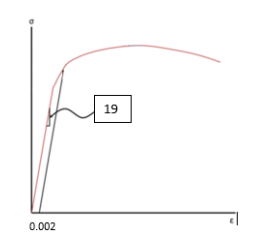
For the σ vs. ε figure below, which material property is denoted via #19
Elastic Modulus
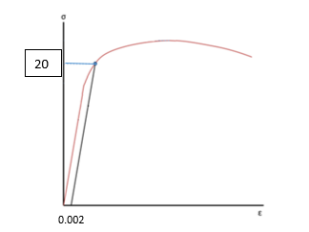
For the σ vs. ε figure below, which material property is denoted via #20
0.2% Yield Strength
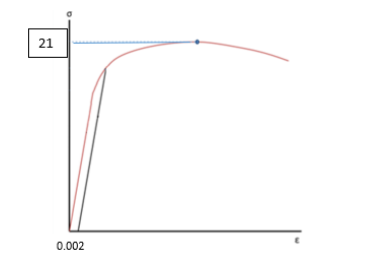
For the σ vs. ε figure below, which material property is denoted via #21
Ultimate Tensile Strength
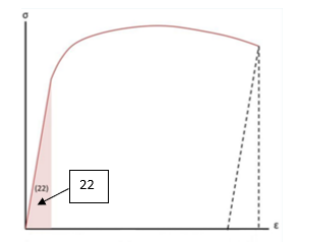
For the σ vs. ε figure below, which material property is denoted by the area via #22
Modulus of Resilience
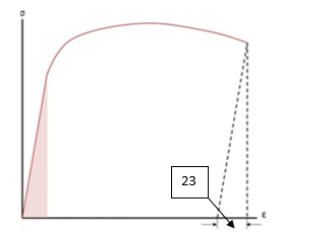
For the σ vs. ε figure below, which material property is denoted by dimension via #23
Total Elastic Strain
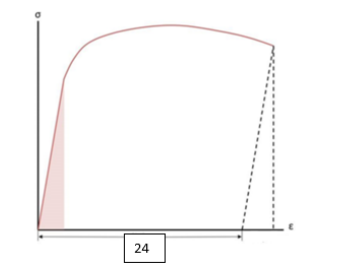
For the σ vs. ε figure below, which material property is denoted by dimension via #24
Ductility (% Elongation)
Which material property is a measure of resistance to localized, permanent surface deformation?
Hardness
Which material property is a measure of energy absorbed before fracture?
Modulus of Toughness
Which material property is sometimes referred to as the material’s stiffness?
Young’s Modulus
Which properties listed below have the strongest influence on the “toughness” of a material?
Tensile Strength and Ductility
Hardness is most strongly correlated with which one of the following properties?
Tensile Strength
A cylindrical rod of titanium is 120 mm in length and has a diameter of 15 mm. If an elongation of 10.5 mm is observed when a tensile load of 130,000 N is applied along its axis, what is the true stress? (E = 107 GPa and σy = 650 MPa)
800.0 MPa
If a metal has a high Modulus of Elasticity, which of the following statements is logical?
Atoms in this material are strongly bonded, so we expect the thermal expansion coefficient to be small for a metal
What is the main difference between a proeutectoid microconstituent formed above the eutectoid line and a primary microconstituent formed above the eutectic line?
The proeutectoid microconstituent is formed within a solid phase, typically along grain boundaries, whereas the primary microconstituent is formed within a liquid phase
Which of the following is an advantage of ductile materials?
They stretch and deform before breaking, thus giving some advance warning
Considering the Hume-Rothery rules for atomic size factor and crystal structure only, the phase diagram could potentially be the binary phase diagram for which element combination(s)?
Elements X and Y
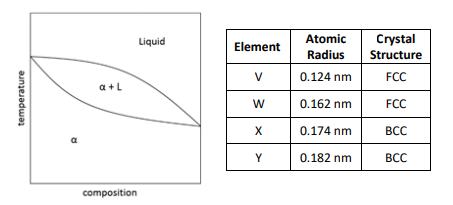
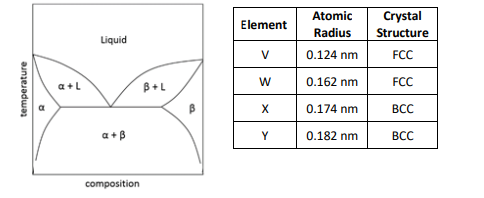
Considering the Hume-Rothery rules for atomic size factor and crystal structure only, the phase diagram could potentially be the binary phase diagram for which element combination(s)?
Elements V and W & Elements W and X
Which of the following is a necessary condition for diffusion to take place?
Enough thermal energy for the diffusing atom to vibrate, break bonds, and move
You are tasked to process a thin composite laminate that is resistant against impact and can withstand high loads on various in-plane directions. Fibers are made of glass, and the matrix (supporting material) is polymeric. Which of the following processing strategies would you recommend?
All the above
Which of the following tests can be used to provide information on toughness of a metal?
Charpy impact test
Which of the following in NOT a reason for adding additional alloying elements in steel?
To increase the Weibull modulus of the metal
Which of the following is not a material property?
Stress intensity parameter, K
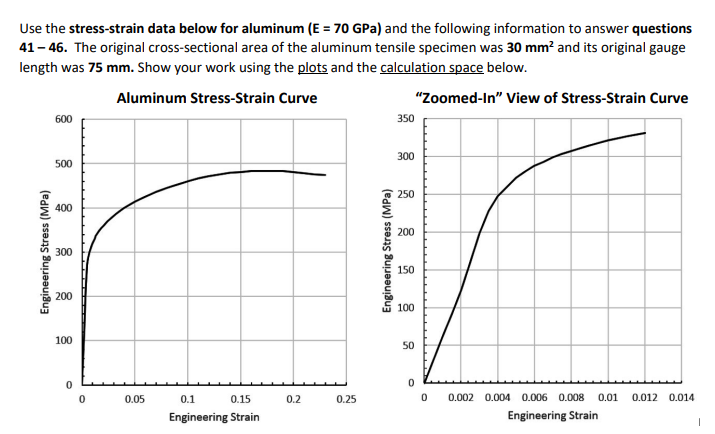
280 MPa
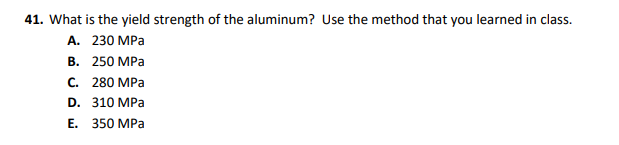
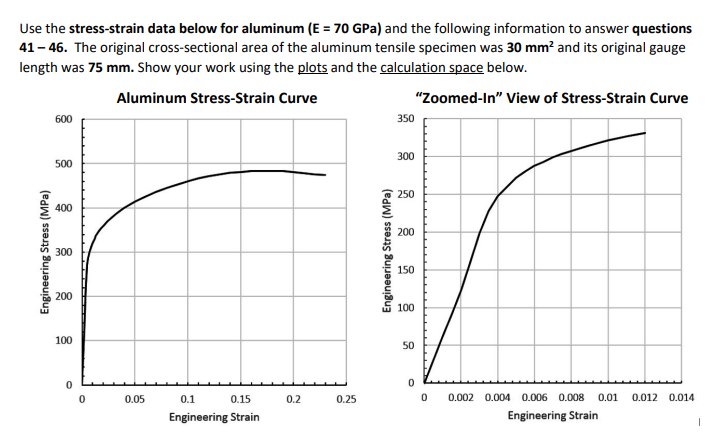
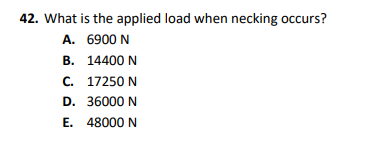
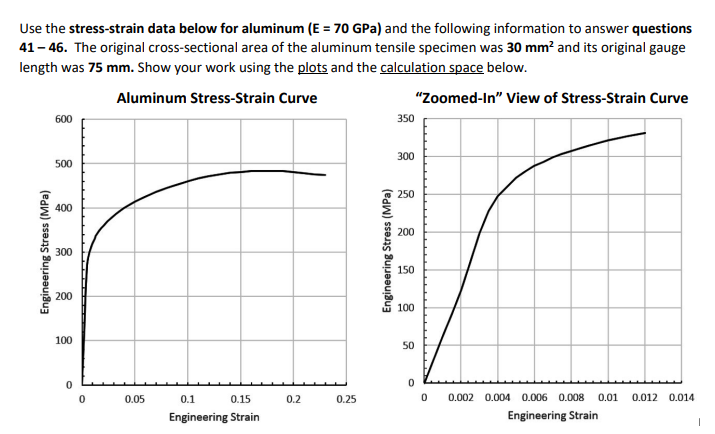
14400 N