BIO 400 vocabulary
 Call Kai
 Learn
Learn Practice Test
 Spaced Repetition
 Match
Match Flashcards
 Knowt Play
1/614

There's no tags or description
Looks like no tags are added yet.
615 Terms
Organisms
Living things with 7 specific properties (wherever found).
Systems
Collections of interacting parts.
Self-organization
The ability for an organism to grow and develop on its own. Offspring are given a set of instructions and some genetic material, which is used to build early versions of given organisms.
Self-regulation
The ability for an organism to control it’s own internal conditions and activities- repair and change things to adapt.
Evolution
The ability for organisms to adapt to changing environments over generations (not for immediate survival, bigger picture).
Hierarchical Organization
Consists of nested systems- our planet has millions of different systems, all of which interact with one another.
Cells
The smallest unit that can have all the properties of life.
Genetic system
Information for structure and function is inherited as DNA molecules in each cell. DNA molecules represent the ______________ on our planet.
Gene expression
When DNA directs the synthesis of RNA and proteins, which then cause growth, development, and other behaviors.
Metabolic systems
Chemical reactions that transform energy and matter to build and maintain life. Change one chemical compound to another (different systems interacting, causing change).
Enzymes
Proteins that catalyze (speed up) specific chemical reactions.
Catalyze
To speed up chemical reactions.
Feedback regulation
Output (or product) of a process regulates the process itself (creating a feedback loop). Ex: thermostat does not need to be managed, it automatically regulates temperature.
Negative feedback
Self-limiting. Output of the process shuts the process down.
Positive feedback
Self-reinforcing. Output of the process speeds up the process itself (ex: contractions and pregnancy).
Divergence
_________ (different changes) of lineages leads to new species.
Paramecium
A single celled organism, which uses cilia to swim.
Hydrophilic
Water soluble substances. Surface atoms have polar covalent and/or ionic bonds.
Hydrophobic
Non-water soluble substances. Substances have non-polar covalent bonds.
Dissociation of water
The transfer of an H+ ion (proton) from one H2O to another.
Hydronium ion
Product of the dissociation of water - H3O+ (but often abbreviated as H+).
Hydroxide ion
Product of the dissociation of water - OH-.
The pH scale
Measure the concentration of H+ (hydronium) ions on a scale of 0-14.
Logarithmic
As in the pH scale, a change of 1 point means there is a 10x change in [H+] (concentration).
Acids
Raise [H+] (concentration) and lower [OH-] when dissolved in water. Ex: HCl (hydrogen atoms will quickly find an oxygen to bond to, forming hydronium).
Bases
Lower [H+] (concentration) and raise [OH-] when dissolved in water. Ex: NH4+ (ammonia is able to pull a proton either off a water molecule to create a hydroxide OR off of a hydronium ion to convert it back into water).
Ocean acidification
CO2 absorption by H2O lowers its pH.
Elements
Substances that can’t be broken down to simpler substances by chemical reactions.
Chemical reactions
Rearrange chemical bonds between atoms.
Hydrogen
H
Oxygen
O
Nitrogen
N
Carbon
C
Calcium
Ca
Phosphorous
P
Potassium
K
Sodium
Na
Sulfur
S
Chlorine
Cl
Magnesium
Mg
Atoms
Smallest particle that retains the properties of elements. Made up of 3 subatomic particles.
Protons
Positively charged subatomic particles located in the nucleus (center of the atom).
Electrons
Negatively charged subatomic particles which orbit the nucleus.
Neutrons
Subatomic particles with no charge, located in the nucleus.
Atomic number
The number of protons that an atom has. Atoms of the same element have the same ____________.
Isotopes
Atoms of an element with a different number of neutrons and a different atomic mass.
Atomic mass
Weight of an atom in daltons (Da).
Radioisotope
Isotope with an unstable nucleus that emits raditation
Radiation
Energy and/or particles emitted by isotopes with unstable nuclei.
Radioactive decay
Transformation of radioisotope into a different element. Occurs when the emission changes the atomic number.
Molecules
2 or more atoms held together by covalent bonds. Some contain only one element.
Compound
A mixture of elements. _____________ have different properties compared to their elements.
Molecular formula
The notation that describes the number and kind of atoms in a molecule. Ex: H2O for water.
Structural formula
The notation that shows the arrangement of atoms in a molecule.
Chemical reactions
The making and or breaking of covalent bonds.
Reactants
The molecules at the start of a reaction.
Products
The molecules at the end of a reaction.
Chemical equation
Shows chemical reaction using molecular formulas. Indicates number and type of molecules included. Ex: the formation of H2O (2H2 + O2 —> 2H2O).
Electron orbitals
Spaces around nucleus containing electrons. Hold up to 2 electrons each.
Shell model
Representation of occupied orbitals.
Valence
Number of covalent bonds an element forms. Usually equal to the number of unpaired electrons in the outermost shell.
Groups
Columns of elements in periodic table. Have the same number of electrons in their outer shell.
Covalent bonding
Atoms share 1 or more pairs of electrons to fill outermost shells. Each shared pair is a bond.
Non-polar covalent bonds
Atoms equally share electrons. Occurs between atoms of the same element, also occurs between C and H.
Polar covalent bonds
Unequal sharing of electrons by two atoms. Electrons spend more time around the atom with the highest electronegativity. Creates a partial negative charge on that atom and the other atom has a partial positive charge.
Electronegativity
An element’s affinity for electrons.
Hydrogen bond
Attraction of H atom in a polar covalent bond to a partial-charged atom in another polar covalent bond. Weak, but important. Ex: between H2O and NH3.
Ions
Electrically charged atoms. Have an unequal number of protons and neutrons. There are 2 different types of ions.
+ ions
Lost electrons.
- ions
Gained electrons.
Ionic bonds
2 ions held together by opposite charge. Strong, but weak in the presence of water.
Van der Waals interactions
Attraction between 2 adjacent atoms due to temporary dipoles in their electron clouds. Weak and caused by close proximity.
Dipoles
Temporary polarization in electron clouds.
Organic chemistry
Study of carbon compounds. Carbon forms the backbone of all biological molecules.
Tetrahedron
Pyramidical geometric arrangement formed when there are four single bonds. Ex: Methane (CH4).
Functional groups
Atoms that give organic compounds unique properties, including water solubility and the ability to participate in chemical reactions.
Non-covalent interactions
Can cause molecules to stick or group together. Include H-bonds, ionic bonds, Van der Waals, and hydrophobic forces.
Binding
Molecules sticking together by non-covalent interactions.

Methyl group
Hydrophobic: - CH3

Sulfhyrdyl group
Hydrophobic: - SH
Weakly polar, low solubility in water, but reactive.
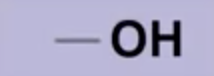
Hydroxyl group
Hydrophilic: - OH

Carbonyl group
Hydrophilic: - CO

Carboxyl group
Hydrophilic, acidic: - COOH

Amino group
Hydrophilic, basic: - NH2

Phosphate group
Hydrophilic, acidic: - OPO3²-
Phosphate group
Functional group that confers energy to C compounds.
Dehydration reaction
Used to link monomers into polymers or other complex structures.
Monomers
Small subunits.
Polymers
Chain of monomers, also known as macromolecules.
Hydrolysis reaction
Breaks polymers into subunits.
Carbohydrates
Monomers contain 1 H2O for each C (CH2O)N. Most have suffix “-ose” in name. Water soluble.
Monosaccharides
“Simple sugars” (composed of 1 unit) that conform to CH2O setup.
Monosaccharides
Most are sweet tasting and have a 3-6 C backbone.
Fuel, subunits, raw material.
Cells use monosaccharides as _____, ___________, and ___________.
Disaccharides
Sugars made of 2 monosaccharides.
Glycosidic linkage
Region formed by dehydration reaction between monosaccharides.
Glycosidic linkages
___________________ can trap one or both subunits in their ring form.
Fuel
Cells use disaccharides as _____.
Selective Permeability
Ability of membranes to control what passes through.
Membrane sidedness
Inside and outside surfaces are functionally distinct due to orientation of proteins and lipid (set during synthesis).