Arteries, Veins & Capillaries
 Call Kai
 Learn
Learn Practice Test
 Spaced Repetition
 Match
Match Flashcards
 Knowt Play
1/54

There's no tags or description
Looks like no tags are added yet.
Name | Mastery | Learn | Test | Matching | Spaced | Call with Kai | Chat |
|---|
No analytics yet
Send a link to your students to track their progress
55 Terms
What is the function of arteries?
To carry blood away from the heart and distribute it throughout the body
How does blood travel through the arterial system?
Large arteries → medium arteries → small arteries → arterioles
Why do arteries have thicker walls than veins?
Because they carry blood under high pressure.
What are the three types of arteries?
Large elastic arteries
Medium muscular arteries
Small arteries and arterioles
What are large elastic arteries also called?
Conducting arteries.
Give an example of a large elastic artery.
The aorta.The aorta.
Why are elastic arteries called “elastic”?
Because their walls contain many elastic fibres that allow them to stretch and recoil.
What is the function of elastic recoil?
To maintain blood flow and blood pressure between heartbeats.
Why don’t arteries collapse between heartbeats?
Because elastic recoil keeps blood moving even when the heart relaxes.
What are medium muscular arteries also called?
Distributing arteries.
Give an example of a muscular artery.
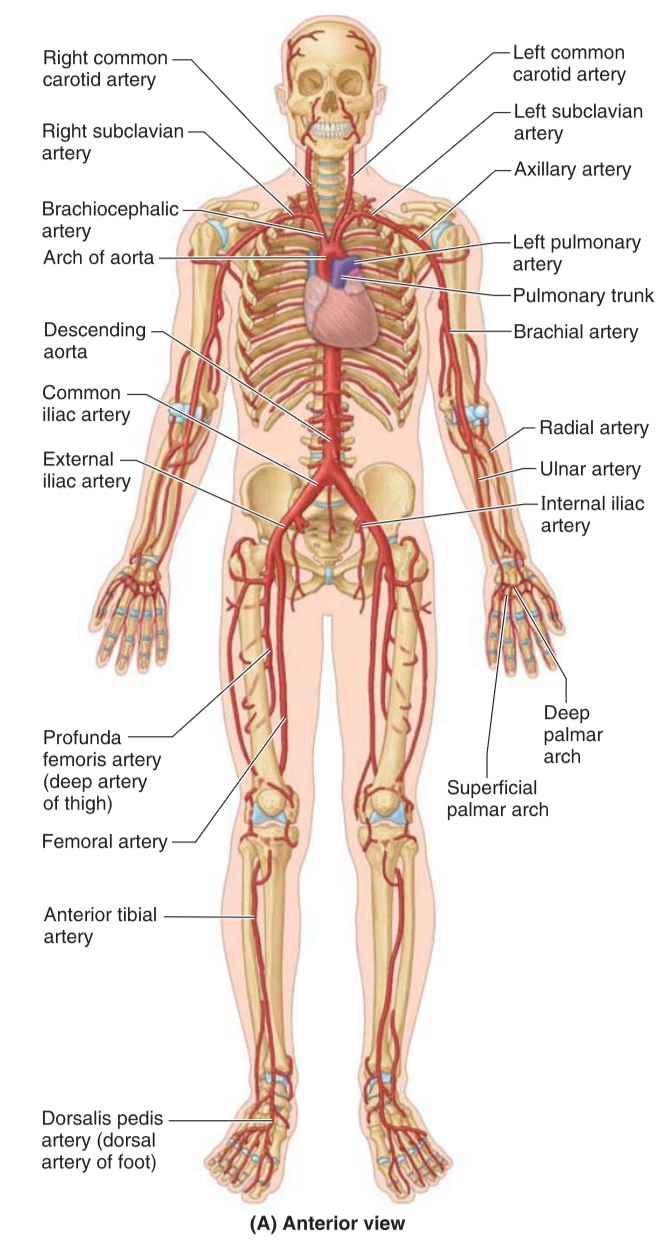
The femoral artery.
What is the main function of muscular arteries?
To distribute blood to different parts of the body.
What is vasoconstriction?
Narrowing of an artery caused by contraction of smooth muscle in the tunica media.
Why is vasoconstriction important?
It regulates blood flow to different tissues according to the body’s needs.
What are the characteristics of arterioles?What are the characteristics of arterioles?
Small lumen
Thick muscular wall
What regulates arterial blood pressure most?
The smooth muscle tone of the arterioles.
Why are arterioles called the “resistance vessels”?
Because changes in their diameter have the greatest effect on blood pressure and blood flow.Because changes in their diameter have the greatest effect on blood pressure and blood flow.
What is hypertension?
Persistently high blood pressure.
How can increased arteriolar tone lead to hypertension?
Increased smooth muscle contraction narrows the lumen, increasing resistance and raising blood pressure.
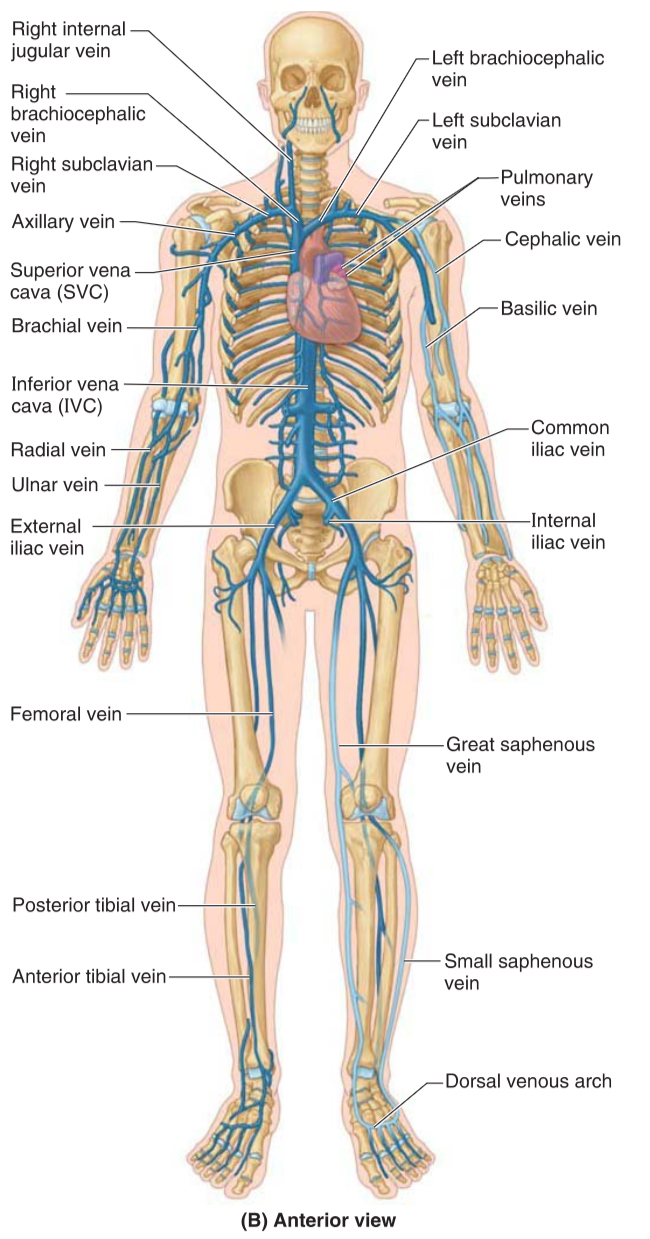
What is the function of veins?
To return blood to the heart.
Which veins are unusual because they carry oxygenated blood?
The pulmonary veins.
Why are pulmonary veins an exception?
Because they return oxygenated blood from the lungs to the left atrium.
Why are vein walls thinner than artery walls?
Because blood pressure is much lower in veins.
What are venous plexuses?
Networks of interconnected veins.
Give an example of a venous plexus.
The dorsal venous arch of the foot.
Why do many veins contain valves?
To prevent backflow of blood.
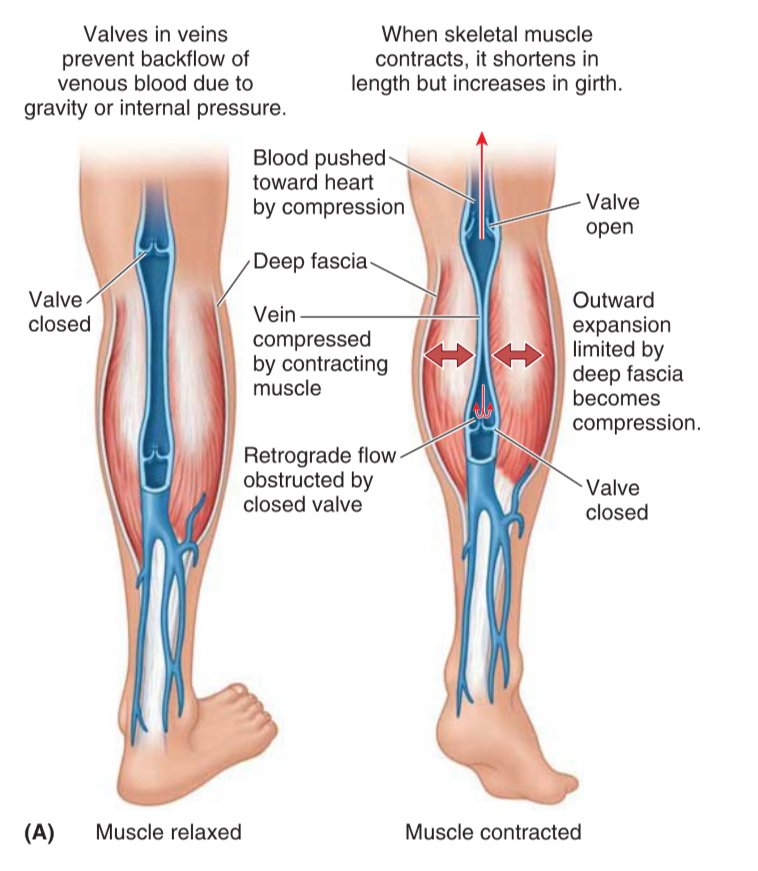
Where are venous valves especially common?Where are venous valves especially common?
The limbs, especially the legs.
Why are valves particularly important in the legs?
Because they help blood return to the heart against gravity.
What is the musculovenous pump?
The squeezing of veins by contracting skeletal muscles to help move blood toward the heart.
Why does walking help venous return?
Contracting leg muscles compress the veins, pushing blood upward.
Why don’t the veins refill immediately after being compressed?
Because venous valves prevent blood flowing backwards.
Why is prolonged sitting associated with venous pooling?
Because the musculovenous pump is inactive.
What are capillaries?
Microscopic vessels connecting arterioles and venules
Where are capillaries arranged?
In capillary beds.
What is the function of capillary beds?
Exchange of oxygen, nutrients, waste products, and other substances between blood and tissues.
Which vessels deliver blood to capillaries?
Arterioles
Which vessels drain blood from capillaries?
Venules
Why are capillary walls so thin?
To allow efficient diffusion of substances between blood and tissues.
What is an arteriovenous (AV) shunt?
A direct connection between an arteriole and a venule that bypasses the capillary bed
Where are AV shunts especially numerous?
The skin.
Why are AV shunts important?
They help regulate body temperature by controlling blood flow through the skin.
What happens when an AV shunt opens?
Blood bypasses the capillary bed.
Compare elastic arteries and muscular arteries.
Elastic | Muscular | |
Conducting | Distributing | |
Elastic tissue | Smooth muscle | |
Maintain BP | Elastic | Muscular |
Conducting | Distributing | |
Elastic tissue | Smooth muscle | |
Maintain BP | Control blood flow |
Compare arteries and veins.
Arteries | Veins |
Away from heart | Toward heart |
Thick walls | Thin walls |
High pressure | Low pressure |
Usually no valves | Valves present |
Small lumen | Larger lumen |
Compare arterioles and capillaries.
Arterioles | Capillaries |
Regulate blood flow | Exchange substances |
Smooth muscle | Endothelium only |
Why can arteries be felt as a pulse but veins cannot?
Because arteries carry blood under high pressure generated by each heartbeat.
Why is an intravenous (IV) injection usually given into a vein rather than an artery?
Because veins are lower pressure, have thinner walls, and are safer to access than arteries.
Why do arteries bleed more forcefully than veins?
Because arterial blood is under much higher pressure.
Why are capillaries the only vessels where exchange occurs?
Because they have walls that are only one endothelial cell thick.
A patient is standing still for several hours. Why are they at increased risk of swollen ankles?
Because reduced activity decreases the musculovenous pump, allowing blood to pool in the leg veins.
Why is knowledge of arteries important in CT angiography?
Because contrast follows the arterial system, allowing assessment of vessel narrowing, aneurysms, and blockages
Why is the musculovenous pump clinically important in imaging?
Reduced venous return increases the risk of venous stasis and deep vein thrombosis (DVT), which may require ultrasound or CT imaging.
Why are AV shunts important when interpreting thermal regulation?
They alter blood flow through the skin, affecting heat loss and conservation
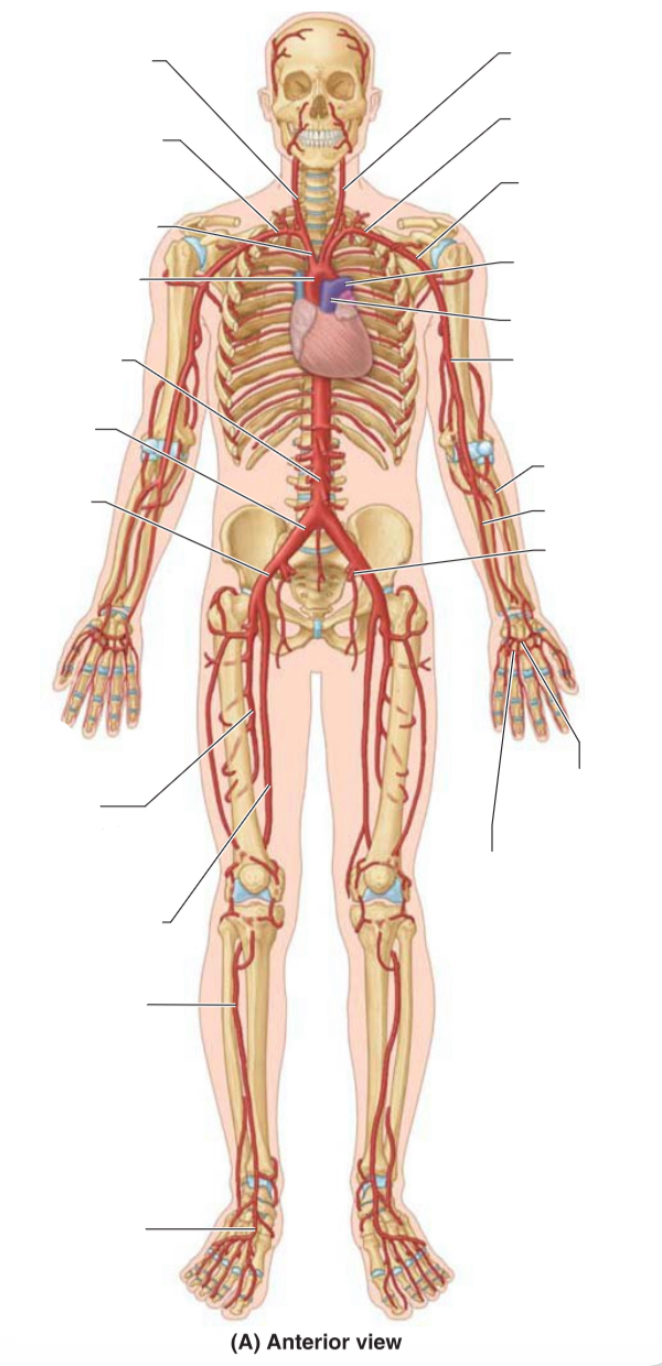
Label the arteries
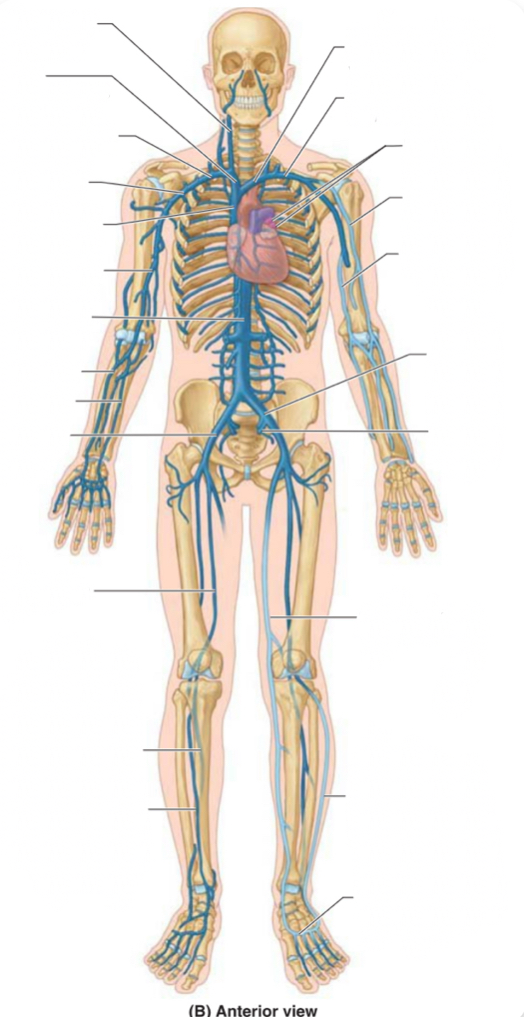
Label the veins