Research Methods 344
 Call Kai
 Learn
Learn Practice Test
 Spaced Repetition
 Match
Match Flashcards
 Knowt Play
1/61

There's no tags or description
Looks like no tags are added yet.
Name | Mastery | Learn | Test | Matching | Spaced | Call with Kai | Chat |
|---|
No analytics yet
Send a link to your students to track their progress
62 Terms
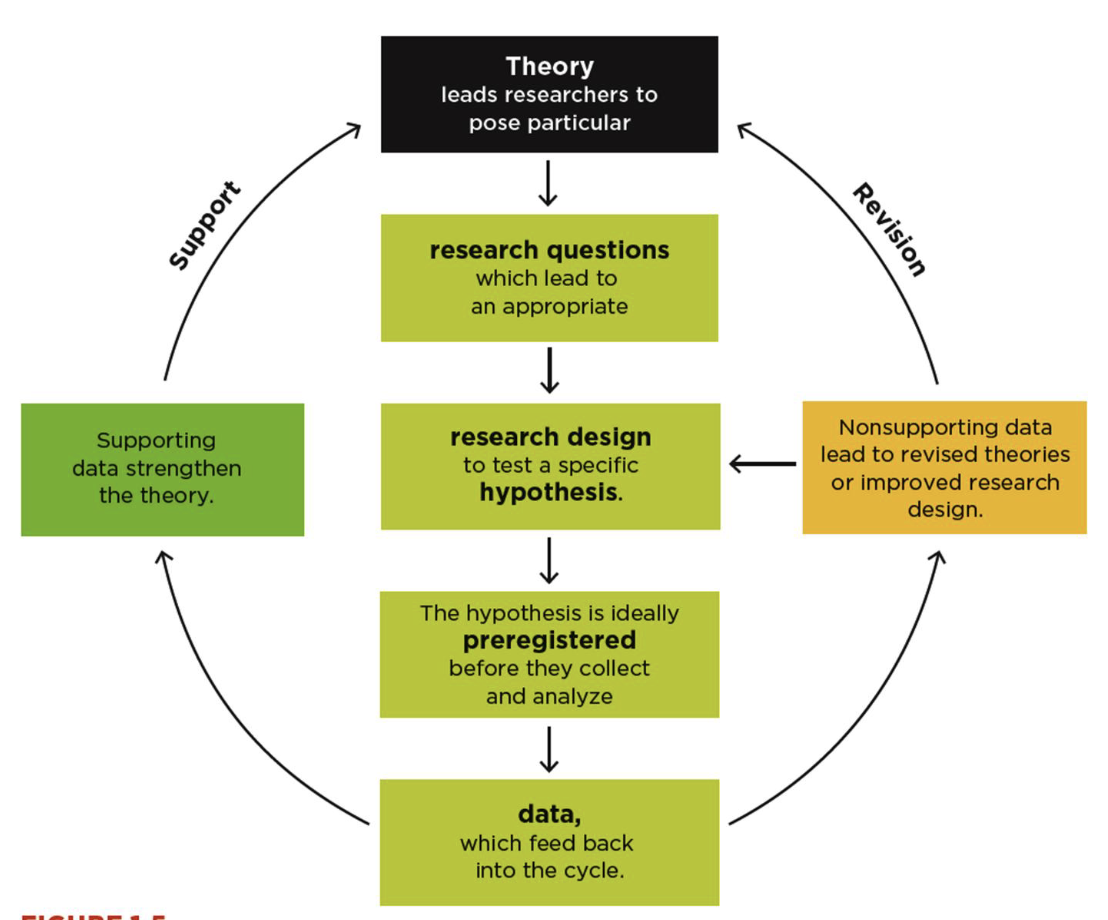
The Theory-Data Cycle
Theories lead researchers to pose research questions, then creating a research designed around a hypothesis
Data gives feedback on the theory, leading to support/revision.
Characteristics of good sci theories
Supported by data
Falsifiable
Have parsimony
Do studies prove theories?
No - can support them, but studies do not prove theories
Parsimony definition
The degree to which a scientific theory provides the simplest explanation of some phenomenon
Merton’s Scientific Norms (standards of practice)
Universalism
Disinterestedness
Communality
Organized Skepticism
Basic research
“Fundamental”/”pure” research aims to gain new knowledge about observable phenomena and facts
Does not aim to extrapolate or apply the data
Translational research
“bench to bedside” - discoveries in the lab aim to produce practical applications, treatments, etc.
Applied research
Problem-focused, specific - often uses prior knowledge and experimentation to evaluate/solve/improve existing problems
Experience as a Source of Information
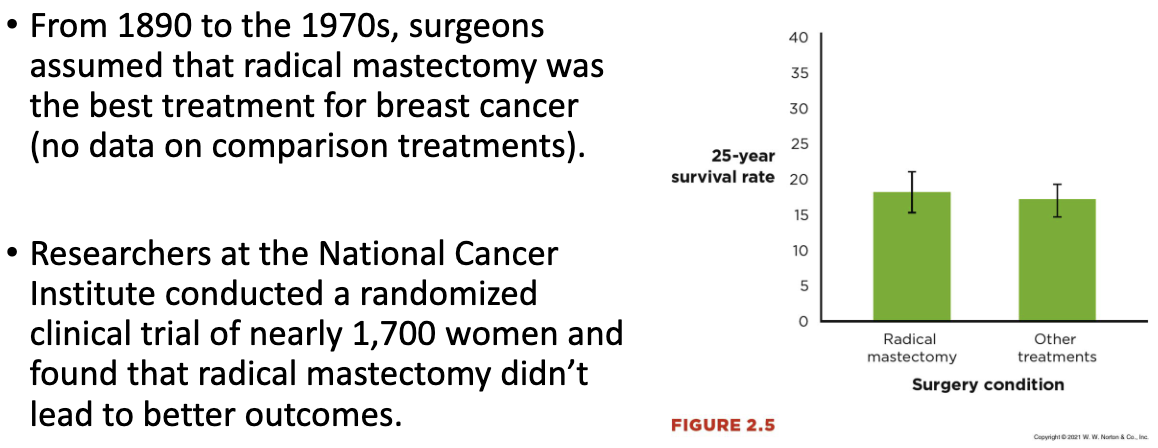
Bad - Has no comparison group, is confounded
Example demonstrating the need for a comparison group
Bushman 2002 study?
Examined effect of catharsis on aggression - Good research that controlled for potential confounds, systematic comparison
i.e. sitting, punching bag, punching bag w/ face
How is research probabilistic?
Findings are NOT expected to explain all cases - there may always be exceptions
What is intuition?
Hunches, gut feelings, sixth senses
NOT reliable evidence because of biases humans are susceptible to
Comfort affirmation bias
Tendency to be swayed by good stories
Availability heuristic
Being persuaded by what easily comes to mind
eg. believing higher probability of shark attacks because of movies
Present/present bias
Failing to think about what we cannot see
eg. tendency to consider real-time rewards more than larger rewards in the future, i.e. instant gratification
Confirmation bias
Focusing on evidence supporting our existing beliefs; ignoring that which doesn’t
Bias blind sport
Believing that oneself is not subject to being biased
What questions to ask when encountering news in Popular Media
Could this be disinformation?
Can this be cross-checked with legitimate sources?
What is the context of this story?
Is the source politically biased?
Types of untrustworthy vs trustworthy Sources of Info (image)

What are variables? What are their characteristics?
They change/vary from person to person - eg. factor, condition, trait
at least two levels
Constant: eg. 60% of highschoolers pursue college - doesn’t change
They can be measured and/or manipulated
Measured variables are…
Observed and Recorded
Manipulated variables are…
Controlled, Changed
How do researchers measure variables?
The conceptual variable (eg. expression of gratitude, depression) is measured through an Operational Definition (can be directly measured, eg. surveys, score on diagnostic tests)
What are the Three Types of Claims
Frequency
Association
Causal
Frequency claims
Describes a particular rate/degree of a single variable
Involves only one measured variable
eg. “1 in 4 working students skip class due to job, college”
Association claims
Argues that one level of a variable is associated with a particular level of another variable
Involved at least two measured variables - which are said to correlate
eg. “People with higher incomes spend less time socializing”
Types of measured associations
Positive, Negative, Zero
How can association be used?
We can make predictions based on them - extrapolating from evidence
Stronger association —> More accurate prediction
Positive and negative associations can predict, Zero associations cannot
Causal claims
Argues that change of one variable is responsible for changing the other
Causal claims are supported by experiments
eg. “Social media overuse leads to anxiety”
What else can claims be based on, if not Research?
Experiences
Intuition
Authority
What are the Four Big Validities?
Construct validity
External validity
Statistical validity
Internal validity
Construct validity
How well the operational variable of a study approximates (measures) the conceptual variable
External validity
How well the study’s results generalize to some larger population
eg. random, inclusive, and representative samples; other situations/contexts
Statistical validity
How well the data supports the conclusions made
eg. strength of an association, statistical significance
Margins of Error
Internal validity
How likely A, rather than some other variable, is responsible for changes in B
i.e. Third Variable Problem
What is special about Interrogating Causal Claims?
the Three Criteria for Causation:
Covariance: an association under controlled experimentation
Temporal precedence: study method has A come first, before B
Internal validity: study method ensures no plausible alternative explanations for the change in B
Significance of the Tuskegee Study (1930s)
Illustrated 3 major violations of ethics
Participants were not treated respectfully (false pretenses, withholding treatment)
Participants were harmed (syphilis, later generations)
Participants were a targeted, disadvantaged social group
Significance of the Milgram Obedience Studies
Illustrated a difficult ethical balance
Ethical questions about debriefing
How to balance risk between gain for society vs. participant wellbeing/mental
What is the Belmont Report?
1979 document outlining core ethical principles + guidelines to Protect Human Subjects of Research
Belmont Report Principle #1
Respect for Persons
People treated as autonomous agents, those w/ diminished autonomy entitled to protection
Application: Informed Consent Process
Voluntary participation free of coercion, undue influence
Providing information & Ensuring its comprehension
Belmont Report Principle #2
Beneficence
Maximize possible benefits and minimize risks
Emotional/psych distress/trauma, embarrassment/shame/guilt, invasion or breach of privacy/confidentiality
How to mitigate risks:
Confidentiality, privacy, anonymity, debriefing, emphasizing voluntary participation
Belmont Report Principle #3
Justice
Equitable selection and assigning of participants
What oversees/ensures the principles of the Belmont Report?
Institutional Review Board (IRB)
Committee responsible for enforcing ethical research involving human participants
Ethical Decision-making Balances (3)
Research risks vs. Benefits
Rights of individual participant vs. Societal gain
Free participation vs. Coercion
What are the equivalent counterparts of the Belmont Report and IRB for Animal Resarch?
Animal Welfare Act (AWA)
Institutional Animal Care & Use Committee (IACUC)
The Four Rs of Animal Care
Replacement: Avoiding using animals if possible
Refinement: Tuning procedures and care to reduce distress
Reduction: Using the fewest # of animals as possible - minimize harm
Rehabilitation: Post-experiment welfare - recovery
Reasons for discrepancies exist in research data?
Unclear definitions of the operational definition
Between-evaluator biases, differences
Common Types of Measures?
Self-report measure
Observational/behavioral measure
Physiological measure
No superior one - appropriate method depends on the context
Two main scales of measurement
Categorical: i.e. nominal
Quantitative: includes ordinal, interval, and ratio scales
Reliabilty
Are scores consistent?
Three types of Reliability
Test-retest reliability
Interrater reliability
Internal reliability (Does the test measure what its supposed to?)
Can reliability be quantified?
Yes - by the correlation coefficient r
Validity
How accurately the method/test measures what it claims to measure
Types of Construct Validity
Face validity
Content validity
Criterion validity
Convergent validity
Discriminant validity
Face validity
The construct is obvious - looks like what is being measured
eg. low FV: “Your Favorite Meals Reveal If You’re An Introvert or Extrovert”
Content validity
The measure contains all parts that your theory says it should contain
eg. Comprehension as a measure of all dimensions

Criterion validity
Also called “Predictive validity”
How well findings correlate with concrete outcomes
eg. The left has better criterion validity

What does using a known-groups paradigm help?
How well the experimental test measures a trait as compared to an established assessment strategy
eg. how well the experiment’s criteria for depression measure depression, as compared to what the BDI categorizes subjects as
Convergent vs. Discriminant validity
Convergent: scores on the measure are related to other measures that are theoretically similar (eg. Job stress vs. Workplace burnout)
Discriminant: scores on the measure are unrelated to other measures that are theoretically different (eg. Typing speed vs. Hair color)
Relationship between Reliability and Validity
Reliability is necessary, but not sufficient for validity
They are not the same
Internal reliability vs. Internal validity
Internal reliability: Test measures what it claims to
Internal validity: Method used ensures no Third Variable Problem