Metabolic tests 2: IMViC, TSI, catalase, bonus urease and coagulase; a few Metabolic tests part 1 (catalase, oxidase).
 Call Kai
 Learn
Learn Practice Test
 Spaced Repetition
 Match
Match Flashcards
 Knowt Play
1/11

There's no tags or description
Looks like no tags are added yet.
Name | Mastery | Learn | Test | Matching | Spaced | Call with Kai | Chat |
|---|
No analytics yet
Send a link to your students to track their progress
12 Terms
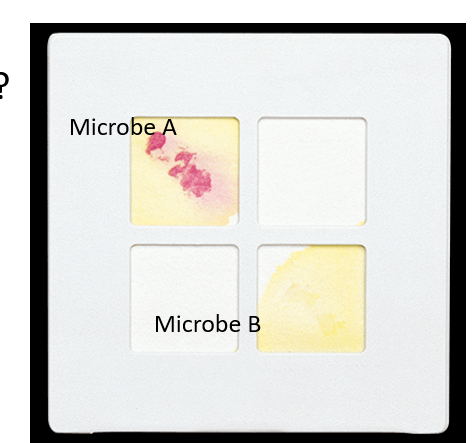
2 different bacteria, Microbe A (red color) and Microbe B (yellow color).
Which one of the microbes is "indole positive" and which enzyme does this microbe make that permits it to make indole?
Microbe A; tryptophanase
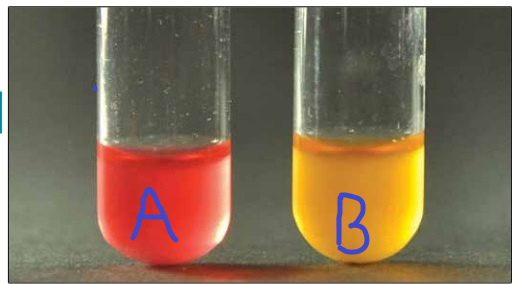
Methyl Red test results for 2 bacteria, Bacterium A and Bacterium B.
(Methyl Red) MR +
Does not carry out mixed acid fermentation
final pH ~4.4 or lower
Which microbe could be E. coli?
A
B
A
A

VP results for 2 bacteria, Bacterium C and Bacterium D
Which microbe could be E. coli?
Which microbe could be Enterobacter aerogenes?
Which microbe carries out 2,3-butanediol fermentation/butylene glycol fermentation?
Which microbe makes acetoin/acetylmethylcarbinol?
C
D
D
D
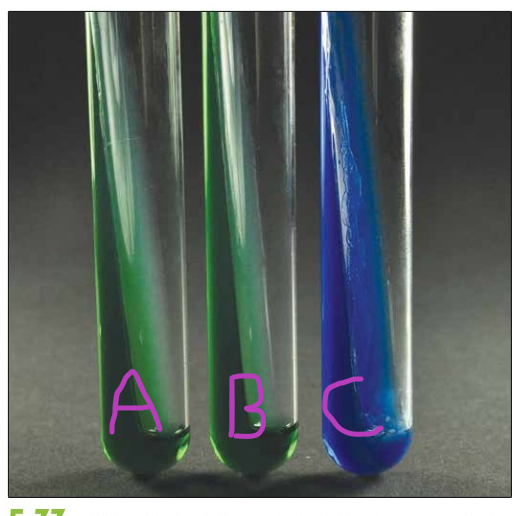
Simmon's Citrate Agar slants
A= uninoculated, green
B= Microbe B, green
C= Microbe C, blue
Which microbe can use citrate as its sole source of carbon and energy?
Which microbe could be Enterobacter aerogenes?
C
C

TSI slants:
Presume tube C is the uninoculated control
This microbe makes hydrogen sulfide
This tube contains iron sulfide
This microbe ferments glucose only and does not make hydrogen sulfide
This microbe ferments glucose and either lactose or sucrose or both, and makes CO2 and/or H2, carbon dioxide and/or molecular hydrogen
This microbe cannot ferment any sugars and does not make hydrogen sulfide
D
D
A
E
B
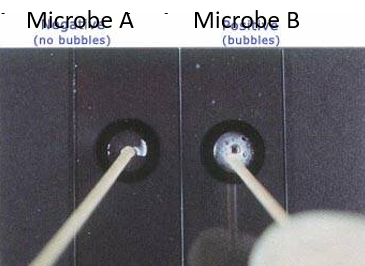
Catalase test results for 2 microbes, A and B
This microbe is catalase positive
This microbe could be a member of the genus Streptococcus
This microbe could be a member of the genus Staphylococcus
B
A
B
Which pH indicator: test pair below is incorrect/false?
a. Phenol Red: TSI
b. bromthymol blue: indole
c. methyl red: MR test
d. bromthymol blue: Simmon's citrate test
B
What are the IMViC results for E. coli?
++--
Indole (I): Positive
Methyl Red (M): Positive
Voges-Proskauer (V): Negative
Citrate (C): Negative
Fecal contamination of food and/or drinking water is indicated by the presence of high numbers of ______.
Candida albicans_
Staphylocoous aureus
Enterobacter aerogenes
E. coli
E. coli
Bonus True or False?: If a microbe makes urease, it can hydrolyze urea and release ammonia.
True
Bonus True or False: If a microbe is oxidase-negative, you know you can not perform aerobic respiration
False
Bonus, True or False? One way to differentiate Staphylococcus aureus from Staphylococcus epidermidis is that S. aureus is coagulase-positive and S. epidermidis is coagulase-negative.
True