Parathyroid Anatomy and USA w/Pathology
 Call Kai
 Learn
Learn Practice Test
 Spaced Repetition
 Match
Match Flashcards
 Knowt Play
1/64

There's no tags or description
Looks like no tags are added yet.
Name | Mastery | Learn | Test | Matching | Spaced | Call with Kai | Chat |
|---|
No analytics yet
Send a link to your students to track their progress
65 Terms
How many parathyroid glands do we have?
4
Parathyroid is located…
In the mid and lower posterior regions of the thyroid
The inferior pair of parathyroid glands are usually more ________ than the superior pair
Anterior
Parathyroid gland shape
Disc/bean
Normal parathyroid measurements
Length: 5-7mm
Width: 3-4mm
AP: 1-2mm
Parathyroid hormone and calcitonin control…
Calcium absorption/excretion in the intestines and kidneys
Increased serum levels of calcium leads to …
Hypercalciuria and hypercalcemia
Low calcium levels in the blood leads to:
Increase in release of PTH
Decrease in the release of calcitonin
Reduced excretion of calcium in intestinal tract to increase the level of calcium in the blood
Kidneys increase resorption of calcium during blood filtration
End result = increasing calcium serum levels
High calcium levels in the blood leads to:
Decrease in the release of PTH
Increase in the release of calcitonin
Increased excretion of calcium in the intestines to reduce the level of calcium in the blood
Kidneys reduce calcium resorption during blood filtration
End result = reduced calcium levels in blood
Parathyroid pt position
Pts neck is hyperextended and turned away from the side being examined
Superior parathyroid gland is usually located …
Posterior to the midsegment of the thyroid lobe
Inferior parathyroid gland is usually located …
Close to the lower pole of the thyroid lobe
Parathyroid glands may be found __________ the clavicles, in the lower neck, upper mediastinum or retroplacental in location
Below
Parathyroid normally appears as…
A subtle hypoechoic area adjacent to the lower 2/3rds of the thyroid gland
Hyperparathyroidism
Increased function of the parathyroid glands
Common in women after menopause
Primary hyperparathyroidism most commonly occurs due to
Single adenoma in one parathyroid gland
Primary hyperparathyroidism is the most common classification of:
Multiple endocrine neoplasm (MEN) syndrome
Primary hyperparathyroidism is associated with
Hypertension, nephrolithiasis, osteopenia, weakness, malaise, dyspepsia, constipation, polyuria
Renal calculi formation due to chronic serum hypercalcemia in blood
Primary hyperparathyroidism
PTH secretion is constantly induced by the adenoma, which causes parathyroid gland hyperplasia
Parathyroid hormone will counteract the production of calcitonin
Increasing PTH increases serum calcium levels
Increasing calcitonin reduced serum calcium levels
Increased PTH reduced vitamin D storage, causes deficiency
Increased levels of PTH cause increased renal excretion of phosphate = reduced serum phosphate levels
Calcitonin
Is a hormone produced by the parafollicular cells of the thyroid that is responsible for calcium metabolism and excretion
Increased levels of _____ and calcium in the blood
PTH
Secondary hyperparathyroidism
All 4 glands hyperfunctioning
Usually caused by renal failure, also vitamin D deficiency, malabsorption syndromes
Failing kidneys cannot remove phosphorus from the blood which caused calcium levels to drop
PTH production is increased as the body tried unsuccessfully to raise calcium levels
Low serum calcium with high PTH levels seen early in the disease progression
Secondary hyperparathyroidism = _________calcemia
Hypo
Primary hyperparathyroidism = ________calcemia
Hyper
Most common hyperparathyroidism
Primary
Ectopic parathyroid tissue
Found in 15-20% population
75% found near thymus gland near heart
Can be found within the thyroid tissue
May also fail to descend far enough and remain by carotid arteries and/or esophagus
Most common cause of primary hyperparathyroidism
Parathyroid adenoma
Parathyroid adenoma
Benign nodule varying in size, usually less than 3cm, average is 1cm
Usually occur in a single gland
Scintigraphy, MRI, and CT exams can also be used to localized parathyroid adenomas
FNA Bx can be used to definitively diagnose the presence of an adenoma
USA parathyroid adenoma
Oval-shaped, hypoechoic, encapsulated, homogeneous, solid mass
May resemble thyroid adenomas but protrude off POSTERIOR surface of thyroid
Hypervascular masses
Vascular Arc - vascularity surrounds 90-270 degrees around mass
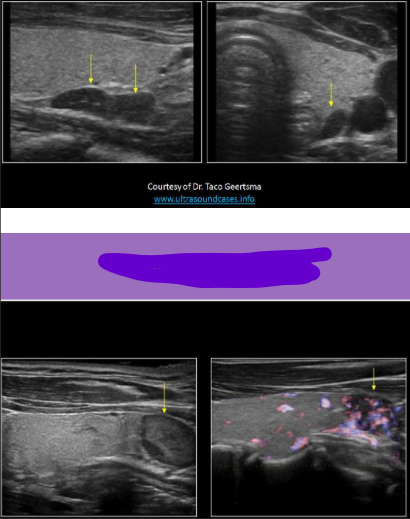
Parathyroid adenoma
Parathyroid carcinoma
Rare, slow growing
Increased risk with MEN syndrome and neck radiation
Variable sonographic appearance
Parathyroid carcinoma Symptoms
Bone pain, constipation, fatigue, frequent thirst, frequent urination, kidney stones, muscle weakness, N/V, poor appetite
USA Parathyroid carcinoma
Small, irregular, firm masses
Usually larger than benign adenomas
Taller than wide shape correlates with malignancy
May adhere to surrounding tissues
Varied echogenicity
Mets to regional nodes or distant organs may occur
Normal Lymph nodes
Thin disk or bean shaped
<1cm diameter
Hypoechoic rim with echogenic center
Normal lymph nodes do NOT exhibit posterior enhancement
Lymph nodes
Enlarged nodes are non-specific finding
Seen with infection, lymphadenopathy, mets
Pts with prior hx of thyroid cancer and/or thyroidectomy due to cancer should be evaluated regularly
Abnormal lymph nodes
Rounded or plump appearance
Cortex will become more hypoechoic or may even be anechoic due to increase in fluid
Edematous nodes will exhibit posterior enhancement
Central hilum disappears with enlargement
Blood flow to hilum will increase
Parotid gland
Largest saliva gland; located anterior to the ear, wrapped around the mandibular ramus; Stensen duct carries saliva into mouth
Submandibular glands
Located under the mandible; Wharton duct carries saliva into mouth
Sublingual glands
Located under tongue
Salivary glands
Parotid, submandibular, sublingual
Salivary glands are supplied blood by ___________ and drained into the IJV
Branches of the ECA
Saliva contains _________
Amylase
Sialolithiasis
Stones form within the gland or duct or oral cavity
May see posterior shadowing
If stone causing obstruction, the duct will be dilated within the gland
Infection of the salivary glands causes…
Enlarged glands with decreased echogenicity
Most common infection of the salivary glands and affects parotid glands
Mumps
Bilateral salivary gland enlargement usually indicates:
Infectino
Unilateral salivary gland enlargement usually indicates:
Mass formation
Most common malignancy in salivary glands
Mucoepidermoid carcinoma
Sjogren syndrome
Immune system disorder causes a reduction in saliva production
Associated with rheumatoid arthritis and lupus
Primary symptoms are dry eyes and dry mouth
Usually affects the parotid and submandibular glands
May cause swelling of the salivary glands
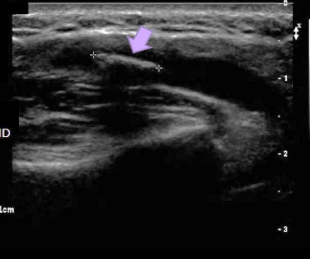
Sialolithiasis
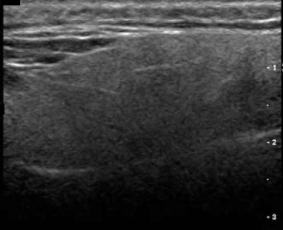
Normal submandibular salivary gland
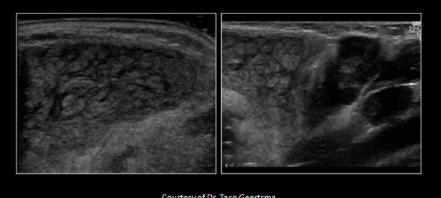
Acute parotitis/mumps infection
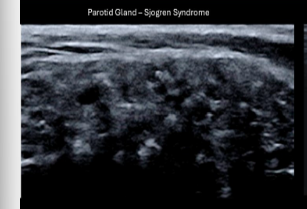
Sjogren syndrome
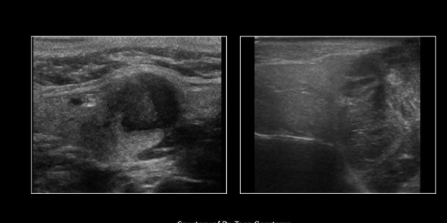
Salivary malignancy
As levels of the parathyroid hormone increase, how are serum calcium levels affected?
Increased
As levels of calcitonin increase, how are serum calcium levels affected
Decreased
Scan the area extending from the _________ superiorly to the __________ inferiorly to locate the parathyroid glands
CCA bifurcation; thoracic inlet
What may assist in localizing the parathyroid gland?
Ask the pt to swallow, place focal zone deep to the thyroid, use graded compression
Primary hyperparathyroidism most commonly occurs due to:
Single adenoma in one parathyroid gland
Secondary hyperparathyroidism most commonly occurs due to:
4 hyperfunctioning glands
Hypophosphatemia is associated with:
Increased PTH levels
Which of the following indicates secondary parathyroidism
High serum calcium with high PTH levels
Low serum calcium with high PTH levels
Low serum calcium with low PTH levels
High serum calcium with low PTH levels
Low serum calcium with high PTH levels
What causes an increased risk of parathyroid cancer?
MEN syndrome and neck radiation
Which of the following is a symptom of primary parathyroidism
Frequent thirst
Lack of urination
Kidney cysts
All of the above
Frequent thirst
Parotid gland is located _______ to the ear
Anterior