BIO MOLECULES 2
 Call Kai
 Learn
Learn Practice Test
 Spaced Repetition
 Match
Match Flashcards
 Knowt Play
1/66

There's no tags or description
Looks like no tags are added yet.
67 Terms
property of lipids, elements that make up lipds and their compositions, types of lipids?
They have no affinity to water (insoluble) or hydrophobic
Made up of lots of carbon and hydrogen but little amounts of oxygen.
Types of lipids: Triglycerides, Phospholipids and Cholesterol
USES OF LIPIDS IN BODY?
Energy store - major long-term energy store in humans; energy is released when lipids are respired.
Insulation - reduces heat loss from the body.
Water production - produces metabolic water when respired, important in animals such as camels.
Lubrication - reduces friction between surfaces.
Shock absorption - protects organs from physical damage.
Waterproofing - lipids form a water-resistant barrier, reducing water loss.
STRUCTURE OF TRIGLYCERIDE ?
Made of carbon, hydrogen and oxygen
One molecule of glycerol and three fatty acids
The glycerol and fatty acids are joined by 3 ester bonds.
The three fatty acids can have different hydrocarbon chains.

structure of glycerol?
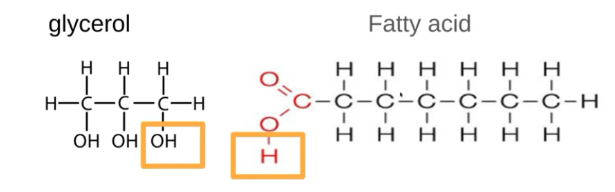
A 3 carbon molecule with 3 hydroxyl (OH) groups so an alcohol
Each -OH group is bonded to a carbon atom.

structure of fatty acids
Fatty acids contain a carboxyl group (-COОН) attached to a hydrocarbon chain.
Fatty acids can be saturated or unsaturated.
The carboxyl group is an acidic group.
describe the esterification process (or condensation) of fatty acids and glycerol to form a triglyceride
A triglyceride is formed when one glycerol reacts with three fatty acids.
The glycerol loses an hydroxyl (-OH) group and the fatty acids loses a hydrogen.
This a condensation reaction.
An ester bond forms between the glycerol and each fatty acid.
One molecule of water is released for each ester bond formed.
Therefore, forming one triglyceride produces three ester bonds and three water molecules.
Overall:
glycerol + 3 fatty acids - triglyceride + 3H₂O
describe the types of fatty acids
Saturated: Contains no carbon-carbon double bonds (C=C) in its hydrocarbon chain and each carbon atom is joined to the next by a single bond.
Contains the maximum possible number of hydrogen atoms.
Unsaturated: Contains one or more carbon-carbon double bonds (C=C) in its hydrocarbon chain.
Therefore contains fewer hydrogen atoms than a saturated fatty acid.
C=C double bonds can cause the hydrocarbon chain to bend/kink.
describe the structure of a Saturated triglyceride
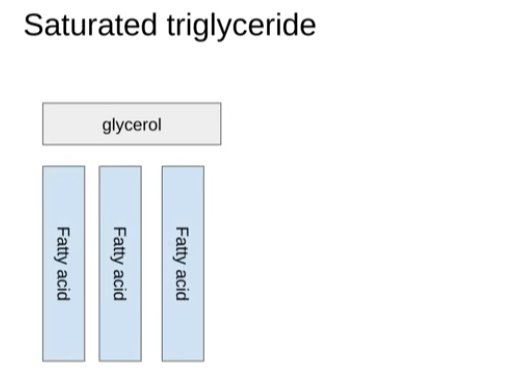
Glycerol bonded to three saturated fatty acids by three ester bonds.
The fatty acids contain no C=C double bonds.
The fatty acid chains are straight.
describe the properties of a saturated triglyceride
Straight chains can pack closely together.
This produces stronger intermolecular forces between molecules.
Therefore, more energy is needed to separate the molecules, giving a high melting
point.
Usually solid at room temperature (e.g. lard).
Animal fats
Generally considered the least healthy of saturated, monounsaturated and
polyunsaturated fats.
describe the structure of an unsaturated triglyceride
Glycerol bonded to three unsaturated fatty acids by three ester bonds.
The fatty acids contain one or more C=C double bonds.
The C=C double bonds cause kinks/bends in the fatty acid chains.

describe the properties of an unsaturated triglyceride
The kinks mean the fatty acid chains cannot pack closely together.
• This produces weaker intermolecular forces between molecules.
• Therefore, less energy is needed to separate the molecules, giving a lower melting
point.
Usually liquid at room temperature, e.g. olive oil.
describe the structure of polyunsaturated triglyceride
Glycerol bonded to three polyunsaturated fatty acids by three ester bonds.
Each fatty acid contains two or more C=C double bonds.
The multiple C=C double bonds cause more kinks/bends in the fatty acid chains.
describe the Properties of a Polyunsaturated triglyceride
The multiple kinks mean the fatty acid chains cannot pack closely together.
• This produces weaker intermolecular forces between molecules.
Therefore, less energy is needed to separate the molecules, giving a lower melting
point.
Usually liquid at room temperature.
Generally considered healthier than saturated and monounsaturated fats.
e.g fish oil
describe the Breakdown of a triglyceride?
• Triglycerides are broken down by hydrolysis.
• Water is used to break the ester bonds.
This produces:
• glycerol
• three fatty acids
Overall:
triglyceride + 3H₂O - glycerol + 3 fatty acids
What is the structure of a phospholipid?
1 glycerol molecule
2 fatty acid molecules
1 phosphate-containing group
A simple organic molecule, such as choline
Therefore, a phospholipid has two fatty acid tails instead of the three found in a triglyceride.
hydrophilic head and a hydrophobic tail
describe the hydrophilic head and the hydrophobic tail of a phospholipid
Hydrophilic head
Contains glycerol and phosphate group.
The phosphate group is polar (charge) and interacts with water.
Therefore, the head is hydrophilic.
The head orientates towards water.
Hydrophobic tails
Made from 2 fatty acids.
Fatty acid tails are non-polar (no charge) and do not interact with water.
Therefore, the tails are hydrophobic.
The tails orientate away from water.

describe how phospholipids form a bilayer
Phospholipids form a phospholipid bilayer in cell surface membranes.
A bilayer forms because there is water outside the cell and water
inside the cell.
The hydrophilic heads orientate towards the water on both sides of
the membrane.
The hydrophobic fatty acid tails orientate away from water, towards
the middle of the membrane.
This forms two layers of phospholipids, with the hydrophobic tails
facing each other in the centre.
This forms the basic structure of cell surface membranes.
Q: How do phospholipids form cell membranes?
Phospholipids have a hydrophilic head and
hydrophobic tails.
Because they have both regions, they are
amphipathic.
In water, they arrange into a bilayer with:
hydrophilic heads facing the water
hydrophobic tails facing inwards
Phospholipid bilayers form the basic structure of cell surface membranes and membranes surrounding organelles.
Q: Why is the phospholipid bilayer useful
The hydrophobic interior prevents many water-soluble and charged substances from
passing directly through the membrane.
This contributes to the membrane's selective
permeability.
describe and explain the functions of triglyceride
1. Energy storage
Triglycerides are used as a respiratory substrate.
They release more energy per gram than carbohydrates when oxidised.
They can release water when metabolised, which is useful in some animals.
2. Do not affect water potential
Triglycerides are insoluble in water.
Therefore, they do not affect the water potential of cells.
3. Hormone production
Lipids are used in the production of some hormones.
4. Waterproofing
Lipids form waterproof layers on surfaces.
5. Buoyancy
Lipids can provide buoyancy because they are less dense than water.
6. Insulation and protection
Triglycerides form insulating layers that reduce heat loss.
They provide protection around organs.
Lipids are also associated with myelin sheaths around nerves.
7. Absorption of fat-soluble molecules
Dietary lipids aid the absorption of fat-soluble vitamins, such as vitamin A.
describe the basic structure of cholestrol
Cholesterol has a four-carbon-ring structure.
It has both hydrophilic and hydrophobic regions.
It fits between the phospholipids in cell membranes.
describe the role of cholestrol in cell membranes?
Cholesterol regulates membrane fluidity and permeability.
At high temperatures, it reduces membrane fluidity, helping prevent the membrane
becoming too fluid.
At low temperatures, it prevents phospholipids from packing too closely together,
helping prevent the membrane becoming too rigid. At low temperatures, cholesterol increases membrane fluidity.
Therefore, cholesterol helps maintain membrane stability.
define Amphipathic
Amphipathic = a molecule containing both hydrophilic and hydrophobic regions.
draw and label the general structure of an amino and then describe the structure in words
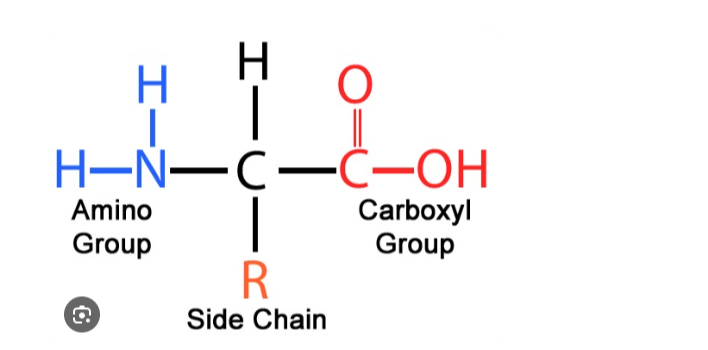
carboxyl group
amine group
central carbon
R side chain
hydrogen
facts about an amino acid?
Amino acids are monomer units that form a polymer called a polypeptide. These polypeptides then combine to form proteins.
The R group gives an amino acid its properties. The R group changes between the different amino acids.
Changing the amino acid can lead to a change in the shape of the protein and may stop it from functioning.
what is a peptide bond and what is the simplest amino acid
A peptide bond is a bond that forms between a carboxyl group and and a amino acid group.
Glycine = simplest amino acid with it's R group just being hydrogen.

describe how a dipeptide is formed?
One amino acid loses its -OH from it's carboxyl group and another amino acid loses it H from it's amine (or amino acid)
group.
A peptide bond is formed.
This forms water making it a condensation reaction.
Hydrolysis could also be used to reform the amino acid
monomers again by adding water.

describe the primary structure of a protein?
The sequence of amino acids bonded by peptide bonds.
Amino acids can be joined together to make a polypeptide in aprocess called polymerisation.
How is a polypeptide formed?
Amino acids are joined by condensation reactions.
Each condensation reaction forms a peptide bond and releases
one molecule of water.
Repeated condensation reactions produce a polypeptide chain.
The sequence of amino acids determines the protein's ultimate/final 3D shape and therefore its function.
describe the secondary structure of a protein
A polypeptide has -NH+ (positively charged) and -C=O- (negatively charged) groups on either side.
These two groups form a weak hydrogen bond.
The hydrogen bonds hold the the folded polypeptide chain in place.
This weak hydrogen bond causes the polypeptide chain to be twisted/folded into alpha helix or beta pleated sheet.
3-D shape due to the Hydrogen bonds
describe the tertiary structure of a protein
The alpha helix or beta-pleated sheet folds further to form the protein's complex 3D structure.
The tertiary structure is held in place by different bonds
and interactions:
Disulfide bonds - fairly strong; form between -CH2-S-CH2 groups but the actual bond formed is S-S.
lonic bonds - form between -NH3+ and -C=O-O groups; relatively easily broken but the actual ionic attraction is
between NH₂+ and O-.
Hydrogen bonds - numerous but relatively easily broken; form between -NH and C=O groups but the actual hydrogen bond is between the H of -NH and the O of C=O.
Amino acids with hydrophobic R groups orientate towards the centre of the protein.
Amino acids with hydrophilic R groups orientate towards the outside of the protein.
Q: How does heating denature the tertiary structure of a protein, and why is this important for enzymes?
The tertiary structure of proteins can be DENATURED by heating.
The heat increases the kinetic energy of the molecule and makes parts of it vibrate faster.
This means that the bonds (not co- valent) that hold the protein in its globular shape are broken and its complex shape will unravel.
This is particularly important in enzymes as it is the tertiary structure that defines the active site.
Q: How do interactions between the R groups cause globular proteins to form, and why are they water
soluble?
Hydrophobic R groups move towards the centre of the polypeptide, away from water.
Hydrophilic R groups move towards the outside, where they can interact with water.
These interactions cause the polypeptide chain to twist and fold into a specific 3D shape, forming a
globular protein.
The hydrophilic R groups on the outside can interact with water molecules, making the protein water
soluble.
describe a quatennary structure
Contains a number of individual polypeptide chains that are linked in various ways.
There may be a non-protein

what are the 2 categories of proteins
globular
fibrous
Q: What are the main properties of globular proteins?
Compact, roughly spherical 3D shape
Soluble in water
Hydrophobic R groups are positioned towards the inside, away from water.
Hydrophilic R groups are positioned on the outside, where they interact with water.
Often have metabolic functions, e.g. enzymes.
Q: Why are globular proteins soluble in water?
Hydrophobic R groups are positioned inside the protein, away from water.
Hydrophilic R groups are positioned outside the protein.
The hydrophilic R groups can interact with water, making the protein soluble.
Q: What is the function of globular proteins?
Mainly involved in metabolic functions.
Examples include enzymes and hormones.
what are the examples of globular proteins
Haemoglobin - conjugated protein
Insulin
Amylase - enzyme
Q: What is a conjugated protein?
A protein with a non-protein group attached, called a prosthetic group.
Q: Give an example of a conjugated protein and its prosthetic group.
Haemoglobin - contains haem groups, each containing an Fe2+ ion.
Q: What is the function of haemoglobin?
Transports oxygen in the blood.
Each haem group can bind to one oxygen molecule.
Q: What is the structure of haemoglobin?
Made from 4 polypeptide chains:
2 alpha globin chains
2 Beta globin chains
Each polypeptide has its own tertiary structure.
Each chain is associated with a haem prosthetic group.
Q: What is the structure of insulin?
Made of two polypeptide chains: A chain and B chain.
A chain begins with a section of a-helix.
B chain ends with a section of ẞ-pleated sheet.
The two chains are joined by disulfide bonds.
Hydrophilic R groups are positioned on the outside, making insulin soluble in water.
Therefore, insulin is a globular protein.
describe amylase
Globular protein
Enzyme
Function: catalyses the breakdown of starch into maltose
A single chain of amino acids with both alpha helix and a beta pleated sheet sections
Q: What are the main properties of fibrous proteins?
Long, repetitive structures
Generally insoluble in water
Strong and tough
Mainly have structural functions
Often have many interactions/cross-links between polypeptide chains.
Q: Why are fibrous proteins insoluble in water?
They have many hydrophobic R groups exposed along their structure.
This means they do not interact readily with water, so they are insoluble.
Q: What is the function of fibrous proteins and examples?
They provide structural support, strength and protection.
Examples:
Collagen → connective tissues
Keratin - hair, nails, etc.
Elastin elastic tissues such as blood vessels and lungs.
Q: What is collagen?
Fibrous protein
Made of 3 polypeptide chains wound together.
Has a repetitive amino acid sequence.
Every third amino acid is glycine, allowing the chains to pack closely.
Hydrogen bonds help hold the chains together.
Provides strength and structural support.
Found in tendons, artery walls and bones.
Q: What is the structure and function of keratin?
Fibrous protein.
Rich in cysteine.
Cysteine forms many disulfide bonds between polypeptide chains.
Hydrogen bonds also form between the chains.
Disulfide bonds + hydrogen bonds make keratin very strong.
Strong links: disulfide bonds.
Weaker links: hydrogen bonds and salt bridges.
Provides mechanical protection.
It is waterproof.
Found in fingernails, hair, horns, scales, fur and feathers.
Q: What is elastin?
Fibrous protein
Cross-linking and coiling give it strength and flexibility.
Can stretch when a force is applied but return towards its original shape.
Found in lungs, blood vessels, bladder and skin.
what are the types of inorganic ions
cations
anions
what are the cations needed to know
calcium ion
sodium ion
potassium ion
hydrogen ion
ammonium ion
what are the roles of calcium ion
sodium ion
potassium ion
hydrogen ion
ammonium ion
Calcium ions = muscle contraction and bone formation
sodium ions = nerve impulse and affect absorption of carbohydrates in the intestine
potassium ions = nerve impulse and stomatal opening
Hydrogen ions = production of ATP and PH determination (more hydrgen ions than OH ions in solutions create an acid)
Ammonium ions = production of nitrate ions by bacteria
what are the anions
nitrate
hydrogen carbonate
chloride
phosphate
hydroxide
what are the roles of nitrate
hydrogen carbonate
chloride
phosphate
hydroxide
Nitrate ions = component of nucleic acids and a component of the nitrogen cycle
Hydrogen carbonate ions = involved in the transport of carbon dioxide
Chloride ions = involved in the transport of carbon dioxide and regulates affinity of
hemoglobin to oxygen
Phosphate ions = components of phospholipid, ATP and nucleic acid and helps root growth
Hydroxide ions involved in regulation of blood pH (more OH ions Dan hydrogen ions in solution create an alkali)
reducing suagrs
Reducing sugar = a sugar that can donate electrons to another substance.
The reducing sugar is therefore oxidised.
In the presence of an oxidising agent, the bond between the ring oxygen (O) and
carbon 1 (C1) is broken.
This opens the sugar's ring structure.
The sugar can then donate electrons to the oxidising agent.
non reducing sugars
Non-reducing sugar = a sugar that cannot donate electrons to an oxidising agent.
The bond between O and C1 cannot be broken/opened because C1 is involved in a
glycosidic bond.
Therefore, the sugar cannot form the reactive open-chain structure needed to donate
electrons.
It therefore does not reduce the oxidising agent.
Test for Reducing Sugars
Add sample to a test tube.
Add equal volume of Benedict's reagent.
Heat in a boiling water bath for ~5 minutes.
Positive: Blue green/yellow/orange/brick-red precipitate = reducing sugar present.
Negative: Remains blue test for non-reducing sugars.
Test for Non-Reducing Sugars
Use a fresh sample.
Add dilute HCI.
Heat in a boiling water bath to hydrolyse glycosidic bonds.
Neutralise with an alkali, such as sodium hydrogen carbonate (NaHСO,).
Add Benedict's reagent.
Heat in a boiling water bath.
• Positive: Blue green/yellow/orange/brick-red precipitate = non-reducing sugar
was present.
Negative: Remains blue = no reducing or non-reducing sugars detected.
protein test
1. Add a few drops of Biuret's reagent (sodium hydroxide and copper (II) sulphate) to the food
sample in a test tube.
2. Shake the solution to mix and wait for a few minutes.
3. If protein is present, the solution turns from blue to purple.
starch test
1. Put some of the food sample into a test tube.
2. Add a few drops of iodine solution from potassium iodide to the food sample using a pipette.
If starch is present, the solution turns from brown to blue-black. Note any colour change in a
table of results.
lipids test
1. Add a few cm³ of ethanol to the food sample.
2. Pour this mixture into a test tube of equal volumes of distilled water.
3. If lipids are present, a white emulsion is formed on the surface of the mixture.
4. This is called the emulsion test.
Result (if positive): Solution turns a milky colour (cloudy white emulsion).
glucose test
Method: Dip the test strip directly into the solution.
Result (if positive): A colour change occurs if glucose is present. Compare the
resulting colour to a chart of known colour changes to determine the exact
concentration.
Colorimetry of glucose method - Preparing the Dilution Series (Steps 1-4)
Collect 10 cm³ of 1% glucose solution in a 50 cm³ beaker.
Use a clean syringe for each transfer to make a dilution series with distilled water (1.00%, 0.50%, 0.25%, 0.13%, 0.06%), mixing thoroughly and labeling as you go.
Label 7 boiling tubes: 1.00%, 0.50%, 0.25%, 0.13%, 0.06%, 0.00%, and UNKNOWN.
Add 1 cm³ of each corresponding concentration, 1 cm³ distilled water to the 0.00% tube, and 1 cm³ of the Unknown solution to the UNKNOWN tube.
Colorimetry of glucose method - Benedict's Reaction & Heating (Steps 5-7)
Add 10 cm³ of quantitative Benedict's reagent to each of the 7 boiling tubes.
Place all 7 boiling tubes into a water bath and incubate for 15 minutes.
Remove the boiling tubes from the water bath and leave them in a rack to cool.
Colorimetry of glucose method - Centrifuging to Clear Precipitate (Steps 8-9)
Pipette 2 cm³ of each solution into a labelled 2 cm³ centrifuge tube (it is fine if precipitate has started settling).
Prepare an 8th centrifuge tube with 2 cm³ of water as a balance tube.
Centrifuge all 8 tubes for 2 minutes, ensuring every tube is placed opposite a balancing partner in the rotor head.
Colorimetry of glucose method - Colorimetry & Calibration Curve (Steps 10-13)
Set the colorimeter to red light and use a cuvette of distilled water to set transmission to 100%.
Carefully pipette the supernatant from each centrifuge tube into a clean cuvette, measure transmission, and record in a table.
Plot a calibration curve using the known concentrations (0.00% to 1.00%) against percentage transmission.
Use your calibration curve to determine and record the concentration of the Unknown glucose solution.