1.2. Factors that effect Equilibrium
 Call Kai
 Learn
Learn Practice Test
 Spaced Repetition
 Match
Match Flashcards
 Knowt Play
1/12

There's no tags or description
Looks like no tags are added yet.
Name | Mastery | Learn | Test | Matching | Spaced | Call with Kai | Chat |
|---|
No analytics yet
Send a link to your students to track their progress
13 Terms
What is Le Chatelier’s Principle and how does it link to Position of Equilibrium? What are the factors that effect Equilibrium that LCP will work to reduce the change of?
Le Chatelier’s Principle predicts which way the system will shift.
it will shift to reduce the change
Factors that affect equilibrium (changes):
Concentration
Pressure
Volume(dont need)
Temperature
NOT CATALYST
Where does the equilibrium shift if concentration of a reactant is increased?
Will be product, forward, right favoured to use up the added reactants and create more products.
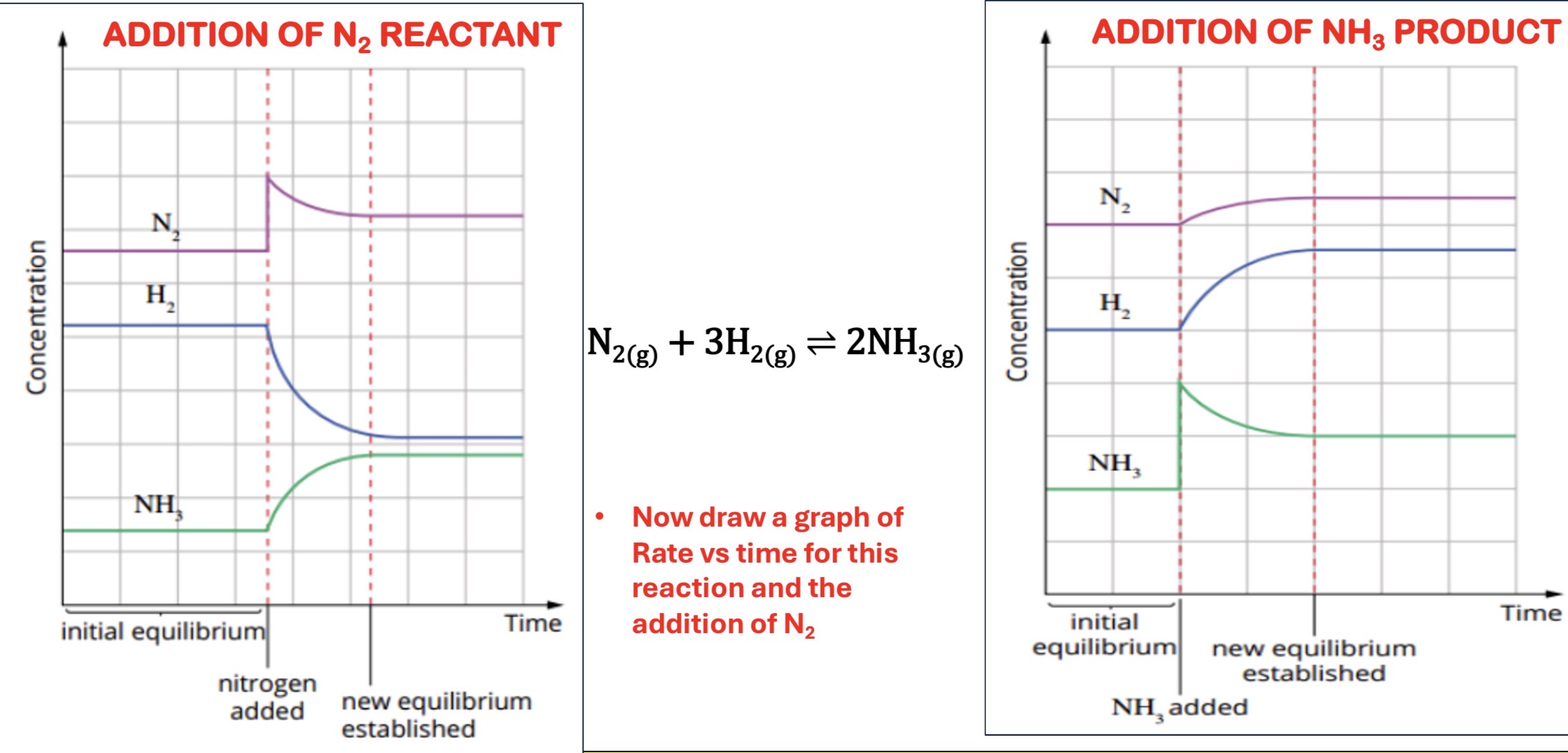
What is happening in these two graphs? Relate to collision theory.
Note: Sharp change means that one was changed.
FIRST GRAPH:
The addition of one of the reactants lead to higher rate of reaction for FOWARD
hence more reactants is being used up and more products is formed, increasing more collisions and increasing rate of reaction for products
establishing a new equilibrium
SECOND GRAPH:
the addition of products lead to high reverse reaction rate due to more molecules colliding
hence this leads to more reactants is being produced and products get used up, increasing rate of reaction for reverse since more molecules are colliding
forms a new equilibrium
Does concentration ever return to before after additional products/reactants is added?
NO NEVER
Which state does Pressure and Volume only effect?
ONLY gaseous equilibria
What happens when Pressure increases?
Shift in the direction with LESS gaseous particles to decrease pressure.
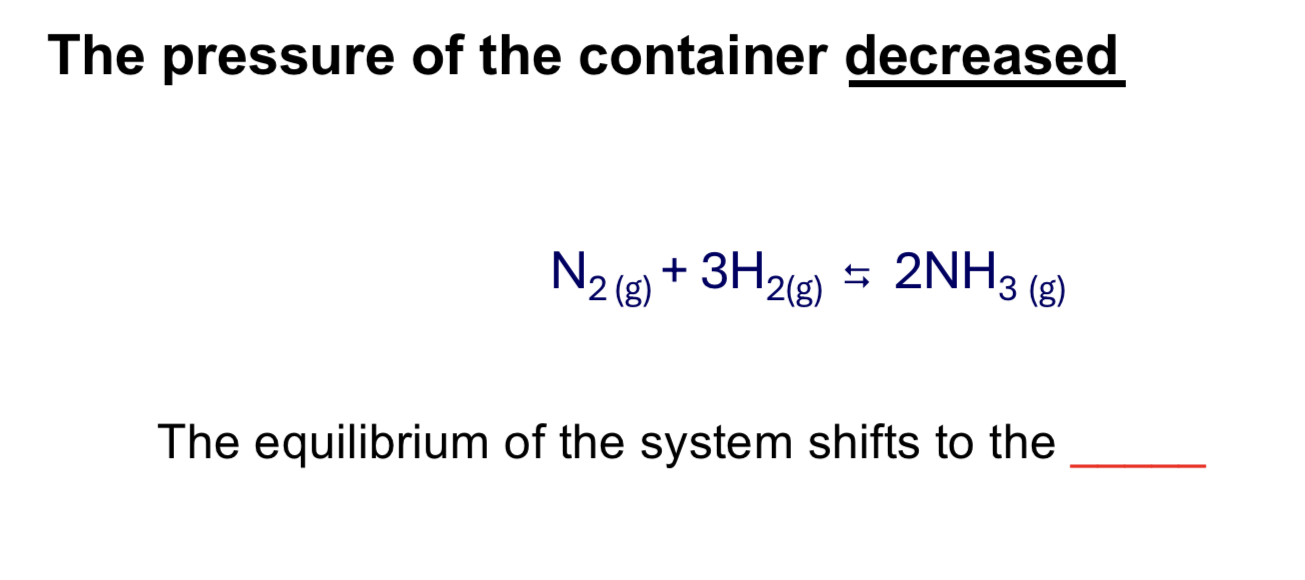
The equilibrium shifts to the left because there is MORE gaseous particles and therefore will increase the pressure.
What happens if there are equal numbers of reactant and product particles when pressure changes?
NO CHANGE will occur and no shift in position of equilibrium.
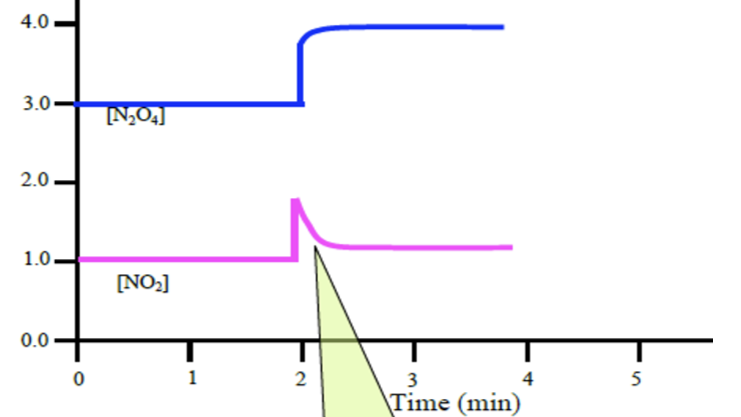
What’s happening in this graph? N2O4(g) + heat → 2NO2(g)
an increase in Pressure, therefore the reverse reaction is favoured as it has less particles.
Note: pressure change changes both reactants and products
Where does increasing temperature in surrounding shift the equilibrium towards?
Will shift equilibrium in favour of endothermic reaction.
this is to use up the heat and decrease temp.
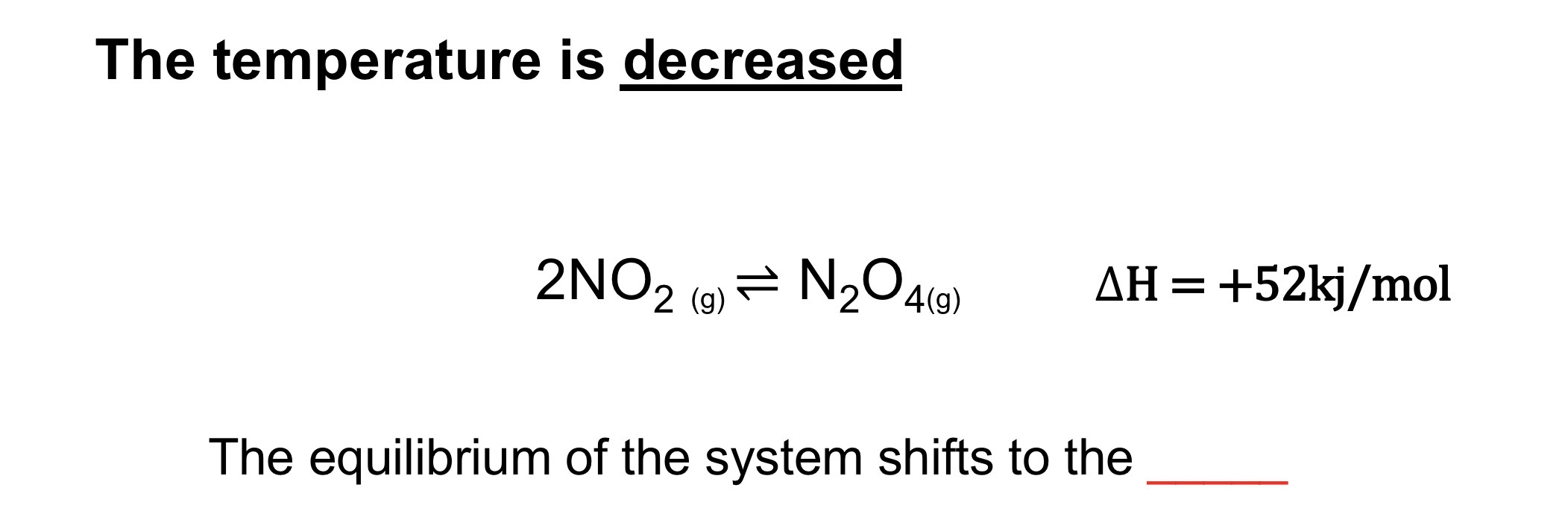
Shifts to the left (exothermic) to add more heat back into system.
What to assume if reaction does not indicate enthalpy?
that it is EXOTHERMIC
What does the CONC/TIME graph look like for change in temperature?
Gradual change, no sharp changes.