Section 2, 4 & 6
 Call Kai
 Learn
Learn Practice Test
 Spaced Repetition
 Match
Match Flashcards
 Knowt Play
1/13

There's no tags or description
Looks like no tags are added yet.
Name | Mastery | Learn | Test | Matching | Spaced | Call with Kai | Chat |
|---|
No analytics yet
Send a link to your students to track their progress
14 Terms
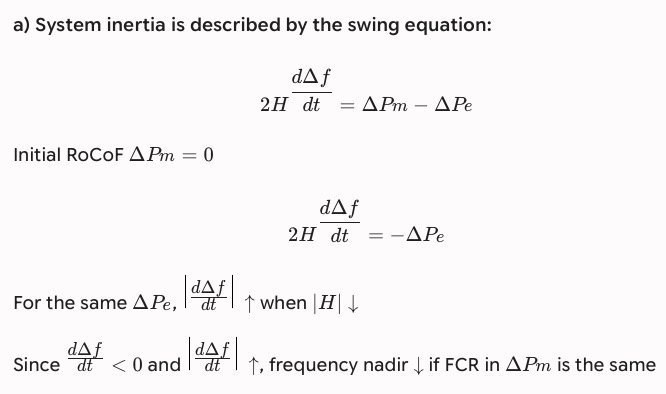
Explain how reduced system inertia affects system rate of change of frequency (RoCoF) and frequency nadir (minimum instantaneous frequency) for a given active power disturbance such as disconnection of a large synchronous generator or HVDC link.
Describe different remedial measures and their working principles for limiting frequency nadir in a low inertia power system
FFR: Active power is injected very quickly when frequency falls, directly raising the nadir
FCR: Stabilizes the frequency to steady state but not nominal
Kp (proportional/droop gain): Determines how much power is delivered per Hz of frequency deviation, higher Kp results in higher nadir, when Kp is too high up it produces oscillations
Ki (integral gain): Integral action eliminates steady state frequency error
Delay: Larger delay results in a deeper nadir
Why does generator governor control use droop control instead of PI control for providing frequency containment reserve in a large power system?
Sharing according to droop constant not controller and process speed
Avoid fighting in case of multiple PI controllers controlling the same frequency
What is the difference between proportional droop and PI-based droop for governor control?
P-based droop: Steady state gain = transient gain, steady state frequency error persists, typical for BESS with low delay in power regulation
PI-based droop: Steady state gain ≥ transient gain, steady state frequency error goes to zero, typical for hydro with significant delay in penstock for power regulation
What are the main factors that affect the system frequency nadir during an active power disturbance?
What are the remedial measures (strategies) to limit frequency nadir in a low inertia power system?
System inertia, generator governor response (droop), and FFR
Remedial measures: FFR, synthetic inertia, more/faster FCR
What is an electrically strong or weak system?
What are the common measures to indicate the grid electrical strength?
Electrically strong system: Provides high short circuit capacity or low grid impedance
measures → SCC, SCR
What is the physical meaning of reactive droop in an automatic voltage regulator (AVR) in a synchronous generator?
Control voltage at a remote or internal bus through load compensation
Reactive droop only compensates for reactive voltage change
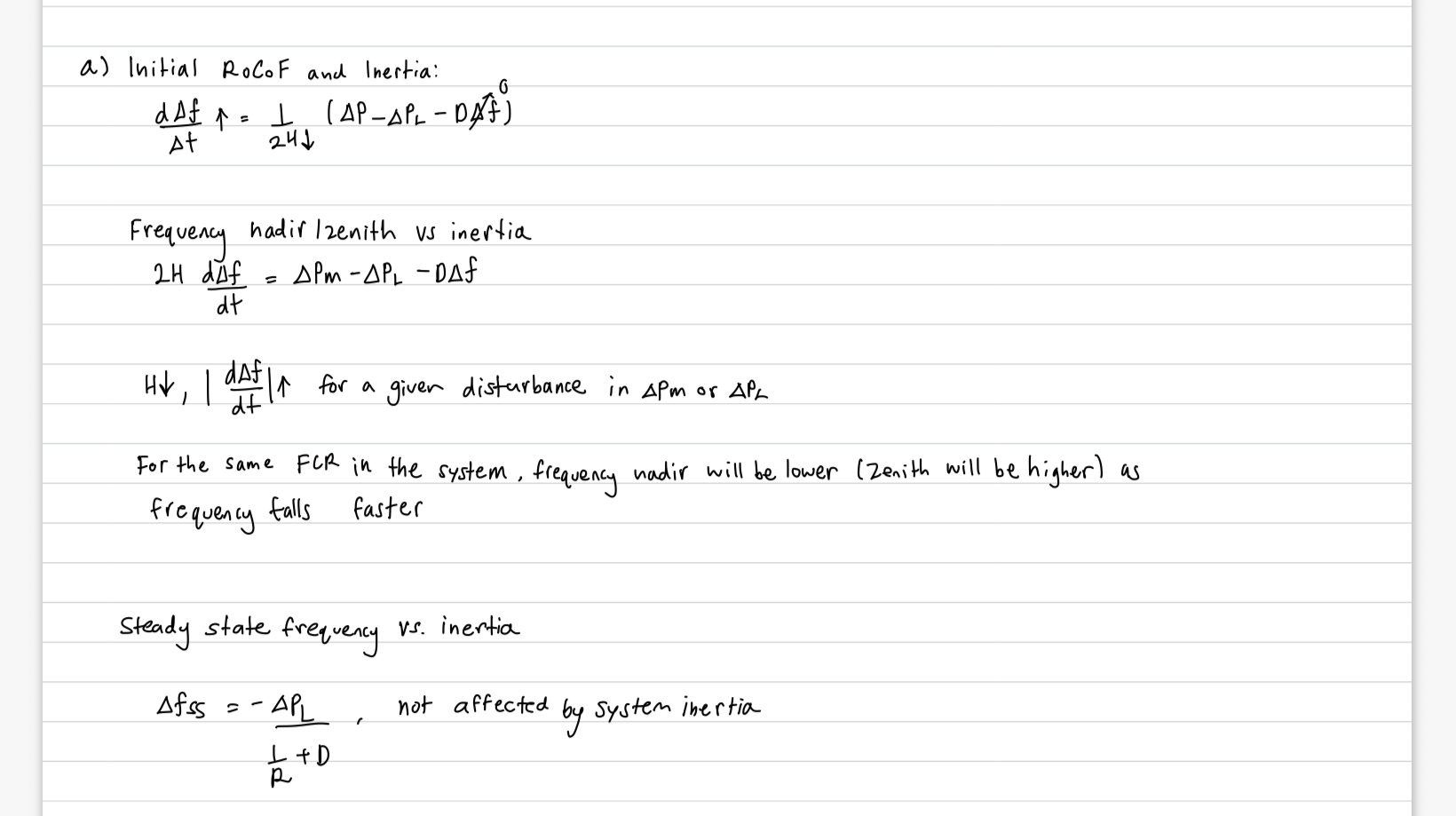
Explain how reduced system rotational energy (synchronous inertia) affect system frequency stability and quality in terms of rate of change of frequency (RoCoF), frequency nadir and zenith, and steady-state frequency deviation.
Explain the purpose of droop-based control for frequency regluation in a power system.
Sharing FRC among multiple generators, avoid PI controller fighting among generators
In transmission system, there are different disturbances such as short circuit, switching in and out of different electrical equipment and load variations from minute to minute to hour to hour.
Explain what the main factors are that affect the grid voltage (magnitude) during such disturbances.
Grid strength and impedance, SCC
load level
load power factor
load voltage dependence characteristics
In transmission system, there are different disturbances such as short circuit, switching in and out of different electrical equipment and load variations from minute to minute to hour to hour.
Explain what the remedial measures that exist in the power system to regulate the grid voltage after a voltage disturbance occurs.
Enhance grid SCC (e.g. synchronous condenser)
Voltage regulation
—> AVR from synchronous generator, FACTS devices, inverter based generator/ storage, tap changer
Reactive compensation
—>Shunt reactor/capacitor, line disconnection, bypass of series compensation
For an efficient and economical operation of a power system, the losses in the transmission system should be kept as low as possible. Explain the operational methods.
Uniform voltage control
Local reactive power compensation
Increase voltage set point slightly
In Sweden 78% of all transmission losses occur on the overhead line. Propose two methods that are reasonable and economical to minimize the losses in the transmission system.
Parallel lines
Phase changing transformers (boosters)
In power system analysis per unit system is commonly used. Explain the benefits of using per unit values of electrical quantities as compared to using values in kV, kA, and Ω
3 and 3 disappear in power calculations
V, I, and Z expressed in percentage of the base values (more comparable)
Gets rid of transformer nominal ratios in p.u. calculations