Psychology: Chapter 6 - States of Conciousness
 Studied by 0 people
 Call Kai
 Learn
Learn Practice Test
 Spaced Repetition
 Match
Match Flashcards
 Knowt Play
1/67

There's no tags or description
Looks like no tags are added yet.
Name | Mastery | Learn | Test | Matching | Spaced | Call with Kai |
|---|
No study sessions yet.
68 Terms
What is consciousness?
our immediate awareness of our internal and external states.
What did William James mean by “stream of consciousness”?
William James coined “stream of consciousness” to signify how we experience our conscious life because consciousness
What types of attention are part of consciousness + an example?
Limited capacity: brain’s processing power is finite, we can only attend to or be consciously aware of a small amount of information at any given time;
sustained attention; maintain focus and alertness over a prolonged period is limited
divided attention; ability to attend to, or perform, multiple tasks or stimuli simultaneously
spatial attention; ability to focus on specific locations in the environment is also capacity-limited
Cocktail party effect. Dichotic listening and shadowing.
What is selective attention?
Select specific stimuli while ignoring others. (Sustained attention, Divided attention, Spatial attention are examples)
What are biological rhythms?
internal rhythms of biological activity.
What is a circadian rhythm?
pattern of sleep-wake cycles that in humans roughly correspond to period of day and night.
What is the role of the SCN in sleep?
The suprachiasmatic nucleus (SCN) is a small group of neurons in the hypothalamus. When day turns to night the SCN gets notified via incoming information from the retina, and then directs the pineal gland to secrete melatonin triggering sleepiness
How does light regulate melatonin?
During the day, photoreceptors in the retina communicate to the SCN and melatonin remains low
When we are not exposed to light the SCN extends the body’s day and other rhythms like body temperature and melatonin production no longer coordinate
– However, the 24-hr clock can quickly be restored
What individual differences exist in circadian rhythms, and how does sleep regulation tie into this?
“Owls” vs “Larks.” Chronotype.
Sleep Regulation: brain’s ability to switch between sleep and wakefulness in response to the external environment.
What disrupts normal sleep?
Circadian rhythm sleep disorder caused by mismatch of one’s sleep cycle and the environment. Biological clock disrupted by jet lag and shift work. Causes fatigue, sluggishness, and irritability, Depression and anxiety
What is insomnia?
Insomnia is an inability to fall asleep or stay asleep. It’s the most common sleep disorder. Often triggered by stress and more common in older adults.
What is sleep debt and what can it lead to?
Insufficient Sleep on a chronic basis.
Without enough sleep we can feel depressed, have lower productivity, lower immune system responses, and are more apt to make mistakes
– Increase blood pressure, stress hormones, obesity
– Irritability, distractibility, moral judgement and other cog. Impairment with >4hrs; <48hr can results in hallucinations
Sleep rebound:
we fall asleep quickly if we’re sleep deprived
What brain structures and hormones are involved in sleep?
Hypothalamus, pons (for REM), SCN and thalamus (regulate slow-wave sleep)
– Melatonin, follicle stimulating hormone (FSH), luteinizing hormone (LH), and growth hormones
The pineal gland releases melatonin during sleep. Melatonin is thought to be involved in the regulation of various biological rhythms and the immune system. During sleep, the pituitary gland secretes both FSH and LH which are important in regulating the reproductive system. The pituitary gland also secretes growth hormone, during sleep, which plays a role in physical growth and maturation as well as other metabolic processes
What is the Restorative Theory of Sleep?
Sleep restores our brains and bodies. Sleep deprivation reduces immune functioning. Rats heal slower when deprived of sleep.
What is the Adaptive Theory of Sleep?
Organisms sleep for self-preservation and to stay away from predators.
How does sleep relate to cognition and learning?
Sleep deprivation leads to reduced maintenance of attention, make decisions, recall LT memories
Sleep and learning
– We sleep better after learning content, we’re more creative, and better able to process emotion
– Don’t cram for exams!
What are the two general phases of sleep?
REM: darting eye movements and active brain waves.
Non-REM: four phases with varying brain wave changes.
Sleep is not uniform and demonstrates variations in brain waves during different stages
– Frequency and amplitude
How long is a typical sleep cycle?
90–100 minutes per cycle, ~ 5x/night, through 5 stages (NREM and REM) Just over 1h
What happens in Stage 1 sleep (what is experienced)?
Non-REM: Transition into sleep (5 mins).
• Heart rate, breathing rate, blood pressure, body temperature, and muscle tension all decreases
• Alpha waves (awake) change to theta waves
• Easy to wake
• Experience hypnagogic state (a transitional state between wakefulness and sleep), hypnagogic hallucinations (vivid sensory experiences), and myoclonic jerks (sudden muscle spasms).
What happens in Stage 2 sleep?
Non-REM: Harder to wake (15–20 mins).
• Slowing of brainwaves – still theta
– Sleep spindles and K-complex (exclusively in stage 2*)
• Rhythmic breathing, occasional body twitches, but generally relaxed
• Near the end, brainwaves slow to delta waves (deep sleep)
What characterizes Stages 3 & 4 sleep?
Non-REM: deepest sleep (5-15 and 20-30 mins, respectively)
• Characterize by low frequency high amplitude waves
– Delta waves. 20%-50% at stage 3, >50% at stage 4
• Slow heart rate, brain and body in total relaxation
• Mostly delta waves
• Sleep walking and bed wetting more likely
• Hard to wake
What happens during REM sleep (stage 5)?
Rapid Eye Movement (REM): (5-15 mins)
• Rapid and jagged brainwaves (just like being awake)
• Increased heart rate, rapid and irregular breathing, and dreaming – paralysis of muscle systems
Paradoxical sleep: deep sleep and relaxed, but considerable brain activity
• Dreaming during this time
What is REM rebound?
If deprived of REM we enter into REM sleep more quickly and stay there longer
What is the relationship between REM and learning, and how do lesions to pons impact learning and memory?
REM consolidates new memories. REM increases after novel learning. Antidepressants disrupt REM but animals still learn. Pons lesions don’t impair learning or memory.
What is Freudian dream analysis, and what was Jung’s take on this topic?
Dreams express unconscious wishes.
Manifest Content: what you’re able to recall – actual event
Latent Content: unconscious elements which have symbolic meaning.
The collective unconscious, as described by Jung, is a theoretical repository of information he believed to be shared by everyone. According to Jung, certain symbols in dreams reflected universal archetypes with meanings that are similar for all people regardless of culture or location.
What are common dream themes?
Chased, sexual experiences, falling, school, being late, trying again and again to do something, flying, being attacked, being killed, swimming, being nude, eating delicious food, finding money, fire, killing someone, teeth falling out, drowning
What is Cartwright’s information-processing theory?
Dreams process information from the day (memory encoding and problem solving). REM increases during stress or learning.
What is Hobson’s activation-synthesis hypothesis?
During sleep the brain has a lot of random activity via the brainstem that activates the sensory systems
Dreams reflect the brains efforts to make sense of, or find meaning in the neural activity taking place during sleep or REM sleep – synthesizing
What are Nightmares, Lucid Dreams, and Daydreams
Nightmares are dreams filled with intense anxiety, helplessness, powerlessness, danger
– More common among those under stress
Lucid dreams are when the sleeper knows they’re dreaming and can actively guide the outcomes
Daydreams are fantasies that occur while one is awake and aware of external reality but is not fully conscious
What is cognitive-behavioural therapy for sleep?
Psychotherapy focused on cognitive processes and problem behaviours.
What is parasomnia + examples?
Group of sleep disorders with disruptive motor activity during REM or non-REM. Examples include sleepwalking, restless leg syndrome, night terrors
What is sleepwalking, and when does it usually occur?
Get up and walk around. Usually avoid complex activities, stairs,
and obstacles, but accidents happen. Appears to be inherited
Most often takes place during the first 3h of sleep. Occurs in 5% of children
What is REM sleep behaviour disorder (RBD) and what can be related to it?
Muscle paralysis during REM fails (occurs in older ages)
– Second half of the night - around 90 minutes in
– A lot of motor activity (kicking, failing), pose a risk to themselves and sleeping partners
– Related to Parkinson’s disease → now acts as diagnostic indicator
What is restless leg syndrome and what can it be linked to?
Discomfort in legs during inactivity or sleep. Linked to kidney disease and diabetes.
What are night terrors, where is it the most common, and which stages does it normally occur?
People awake suddenly screaming in fear and agitated, increased heart rate and breathing (can’t recall event, unlike nightmares usually).
– More common among children. Tends to occurs in Stages 3&4, no memory
What is sleep apnea, where is it most common, and what are the two types?
repeatedly ceasing to breathe during the night, depriving the brain of oxygen and frequent awakenings. It’s the second most common
– Brain fails to send a breathe signal, throat muscles become too relaxed, in extreme cases can lead to cardiac arrest
– More common in overweight individuals, contributes to cardiovascular disease.
Two types: Obstructive (airway gets blocked) and central (disrupted signal from brain)
What is narcolepsy and how is it normally treated?
marked by an uncontrollable urge to fall asleep. May suddenly fall into REM and awake feeling refreshed.
– Some experience loss of muscle tone (cataplexy), experience vivid dream-like hallucinations during episode, appears to be inherited
– Report feeling well rested
Treated with psychomotor stimulants
What is addiction?
psychological or physical compulsion to take a drug, resulting from regular ingestion and leading to maladaptive patterns of behaviour and changes in physical response
– Physical dependence demonstrates in changes in bodily function
– Psychological dependence demonstrates an emotional need
What is tolerance?
mark of physical dependence on a drug, in which the person is required to take incrementally larger doses of the drug to achieve the same effect
a person's body or brain has a diminished response to a medication or substance following repeated use
What are withdrawal symptoms?
unpleasant and sometimes dangerous side effects of reducing intake of a drug after a person has become addicted
What are psychoactive drugs + 4 examples/categories?
chemicals that affect awareness, behaviour, sensation, perception, or mood
– Some are illegal (heroin, ecstasy, cocaine) some are not (coffee, alcohol, cannabis)
Examples/Categories are: Depressants, Stimulants, Opiates, Hallucinogens
What are depressants, examples, and what are they agonists of?
• A drug that tends to suppress the CNS
• Alcohol, barbiturates, and benzodiazepines
• Agonists of GABA
What is alcohol and how does it represent a Biphasic effect?
a depressant taken in liquid form and is the most commonly used psychoactive drug;
ethyl alcohol binds to GABA and reduces firing.
Biphasic effect: starts as a stimulant but ends as a depressant
What is considered a “standard drink,” and what are BAC levels?
Depressants “standard drink:” 12 oz beer, 4 oz wine, 1.25 oz hard liquor
“Drunk driving” = .05-.08
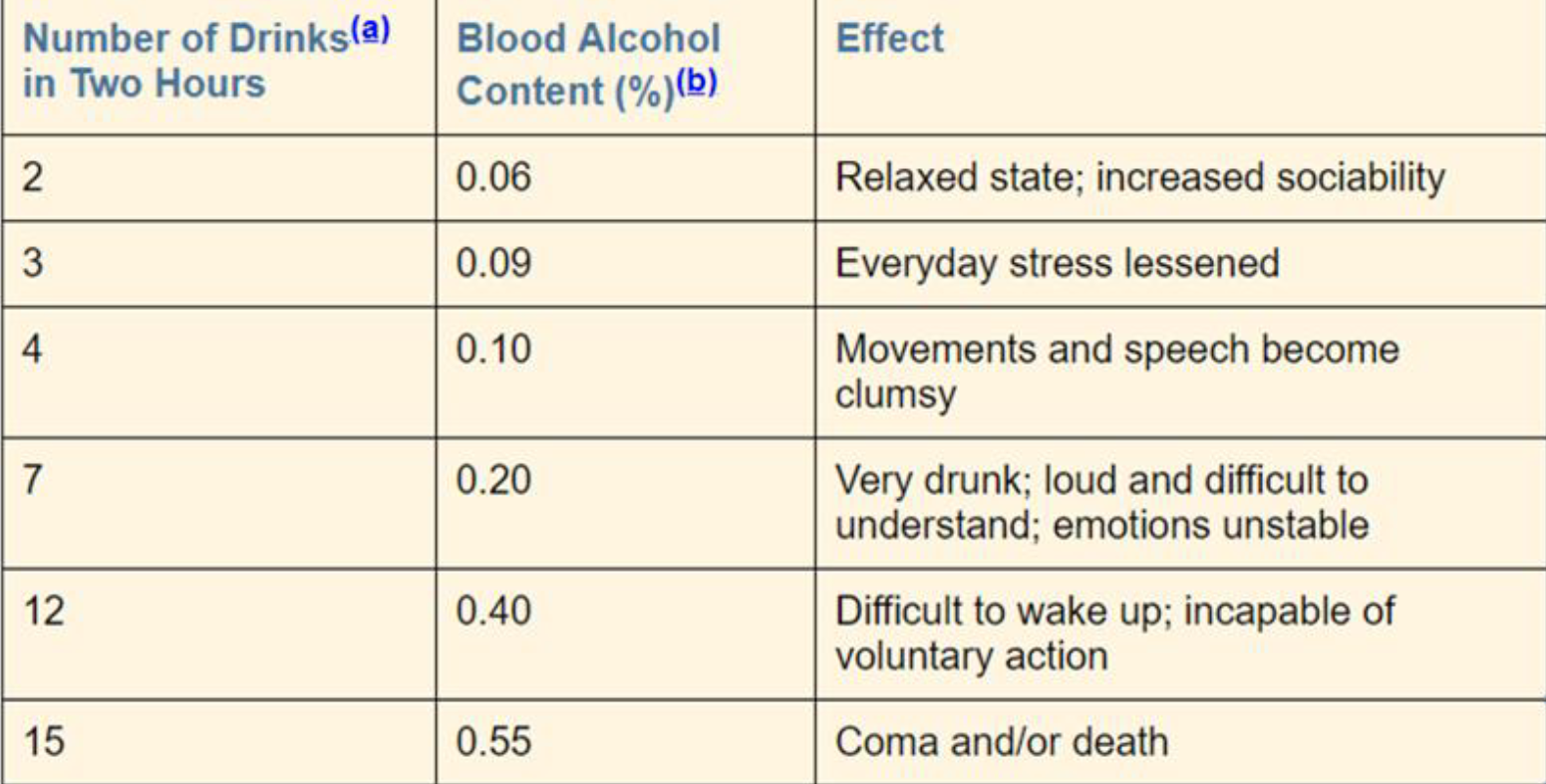
What is binge drinking and alcohol dehydrogenase?
the consumption of 5+ drinks in a row, reported that 60% of college- and university-aged students binge drink
What is alcohol dehydrogenase deficiency?
Present in 50% of Asians; Chemical responsible for breaking down and eliminating alcohol is deficient. Individuals react very negatively to even small amounts of alcohol
How does alcoholism impact life?
Alcoholism impacts an individual’s family, social, and occupational life
• Implicated in more than a third of suicides, homicides, assaults, rapes, and accidental deaths
• Just under 40% of car accidents in Canada involve alcohol
• Long-term effects like cirrhosis in which the liver is scarred – FASD
What are sedative-hypnotic drugs + example?
produce feelings of relaxation and drowsiness
• Benzodiazepines (anti-anxiety) developed in the 50s are the most popular today
– Xanax, Ativan, Valium
– Does not produce drowsiness like alcohol
– In high doses it can lead to intoxication and addiction
What are stimulants, what are they agonists of, and what are they associated with?
substances that increase the activity of the CNS
dopamine agonists; block dopamine reuptake;
associated with reward and craving.
What is cocaine and what does it do?
the most powerful natural stimulant. In the early 20th century it was used for pain
– Brings a rush of euphoria and well-being
– Increases activity of dopamine
What are methamphetamines and amphetamines?
Types of stimulants:
Methamphetamines produces feelings of euphoria
– Fast acting and leaving, prompting runs of use, lower risk of OD
– Meth mouth, skin infection, memory loss, paranoia, hallucinations
Amphetamines are manufactured and increase energy and lower appetite. Highly addictive qualities
– Increases activity of dopamine
– Used to treat ADHD
– Club drug, ecstasy (MDMA) dumps serotonin resulting in euphoria
– 60% of users are men
What is caffeine and what can it cause?
mild and legal and the world’s most widely used stimulant (80%)
– Insomnia, nausea, irregular heart beat
What is nicotine and what can it lead to?
Nicotine legal, but highly addictive. Most commonly taken in via smoking and reaches the brain faster than injection into the blood stream
– Heart disease, stroke, variety of cancers
– Acetylcholine receptors
– 20% of people 14+yrs regularly smoke tobacco
What are opioids and what can they do?
They are derived from the sap of the opium poppy
– Heroin, morphine, codeine, and OxyContin
– Rush of euphoria lasting for hours
• Pain reliever (analgesic), but highly addictive
– Methadone, similar effects but without psychoactive qualities
– Codeine is low potency
• Mimics the effects of endorphins
• Danger for overdose ~ Opioid crisis
What are hallucinogens?
substances that dramatically change one’s state of awareness, causing powerful changes in sensory perception
• As a group they show considerable variability
– Mescaline and LSD are serotonin agonists
– PCP and ketamine are antagonists of NMDA glutamate.
• Are thought to have fewer additive qualities
What is LSD and what can it lead to?
Lysergic acid diethylamide (LSD) is a hallucinogen that brings on hallucinosis, a state marked by a strengthening of visual perceptions and profound psychological and physical changes
• Binds to serotonin receptors
Leads to Flashbacks: recurrences of sensory and emotional changes even after LSD has left the body
What is cannabis, its active chemical, and what can it do?
A type of hallucinogen. A hemp plant producing cannabis and hashish;
• Tetrahydrocannabinol (THC) is the active chemical
• When smoked it produces a mixture of hallucinogenic, depressant, and stimulant effects
• Interferes with memory, sensorimotor tasks, can impact sperm count and abnormal ovulation
Prenatal exposure and alternate usage of cannabis
Prenatal exposure has shown negative impacts on inhibition, behavioural self-control, and working memory
Treatment: Chronic pain, chemotherapy, glaucoma, disease-related, anorexia, MS, HIV or AIDS, spinal cord injury, arthritis, and epilepsy
What is the Reward learning pathway (pleasure pathway) and Reward-deficiency syndrome - IMPORTANT
Reward learning pathway (pleasure pathway): brain circuitry that is important for learning about rewarding stimuli. Gives drugs their addictive properties.
Travels from ventral tegmental area of mid brain (where dopamine is produced), to the nucleus accumbens (house of the reward pathway), to prefrontal cortex.
• Activated by pleasurable stimuli or events and comes to anticipate a response
Reward-deficiency syndrome: people might abuse drugs because their reward centre is not readily activated by usual life events
What is hypnosis?
Hypnosis is an altered state of consciousness during which people can be directed to act or experience the world in unusual ways
– Self focus and attention, minimal attention to external stimuli
– In a clinical setting it may be used to promote relaxation and openness to altered thought and perception
• Guided into a suggestible state, must involve the person’s willingness to relinquish control
How is someone hypnotized?
1) Focus on one thing.
2) Encourage comfort and relaxation.
3) Trust the hypnotist.
4) Use imagination.
Who is more susceptible to hypnosis and what’s it used for?
Most people; 15% highly susceptible; 10% immune; used for pain management, depression, anxiety, smoking, and weight loss
What are the two theories of how the participant’s attention is diverted from the pain in hypnosis?
The divided (dissociation) consciousness theory of hypnosis, proposed by Ernest Hilgard, suggests that hypnosis causes a split in consciousness, creating two separate streams of awareness. One part of the mind remains aware of the external world, while another, more deeply absorbed part follows hypnotic suggestions
The social/cognitive process theory, proposed by Nicholas Spanos, views hypnosis as a social role that individuals perform. It suggests that the behaviours and experiences of a hypnotized person are influenced by their expectations of how they should act while hypnotized.
What are hypnotic effects (3 responses)?
Motor control is an area that is readily influenced by a hypnotist
• Posthypnotic responses: a predetermined signal that elicits a response after being roused from hypnosis
• Posthypnotic amnesia: directed to forget something learned during hypnosis
• Hypnotic hallucinations: guided to experience or not experience events or objects
How does hypnosis affect the brain? - IMPORTANT
When a person is put into a state of relaxation during hypnosis, activity in the cerebral cortex and thalamus tends to slow down. Following this, if guided into mental absorption or total focus, cerebral blood flow and neural activity can speed back up.
The anterior cingulate cortex is implicated in general awareness and the unpleasantness associated with pain.
If a person is exposed to pain under hypnosis, the neurons that send pain messages continue to fire as usual. However, the brain's awareness of the unpleasantness of that pain is greatly reduced. This suggests hypnosis can alter the subjective experience of pain without blocking the initial pain signals.
What is meditation?
a technique designed to run one’s consciousness away from the outer world, towards inner cues and awareness, ignoring all stressors
– Often done alone
• Typically, it involves going to a quiet place, in a specific or comfortable position, controlling one’s breathe, limiting outward attention, and forming internal images
• Ancient practice traced through world’s major religions
• Best-known practices derive from yoga
• All involve self-regulation practices
What is mindfulness meditation and what can it do?
has the person pay attention to their feelings, thoughts, and sensations, but with detachment and without judgement. Has been shown to produce the same brainwaves associated with the relaxed phase prior to sleep
• Can lower respiration, heart rate, blood pressure, and muscle tension
• Been used to treat pain, asthma, high blood pressure, heart problems, skin disorders, diabetes, and viral infection