Advanced Patient Care Exam 1: Chapters 14 and 15
0.0(0)
Studied by 0 people Call Kai
 Learn
Learn Practice Test
 Spaced Repetition
 Match
Match Flashcards
 Knowt Play
Card Sorting
1/79

Earn XP
Description and Tags
Last updated 2:50 PM on 2/22/23
Name | Mastery | Learn | Test | Matching | Spaced | Call with Kai | Chat |
|---|
No analytics yet
Send a link to your students to track their progress
80 Terms
1
New cards
What is the most common drug interaction?
Drug receptor interactions
2
New cards
Where does most drug metabolism occur?
In the liver
3
New cards
Acronym for pharmacokinetics
ADME
Absorption
Distribution
Metabolism
Excretion
Absorption
Distribution
Metabolism
Excretion
4
New cards
Efficacy
The degree to which a drug produces a desired effect
5
New cards
Potency
Relative concentration required to produce an effect
6
New cards
Half-life
The time required for drug concentration to reduce by 50%
7
New cards
Side effect
Mild and predictable
8
New cards
Adverse Effect
Unwanted effect, more serious
9
New cards
Toxicity
The degree to which something is poisonous; antidote treats this effect
10
New cards
Idiosyncratic Reaction
Occurs when a patient overreacts or under-reacts to a drug or has an unusual reaction
11
New cards
Allergic Reaction
Immune mediated response by the body to a drug
12
New cards
Drug-drug interactions
When two or more drugs act in unison to produce a response
13
New cards
Synergism
Two drugs act together to produce a positive (additive) response
14
New cards
Incompatibility
Drugs that should not be taken together
15
New cards
Why drug interactions can be dangerous
Many drugs alter the metabolism of other drugs
16
New cards
Pharmacogenetics
Study of how your genes (DNA) affect your response to medications
17
New cards
How are drug interactions impacted?
Method of consumption and where it acts in the body
18
New cards
What happens after you take a drug?
The body needs to break it down and get it to the intended area
19
New cards
How is the drug response influenced?
DNA can affect multiple steps in the drug breakdown process
20
New cards
Enteral
Through the GI tract
21
New cards
Parenteral
Injected directly into the body, bypassing the GI tract
22
New cards
Intradermal
Within the skin layers
23
New cards
Subcutaneous
Under the skin
24
New cards
Intramuscular
Into the muscle
25
New cards
Most common intravascular injection
IV
26
New cards
Intraarterial (IA)
Injected into an artery (angiography)
27
New cards
Intrathecal
Contrast injected into the spinal canal; myelograms and anesthesia
28
New cards
Intravenous
Route that offers the most immediate effects; common route for fluids
29
New cards
What are the 4 different structures of blood vessels?
Tunica intima, tunica media, tunica adventitia, and lumen
30
New cards
Tunica Intima
Innermost, connective tissue
31
New cards
Tunica Media
Thicker in arteries, smooth muscle
32
New cards
Tunica Adventitia
Stabilize and anchor vessel
33
New cards
Lumen
Center of vessel where the blood flows
34
New cards
What are the two types of blood circulation
Arterial and venous
35
New cards
Arterial
Takes blood away from the heart; thicker muscle wall; High pressure; High O₂ (Except pulmonary artery)
36
New cards
Venous
Take blood to heart; deoxygenated blood (except pulmonary vein); peripheral veins have valves
37
New cards
What does IV site selection depend on?
length of therapy, material to be infused, and patient age/overall condition
38
New cards
What should be avoided for IV selection sites?
Flex areas, bruises, sclerosed or thrombosed veins, areas of skin disease or breakdown, tattoos, and mastectomy
39
New cards
What are some common venipuncture sites in adults?
Digital–Metacarpal, Cephalic, basilic, and median cubital
40
New cards
What are common venipuncture sites in adolescents?
Metacarpal, median cubital
41
New cards
What are common venipuncture sites in infants and neonates?
Scalp veins, umbilical vein, hands and feet
42
New cards
When is IV therapy used?
Medication administration, fluid replacement, and parenteral nutrition
43
New cards
When is IV therapy used for medication administration?
When rapid response is necessary, chemotherapy
44
New cards
What is involved in IV therapy used for fluid replacement?
Dextrose in water (D₅W), normal saline (NS), and lacated ringers (electrolyte replacement)
45
New cards
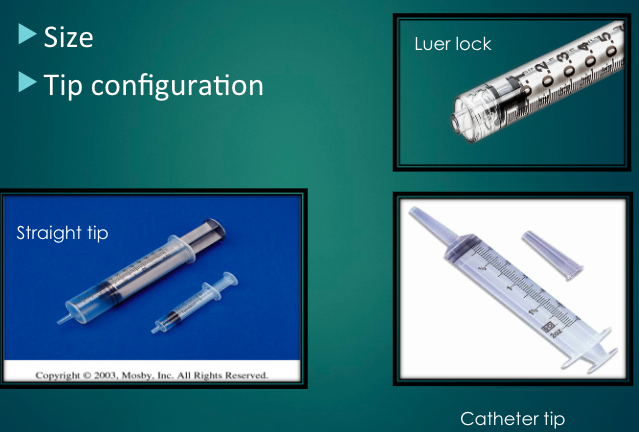
Types of syringe tips
Luer lock, straight tip, catheter tip
46
New cards
Catheter tip
Connected to a catheter; usually used for contrast media
47
New cards
Straight tip
Can be used with or without a needle
48
New cards
Luer lock
Needle locks directly into the tip of the syringe
49
New cards
Steps to filling a syringe
Do not contaminate the plunger, fill the syringe with air to desired level, invert the bottle, inject air into the bottle, and withdraw solution
50
New cards
What are the different venipuncture devices?
Wing tip (butterfly), hypodermic, and IV catheter
51
New cards
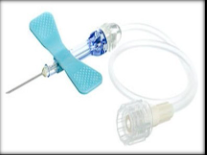
Wing Tip Needle Facts
Short small gauge metal needle with one or two plastic side arms; 19 – 27 g, .5” - .75” length; Used for short term therapy
52
New cards
Advantages of wing tip needle
easy to use; less chance of phlebitis
53
New cards
Disadvantages of wing tip needle
rigid, less mobility, may infiltrate
54
New cards
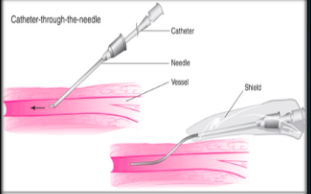
Over the needle catheter facts
Plastic catheter mounted on metal needle; 10 – 27g, .75” - 3” length; used for more long term therapy
55
New cards
Advantages of over the needle catheter
Decreases chance of infiltration, allows for patient mobility
56
New cards
Disafvantages of over the needle catheters
Phlebitis, can kink, improper insertion can lead to catheter emboli
57
New cards
What is the use of existing lines sometimes called?
Piggyback
58
New cards
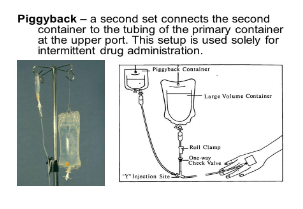
What is piggyback?
connecting an IV bag via its own tubing to an existing IV line
59
New cards
What does piggybacking do?
Before beginning, assure compatibility of meds, Piggyback line is filled and clamped before attached to the IV line, IV line is clamped, Piggyback line is opened
60
New cards
Important intermittent venous access things to know
Never flush with sterile water, wipe stopper, inject 1cc normal saline, observe the site, inject contrast, and flush with saline
61
New cards
Venipuncture procedure facts
Requires assembly supplies, do not draw up contrast in front of patient, do not inject anything drawn up by others, tear tape prior to putting on gloves, place tourniquet 6-8 inches above puncture site
62
New cards
What are the standard precautions for venipuncture?
Wash hands, don gloves, cleanse site
63
New cards
What is the procedure for venipuncture?
Acute angle to puncture skin, decrease angle advance cannula, release tourniquet, secure device
64
New cards
What does it mean to verify patency?
Making sure the vein is open and that we are in the right spot
65
New cards
How do you verify patency?
There is blood return on aspiration, palpate site, observe for swelling or redness, inject saline, question patient about pain, never force an injection
66
New cards
How many times should you verify your medication before injection?
3 times
67
New cards
When should you verify your medication?
When picking it out, when drawing it up, and right before injection
68
New cards
What should you do during injection?
Document any adverse effects and patient reaction
69
New cards
Charting of medication facts
Must comply with institution policies, all medications are recorded in the patients EMR, there are radiology specific forms and incident report forms
70
New cards
What medication information is included in the patient’s EMR?
Date, time of day, drug name, dosage, route of administration, person administering drug
71
New cards
What is included in the radiology-specific forms?
Radiologic requests, informed consent, contrast administration records
72
New cards
What is the process of discontinuing IV lines?
Prepare tape or bandaid, wash hands and don gloves, stabilize cannula and remove tape, inspect the site, place sterile gauze over the site, remove the needle and apply pressure, dispose of the needle, and apply dressing.
73
New cards
What should you do if the IV is running slowly or not running at all?
Check the obvious
74
New cards
What happened in IV therapy if there is infiltration (extravasation)?
Injection into tissues surrounding vein
75
New cards
What happened in IV therapy if there is hematoma?
bruising, bleeding into the tissues
76
New cards
What happened in IV therapy if there is phlebitis?
Inflammation of the vein
77
New cards
What happened in IV therapy if there is infection?
It is not immediately evident
78
New cards
What should you do in IV therapy if there is catheter embolism?
Check catheters at the end of procedure, if broken place tourniquet above site, call doctor
79
New cards
What should you do in IV therapy if there are allergic reactions?
Monitor patient for signs of itching, dyspnea, color changes, sweating
80
New cards