Microevolution
 Call Kai
 Learn
Learn Practice Test
 Spaced Repetition
 Match
Match Flashcards
 Knowt Play
1/22

There's no tags or description
Looks like no tags are added yet.
Name | Mastery | Learn | Test | Matching | Spaced | Call with Kai | Chat |
|---|
No analytics yet
Send a link to your students to track their progress
23 Terms
Genetic Variation
Genetic variation makes evolution possible
As we know from genetics, each offspring inherits different information from their parents
Genetic Variation = Random!
Allele Frequency
the number of copies of an allele compared to the total number of alleles in a population
Changing Allele Frequencies
Natural selection changes allele frequencies – and ultimately affects phenotype
5 Factors lead to such changes: Natural Selection is the most significant
Microevolution
small changes within a species
involves changes in allele frequencies over time
5 Fingers of Evolution
Mutations
Gene Flow/Migration
Non-Random Mating
Genetic Drift
Natural Selection
Mutations
RANDOMLY OCCUR: cause genetic variation and change allele frequencies
Mutations occur in the DNA of an individual – but have the potential to affect an entire gene pool!
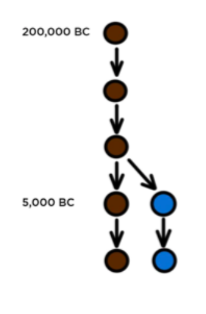
Ex. At the beginning of the human race, brown was the only eye colour humans could have. The allele frequency for brown eyes was 1.0 (100%)/ A mutation created a new allele for blue eyes! Slowly, the allele frequency shifted, although brown is still the most common
Beneficial Mutations
Increase chances of reproductive success
Detrimental Mutations
Decrease chances of reproductive success
Neutral Mutations
No effect on reproductive success
Why Do Harmful Alleles Still Exist?
They are recessive: Harmful alleles are usually recessive. This means they can be passed on over and over through carrier genes, and that individual will still survive to reproduce.
They have benefits: Some harmful genes have beneficial properties. Larger amounts of people in areas where malaria is common have the allele for Sickle Cell Disease – because those who are carriers for this allele have malaria resistance!
Later Timing: Some of these harmful conditions, such as Alzheimer’s or Huntington’s Disease, don’t show until later in life when someone has already reproduced.
Gene Flow/Migration
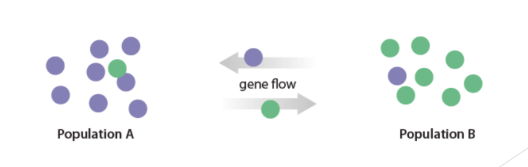
Gene flow: Describes the net movement of alleles from one population to another as a result of migration of individuals
Ex. Grey wolves may travel over 800km in search of a mate. They may cross into a new population bringing new alleles into that gene pool. This can lead to greater genetic diversity which may help the population survive future challenges.
Non-Random Mating – Preferred Phenotypes
Non-Random Mating: mating among individuals on the basis of mate selection for a particular phenotype or due to inbreeding
Preferred Phenotypes: Some breeds mate based on preferences for certain traits because they think that will make a better mate
Ex. Male caribou with longer antlers are preferred by female caribou because they are more likely to win in fights
In-Breeding
Inbreeding occurs when closely related individuals breed together.
Since genotypes are so similar, this increases the frequency of recessive alleles (which can sometimes be harmful, such as genetic diseases)
Purebred dogs were inbred in the past, leading to deformities and health issues, whereas “mutts” are often seen as more healthy with more genetic variation
Genetic Drift
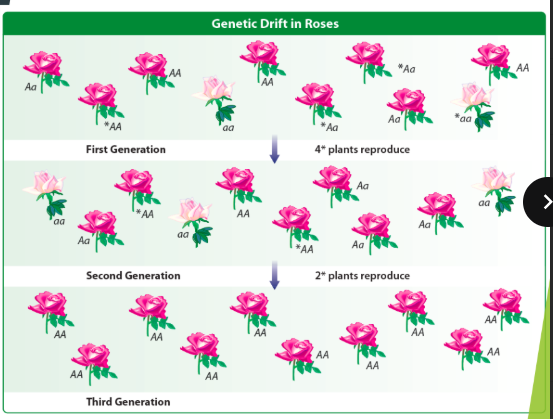
Genetic Drift: the change in frequencies of alleles due to chance events in a breeding population
In nature, sample size can greatly affect the pool of a population – smaller populations will be affected more easily!
However, in nature, most populations are large enough this won’t happen….
Certain events can cause genetic drift when large populations are made smaller (Ie. The Founder Effect and The Bottleneck Effect)
The Founder Effect
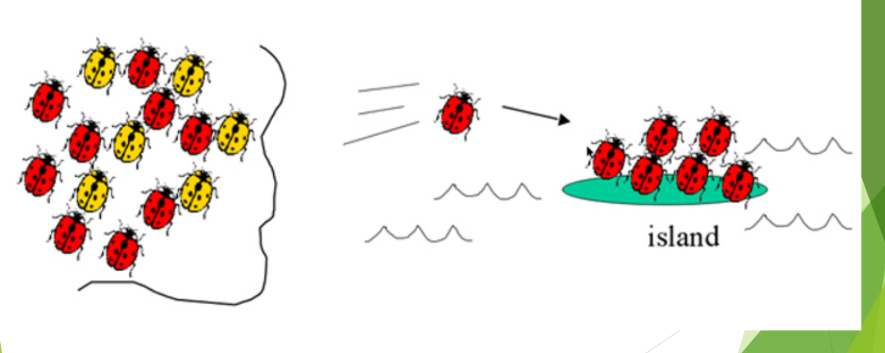
New populations are often formed by a few individuals, the “founders”
These founders will continue to reproduce their DNA – which may result in reduced diversity
If rare alleles are present, they will be increased in frequency
This often happens on islands or in isolated communities
Ex. One of the ~200 original founders of Amish society had this syndrome, which causes additional fingers/toes. This is very common in the Amish population compared to the rest of the world because of this.
The Bottleneck Effect
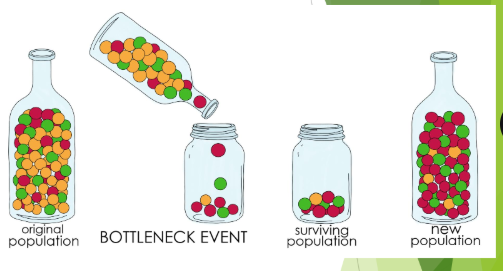
Bottleneck Effect: Changes in gene distribution that result from a rapid decrease in population size
Starvation, disease or natural disasters (volcano, earthquake, etc.) can drastically decrease population size
The population that is left may have decreased genetic diversity, changing allele frequencies
Ex. Elephant seals were hunted to near extinction in the 1800s. At one point, there were only about 20 individuals left. Now, the elephant seal populations has much less variation than they would if their ancestors were all from different populations.
Natural Selection
Natural Selection = Non-Random
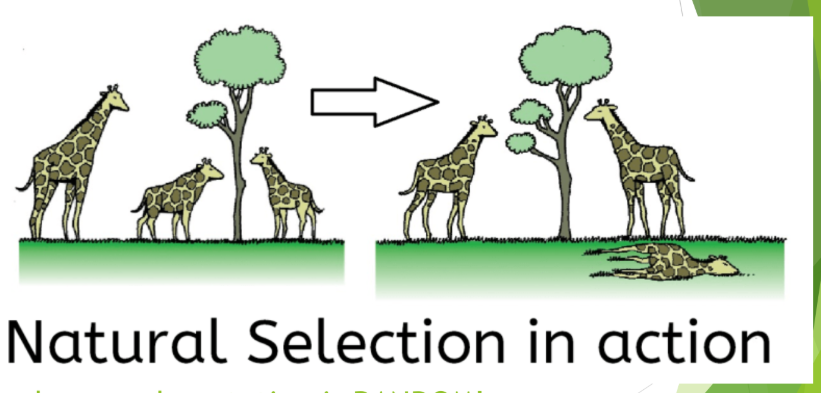
Natural Selection acts ON genetic variation – it is the only mechanism of evolution that leads to adaptation
Individuals with genes that help them to survive will reproduce and pass along those genes!
This is dependent on the environment of the population – natural selection creates individuals better suited to that environment!
Natural Selection - 3 Types
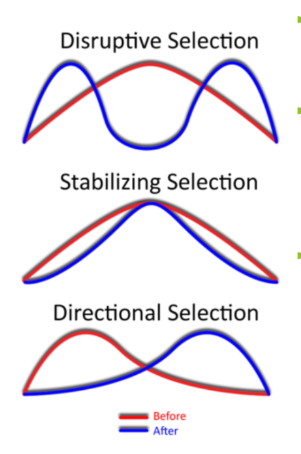
Stabilizing Selectoin
Disruptive Selection
Directional Selection
Stabilizing
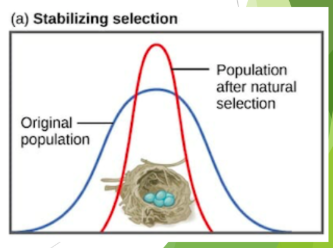
natural selection that favours intermediate phenotypes and acts against extreme variants
ex. Robins usually lay 4 eggs. Smaller batches may result in no viable offspring. Larger batches may result in malnourished chicks.
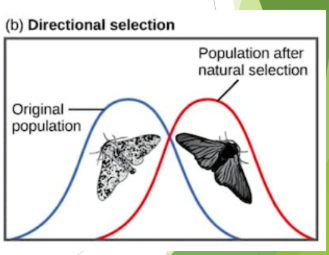
Directional
natural selection that favours the phenotypes at one extreme over the other, resulting in shifting towards that extreme
ex. Light coloured peppered moths are better camouflaged against a light environment. Dark coloured moths are better camouflaged in a soot-covered environment. During the industrial revolution, the colour of moths shifted from light to dark.
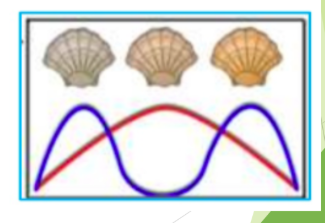
Disruptive
natural selection that favours the extremes of a range of phenotypes rather than the intermediate, resulting in a peak at either end
Ex. In the ocean, light coloured oysters blend in amongst the rocks. Dark coloured oysters blend into the shadows. Medium coloured oysters do not blend into either backdrop and are easy prey.
Sexual Selection
Sexual Selection: natural selection for mating based, in general, on competition between males and choices made by females
Intersexual Selection: Female choice of mates
Intrasexual Selection: Conflicts between males
Causes Sexual Dimorphism: The differences between males and females in a species
Ex. Male mallard ducks have bright green heads – this is more preferable for female ducks, so these males are more likely to reproduce
Preferred Phenotypes
Individuals choose mates based on physical or behavioural traits