Lecture 6- Cellular Environment
 Call Kai
 Learn
Learn Practice Test
 Spaced Repetition
 Match
Match Flashcards
 Knowt Play
1/122

There's no tags or description
Looks like no tags are added yet.
Name | Mastery | Learn | Test | Matching | Spaced | Call with Kai | Chat |
|---|
No analytics yet
Send a link to your students to track their progress
123 Terms
The largest single component of the body is
water
Continual intake and output of fluids in the body between various compartments are important for (2)
transporting nutrients and oxygen to the cells
removing waste and manufactured substances from the cells
Total Body Water (TBW)
the % of total body weight composed of water, can vary w age, gender, and body fat composition
Obese pts can be expected to have what TBW
less TBW with respect to body weight
Infant’s TBW
it is about 70-80% bc infants store less fats but bc they have high MR hey can be susceptible to TBW and potential evaporate fluid loss
With increasinf age, what happens to the TBW
declines due to increased fat and decreased muscle mass
Body fluid is contained in what 2 major compartments
Intracellular and extracellular
In all age groups most of the body fluid is
Intracellular (2/3)
The extracellular fluid is THEN broken down into 2 what compartments?
Intravascular and Interstitial
Intravascular-
Inside blood vessels
AKA PLASMA
one of the compartments that extracellular gets further broken down to
Interstitial-
environment btw cells and the capillary membrane
one of the compartments that extracellular fluid gets further broken down to
1L of water weighs
1kg
2.2 lbs
How does the typical 17L of extracellular fluid get distributed?
3L intravascular
8L interstitial
5L trapped in dense connective tissue and bone
1L transcellular water
Fluid Homeostasis has a net result of what 4 processes
Fluid Intake
Fluid Absorption
Fluid Distribution
Fluid Excretion
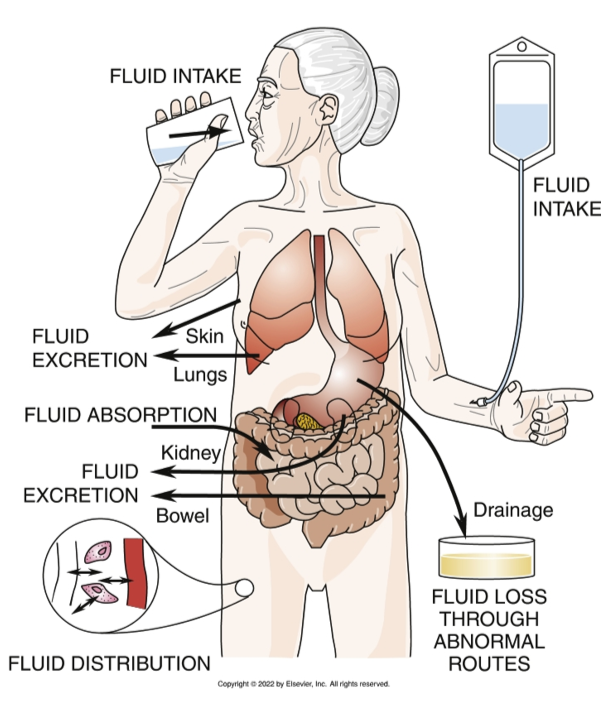
Fluid Intake-
entry into the body by any route: eating/drinking/cellular metabolism/ IV/ Feeding tubes
Fluid Absorption-
from the GI tract / from the Kidneys
Fluid Distribution
between vascular, interstitial, and intracellular compartments
Its fluid reaching the vasculature distributes between fluid compartments
Fluid Excretion-
urinary tract, skin, bowels, lungs
How does fluid intake get absorbed befpre reaching vascular compartment?
Fluid absorption from the GI tract depends on osmotic forces generated by absorption of electrolytes and other particles
What is fluid distribution the net result of?
Filtration across permeable capillary membrane
How does fluid distribution between the interstitial and intracellular compartment occur
by osmosis
Insensible fluid loss-
the amount of body fluid lost daily from skin, resp system, and bowel that is not easily measured
How is fluid excretion controlled?
primarily by the hormones Antidiuretic (ADH), Aldosterone, and Natriuretic peptides (NPs)
Filtration-
the process where fluid moves out of the capillaries into the surrounding tissue (interstitium) driven by hydrostatic forces
Osmosis-
The net movement of water caused by the osmotic concentration gradient
facilitates the movement of water between interstitial and intracellular fluid compartments across the cell membrane, driven by differences in solute concentration
Fluid Distribution between the vascular and interstitial compartments is the net result of…
filtration across permeable capillary membranes
what 2 forces move fluid from capillaries into the interstitial compartments at the capillary level?
Capillary hydrostatic pressure
Interstitial fluid colloid osmotic pressure
Capillary hydrostatic pressure-
outward push pf fluids against the capillary walls, it is important in that the blood is coming from the arteries deliveries oxygen and nutrients to the cells/tissues
Colloid osmotic pressure-
the pulling force of particles into the interstitial fluid
What provides nutrient and oxygen delivery to the cells?
water, sodium, and glucose that readily move across capillary membrane into the interstitial space
What DOES NOT cross the capillary membrane under normal circumstances?
plasma proteins bc they are too large to pass
What do the plasma proteins create then?
the plasma oncotic pressure:
“pulls” water, waste, and manufactured substances from cells back into circulation at the venous ends of the capillaries
How does the hydrostatic and colloid osmotic pressure in the INTERSTITIAL COMPARTMENT differ based on circumstances?
It is quite small in normal circumstances
During pathologic conditions like inflammation or injury, it caused plasma proteins to leak into the interstitial space, increasing excess fluid accumulation in the interstitial
During inflammation/injury, plasma proteins leak due to increased capillary membrane permeability, increasing excess fluid, what is this called?
EDEMA
what is our blood colloidal osmotic pressure?
25 mm Hg
Considering the 25 mmHg blood colloidal osmotic pressure, what happens during filtration and reabsorption?
In filtration, the hydrostatic pressure is greater, so fluid exits the capillary to balance
In reabsorption, the hydrostatic pressure is less so fluid reenters the capillary to balance
what are the things that can move across the plasma membrane (simple diffusion)?
water and small,uncharged lipid-soluble molecules
Can electrolytes move across the PM? How do they do it?
NO, they require specific channels such as Facilitated Diffusion or Active transports
Facilitated Diffusion is..
passive transport
Water passes through…. in the cell membrane
aquaporins
Osmolality-
difference in particle concentration inside and outside the cell
Number of dissolved particles in a solution
What created an osmotic pressure gradient ?
when there is a difference in particle concentration inside and outside the cell = osmolality
Osmosis moves water from an area of … solute concentration, to an area of … solute concentration, so this means water moves into a….
low to high
so water moves into a MORE concentrated solution
water moves down its concentrated gradient from high to low concentration of water
Osmotic concentration of a solution depends on..
only on the number of particles without regard to their size, charge, or mass
What are examples of solute particles?
crystalloids or colloids
to be an effective osmole, the particle must be largely confined to one particular compartment
What are the osmoles of Extra and Intracellular?
Sodium- Extracellular
Potassium- Intracellular
Understanding Osmosis is key to understanding what conditions?
cirrhoris = decreased protein production
Volume depletion from DKA/HHS= too many effective osmoles in the extracellular space
Inflammatory conditions= lead to fluid sequestration=pancreatitis
Isotonic solution
Hypotonic Solution
Hypertonic solution
iso- normal
hypo- swollen RBC “hypo=hippo”
Hyper- shrunken RBC “hyper=skinny”
Ions are made of…. What 2 types is there?
electrolytes that form electrically charged particles (electrolytes dissociate into ions when dissolved in water)
Cations- (+) “ my cat makes me happy +
Anions- (-) “ ah no" -”
Electrolyte solutions conduct an..
electric current
it imports excitable cells like nerve and muscle cells
Ions are measured in
Milliequivalents
Nonelectrolytes:
solutes that do not dissociate (ionize) in solution and do not carry an electrical charge
so when they are dissolved in water, they do not break down into anything smaller than
Nonelectrolytes that play a role in homesostasis include:
Glucose, Proteins, Urea, Lipids, Organic molecules (hormones, neurotransmitters)
How are nonelectrolytes significant in maintaining intravasuclar volume?
the ionic composition of interstitial and intravascular fluid is similar, the main different is that INTERSITIAL fluid contains less protein = affects osmotic pressure”
most abundant EXTRACELLULAR ions are
Cations- Sodim and Calcium
Anions- Chloride and Bicarbonate
Plasma membrane is impermeable to
charge particles
so ion exchange occurs through channels
Electrolyte composition in homeostasis is maintained through
pumps or ion channels located in the cell membrane
Electrolytes have a greater…
osmotic pull than nonelectrolytes
Bc they dissociate into ions when dissolved in water, it increased their total solute concentration= larger osmotic gradient
Explain composition and osmolality between intraceullar and extracelluar compartments
composition of electrolytes is different
osmolality is the same (280-290 mOsmol)
Fluid imbalance/changes in electrolyte concentration will affect
movement of water across the plasma membrane
In clinical situations, what concentration of an electrolyte is measured?
the plasma (intravascular fluid) concentration
What are the 4 processes that work together to maintain electrolyte concentrations as a result of normal # electrolytes in plasma?
Electrolyte Intake
Electrolyte absorption
Electrolyte distribution
Electrolyte excretion
Electrolyte Intake
Occurs through food and drink
Oral medications
Feeding tubes or IV nutrition
Electrolyte Absorption
Depends on if intake occurs orally:
GI tract and Kidneys contents/abnormalities
Availability of binding proteins (calcium)
Concentration gradients (potassium)
Electrolyte Distribution factors that affect it:
Concentration gradients
Cell membrane permeability
Kidney function
Hormones
Acid Base Balance
Fluid Intake
Diet and nutrition
Electrolyte Excretion
through urine, feces, and sweat
urinary excretion is influenced by Aldosterone hormone
Electrolyte Loss
some pt lose it through abnormal routes that cause imbalances, so they exit body via
vomiting
nasogastric suction
paracentesis
fistula drainage
Electrolyte abnormalities may be due to
increase/decrease electrolyte intake or absorption
Shift of electrolytes between body fluid compartments
Increase/decrease of electrolyte excretion
Electrolyte loss through abnormal routes
Electrolyte concentrations need to be maintained at a …
very narrow range!
How can we look for electrolyte imbalances?
measuring electrolytes via plasma on blood draws
What are the charges of the IC and EC compartments?
it is different so it created an electrical gradient
What does plasma serve as?
a barrier for electrolytes to move from one compartment to another
Specific protein channels allow…
for electrolyte exchange and return to homeostasis
Potassium balance is regulated bc of its role in
neuromuscular function
increased serum potassium lvl activates mechanisms that
move potassium into the cell and excrete excess from the body
Insulin-
causes activation of and increases the number of Na/K ATPase pumps
Epinephrine-
causes activation of Na/K ATPase pump via secondary messenger
Aldosterone-
promotes renal excretion of potassium in the distal convoluted tubules of kidneys
90-95% of K excretion is via Aldosterone promotion!!
Ratio of ICF potassium to ECF concentration is
the major determinant of the resting membrane potential
resting membrane potential is the
electrical charge difference across the PM of a resting, non-stimulated cell
necessary for transmission and conduction of nerve impulses + normal cardiac rhythms + contraction of skeletal and smooth m.
At rest the inside of the cell is
negatively charged, which is maintained by the action of Sodium Potassium ATPase pump and potassium leak channels
Resting membrane potential is about
-70 mV to -90 mV
When an action potential is initiated, an influx of ….. occurs leading to..
cations (sodium) leading to a more positive IC environment
What is threshold? and what happens if it is reached?
-55 mV
voltage gated sodium channels open and causes depolarization
Depolarization:
shift in a cells membrane potential, making the inside of the cell less negative compared to its resting state
what happens AFTER depolarization?
repolarization occurs when voltage gated potassium channels open and potassium LEAVES the cell creating a more (-) internal environment
Potassium leak channels:
membrane bound channel that stay lightly open, allowing K to flow down its concentration gradient
Hypokalemia:
serum lvl drops to <3.5
Caused by decreased intake, shift of K from plasma, Increased K excretion via kidneys, diarrhea, loss through vomit/drainage/suction
Clinical manifestation of Hypokalemia:
loss of EC K= more IC K to move down its concentration gradient (goes from in to out) →
Creates a (-) IC environment= not RMP ): →
Fewer anions (P,P) will be neutralized= Cell interior is NEGATIVE →
Cell is less responsive so you need a stronger stimuli for it to react →
Cell is Hyperpolarized= more (-) than RMP = Muscle Weakness!! →
Muscle weakness causes:
skeletal m weak/paralysis
decreased GI activity
postural hypotension
→ Ends w Cardiac arrythmias! (develop U wave in EKG)
Hyperkalemia
Potassium lvl goes up to >5.0
caused by Increased intake, Shift of K into ECF, Decreased K excretion via kidneys, Drugs that decrease renal excretion, Laboratory error
Clinical manifestations of Hyperkalemia
Increased EX K decrease IC K movement out of cell →
More (+) IC environment- less K leaving cell = neutralizes the - anions →
Cell inside is LESS - = increased excitability →
Cell is Hypopolarized, goes to AP threshold →
Muscle weakness:
skeletal m weak/paralysis
intestinal cramp and diarrhea
tingling lips/fingers/restlessness
→ Leads to cardiac arrythmias! (peaked T waves on EKG)
Magnesium is stored in
40-60% in muscle and bone
30% in cells
Magnesium ions exist in blood as
bound (phys inactive) and unbound (phys active) forms
Regulation of Magnesium occur in
small intestine and kidney
Hypomagenisemia causes:
Chronic alcoholism!!
Malnutrition
Malabsorption syndromes
Pancreatitis
Ileal resection
Hypercalcemia
Diuretic, DKA
emesis, gastric suction, fistula drainage
Causes of Hypermagnesemia
lvl goes up to >3
rare but associated w renal failure!
magnesium containing antacids can exacerbate this in pts w chronic renal failure
Magnesium controls the release of
Acetylcholine at the motor endplate
Hypomagnesemia: excessive ACh release- cramps, twitch, insomnia, Torsades
Hypermagnesemia: decreased ACh release- lethargy, hypotension, resp depression, paralysis, - tendon reflexes
Clinical manifestation of Magnesium
It is cofactor of IC enzymatic rxns: DNA/RNA synthesis + Protein synthesis
Muscle function and relaxation - Pregnancy!!
Regulates the release of neurotransmitters at junction
Low mag lvls decrease activity of enzyme that drives Na/K pump
(-) mag in myocardium= cardiac dysrhythmias- Torsades de Pointe
Phosphate groups enable
enzymes to catalyze specific biochemical reactions
Phosphate in pH regulation
acts as an IC buffer