Root causes of environmental problems
 Call Kai
 Learn
Learn Practice Test
 Spaced Repetition
 Match
Match Flashcards
 Knowt Play
1/24

There's no tags or description
Looks like no tags are added yet.
Name | Mastery | Learn | Test | Matching | Spaced | Call with Kai |
|---|
No analytics yet
Send a link to your students to track their progress
25 Terms
how to understand sustainability in fashion?
combining value chain analysis and systems thinking.
what are the advantages/strengths of the value chain approach?
impact, incentives, solutions at each stage
combines multiple methods and disciplines
what is economics and its 2 main features?
the study of how people make choices under conditions of scarcity, and of the consequences of those choices for society.
2 features
choices: the incentives and trade-offs affect the decisions we make
consequences: every decision creates impacts, such as costs, benefits, winners, and losers.
(economics makes those transparent)
in society, who are the decisions made by?
individuals living in households that make consumption and saving decisions every day.
firms that produce goods and services and invest in capital.
governments, that '“set the stage” for the interaction between individuals and firms
about individual/households decisions
make decisions faced with a budgetary constraint
maximize their happiness from consumption (of marketed and non-marketed goods)
trade-offs are inevitable
happiness may depend on many individual and social factors
about firms decisions
make production decisions based on information from markets
they maximise their profits from production
by deciding what and how much to produce
and by choosing a combination of inputs
profit maximization may involve different strategies that all have different environmental impacts
about government decisions
gov face decisions, especially when markets fail
provision of public goods
correcting wrong price signals (should we tax CO2 emissions?
leveling the playing field (regulation and non-competitive markets)
What are the root causes of environmental problems?
env problems are ultimately caused by human decisions
those decision take place in a certain institutional environment (rules, regulations, incentives…)
those decisions make perfect sence for the individual
but bad for society as a whole
solution: address shortcomings of institutional environment
what is the power of markets?
markets send signals about value
allocate resources and goods in the most efficient way (though this can be perceived as unfair)
markets create value
but markets often fail, creating losses to society
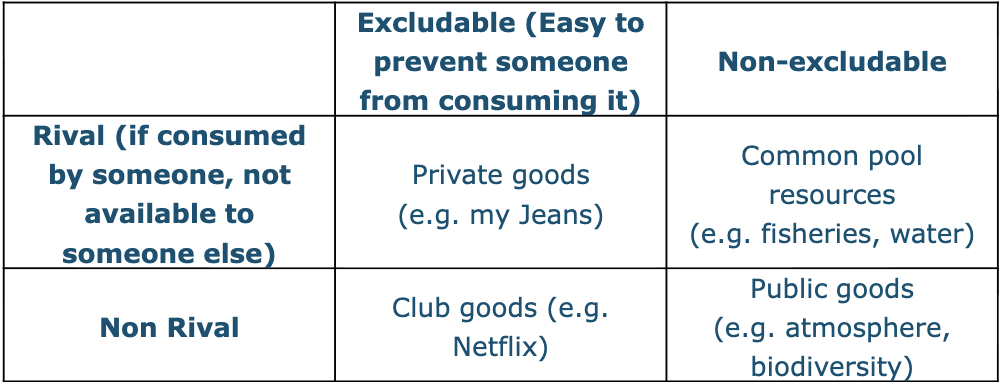
what are the differences between public and private goods?
what is an externality?
occurs when a person or firm does not bear all the costs or receive all the benefits of his or her actions.
it is the unintended side-effect of our consumption and/or production decisions
the presence of an externality creates a gap between the private costs and the true cost of a given action.
for e.g. the price we pay for a t-shirt reflects the cost to the producer, it is not the true cost to society as a whole.
what are examples of negative and positive externalities?
-ve externalities (costs)
pollution emitted by a factory that pollutes waterbodies nearby
+ve externalities (benefits)
benefit for a consumer or firm
pollination from bees for an apple farmer
what is flow and stock pollution?
flow pollution - short life pollutants
if the residuals have short lifespans before being broken down into harmless forms
stock pollution - long lifespan pollutants
have to worry about their accumulation in the environment
the stock of pollution refers tot he accumulation of a particular pollutant in a given space and time
what does the stock of a given pollutant and its damage depend on?
the stock of a given pollutant depends on
the flow of new emissions
the decay of the pollutant itself
damages depend on
the stock (the concentration) of the pollutants
mercury or heavy metals in aquifiers: toxicity for water users
ghg emissions (CO2, CH4, N2O) in atmosphere: climate change
plastics
acidifying substances (SO2, NOX, NH3) in soil: acidification
what are ten key insights from economics?
economic and environmental systems are determined simultaneously.
the behavioural underpinnings of economics matter for environmental policy
environmental resources are scarce, and using them in one way has an opportunity cost.
the free market system can generate the ‘wrong’ level of environmental quality
markets have proved to be the best way of allocating a vast range of resources
government intervention does not always make things better, and can make things worse
environmental protection costs money
when managing renewable resources such as fish and forests, choosing maximum sustainable yield at the best level at which to harvest is rarely optimal.
whilst economic growth may contribute to current environmental problems, few people would swap their position today with their equivalent 200 years ago
many of the world’s most serious environmental problems are global in nature
what are the differences between private vs. social costs?
private costs
costs that accrue to the producer
e.g. labor, machinery, raw materials
external costs
costs imposed on others
e.g. CO2, water and soil pollution
social costs
all costs, that is, private costs and external costs
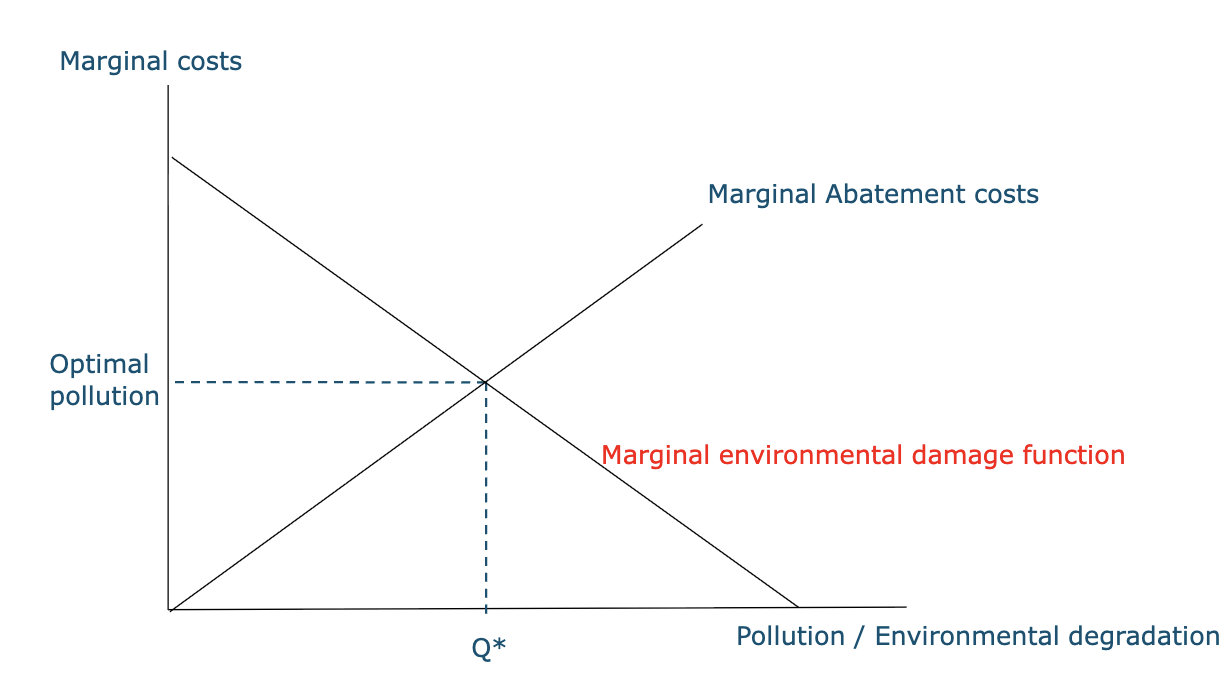
zero pollution is rarely optimal for society. Instead, what is?
instead, policy aims to find a balance where the marginal cost of abatement equals the marginal environmental damage
what is the trade off?
environmental quality is beneficial, but reducing emissions (abatement) is costly
what is optimal pollutions?
the point where the cost of an additional unit of pollution equals the cost of abating that unit
what are the 3 policy instruments?
command & control: standards, bans, and direct regulations
economic incentives: market-based approaches like taxes (e.g. carbon tax) or tradeable permits (e.g., EU ETS) to internalize external costs
institutional approaches: information, nudging and social norms
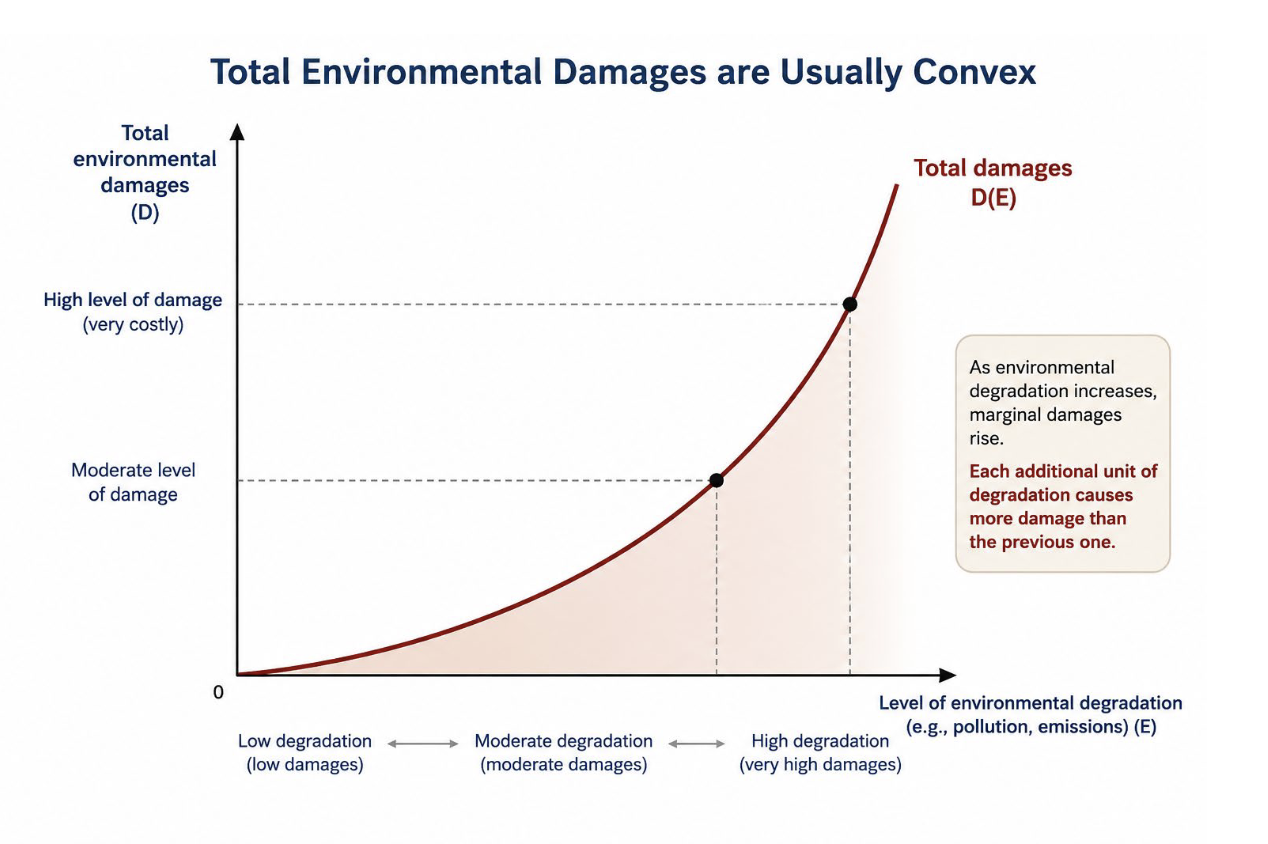
graph for total environmental damages
usually convex
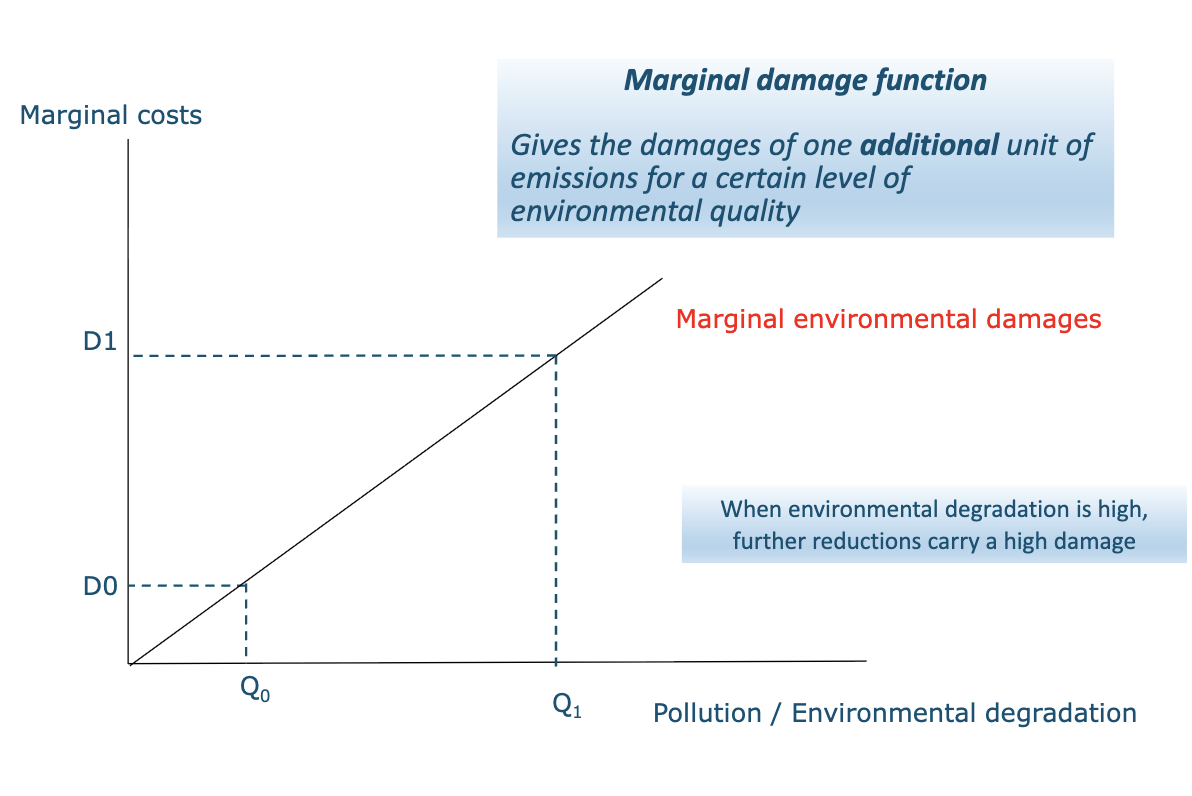
graph for marginal environmental damages
function: gives the damages of one additional unit of emissions for a certain level of environmental quality
when environmental degradation is high, further reductions carry a high damage
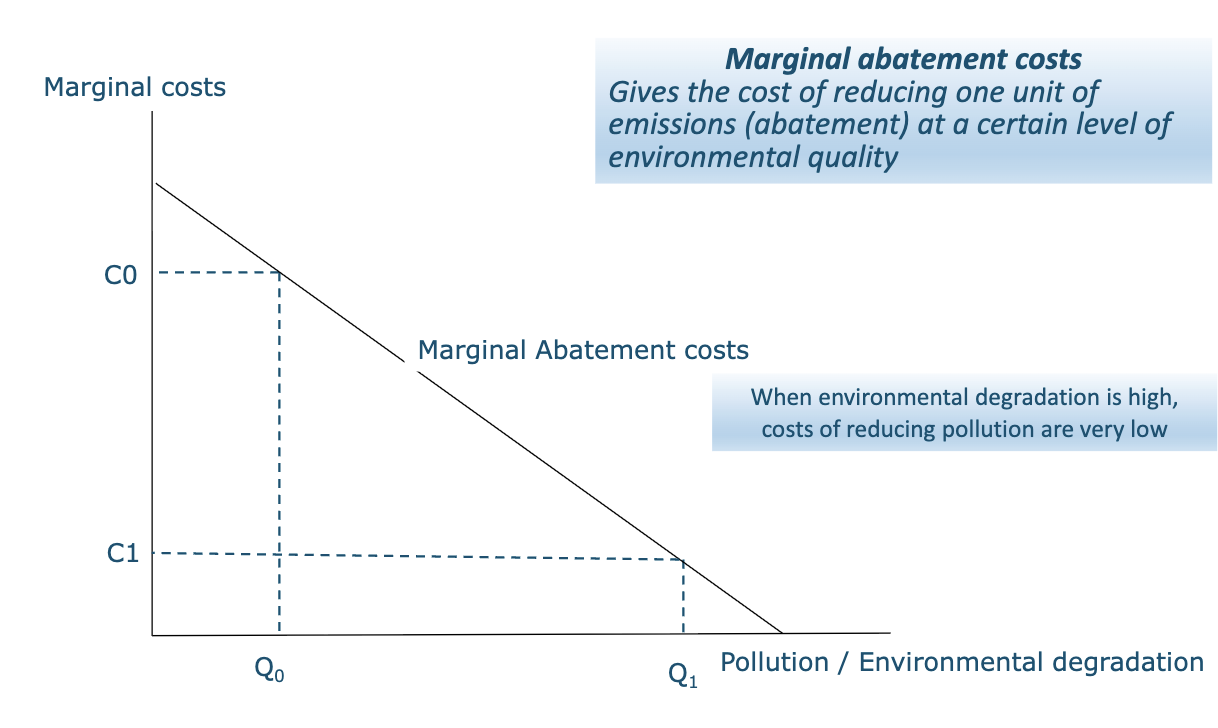
graph for marginal abatement costs
function: gives the cost of reducing one unit of emissions (abatement) at a certain level of environmental quality
when environmental degradation is high, costs of reducing pollution are very low
graph for optimal pollution