High Renaissance (Milan + Rome)
 Call Kai
 Learn
Learn Practice Test
 Spaced Repetition
 Match
Match Flashcards
 Knowt Play
1/21

There's no tags or description
Looks like no tags are added yet.
Name | Mastery | Learn | Test | Matching | Spaced | Call with Kai | Chat |
|---|
No analytics yet
Send a link to your students to track their progress
22 Terms
Stylistic Characteristics of Paintings
Absolute clarity : Figures, story, narrative elements are obvious
Ideal light : Soft modeling, sfumato (Da Vinci) creates smooth transition, ideal beauty
Sfumato - (Da Vinci) Hazy transition eliminating harsh lines for a smoky effect
Exclusive Subject matter : for high level thinkers
Compositional order : Symmetry, logic, order, mathematics
Primary Triad of Colors : red, blue, yellow
Single Focal Point : sometimes have additional focal points
Geometricity : triangles, squares, circles
Closed composition : Containment, bracketing of elements (framed)
Humanistic themes : Related to society, politics, religion, philosophy, psychology
Zeitgeist : period of thinking; intellectual thought
Harmonious Composition - Create balance
Integrating architecture, sculpture, and painting
Idealized Human Figures : Derived from classical sculptures (Greek and Roman)
Artists
Da Vinci - “non-finito” work (unfinished), studied human anatomy, psych., geometry, arithmetic, engineering, ect.
Raphael - working on Pope’s library room (Vatican Palace)
Michelangelo - working on Sistine Chapel (Vatican Palace)
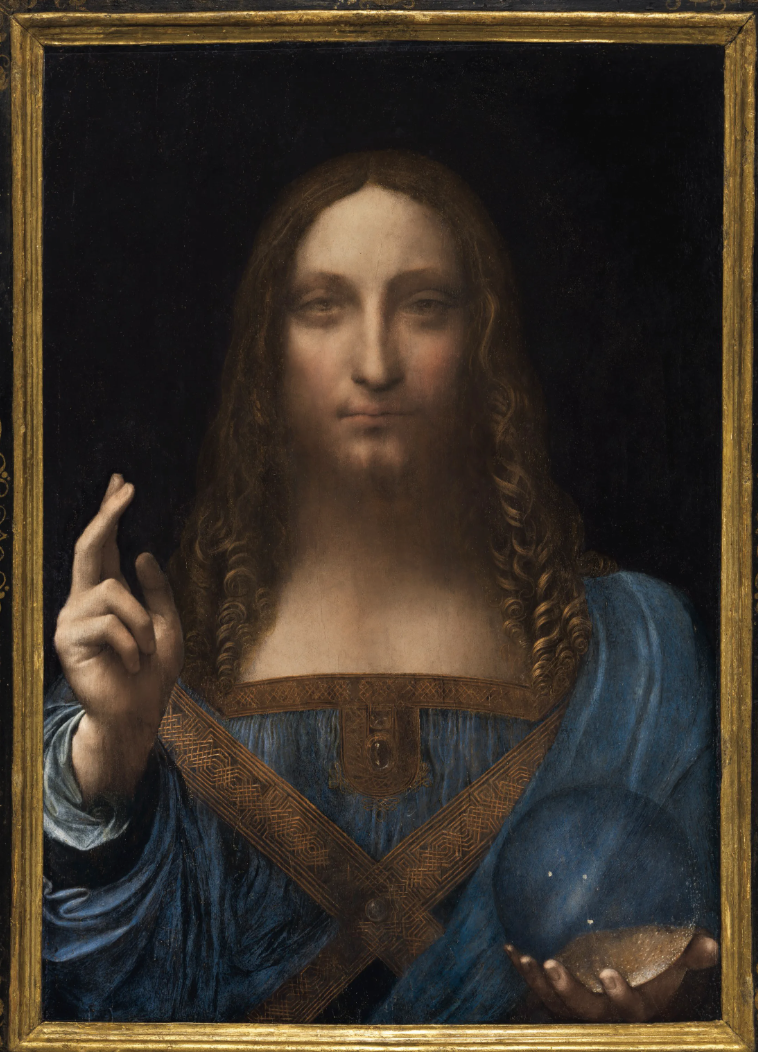
Da Vinci “Salvator Mundi” (c.1500)
oil painting - “Savior of the World”
Sfumato : Created softer lines, light and shadow blend into each other
Chiaroscuro : light and dark create dimension, depth, and realism
Crystal Orb : represents power over the universe/cosmos
Transparent orb - careful to show light reflecting off of it
Thin layers of oil paint
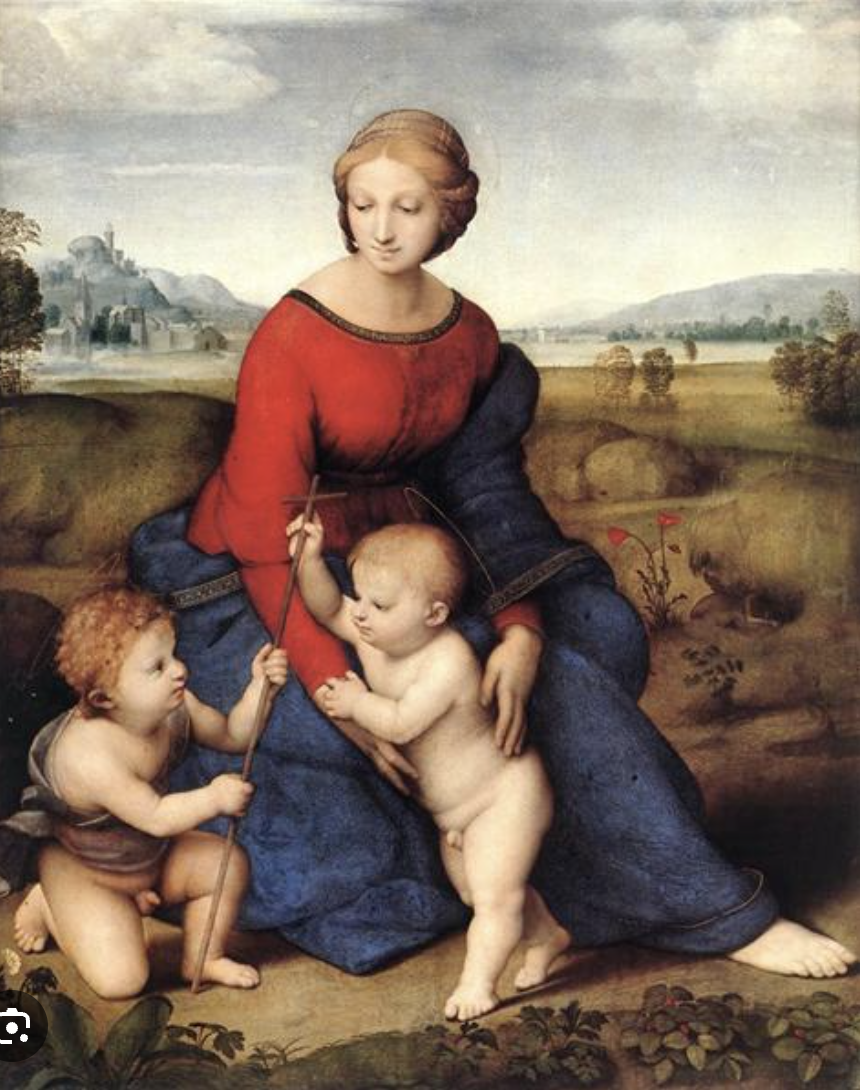
Raphael “Madonna of the Meadow” (1506)
Oil on wood - closed composition, single foci (baby Christ)
Triangular Composition : Represents harmony, balance and divine order
Landscape is peaceful and fades into a deeper atmospheric perspective
John the Baptist : Cloaked, holds a cross, foreshadowing Jesus’s crucifixion
Mary : Pose shows her protective and spiritual nature as a mother
Blue and red show love and purity
All figures are soft (sfumato) and have natural poses, pointed toes are high definition (studied dancers)

Raphael “Madonna of the Goldfinch” (1506)
Uffizi Gallery - oil painting
Triangular Composition : Creates balance, harmony and stability; guides the viewers downwards (Mary’s gaze)
Landscape : soft atmosphere makes figures feel integrated in the nature
Color : Earth tones and muted colors keep the focus on the figures, soft faces (no harsh lines contouring face)
Gold Finch (bird) : represents passion of Christ, red streak is Christ’s blood, sits on thistles, which resembles thorn crown Christ wears in the crucifixion
Toes : Christ’s toes on top of Mary creates intimacy
Focal point : John the Baptist
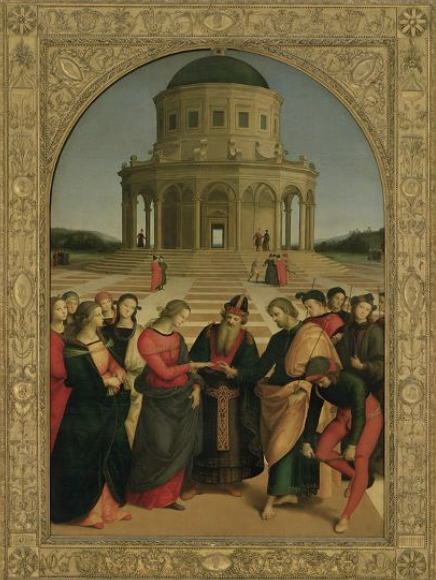
Raphael “Marriage of the Virgin” (1504)
Oil painting
Raphael was trained at Perugino’s workshop
Improved/ perfected Perugino’s “Christ Giving the Keys to Saint Peter”
Composition : Perfect one-point perspective to the doorway (pavement lines) of the temple that pulls viewers to the front - more mathematically precise
Figures are horizontally balanced
Color : Joseph and Mary are wearing contrasting colors to each other, visually anchors the composition and helps distinguish both main figures; muted earth tones’ soft hills and pale blue skies create a calm & open atmosphere
Staff : All suitors carried a staff, Joseph’s bloomed making him the one chosen
One suitor broke his staff, adds human emotion
Contrast from Perugino’s :
P- figures calm, elegant, idealized but are similarly in the same posed and gestures vs R - figures shows greater individuality, adding emotion and narrative energy
P - Figures are standing quietly as witnesses vs R - adding small actions and emotional suitors create a more dramatic narrative movement
P - figures are more static vs R - figures are posed and gestured more naturally
P - figures create a long horizontal line across foreground vs R - Mary and Joseph becomes the focal point and figures are in a curved semi-circle
[ P - painting is more flat and repetitive vs R - more lively and natural composition ]
Perspective & Space :
P - pavement lines lead towards the temple and figures feel separated from the space
Plaza feels wide and empty
R - Takes this concept and tightens the spatial logic , figures relate naturally to the space and structure feels more structurally believable
Mathematically precise and unified

Raphael “School of Athens” (1509-11)
Mural for Pope Julius II library - Buon Fresco
Subject Matter : Gathering of the greatest philosophers and scientists of ancient Greece on debate
Humanistic theme : Conviviality
Classical knowledge and Christian faith can coexist
Plato : In red, points up towards the heavens symbolizes idealism - truth exists in a higher and spiritual realm
Aristotle : In blue earthy tones, gestures horizontally towards the earth symbolizes empiricism - knowledge is gained through observation of the physical world (science)
Michelangelo : laying on brick
Composition : Primary triad , single focal point, exclusive

Raphael “The Sistine Madonna'“ (1512)
Oil on canvas
Subject Matter : Mary delivering Christ to humanity
Mary looks at the viewer, directly confronting us w/ the gift she gave
Makes viewers feel like they are witnessing a sacred event
Vertical Movement : Mary is descending forward through the clouds, appearing directly towards viewers
Cherubs : Soft, contemplating, relaxed
Cherubs feel playful and human
Compare/contrast Giotto’s Cherubs VS Raphael :
G - more emotional, participates w/ the drama creating more tension and intensity of emotions
G - lots of twisting bodies and exaggerated gestures
Dramatic and story telling
R - decorative, add harmony to the atmosphere
R - relaxed, plump, peaceful
Emphasis on High Ren. style of ideal beauty and calm balance

Michelangelo “Vatican Pieta” (1500)
One chunk of marble
Subject Matter : Christ taken down from crucifixion and Mary gently supports his body on her lap
Mary : Young face shows purity at that moment, triangle structure creates stability and harmony
Thin gap between Mary and Christ - does not touch his body b/c he is immortal & divine and she is mortal

Michelangelo “Florentine Pieta” (1550)
Marble
Subject Matter : Christ being supported after crucifixion by Virgin Mary, Mary Magdalene, and Nicodemus (believed to be self-portrait of Michelanglo)
ComposItion : Vertical pyramidal shape
Christ’s body is elongated
Emotion : Darker and more sorrowful mood - reflects spirituality and human vulnerability
Unfinished and damaged - Michelangelo was not satisfied and tried to destroy it

Michelangelo “Rodanini Pieta” (1564)
Marble
Michelangelo’s last work before death
Style : transition to mannerism
Subject Matter : Mary and Christ transcending to heaven (most think it could be Michelangelo and his mother)
Michelangelo was declining in cognitive abilities and thinking about death
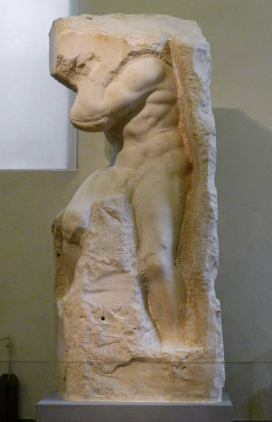
Michelangelo “Atlas” (1525)
Subject Matter : Atlas (greek mythology) carrying the weight of the world on his shoulders
Unfinished
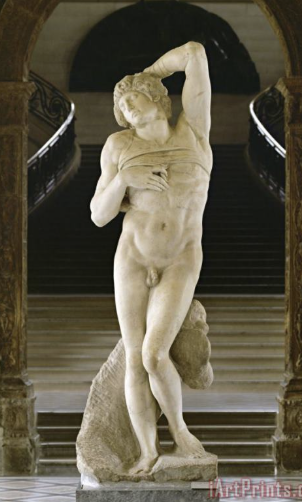
Michelangelo “Slaves for Tomb of Pope Julius II” (1505-13)
Made 40 different slaves around the tomb
Controversial due to figure undressing themselves - suggests stripping and de-clothing
Twisting bodies - Pope wanted it to look like they were struggling

Michelangelo “Madonna of the Stairs” (1482-92)
Marble
Subject Matter : Mary suckling Christ child
Similar to Donatello’s stone piece, it shows intimacy
John the Baptist added to foreshadow crucifixion

Michelangelo “David” (1504)
Meant to be placed 40 ft high on top of a church looking towards Rome - shows defiance of the church
Shows zeitgeist

Michelangelo “Dawn and Tondo” (1506)
Subject Matter : Circular painting of the Holy Family - tempura
Tondo : round paintings; God looking at the painting
Sistine Chapel
Michelangelo and Raphael are competing in the same building under Pope Julius II
Michelangelo works on the chapel ceiling and Raphael is in the library
Frescoes are painting to view in various vantage points throughout the chapel
Used male models

Michelangelo “Creation of Adam”
Sistine Chapel ceiling - fresco
Subject Matter : Moment before God gives life to the first human
Composition : Diagonal lines connect both divine and earthly entities, circles show individualism
Adam : stagnant, strong anatomical modeling, idealized and muscular (ancient Greek sculptures),
Adam is relaxed on the ground
Passive colors - blue & green
God : Active, wind blowing through him, looks physically strong and dynamic
Angels inside brain shaped vessel (brain of God)
Potential of all humanity inside God
God is active
Active colors - red & orange
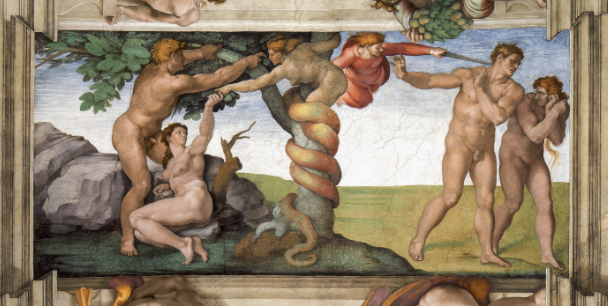
Michelangelo “The Fall and Expulsion from the Garden of Eden” (1508-12)
Sistine Chapel ceiling - buon fresco
Shows temptation and expulsion - sin and its consequences side by side in one image
Adam and Eve : before the fall, Adam and Eve are painted in perfect form. They are composed, beautiful, and have potential. After sin is committed, Eve is now ugly, shows shame, and her beauty is gone.
They both maintain perfect physical forms because sin damages the soul rather than physically

Michelangelo “Last Judgement” (1536-41)
End of wall - Fresco
Subject Matter : Second coming of Christ and final judgement of humanity
Focal Point : God surrounded by saints
Composition : Elongated torsos
Nude bodies - no place to hide from God
Color : Bright blues and oranges - highlight important figures
Help separate the saved (lighter areas) from the damned (darker areas)
Bright blue sky areas create a skull - represents “momento mori”
Michelangelo is painted skinned in this - self doubting himself and his faith
3 demons pulling and biting - represent no room for doubt in faith
Pope Julius is painted with long pointy ears suggesting horns and ghoulish

Da Vinci “Adoration of the Magi” (1481)
Unfinished - oil and tempura on wood
Use of chiaroscuro
Three Magi presenting gifts to baby Christ

Fabriano “Adoration of the Magi” (1423)
Rich colors
excessive ornamental usage, gold, jewels, and patterns