exam4
 Studied by 0 people
 Call Kai
 Learn
Learn Practice Test
 Spaced Repetition
 Match
Match Flashcards
 Knowt Play
1/136

There's no tags or description
Looks like no tags are added yet.
Name | Mastery | Learn | Test | Matching | Spaced |
|---|
No study sessions yet.
137 Terms
is the human spark entirely innate?
no
the waggle dance of bees has a syntax
true
chickadees express the size of a predator by the loudness of their vocalization
false, its how many “dees” there are
inhibitory control
the cognitive factor that represents the ability to filter distracting information during problem solving (like when humans ignore the extra step to get the reward)
innovation rate
this represents the frequency of novel behaviors in foraging or social behavior
monkeys
which animal performs the best on the learning to learn task?
according to the video, is the human spark heavily reliant on language?
yes
what language provides in the human spark video
symbols in understanding, example with the children and the buckets
what is the key to understanding language and the human spark?
the ability to manipulate symbols in your mind, which IS innate
are grammatical mistakes immediately recognized in childhood?
no, this doesnt develop for 10-15 years
are language and tool use closely tied?
yes
what is an old element that people say is evidence of human spark?
tool use and the ability to combine different elements
what is evidence of planning in human language?
saying “tool” v “ticket”, your mouth pre-forms the O shape when saying tool
is the speech impediment gene specific to humans? (foxp2)
no, but it looks different in other species
why are chimpanzee and human brains bigger?
because of their social networks (chimps ~50, humans ~150)
in the puppet show in the human spark video, what is evidence in babies of understanding intentionality?
babies always choose the cooperative puppet, they always choose the helpful wooden shape
can babies see similar tastes to their own?
yes, they choose the puppet who likes the same food as them
what does intentionality provide for the human spark?
an understanding of things in the world, an understanding of what other people are thinking about. this brain region is the most different in human brains than other brains
what are the two main aspects that set humans apart from other species?
insight and imagination
what do animals use to communicate?
their whole bodies (dance, posturing, pheromones, vocalizations)
who uses mating dances to communicate?
wandering albatross, sparrow, sage grouse
what is communication?
one animal influences the behavior of another animal through transmission of a signal (sender→signal→receiver)
is communication in animals an active process?
sometimes
what is an example of a passive process of communication in animals?
sender =frog→ signal=bright color→ receiver=any animal trying to eat the frog
what is the meaning of the signal in animal communication
its inferred from the receivers behavior
communication = sparrow
the bigger the bib size, the greater the dominance, this shows that specialized physical traits can communicate fitness
communication - sage grouse
they do a mating dance, only one or two males in a lek will mate at all, the better the dance, the better the health, strength, and survival. one with tuberculosis will never mate
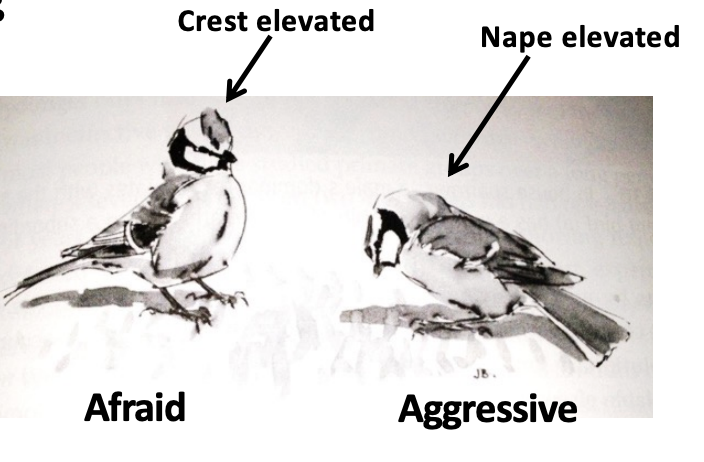
communication - posturing in birds
if they elevate their crest (top of head), theyre afraid, if the nape (leaning forward) is elevated, theyre aggressive
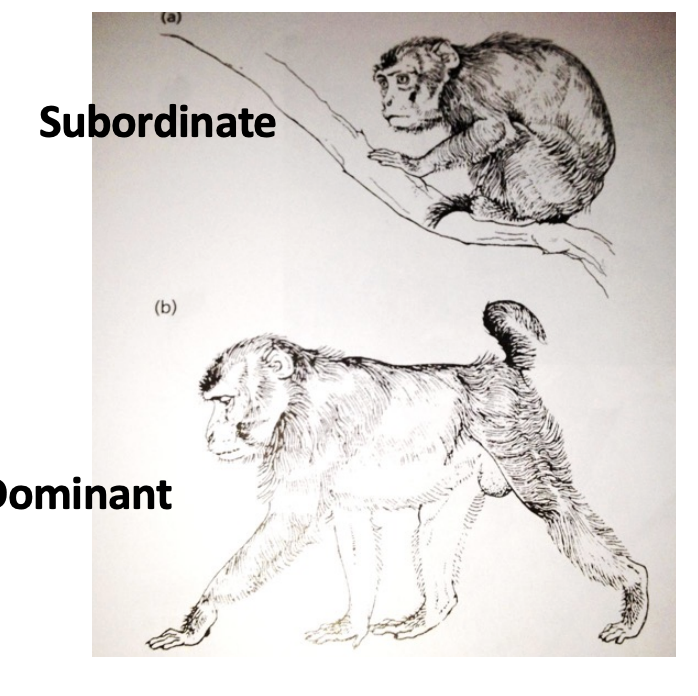
communication - posturing in macaques
their posture communicates social status (subordinate is curled up on a tree, dominant is on all fours
communication - pheromones in garter snake
they collect air particles with their tongues, taste them, pass them to their nasal cavity. females leave pheromone trails for males to follow, females mark one side of an object more than another which conveys direction
communication - pheromones in ants
ants eat static foods (like plants), then they emit odorous chemicals on route home so that other ants can follow the trail
communication - vocal
in male birds, complex songs are correlated with better fitness. some birds (like the one who can mimic the camera shutter) are more sophisticated than human language
what are the four essential aspects of human language?
symbolic, syntax, abstract, generative
human language - symbolic
words stand for things, three on your hand means the number three
human language - abstract
words do not have features of the things they represent, three = word for three oranges
human language - syntax
words are organized into categories and uttered according to rules (order), man bites dog is different than dog bites man
human language - generative
totally novel combinations of words are created and understood (the colorless green ideas sleep furiously (meaningless and novel but still kind of meaningful)
what is one aspect of generativity that may be unique to human language?
recursion
recursion
expressing an idea in language using a certain rule, then in a second step you use the same rule to embed the expression into another expression
is animal communication the same as human in the sense of the four main aspects?
no, animal communication is usually symbolic
example of animal communication being intensity based
bee=yelp, shark=scream. this is symbolic because the vocalization REPRESENTS something (a threat), but it is not abstract because the intensity of the vocalization is proportional to the danger, meaning it does not represent only one thing (louder=moredanger)
symbolic communication - chickadees
in chickadee alarm calls, the number of D notes is proportional to the size of the predator (intensity based), SYMBOLIC, not abstract
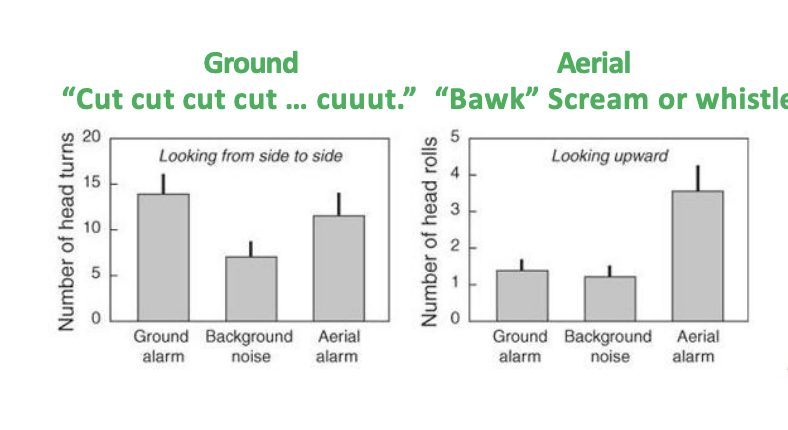
symbolic AND abstract communication - chicken
chicken alarm calls are categorical rather than just intensity based, categorized into ground predators and aerial predators
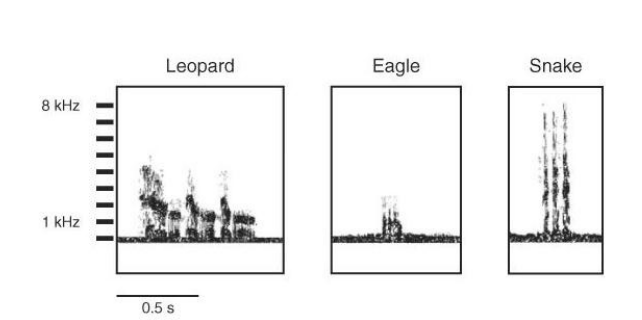
symbolic and abstract communicatio - vervet monkeys
vervet monkeys make even finer distinctions in their alarm calls than chickens do, for leopards, eagles, and snakes, all different frequencies
do monkeys use vocalization to express a known meaning?
yes, see predator → choose what it is → vocalize, this is why it is also abstract
syntax - bees
a set of organizatinoal rules govern bee communication about food quality and location based on angle (of the waggle relative to vertical is the angle of the food relative to the sun), time (spent in the waggle is the distance), and intensity (of the waggle is the quality of the food)
syntax - dolphins
there are only a few vocalizations that the researchers understand, it is unclear if they have syntax
what are the vocalizations of dolphins that researchers know the meanings of?
buzz call (contact), whistle call (identity), alarm call (threat)
artificial grammar tasks
animals can learn images in order, but people can modify to include more complex patterns
looking time task - syntax
habituate to one grammar, then there will be a violation, tamarins look over when the sequence is broken meaning they understand the grammar error
what is recursion
a consituent that contains a constituent of the same kind
hierarchical structure in human cognition
language, music, mathematics, complex motor skills and action planning
can monkeys learn to represent complex, recursive structures?
yes, but this is not their first strategy
can apes learn human language?
apes can learn sign language, but it does not resemble human language learning
kanzi the ape
understands novel utterances that are as long as those understood by human children (2 year old child COMPREHENSION, 1.5 year old child PRODUCTION)
main limitations of apes learning language
capacity for utterance length in production and generative production of novel utterances and ideas
bunny the dog
knows buttons through associative learning
which aspect of human language/communication is unique to humans
generaitve
how are whales larger than humans?
absolute brain size
the measure of brain size which compares each species to a standard species, such as a cat, is called
encephalization quotient
the part of the bee brain related to foraging cognition is
mushroom bodies
what hypothesis convinced you is the human spark?
insight and tool use
invertebrate brain - no brain (nerve net)
only a nerve net, jellyfish, hudra, and anemones
invertebrate - no brain (central ganglia)
only central ganglia - control LOCAL functions, worms, snails, clams, and crabs
invertebrate - no brain (centralized brain)
centralized brain - communicates with whole body, can always skip brain, but it is there, insects
what are ganglia
collections of neurons that control a few local functions (moving mouth and eyes in sync)
what is a centralized brain
it communicated with the whole body
invertebrate - earthworm
no centralized brain, only ganglia (302 total neurons), very simple neurons, they can learn
earthworm food test
no food present, choose the side with the chloride or sodium, they can learn with only 302 neurons where the food is

invertebrate - bees
centralized brain, 960,000 neurons, mushroom bodies (structure of brain), mushroom body gets bigger as the bee leaves the hive, and it depends on foraging experience, not age
invertebrates - octopus
centralized brain, most complex brain of all invertebrates, 300,000,000 neurons
vertebrates
who all has the same basic brain structure
vertebrate brain structure
forebrain (telencephalon and diencephalon), midbrain (mesencephalon), hindbrain (cerebellum, pons, medulla)
what mammal is about as different from humans brain as you can get
shark brain, but still same basic structure
embryonic brain - vertebrates
all vertebrates have a brain that looks like the middle of a brain, will eventually become the parts of the brain
who has a cerebral cortex
only mammals, there are few functions here that the cerebral cortex is NOT a part of
is the cortex in different places across species?
no, its the same basic organization
how different species have different emphasis on cortical regions
mouse somatosensory (whiskers), bat auditory (echolocation), opossum vision (nocturnal)
modern view of brain evolution
all vertebrates have the same basic brain parts but the parts vary in size and complexity, there have been no huge new brain parts added, the main change in size is not organization
main change in size of vertebrate brain
relative sizes of regions and overall brain size
what are the measures of comparing brain size across species
absolute brain size (how big), relative brain size (brain to body ratio), encephalization quotient, cortical neurons
do humans have the largest brain or most total neurons?
no! larger animals generally have larger brains and more neurons
who has the most brain for their body
mammals
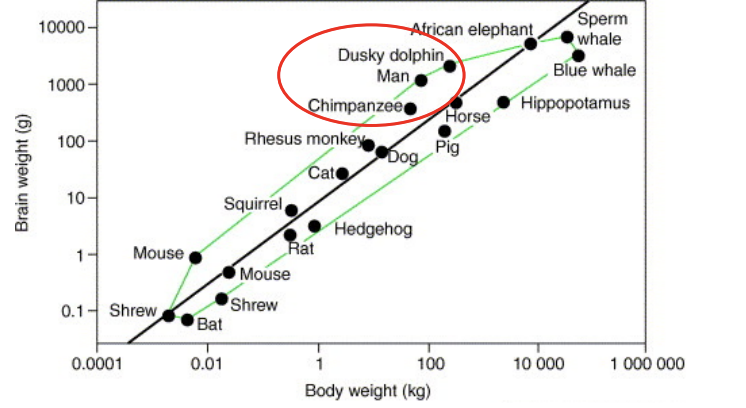
relative brain size graph
species above the line have more brain for their body, species below the line have less brain for their body, species on the line have an average amount of brain for their body size
encephalization quotient
similar to relative brain size, calculated relative to a standard species, for mammals, the standard is a cat (if cat had same body size as human, how big would brain be if humans brain is 7x larger than cat)
who has the highest eq?
humans = 7, nonhuman primates = 2-4, dolphins = 4-5
what is the new method for comparing brain between species?
counting the number of neurons in the brain, make the brain into liquid to count the neurons
what mammals have more brain power than other animals
humans, nonhuman primates, and dolphins
how much body weight does human brain account for
2%
how much metabolic energy does the human brain consume at rest
20%
why doesnt everyone have a big brain experiment
fruit flys given orange and pineapple laced with quinine, flys who pick orange are smart, flies who pick pineapple are dumb, breed smart w smart (slightly larger brain) and dumb w dumb (no brain growth) - TOO much neural material can decrease survival
meat eating
allowed humans to afford big brains
does it take more or less energy to digest cooked food
less energy, which means more energy to the brain
comparing species - brain size and physical features
if there is a lot of variability in physical features like beak, there should also be a lot of variability in mental features
three main brain size differences
learning rate 2. inhibitory control 3. approximate number representations
learning rate
animals should get better at finding the answer on trial 2 of each new problem, learning to learn parallels the brain to body size ratio across mammals
who never learns to learn
rats, squirrels, and tree shrews
what are the cognitive differences related to brain size
learning rate and inhibitory control
inhibitory control and brain volume
inhibitory control is related to endocranial volume across species, more ecv, more inhibitory conrtol
what ecological demands are related to these differences in cognition and brain size
foraging, social structure, and overall innovation rate