VO4 - Parameterizations 2
 Call Kai
 Learn
Learn Practice Test
 Spaced Repetition
 Match
Match Flashcards
 Knowt Play
1/42

There's no tags or description
Looks like no tags are added yet.
Name | Mastery | Learn | Test | Matching | Spaced | Call with Kai | Chat |
|---|
No analytics yet
Send a link to your students to track their progress
43 Terms
What is liquid cloud fraction?
fraction of a model grid cell that is covered by water clouds, defined in each vertical grid cell (3D field)
What is cloud cover?
similar to liquid cloud fraction but over the entire column (2D field)
What is a advantage of subgrid parameterizations?
higher-resolution simulations can be used as reference truth.
What is LES?
Large Eddy Simulations - models with extremly high resolution on a confined region
dx ~150m
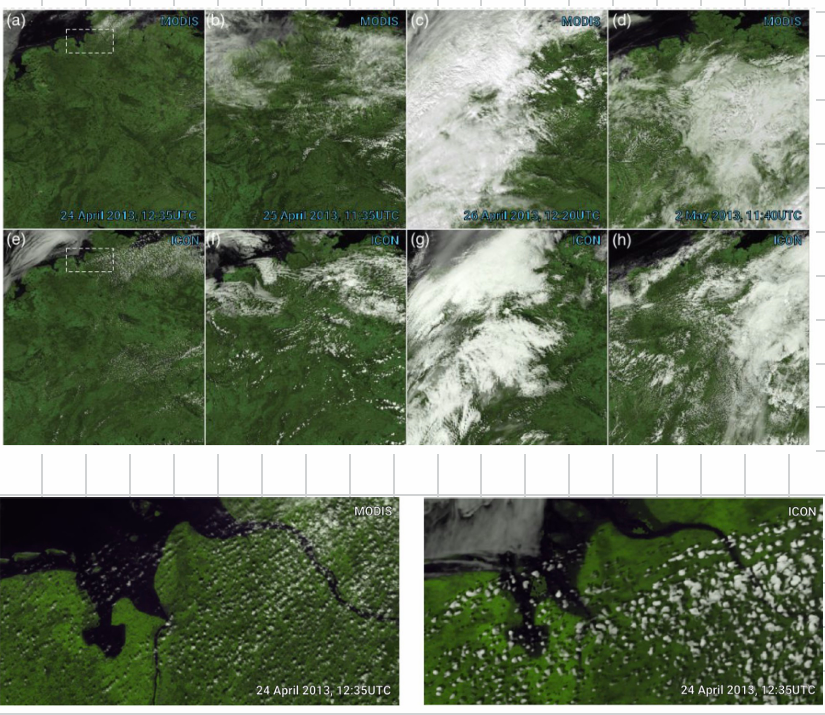
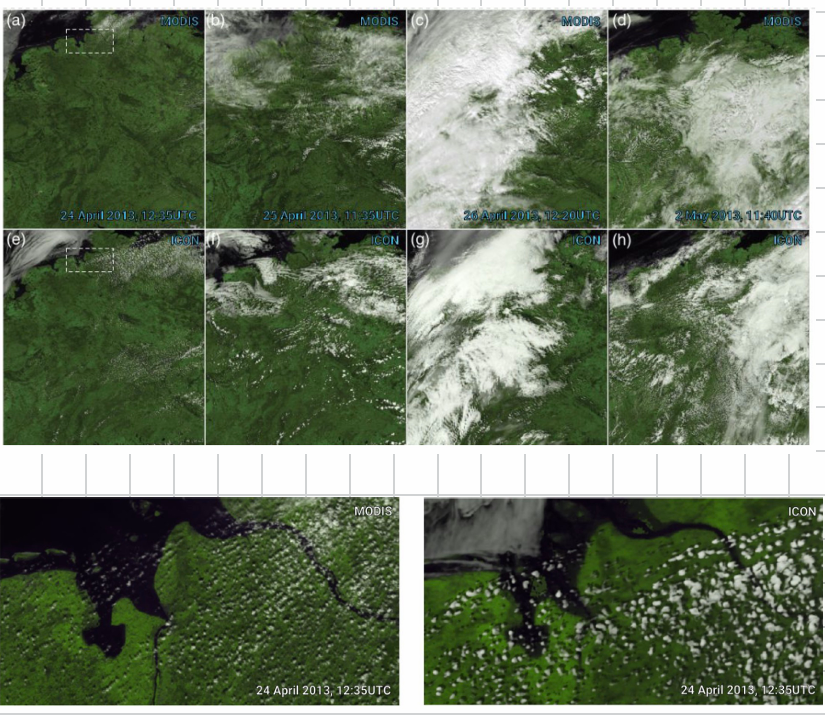
What does this plot show?
Satellite image vs LES with 150m grid resolution
LES resolution still to coarse to resolve small clouds but thats ok as it should only give a possibility thats realistic
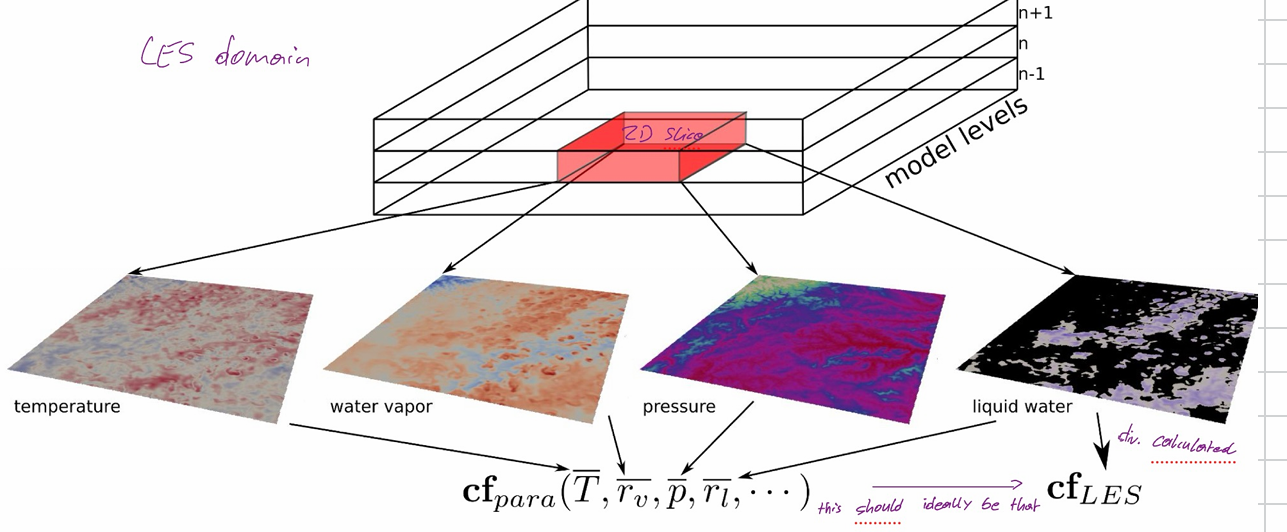
Explain the approach with LES as reference truth.
LES is split up into many individual slices. The statistical properties of the variables in the slice are used as input for the parameterization
parameterized cloud fraction can be directly compared to cloud fraction of the LES slice
What is Total moisture?
Total moisture = water vapor + cloud water
(ice ignored)
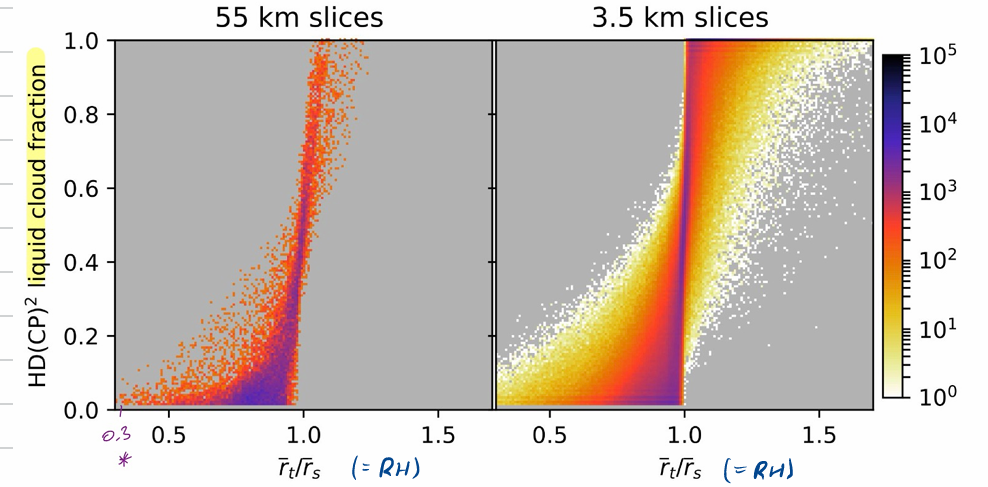
What does this plot show?
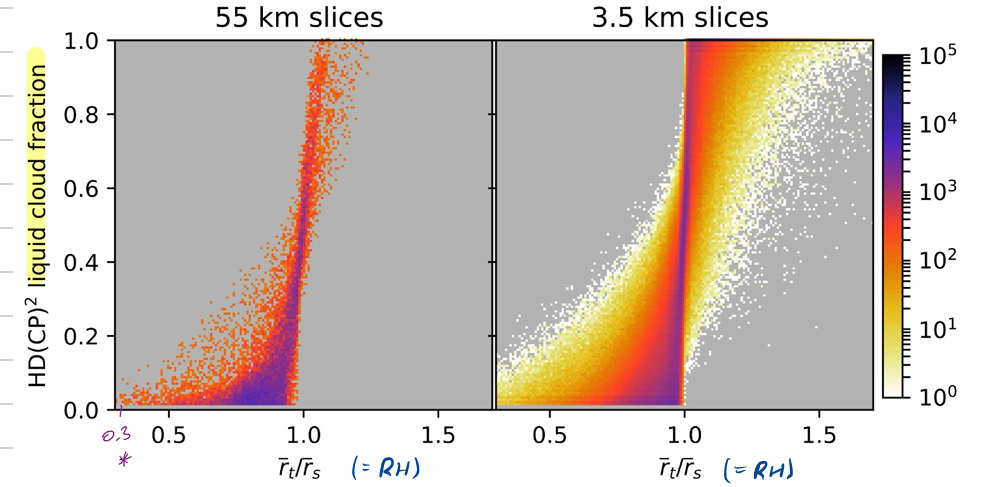
Histogram of total moisture / saturation moisture (=RH) against cloud fraction
The larger the grid box, the less likely it is to reach a cloud cover of 1
even for 3.5km a cloud fraction of 1 is quite rare
even for RH~30% clouds pop up in the 55km slices
Which 4 parameterizations for liquid cloud fraction are there?
All or nothing
Relative humidity from Sundqvist
Beta PDF without Skew
Beta PDF with variable Skew
What are assumptions in the “all or nothing” parameterization?
no subgrid-scale variability in the grid box
(works well for small grid box and liquid water)grid box in thermal equlibrium
What are input variables in the “all or nothing” parameterization?
Temperature
pressure
total moisture
How does the calculation in the “all or nothing” parameterization work?
Calculate saturation water content from the core variables T and p
if total moisture >= saturation water content → cloud fraction = 1
if not → cloud fraction = 0
How many tuning parameter are there in the “all or nothing” parameterization?
0
What assumptions are made in the Relative humidity from Sundqvist?
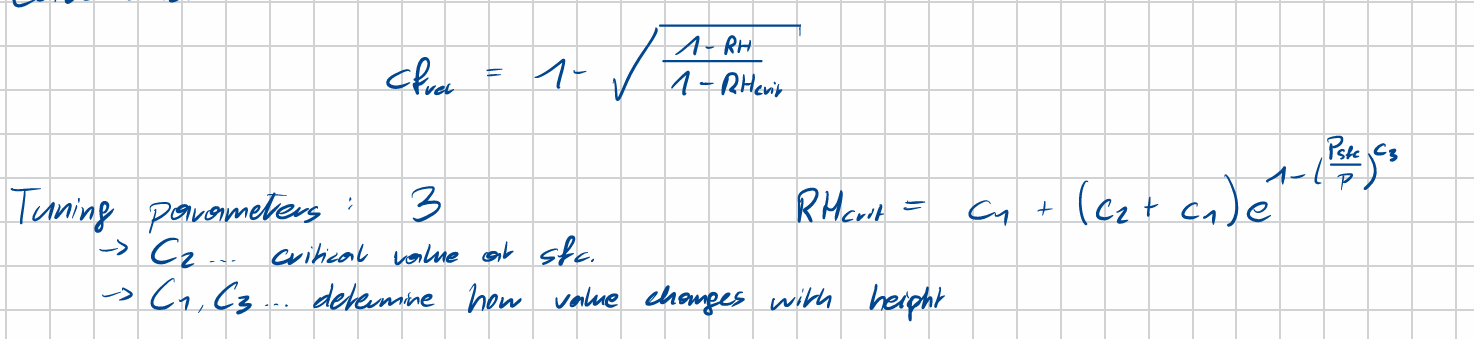
Cloud fraction a function of relative humidity and is 0 below a critical value
at RH = 1 = 100%, cloud fraction = 1
What are the input variables for the Relative humidity from Sundqvist?
Temperature
total moisture
pressure
surface pressure
How does the calculation of the Relative humidity from Sundqvist look?
3 Tuning parameters
What assumptions are made in the Total water PDF parameterization?
distribution of total moisture in the grid cell is described by an analytical distribution
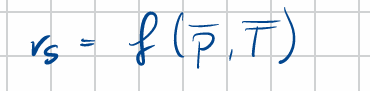
there is a uniform saturation value throughout the grid cell, which is a function of the mean pressure and the temperature:
How does the calculation for the Total water PDF parameterization?
rs from the second assumption
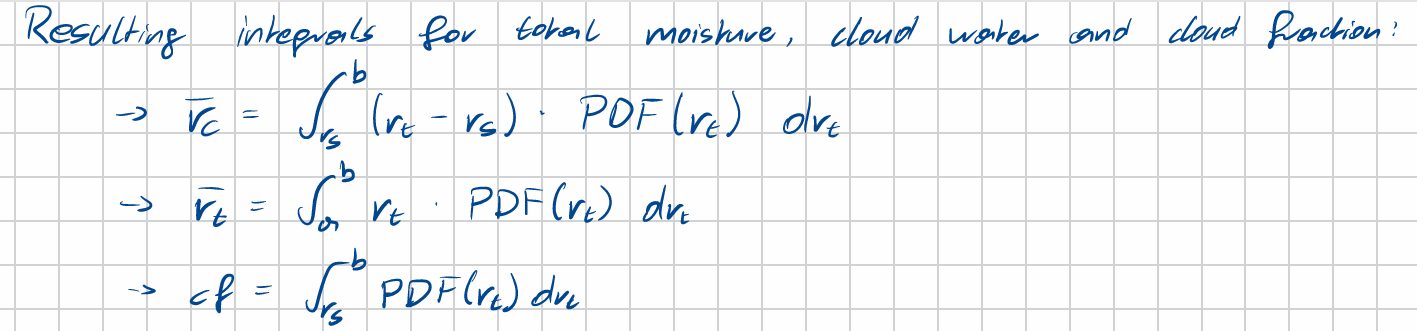
How can the integrals in the Total water PDF distribution be understood?
integration over pdf between rs and b gives cloud fraction cf
if we also take rt - rs into account, this gives us the liquid water amount rc
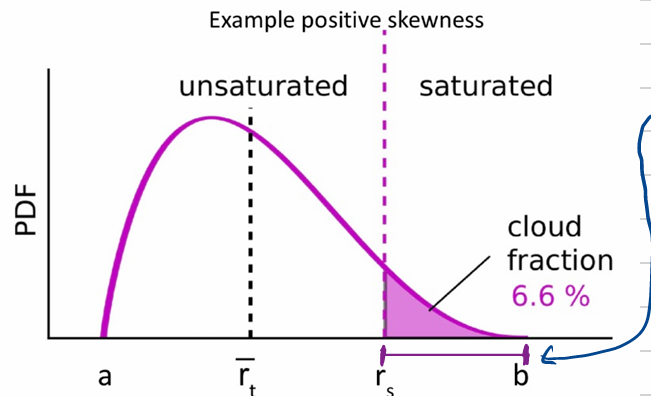
How many degrees of freedom does a Beta distribution have?
4 doF
min, max of (a, b)
two shape parameters p,q > 0
expl Gaussian would have 2 doF
When does the Beta distribution start and end at 0?
If p and q > 1
What is the major advantage / difference of the Beta distribution compared to the normal distribution?
does not go to infinity
When is the Beta distribution symmetric?
p = q
Which two closures can be used to reduce the doF of the Beta distribution?
(q - 1)(p-1) = 2, with p,q > 1
yields 3 doF
using only this closure yields a Beta PDF with flexible skewnessq = p
yields 2 doF
using this closure as well yields a Beta PDF symmetric
What are the 2 doF of the Beta PDF symmetric?
from (q-1)(p-1)=2 and q=p → q, p known
only a and b remain undetermined
What are the input variables of the Beta PDF symmetric?
Temperature
pressure
water vapor
cloud water (not from the dynamical core!)
How does the calculation for the Beta PDF symmetric look?
Saturation value is calculated from T and p
a, b determined iteratively, so that the integrals for total moisture rt and cloud water rc correspond to the input variables
cloud fraction calculated from saturated area of distribution
How many tuning parameters does the Beta PDF symmetric have?
0
What are the 3 doF of the Beta PDF with flexible skewness?
from (q-1)(p-1) = 2 still only one combination for a certain skewness
therefore a, b, and skewness are the doF
What are the input variables for the Beta PDF with flexible skewness?
Temperature
pressure
water vapor
cloud water (not from dynamical core!)
total water skewness (not from dynamical core!)
How does the calculation for the Beta PDF with flexible skewness look?
Saturation value rs calculated from given T and p
thanks to closure, p, q determined from skewness
the free parameters a, b are iteratively determined, so that the integrals for rt and rc correspond to the input variables
cf corresponds to the saturated area of the distribution
How man tuning parameters does the Beta PDF with flexible skewness have?
0
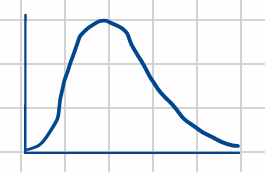
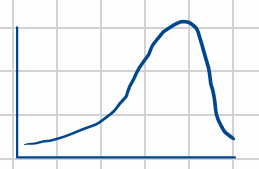
What does positive skewness mean?
there are small regions with very high total moisture
caused by convection
leads to smaller cloud fraction for a given amount of cloud water
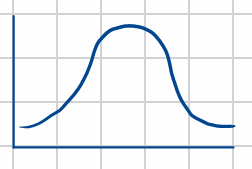
What does no skewness mean?
distribution is symmetric
high values as common as low values
What does negative skewness mean?
small regions with very low moisture
less common
e.g. Sc-fields
leads to higher clouds fraction for a give amount of cloud water
What are the so called core variables?
T, p, humidity
What is the most difficult aspect of the Beta PDF parameterization?
additional variables are required
Where can the additional variables for the Beta PDF parameterization be obtained?
either LES in an offline test or from other parameterizations in a model
From which parameterization can the cloud water be obtained?
from the microphysics parameterization
From which parameterization can the skewness be obtained?
convection and BL parameterization
How does convection impact skewness?
increases skewness
How does turbulence / mixing impact skewness?
decreases skewness
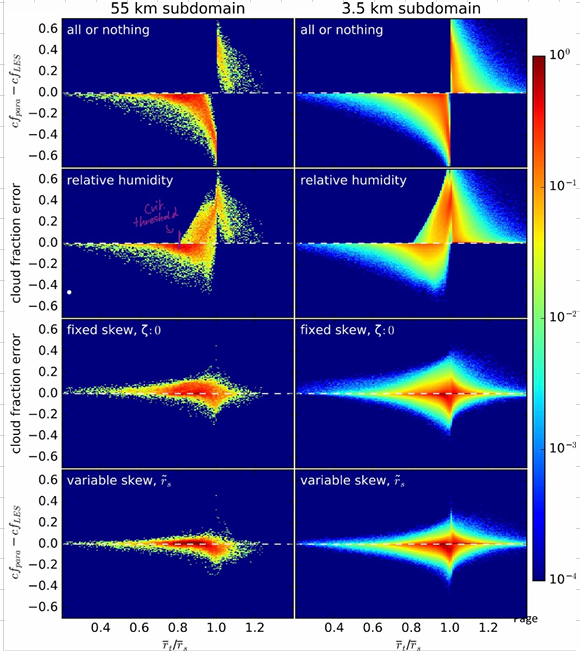
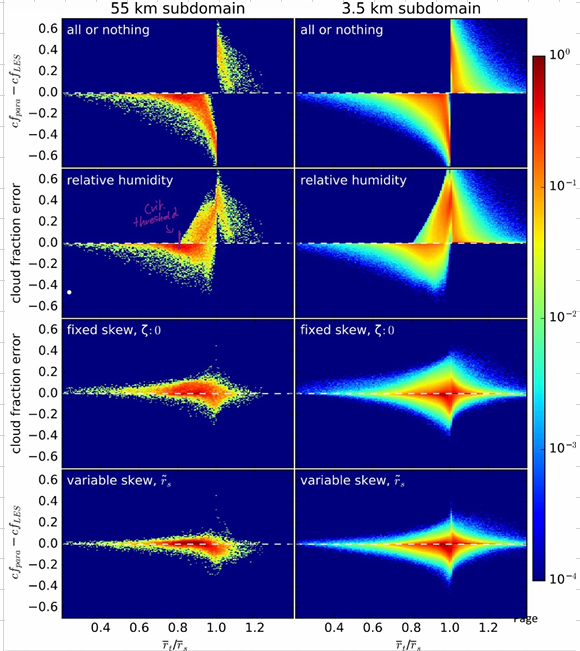
What does this plot show?
y—axis: error in parameterized cloud fraction
errors largest for RH~1
“all or nothing” performs poorly, only ok below RH=1.2 and above RH=0.6
Beta PDF approach much smaller errors and variable skewness provides additional improvement