Chemistry - Quantum Theory and electron configuration
 Call Kai
 Learn
Learn Practice Test
 Spaced Repetition
 Match
Match Flashcards
 Knowt Play
1/40

Earn XP
Description and Tags
Name | Mastery | Learn | Test | Matching | Spaced | Call with Kai | Chat |
|---|
No analytics yet
Send a link to your students to track their progress
41 Terms
What is an orbital?
3-D region where an electron can be found
What does the principal quantum number describe?
energy level of the atom
What is the principal quantum number also called?
the shell, n
What does the angular momentum quantum number describe?
the shape
What is the angular quantum number also called?
sub-shell, l
What does the magnetic quantum number describe?
ml, describes the orientation of an orbital in space
What does the spin quantum number describe?
the spin of the electron, ms
What can the principal quantum number value be
any positive whole number
What can the value for the angular momentum quantum number value be?
positive whole numbers and zero/ spdfg…
What can the value for the magnetic quantum number be?
0… to +- l
What can the spin quantum number value be?
ms=+- 1/2
Write the electron configuration for Maganese:
1s22s22p63s23p64s23d5/ [Ar]4s23d5
Draw the electron configuration according to Hund’s rule for Manganese:
ꜛꜛꜛꜛꜛ
Label the periodic table with SPDF
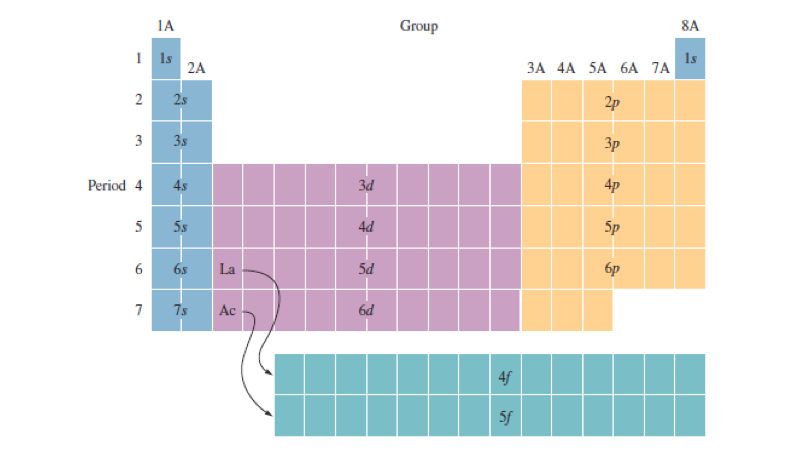
What’s [Ar]4s23d6’s atomic symbol?
Fe
Give the atomic symbol of the element with 4 3p electrons as last electrons added
S
Ten electrons in the n=4, l=2 sublevel
Cd
How many 3p electrons does copper have?
6
What’re the exceptions to Hund’s Law?
Cr and Cu
Why does the periodic table have its characteristic shape?
groups/ families have shared characteristics
What is periodic law?
when chemical elements are arranged in order of increasing atomic number, their physical and chemical properties show a predictable, repeating pattern
What’re the properties of metals?
malleable and ductile
shiny, lustrous, and reflect light
conduct heat and electricity
most oxides are basic and ionic
forms cations in solutions
lose electrons in reactions (becomes positively charged)
What’re the properties of nonmetals?
brittle when solid
dull
electrical and thermal insulators
most oxides are acidic and molecular
forms anions and polyatomic anions
gains electrons in reactions (becomes negatively charged)
What explains Mendeleev’s periodic law?
electron waves
What’s the trend in atomic size?
Bottom left increases atomic radius
Why does the atomic radius decrease when going from left to right on the periodic table?
nucleus has more positive protons that have more attraction to the negative electrons (opposites attract)
What are valence electrons?
electrons with the highest principal energy shells / electrons on the outermost shell
What are core electrons?
electrons on lower shells
What're the key factors in predicting the chemical and physical properties of elements?
the number of valence electrons
Elements in the main groups have the same ______ as the group number
valence electrons
What does the Bohr model accurately predict?
The spectrum of hydrogen and 1 electron ions
Where does the Bohr model fail?
when it’s applied to multiple electron atoms
it can’t account for interactions between electrons
it doesn’t explain why only certain energies are allowed
it doesn’t explain why the electron doesn’t crash into the nucleus
What’s wave-particle duality?
Electrons have the characteristics of particles and waves at the same time.
What is an orbital?
Electron-waves
What can be associated with the physical properties of electrons?
Electron waves
De Broglie proposed that electrons (and all matter) have the properties of waves
The electron-wave (or orbital) is described by an equation related to the electron’s probable location
What is the orbital described as?
a wave function
What is the probability of where the electron is?
square of the function

What does this image represent?
the probable distribution of a wave function
What’re the modifications to Bohr’s diagram?
Replace the linear orbits of the Bohr model with waves (called orbitals)Wh
What is the radial node?
Where there’s no chance of finding an electron
For 1D standing waves, what’re the trends as energy increases?
Energy increases from n=1→ 4