UNIT TEST: METHODS OF RESEARCH (Jeopardy Tues 9/22 and Test Wed 9/23)
 Call Kai
 Learn
Learn Practice Test
 Spaced Repetition
 Match
Match Flashcards
 Knowt Play
1/118

There's no tags or description
Looks like no tags are added yet.
Name | Mastery | Learn | Test | Matching | Spaced | Call with Kai | Chat |
|---|
No analytics yet
Send a link to your students to track their progress
119 Terms
Ethical Guidelines for Research
Informed consent/assent
Debriefing and approved deception
Confidentiality or
Anonymity
IRB (Review)
Protection from harm (physical or mental)
"I Do Care About the Research Participants"

Institutional Review Board (IRB)
A committee at each institution where research is conducted to review every experiment for ethics and methodology. This group determines if the research is following the ethical guidelines.
Includes human and non-human research
Debriefing
After the study, participants should be told the purpose, a full explanation of the hypothesis, and told about any deception
ETHICAL GUIDELINE
Protection from harm
Can't have significant mental or physical risk. Volunteers must leave the experiment in basically the same mental and physical state in which they came to the experiment.
Mental risk of thinking you killed someone is now considered an ethical violation of this category - Milgram experiment
ETHICAL GUIDELINE

Informed consent
BEFORE the study, the volunteer participants must know that they are involved in research and agree to volunteer for it. Participants AGREE to a basic idea of what they are getting into.
Subjects are told that they can leave the experiment at any time
At this point (before the experiment), however, participants will NOT be told if they will be deceived and NOT told about the hypothesis
ETHICAL GUIDELINE
informed assent
Consent may only be given by individuals who have reached 18 years old, the legal age of consent. Assent is the agreement of someone not able to give legal consent to participate in the activity.
Research with children or adults not capable of giving consent (like someone that is mentally disabled) requires the consent of the parent or legal guardian and the assent of the subject.
ETHICAL GUIDELINE
Anonymity or confidentiality
Research must have one or the other of confidentiality or anonymity
Confidentiality: Only researchers can match responses with participants, and steps are taken to prevent outsiders from having this information. The final report will substitute "Participant 58" for the real name.
Anonymity: No personal information is collected: Participants' identities remain unknown, even to the researcher.
ETHICAL GUIDELINE

type of research methods
1. Experiment
2. Case Study
3. Correlation
4. Meta-analysis
5. Naturalistic observation
non-experimental methodologies
Psychological research methodologies that are NOT an experiment:
1. Case study
2. Correlation
3. Meta-analysis
4. Naturalistic observation
THESE do not show cause and effect (causal) relationships
Case Study
Examines one individual or small group in depth
A type of non-experimental method
Much of the what we know of the brain came from case studies of individuals with brain damage
Since it only studies one person, findings of this research cannot be applied to the population without further research
Naturalistic Observation
observing and recording behavior in naturally occurring situations without trying to manipulate and control the situation
Research method that involves watching participants in their habitats without interacting with them.
The goal is to get a realistic and rich picture of the participants' behavior
Cannot establish cause and effect relationships between variables.
A type of non-experimental method
Like Jane Goodall studying chimpanzees

Survey
a technique for getting data for correlational research. This method is for ascertaining the self-reported attitudes or behaviors of a particular group which involves asking people to fill out questionnaires
Often used to gather opinions or attitudes and for correlational research from many people
Questions should be careful of how something is worded can create the framing effect
meta-analysis
a procedure for statistically combining the results of many different research studies
Often, this type of analysis then gets a bigger correlation from all the data and studies
a type of non-experimental method
Correlation
A measure of the extent to which two factors vary together, and thus of how well either factor predicts the other.
A type of non-experimental method
One trait or behavior is related to another
THIS could be positive - the two factors move in the same direction - when one is increased the other factor also increases, and when one is decreased the other factor also decreases
THIS could also be negative - the two factors move in opposite directions - when one is increased the other is decreased and vice versa
Experiment
A research method in which an investigator manipulates one or more factors to observe the effect on some behavior or mental process to show CAUSE AND EFFECT -a causal relationship
Includes: an Independent Variable, a Dependent Variable, a Control Group, and an Experimental Group

Experiment vs Correlation
Correlations don't prove cause and effect, but they do suggest a cause and effect
Experiment is the only research method that can prove cause and effect
Institutional Review Board (IRB)
A committee at each institution where research is conducted to review every experiment for ethics and methodology. This group determines if the research is following the ethical guidelines.
Includes human and non-human research
Deception in an experiment
If you deceived your participants, you should reveal this as soon as possible, apologize for the deception, explain why it was necessary, and correct any misconceptions that participants might have as a result. This can be done during debriefing.
Like when studying the bystander effect, you can deceive subjects to make them think there is a possible fire next door, but you tell them what really happened after it.

Confederate
An actor who is working with the experimenter but pretending that they are not "in on it"

Ethical reforms after Milgram and Zimbardo
Both Milgram and Zimbardo were groundbreaking in our understanding of psychology, but both were criticized on ethical grounds. Each led to changes in the ethical guidelines and the IRB process.
Although both researchers' did follow up debriefings and participants had not suffered long term effects, today these would violate the ethics of "protection from harm." An IRB today would not allow replication of either of these studies.

Obedience studies
Obedience is form of compliance that occurs when people follow direct commands, usually from someone in a position of authority
Stanley Milgram's original experiments began at Yale
He found that about 65% (about 2/3rds) of participants obey experimenters' orders to go all the way to 450 volts
Subjects were only told "the experiment requires that you continue."
Milgram wanted to show how the Nazi's could influence the holocaust.
Milgram's research has been criticized on ethical grounds because the subjects were not protected from psychological harm

attribution theory
Explains how people determine the cause of what they observe in the behavior of others: dispositional attributions or situation attributions
Dispositional: when we attribute a person's behavior to his or her personality rather than the situation the person is in
Situational: when we attribute a person's behavior to the situation the person is in rather than his or her personality
The Milgram experiment, Zimbardo's prison study, and the bystander effect all show that a powerful situation can change who we are

Dispositional attribution
when we attribute a person's behavior to his or her personality rather than the situation the person is in
Situational attribution
when we attribute a person's behavior to the situation the person is in rather than his or her personality
The Milgram experiment, Zimbardo's prison study, and the bystander effect all show that a powerful situation can change who we are
individualistic cultures
societies that prize independence, competition, and personal success
the importance and uniqueness of the individual is stressed
Example: United States

collectivist cultures
societies that prize social harmony, obedience, and close family over individual achievement
A person's link to various groups, such as family or company, is stressed, as in Japanese culture

social norms
Rules about how group members should act
For example, businesses may have formal rules governing appropriate work dress
Can also be informal rules in a group
deindividuation
Loss of self-restraint that occurs when group members feel anonymous and emotionally aroused
You lose your personal identity to the group
More likely to happen if wearing a mask or covering face
Sometimes people get swept up by a group and do things they would never have done if on their own, such as looting, bench-clearing brawls in baseball, or rioting.
Zimbardo Stanford Prison
This social psychologist assigned a group of Stanford students to play either the role of a prison guard or a prisoner.
All were dressed in uniform, and the prisoners were assigned numbers. The prisoners were locked up in the basement of the psychology building, and the guards were put in charge of their treatment.
The students took to their assigned roles perhaps too well, and the experiment had to be ended early because of the cruel treatment the guards were inflicting on the prisoners.
Shows the power of SOCIAL ROLES and how the power of a situational factor can overwhelm dispositional factors

social roles
shared expectations in a group about how particular people are supposed to behave
Bystander Effect
The larger the number of people who witness an emergency situation, the less likely anyone will be to intervene.
The larger the group of people who witness a problem, the less responsible any one individual feels to help.
On cause could be the diffusion of responsibility: People tend to assume that someone else will take action so they need not do so.
If one person does begin to help it has a "ripple effect" - it encourages others to also help
Other causes include the bystander may not notice the situation or the situation may be ambiguous and not readily interpretable as an emergency

Bystander effect experiments
The vicious murder of Kitty Genovese in Kew Gardens, NY, committed within view of at least 38 witnesses, none of whom intervened, led this team to research diffusion of responsibility.
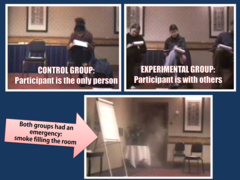
Tested diffusion of responsibility with a "smoke filled room" experiment and a fake seizure experiment
In emergency situations, subjects were less likely to help if they thought others were with them

altruism
unselfish regard for the welfare of others - prosocial behavior

prosocial behavior
positive, constructive, helpful behavior that benefits others
Causes of helping behavior
Some researchers suggest that people act in prosocial ways due to incoming "social debt"
social reciprocity norm: a learned expectation that you will receive help in return for helping others OR that you will help those who have helped you
social responsibility: you should help those in need - like children, the elderly, or the disabled

Social reciprocity norm
a learned expectation that you will receive help in return for helping others OR that you will help those who have helped you
Example: The new local smoothie shop gave away free smoothies on the grand opening. The owners hope that this creates a feeling of indebtedness, leading customers to feel compelled to buy the product in return
Psychology
the scientific study of behavior and mental processes
Psychology is a science that looks for scientifically derived evidence
Critical thinking
thinking that does not automatically accept arguments and conclusions
Rather, it examines assumptions, appraises the source, discerns hidden biases, evaluates evidence, and assesses conclusions
Overconfidence
the tendency to be more confident than correct—to overestimate the accuracy of our beliefs and judgments.
For example: most people think that they are a better than average drivers, but we all can't be better than average
Peer reviewers
scientific experts who evaluate a research article's theory, originality, and accuracy
Theory
Explains behaviors or events by offering ideas that organize what we have observed.
Predicts behaviors or events
Aims to explain some phenomenon and allows researchers to generate testable hypothesis with the hope of collecting data that support it
Hypothesis
A testable prediction, often implied by a theory
A statement that expresses a relationship between two variables

falsifiable hypothesis
the possibility that an idea, hypothesis, or theory can be disproven by observation or experiment
An example of a hypothesis that is NOT falsifiable is: "Aliens are constantly observing us, but they exist in another dimension that completely blocks all physical interaction and detection"
Operational Definitions
a carefully worded statement of the exact variables used in a research study
Example: Research on being "sleep deprived" is too general, therefore this might be defined as "4 hours of sleep or less"
Replicate
Repeat the research
Usually using different participants in different situations
framing effect
How a survey question is worded can effect the responses
The framing effect on surveys is the wording effect
Example 1: people are more approving of "aid to the needy" than of "welfare" even though these are the same idea but with different wording
Example 2: The same idea asked in different ways will make people answer differently:
Do you believe in life on other planets?
VS
Do you believe in aliens?
qualitative research
research method that relies on in-depth narrative data not translated into numbers - informal research methods, including observation, structured interviews (in-depth interviews), focus groups, and projective techniques
quantitative research
research that collects and reports data primarily in numerical form
Like Likert Scales or correlations
Likert Scale
To measure attitudes of survey respondents
The typical scale is a 5- or 7-point ordinal scale used by respondents to rate the degree to which they agree or disagree with a statement

social desirability bias
bias from people's responding in ways they presume a researcher expect or wishes
self-report bias
bias when people report their own behavior inaccurately
example: when asked "do you treat people fairly most of the time?" you might answer yes, but might not realize that you truly don't
Population
THIS is the overall group that is being studied, from which the sample is selected from.
THIS is anyone or anything that could possible be selected to be in the sample.
Example: choosing a small group of students from the total students. The total is students represents THIS TERM
Random Sample
a small group from the population that fairly represents the population because each member has an equal chance of inclusion into the study
the population is too big to study, so this is the small group that you study that will represent the population
Example: Choosing a small group of students from the population, you might number the names of every student and use a random number generator to pick the survey participants
sampling bias
a flawed sampling process that produces an unrepresentative sample
convenience sampling
using a sample of people who are readily available to participate, but it does not represent the population
Therefore you cannot "generalize" to the population with this
representative sample
a sample that accurately reflects the characteristics of the population as a whole, which therefore helps generalize the findings to the whole population
Sample vs Population
If you are studying how high school students at a particular school feel about online privacy, you might choose a smaller random SAMPLE of 100 high school students from the overall larger POPULATION of all high school students at that particular school.
inferring population differences from sample differences
1. Representative samples are better than biased samples
2. Bigger samples are better than smaller ones
3. More estimates are better than fewer, and the best thing to do is meta-analysis
Random Selection
This is the action that creates a random sample
If you are choosing sample using THIS from a high school, you might list all of the students in alphabetical order by their last name and choose every fifth student to be in your sample
Correlation
A measure of the extent to which two factors vary together, and thus of how well either factor predicts the other.
A type of non-experimental method
One trait or behavior is related to another
THIS could be positive - the two factors move in the same direction - when one is increased the other factor also increases, and when one is decreased the other factor also decreases
THIS could also be negative - the two factors move in opposite directions - when one is increased the other is decreased and vice versa
Correlation coefficient
a statistical index of the relationship between two things (from -1 to +1)
-1 is the strongest negative correlation (represents 100%) and 1 is the strongest positive correlation (also represents 100%). Both -1 and 1 are equally the strongest.
Perfect positive correlation
scatterplot with 1.00 correlation

No relationship
scatterplot with 0.00 correlation coefficient

Perfect negative correlation
scatterplot with -1.00 correlation coefficient

examples of scatterplots with correlation coefficients
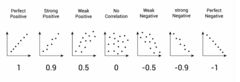
Scatterplot
a graphed cluster of dots, each of which represents the values of two variables
Directionality problem
a problem encountered in correlational studies; the researchers find a relationship between two variables, but they cannot determine which variable may have caused changes in the other variable
Correlation does not prove causation
Correlations help us predict
Example: we know low self esteem CORRELATES with depression
If someone is depressed, we can PREDICT low self esteem. If someone has low self esteem, we can PREDICT depression.
So, can we say for sure that low self esteem will CAUSE depression? Not without an experiment. Correlations can show connections, and SUGGEST causes, but it does not PROVE causes. Directionality problem - It COULD be that low self esteem causes someone to be depressed. OR it COULD be the opposite: people who are depressed causes their esteem to drop.
or there could be a THIRD VARIABLE PROBLEM
third variable problem
the fact that a causal relationship between two variables cannot be inferred from the naturally occurring correlation between them because of the ever-present possibility of third-variable correlation

third variable problem example
Correlations do not prove cause and effect. Some correlations show a third variable problem (lurking variable)
Example: Ice cream sales and drownings actually ARE correlated!
Months with lots of drownings have lots of ice cream sales, and months with not much ice cream sales have very little drownings. Which means they ARE correlated so they ARE connected in some way, but ONE DOES NOT CAUSE THE OTHER!
Hot weather actually causes the increase in both. Hot weather in this case is the lurking variable, also known as the third variable problem.

psychodynamic perspective
behaviors and mental processes are the result of the unconscious
Believes we are shaped by childhood experiences
based on Freud's idea about influence of the unconscious
This perspective analyzes dreams to determine unconscious concerns
Example: this perspective would study altruism by looking at unconscious motivations that the hero was not consciously aware of

behavioral perspective
How an individual responds to the environment - Behaviors are learned and maintained through associations, like receiving rewards or punishments, and also learned through watching and imitating others (social learning)
Example: this perspective would study altruism by looking at all the positive attention a hero gets as a reward
humanistic perspective
behaviors and mental processes are influenced by humans who are naturally good and who can reach full potential through choices and free-will.
People need to be accepted through empathy.
Example: this perspective would study altruism by studying what choices and fee-will can bring out someone's naturally good self to become a hero
cognitive perspective
THINKING influences behavior and mental processes
includes thoughts, attitudes, memories, and expectations
Example: this perspective would study altruism by asking the person acting heroically "what were you THINKING?"

biological perspective (neuroscience)
Brain chemicals called neurotransmitters, hormones, neurons, and our genes influence behavior and mental processes
Example: this perspective would compare the brain of someone who was altruistic with the brain of a normal person
evolutionary perspective
applies evolution's "natural selection" and "survival of the fittest" to psychology
our behavior and mental processes TODAY are because of how it helped our species survive thousands of years ago. Those survival traits were passed down and influence us today.
Example: a person may risk his/her life to save others, but this altruism helps more people survive which allows the human race to survive
sociocultural perspective
behaviors and mental processes are influenced by ethnicity, religion, gender, language, nationality, like differences with individualistic vs collectivist cultures
Examples: which type of culture, individualistic or collectivist, would encourage altruism?
Biopsychosocial perspective
the process of using two or more perspectives to explain behavior or mental processes
BIO: biological and evolutionary
PSYCHO: cognitive, behavioral, humanistic, psychodynamic
SOCIAL: sociocultural
Example: studying "altruism" from each of the seven perspectives instead of just one

Experiment
A research method in which an investigator manipulates one or more factors to observe the effect on some behavior or mental process to show CAUSE AND EFFECT -a causal relationship

Experiment vs Correlation
Correlations don't prove cause and effect, but they do suggest a cause and effect
Experiment is the only research method that can prove cause and effect
Experimental Group
In an experiment, the group that is exposed to the treatment, that is, to one version of the independent variable.
Both groups are treated EXACTLY THE SAME except for the independent variable
Control Group
In an experiment, the group that is not exposed to the treatment; contrasts with the experimental group and serves as a comparison for evaluating the effect of the treatment.
Both groups are treated EXACTLY THE SAME except for the independent variable
Random Assignment
assigning participants to experimental and control conditions by chance, thus minimizing preexisting differences between those assigned to the different groups
COIN FLIP FOR EXPERIMENTAL OR CONTROL GROUP
Used in experiments; NOT surveys
Random Assignment vs Random Selection
Do not confuse these!
Random selection is taking a group a participants FROM the population and each member of the population has an equal chance of being selected
Random assignment is only for an EXPERIMENT where you randomly assign EITHER the control or experimental group, by coin flip or other random method
single blind procedure
An experimental procedure where participants do not know which experimental condition they have been assigned to, but the experimenter does.
Double Blind Procedure
an experimental procedure in which both the research participants and the research staff are ignorant (blind) about whether the research participants have received the treatment or a placebo.
Experimenter bias
the influence of the experimenter's expectations on the outcome of research.
This is done unconsciously and not on purpose
This can be fixed by doing a double-blind procedure
Placebo Effect
experimental results caused by expectations alone; any effect on behavior caused by the administration of an inert substance or condition, which the recipient assumes is an active agent.
Example: A doctor gives you a pill that should cure your allergies to cats. You take it and your allergy goes away. However, it was only a sugar pill.
Testing an experimental hypothesis
Researchers manipulate the IV and measure the DV
Independent Variable
The experimental factor that is manipulated; this variable is the CAUSE whose effect is being studied.
Example: Exercise can make you smarter. The IV here is "exercise"
Example: Coffee makes your memory stronger. The IV here is "coffee"
Independent Variable in the Smoke Filled Room
The amount of people in the room

Dependent Variable in the Smoke Filled Room
How long it took the participant to get help

operational definition
a statement of the procedures used to define the exact research variables - the IV and DV
Example: Coffee makes your memory stronger. The IV here is "coffee" so then if you tested it you would have to state what is considered coffee - is it 8, 10, or 16 ounces of coffee?
Example: Exercise can make you smarter. The DV here is how much smarter you get, so then if you tested it you would have to state "how do you measure how much smarter you get?" - Grades in school? An IQ test? Test grades in AP Psych?
Dependent variable
What is measured
The outcome factor; the variable that is the effect in response to manipulations of the independent variable.
Example: Exercise can make you smarter. The DV here is how much smarter you get
Example: Coffee makes your memory stronger. The DV here is how much stronger your memory becomes
Confounding Variable
a factor other than the independent variable that might produce an effect in an experiment
This is differences among the groups (control and experimental), like testing the control group in the morning and the experimental in the after noon
This is NOT differences between people, like if two people in your experiment were geniuses - thanks to RANDOM ASSIGNMENT these two people would be split - one in control and the other in experimental
Confounding variable example
No confounding variables in the "smoke filled room" experiment because everything was EXACTLY THE SAME except for the independent variable
BUT if they tested the experimental group in the morning and the control group in the afternoon, then the time of day would be a confounding variable because each group was treated differently
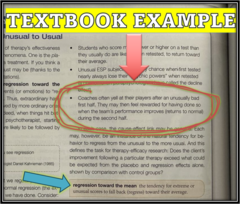
Regression toward the mean
the tendency for extreme or unusual scores to fall back (regress) toward their average.
The example from our textbook about a coach yelling at their team at half-time is attached in the picture (PLEASE READ PICTURE)
confirmation bias
the tendency to search for, favor, and recall information that supports our pre-existing beliefs. Information that goes against our beliefs is ignored or not recalled.
We like things that prove us correct, but we don't like things that prove us incorrect

confirmation bias example
Police think that a suspect is guilty. These police detectives, with this preconceived belief, choose to investigate evidence that supports this theory, ignoring the other facts that suggest the suspect is innocent

Experimenter Bias
The researcher allowing his or her expectations to effect the outcome of a study. Unconsciously done by the researcher.
Double blind helps eliminate this