Rates of Reaction
 Call Kai
 Learn
Learn Practice Test
 Spaced Repetition
 Match
Match Flashcards
 Knowt Play
1/19

There's no tags or description
Looks like no tags are added yet.
Name | Mastery | Learn | Test | Matching | Spaced | Call with Kai | Chat |
|---|
No analytics yet
Send a link to your students to track their progress
20 Terms
Common factors that determine the rate of reaction
Temp
Catalyst
Concentration
SA of solids
Pressure of gases
Ways to measure rates of reaction
Change in mas
Collecting a volume of gas
Changes in colour
Changes in appearance like the formation of a precipitate
Rate of reaction mathematical formula

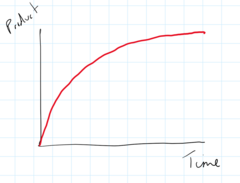
Graph showing how much product is left v time
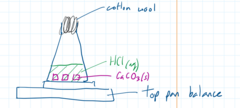
Experiment to meausre how SA affects rate of reaction, and diagram
Use the reaction between HCl
large marble chips
Medium chips
Lots of small marble chips/powder
Measure the mass of CO2 against time every 30 seconds
How does SA affect the rate of reaction
Larger SA= faster rate of reaction
Control variables when experimenting the effect of SA in the rate of a reaction
Temp
Concentration of HCl
Volume of HCl
Mass of CaCO3
Effect of Acid Concentration on Rate of Reaction Mg + HCl
Method: Add a strip of Mg to 40cm3 of HCl and time how long it takes for Mg to disappear. Repeat for different concentrations.
Variables:
Independent: Acid concentration
Dependent: Time for Mg to react completely
Controls: Volume of acid, mass & surface area of Mg, temperature, mixing amount
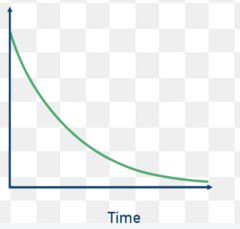
Reactant against time graph
What is the gradient equal to on this graph
the rate of reaction at that time
Effect of Temperature on Rate of Reaction (Disappearing Cross)
Method: Warm 40cm3 of thiosulfate solution to required temp, add 5cm3 of HCl, place over a black cross, and time how long it takes for the sulfur precipitate S to obscure the cross.
Variables:
Independent: Temperature
Dependent: Reaction time (used to calculate rate: 100/time)
Controls: Volumes and concentrations of both solutions, same cross (X)
Conclusion: As temperature increases, the rate of reaction increases.
What is a successful collision
When a collision has enough energy to lead to a chemical reaction
What is activation energy
The minimum energy needed for a collision to be successful
The result of a larger SA of solids for rate of reaction (collision theory)
For the same mass, smaller particles have more surface area.
There is a higher frequency of collisions.
Therefore, so more frequent successful collisions so higher rate of reaction.
The result of increasing concentration of solutions on rate of reaction (collision theory)
Higher concentration means there are more particles per unit volume.
There is a higher frequency of collisions.
Therefore, so more frequent successful collisions so higher rate of reaction.
The result of temperature of solutions on rate of reaction (collision theory)
Higher temperature increases the kinetic energy of the particles (they move faster).
There is a higher frequency of collisions.
The fraction of collisions that are successful increases (as collisions happen with more energy)
Therefore, so more frequent successful collisions so higher rate of reaction.
Why does a catalyst work
As it provides an alternative pathway with lower activation energy so that a greater proportion of collisions are successful
Catalytic Decomposition of Hydrogen Peroxide
Aim: Investigate how different catalysts, catalyst mass, and surface area affect the decomposition rate of hydrogen peroxide H2O2
Equation: 2H2O2 (aq) --> 2H2O (l) + O2 (g)
Method: Add catalyst to 50cm3 of 1% H2O2 in a conical flask, seal with a bung, swirl continuously, and measure the volume of O2 gas collected in a gas syringe at regular time intervals.
Variables Tested:
Type of Catalyst: Manganese(IV) oxide vs. Copper(II) oxide
Mass of Catalyst: 0.5 vs. 0.25
Surface Area: Powder vs. Granules
Key Control: Same volume 50cm3 and concentration 1% H2O2
What does the rate of reaction depend on
The number of collisions per second (frequency)
The energy of the collisions (fixed propn will be successful)
What is a catalyst
A substance that will increase the rate of a chemical reaction without being used up. They are unchanged at the end of the reaction
Two types of catalyst
Heterogeneous Catalyst- the catalyst is in a different physical state from the reactants
Homogeneous catalyst- the catalyst is the same state as the reactants (enzymes)