Upper Limb Muscles
 Call Kai
 Learn
Learn Practice Test
 Spaced Repetition
 Match
Match Flashcards
 Knowt Play
1/41

There's no tags or description
Looks like no tags are added yet.
Name | Mastery | Learn | Test | Matching | Spaced | Call with Kai | Chat |
|---|
No analytics yet
Send a link to your students to track their progress
42 Terms
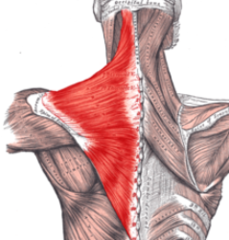
trapezius
large V-shaped muscle on upper back
origin: external occipital protuberance; superior nuchal line; spinous processes of C7-T12
insertion: clavicle; acromion process; spine of scapula
action: rotates, retracts, elevates and depresses scapula; extends neck
deltoid
triangular shoulder muscle; major abductor of humerus
origin: clavicle, acromion process, and spine of scapula
insertion: deltoid tuberosity
action: flexes, extends and abducts shoulder joint

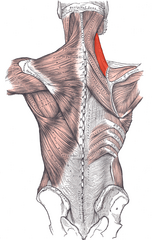
levator scapulae
inserts on medial border and superior angle of scapula; adducts scapula (from scapula--> neck)
rhomboid major
rectangular muscle on upper back; elevates and retracts scapula; layer under trapezius

rhomboid minor
superior to rhomboid major; elevates and retracts scapula (between major and scapula)

supraspinatus
extends from the supraspinous fossa to humerus; abducts humerus

infraspinatus
originates on the infraspinous fossa; rotates humerus laterally

teres major
extends from lateral border of the scapula to the lesser tubercle of the humerus; medially rotates arm (inferior to scapula, attaches to arm; lowest muscle that attaches to scapula)
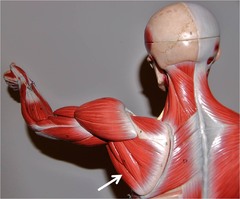
teres minor
originates on the lateral border of the scapula, inserts on humerus; extends and rotates humerus laterally; in between infraspinatus and teres major

subscapularis
originates on subscapular fossa; major medial rotator of arm; 2nd layer, below serratus anterior. lines scapula

serratus anterior
extends from upper posterior ribs towards medial border of scapula; draws scapula toward rib cage (most superficial from scapula, hook up to ribs)

latissimus dorsi
originates on the lower ribs and inserts on the humerus; medially rotates humerus; helps with forced inhalation when upper limb is fixed

pectoralis major
major chest muscle; adducts humerus medially; helps with forced inhalation when upper limb is fixed (interbicular groove)

pectoralis minor
small chest muscle deep to the pectoralis major; acts on scapula; helps with forced inhalation when upper limb is fixed (deep, superior)

coracobrachialis
small muscle in armpit region; flexes and adducts humerus synergistically with pectoralis major

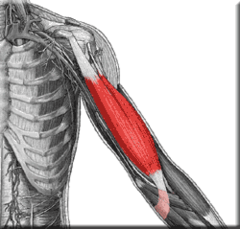
biceps brachii
two headed muscle on the anterior side of the upper arm; elbow flexor and forearm supinator
origin: supraglenoid tubercle and coracoid process
insertion: radial tuberosity
action: flexes elbow and shoulder; supinates forearm
triceps brachii
three headed muscle on the posterior side of the upper arm; extends forearm
origin: infraglenoid tubercle and posterior shaft of humerus
insertion: olecranon process
action: extends elbow and shoulder
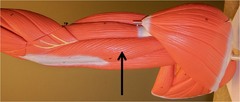
brachialis
between triceps and biceps; flexes forearm (under bicep-- see better from outside)

brachioradialis
originates on the lateral supracondylar ridge of humerus, inserts on the styloid process of the radius; flexes the forearm (runs from elbow up to thumb-side)

extensor carpi radialis longus
originates on lateral ridge of humerus, inserts on second metacarpal; abducts the hand

extensor carpi radialis brevis
originates on lateral epicondyle, inserts on third metacarpal; abducts the hand
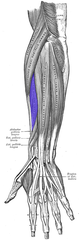
abductor pollicis longus
originates on radius and ulna, inserts on first metacarpal; abducts thumb (pollicis=thumb); middle child is abducted

extensor pollicis brevis
originates from the dorsal surface of the radius; extends the first phalanx of the thumb and abducts the hand

extensor pollicis longus
originates dorsolaterally from the middle part of the ulna; extends the second phalanx of the thumb and abducts the hand (really long tendon from thumb)

extensor digitorum
originates on lateral humeral epicondyle, inserts on digits; extends fingers
origin: lateral epicondyle of humerus
insertion: digits 2-5
action: extends digits 2-5

extensor digiti minimi
slender muscle on the ulnar side of the extensor digitorum, originates on the lateral epicondyle of the humerus, extends proximal phalanx of little finger
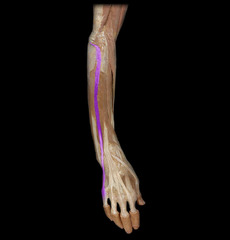
extensor indicis
narrow muscle medial to and parallel with the extensor pollicis longus, originates on the posterior surface of the ulna, inserts on the tendon of the extensor digitorum of the index finger; extends distal and middle phalanges (look in, overshadowed by minimi and digitorum)

extensor carpi ulnaris
originates on the olecranon process of ulna, inserts on fifth metacarpal; adducts wrists

anconeus
short, triangular elbow muscle on posterior side; extends elbow joint and abducts ulna during pronation
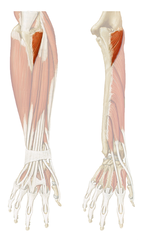
flexor digitorum profundus
originates on proximal 2/3 of ulna, inserts on four distal phalanges; flexes wrist and digits (huge, deep)

flexor carpi ulnaris
originates on the humerus and ulna, inserts on carpals and metacarpals; flexes wrist with power

palmaris longus
originates on medial humeral epicondyle, inserts on palmar aponeurosis; flexes wrist weakly (SUPER long tendon, attaches to palm)

flexor digitorum superficialis
originates on humerus, ulna and radius, inserts on middle phalanges of four digits; flexes wrist, hand and digits
origin: medial epicondyle of the humerus (opposes extensor digitorum)
insertion: digits 2-5
action: flexes digits 2-5

flexor carpi radialis
originates on humerus, inserts on metacarpals; flexes wrist and abducts hand

supinator
two heads, one originates on ulna and the other on the humerus, inserts laterally on radius; supinates forearm/hand (under brachial radialis)

pronator teres
originates on humerus, inserts on radius; pronates forearm/hand (main pronator muscle, tears across mid/inner forearm)

flexor pollicis longus
originates on radius and ulna, inserts on thumb; flexes thumb distally

pronator quadratus
originates on ulna, inserts on radius; pronates forearm/hand (deepest, square)

thenar muscles
group(*) of muscles in the lateral portion of the palm including flexor pollicis brevis, abductor pollicis brevis, and opponens pollicis

opponens pollicis
the most lateral of the thenar group, a small, triangular muscle in the hand, which functions to oppose the thumb (deep to thenar, fine motor control)
origin: trapezium
insertion: 1st metacarpal
action: opposition of the thumb

hypothenar muscles
group of muscles in the medial portion of the palm including flexor digiti minimi brevis, abductor digiti minimi, opponens digiti minimi (palm muscle)

lumbricals
four slender, worm-like muscles in the palm of the hand, originates on the lateral sides of the tendons of the flexor digitorum profundus, inserts on the tendons of the extensor digitorum on proximal phalanges of each finger; flex and extend each finger (between digits, metacarpals)
