2.6-2.9 Theory
 Call Kai
 Learn
Learn Practice Test
 Spaced Repetition
 Match
Match Flashcards
 Knowt Play
1/8

There's no tags or description
Looks like no tags are added yet.
Name | Mastery | Learn | Test | Matching | Spaced | Call with Kai | Chat |
|---|
No analytics yet
Send a link to your students to track their progress
9 Terms
To find the asymptotic behavior of a rational function, what do you do?
Factor out the denominator’s largest variable from the top and bottom.
What are the conditions for the squeeze theorem?
Suppose f(x) <= h(x) <= g(x), and suppose that the limit of f(x) and g(x) are both equal to L as they approach point c.
Then, the limit of h(x) must also equal L.
List the two important trigonometric limits.
NOTE: cos(t)/t is NOT one of the limit identities.

List Theorem 3.


No, because the two limits between which f(x) is sandwiched are not the same.
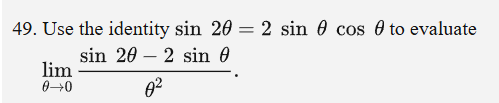
Explain how to solve this.
Upon applying the given identity, factor out a sin(x) and then go from there.
[T/F]: Horizontal asymptotes can include infinity/negative infinity.
False
Extra
Extra
Give an example where the limit of two functions’ sum exists, but the functions’ limits do not individually exist.
1/x and -1/x