class 2 aqua
 Call Kai
 Learn
Learn Practice Test
 Spaced Repetition
 Match
Match Flashcards
 Knowt Play
1/23

There's no tags or description
Looks like no tags are added yet.
Name | Mastery | Learn | Test | Matching | Spaced | Call with Kai | Chat |
|---|
No analytics yet
Send a link to your students to track their progress
24 Terms
Describe the relationship between gross primary production, net primary production, and respiration
net primary = gross primary - cost of respiration
List factors that impact light penetration in aquatic environments
inorganic nutrients, water clarity, depth
Define turbidity, euphotic zone, and compensation depth
turbidity: cloudiness of water due to particles
euphotic zone: layer of water where there is sufficient light for photosynthesis to occur
compensation depth:
Explain how a Secchi disk is used to assess turbidity
if you can see a Secchi disk deeper than the water is clearer if it has to be shallower to be seen its cloudier water
Draw a graph of photosynthetic rate vs. light intensity and explain how and why both vary with depth
theres a sweet spot for light intensity depending on the organism. too bright can inhibit but too little can be not enough to power photosynthesis
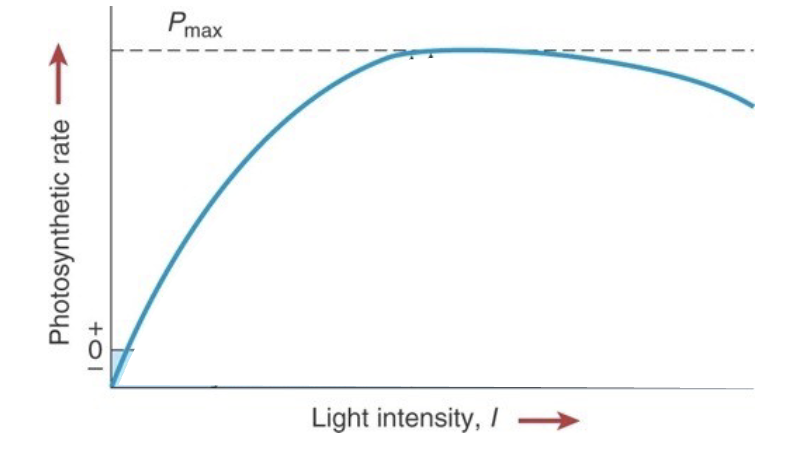
Describe the factors that can influence the compensation depth
Explain how the depth of the euphotic zone can influence which organisms function as the dominant primary producers in a system
Speculate on how human activities might perturb primary producers and ecosystems
human activity can cause increased sediment runoff/turbidity which then favors cyanobacteria over other primary producers which affects food chain
Define macro-, micro-, and limiting nutrients
macro: required in large amounts
micro: required in smallest amounts and often serve as catalysts in metabolic reactions
limiting: the nutrient available in shortest supply
Explain why inorganic nutrients are important
Explain what a limiting nutrient is
the nutrient available in shortest supply
Describe the experimental design for single and multi-nutrient enrichment experiments
1 control
others different combination of nutrients and look for changes in phytoplankton population which tells us which nutrients are important

Predict what the results would be if a nutrient was limiting in a single or multi-nutrient enrichment experiment
in single you would see growth. tells us thats one of the limiting nutrients
in multi you would see growth if it was not the limiting nutrient but if you didn’t see growth then there is limiting and potentially co-limiting
List & describe confounding factors associated with interpretation of results from single and multi-nutrient enrichment experiments
Multi-nutrient co-limitation: more than one essential nutrient is limiting
Biochemical co-limitation: one nutrient may facilitate uptake or assimilation of a second nutrient
Community co-limitation: Different phytoplankton species may be limited by different nutrients
Interpret data from nutrient enrichment experiments to identify potentially limiting nutrients
Discuss the changes in lake Apopka and the underlying factors that caused it to transition from a clear water lake with lush submerged aquatic vegetation to a green-water
lake dominated by phytoplankton
Identify the cause of of the phytoplankton blooms in the Long Island Bays and which nutrient was limiting in these Bays
people ate a lot of ducks (that were raised on farms along waterways) lots of duck waste that entered these water sources which caused phytoplankton blooms. blooms impacted other organisms making them unable to respire or feed efficiently. conducted experiment which had control and nitrogen and phosphate enriched flasks and determined. determined nitrogen as limiting nutrient.
Explain what the ELA is and describe the results of the enrichment experiment of lake 226.
Experimental lakes area
one side of lake added nutrients and other side added other nutrients and looked for differences in phytoplankton levels
one side resulted in algal bloom (carbon and nitrogen) other side did better with phosphorus showing it as the limiting nutrient
Explain what processes and factors lead to phosphorus typically being limiting in freshwater systems and nitrogen being limiting in marine systems.