1.1 Causality and Potential Outcomes Framework
 Call Kai
 Learn
Learn Practice Test
 Spaced Repetition
 Match
Match Flashcards
 Knowt Play
1/42

Earn XP
Description and Tags
GOVT 300 GMU
Name | Mastery | Learn | Test | Matching | Spaced | Call with Kai | Chat |
|---|
No analytics yet
Send a link to your students to track their progress
43 Terms
Observation
information about a particular individual (at a particular time)
An arbitrary observation is denoted by
i
Observations are the
rows is most datasets
Unit of Observation
what our data defines as the individuals or entities for each observations (e.g., people, countries, districts)
Sample Size
the number of observations in our data
Sample Size is denoted by
n
Variable
contains the values of a particular characteristic of the observations
Variables correspond to the
columns in most datasets
Causality deals with the connection between two variables
Treatment variable (aka independent variable): X
Outcome variable (aka dependent variable, response variable): Y
Causality is directional
the treatment produces and influences the outcome: X → Y
That means X→Y is not the same as
Y → X, nor X ←→Y
X → Y (no intermediary)
X is direct/immediate/proximate cause of Y
X → a → b → Y
X is an indirect/remote cause of Y
(We can still say X → Y, even when the relationship is not direct)
Binary treatments
the treatment is present or not
Binary treatments (examples)
• Vaccinated/Not vaccinated
• College Graduate/Non College Graduate
• Incumbent/Non incumbent
Categorical (multinomial) treatment:
mutually exclusive categories
Categorical (multinomial) treatment examples:
• Pfizer/Moderna/Other/Not Vaccinated
• HS or less/Some college/ College / More than College
Numerical treatment
numeric variable with intrinsic meaning
Numerical treatment (examples):
• Number of doses
• Years of formal education
• Amount spend in a campaign
Define Xi
is the value of variable X for observation i
For a binary treatment

An individual can be in one of two conditions
• Treatment: is the condition under which i receives the treatment, Xi = 1
• Control: is the condition under which i doesn’t receive treatment, Xi = 0
Factual
what happened or what we observed
Counterfactual
What would have happened if some key condition were different, but all else remained the same
Under counterfactual causality: a treatment causes the outcome whenever the factual and the counterfactual differ from each other. Why?
Because all else was assumed the same; so if the factual and counterfactuals are different, it must be due to the treatment
All else the same (ceteris paribus) is really important! Why?
If something else were different, then maybe the treatment was not really the cause.
Formal version of counterfactual causality.
• Define two potential outcomes
Potential Outcome under Treatment: what would happen to i if i received the treatment.
• Denoted Yi ( Xi = 1), or Yi (1) .
• Potential Outcome under Control: what would happen to i if i did not receive the treatment
• Denoted Yi ( Xi = 0), or Yi (0).
All else prior and up to receiving or not receiving the treatment is the same (ceteris paribus)
Potential Outcome under Treatment
Yi (1)
Potential Outcome under Control
Yi (0)
Treatment Effect:
Measures the impact of the treatment:
ΔYi = Yi (1) - Yi (0)
ΔYi = 0
The treatment does not cause the outcome:
Yi (1) = Yi (0)
ΔYi > 0
The treatment causes the outcome (an increase):
Yi (1) > Yi (0)
ΔYi < 0
The treatment causes the outcome (a decrease):
Yi (1) < Yi (0)
Sample Average Treatment Effect (SATE)

Equivalent Formulas
where the line over means sample average
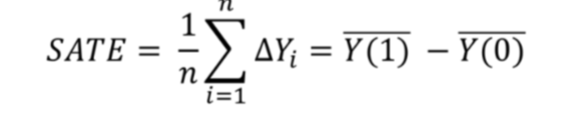
SATE measures
the average effect of the treatment on the outcome
If SATE = 0, we say that, on average, the treatment (X)
does NOT cause the outcome (Y)
If SATE > 0 we say that, on average, the treatment (X)
causes an increase of the outcome (Y)
If SATE < 0 we say that, on average, the treatment (X)
causes a decrease on the outcome (Y)
Population Average Treatment Effect (PATE)
Same as SATE, but for an entire population instead of a sample

Letting N
denote the size of the population
The interpretation of PATE is similar to SATE, but
focusing on the entire population instead of a sample
The Fundamental Problem of Causal Inference
• A unit of observation either gets the treatment or doesn’t!
• We only observe Yi (1) or Y (0 ) for any i !
• So, we cannot calculate Δ Yi for any i !
• So, we cannot calculate SATE for any sample!
• And, we cannot calculate PATE for any population!