Intro to Buiss Ch4: The Contemporary Global Economy
 Call Kai
 Learn
Learn Practice Test
 Spaced Repetition
 Match
Match Flashcards
 Knowt Play
1/65

There's no tags or description
Looks like no tags are added yet.
Name | Mastery | Learn | Test | Matching | Spaced | Call with Kai | Chat |
|---|
No analytics yet
Send a link to your students to track their progress
66 Terms
Globalization
process by which the world economy is becoming a single interdependent system
Imports
product made or grown abroad but sold domestically
Exports
product made or grown domestically but shipped and sold abroad
International Trade with SB’s
Small firms with no international operations (for example, an independent coffee shop) may still buy from international suppliers, and even individual contractors or self-employed individuals can be affected by fluctuations in exchange rates.
Advantages of Globalization
higher standards of living
improved business profitability
quickness in communication and commerce
Disadvantages of Globalization
allows businesses to exploit workers in less developed countries
bypass domestic environmental and tax regulation
loss of cultural heritages
local languages disappearing (English in Africa)
makes the rich richer and the poor helpless
High-income countries
Those with annual per capita income greater than $12,695
Upper-middle income countries
Those with annual per capita income between $4,096 and $12,695
Lower-middle income countries
Those with annual per capita income between $4,095 and $1,046
low-income/developing countries
Those with annual per capita income less than $1,046
Three major marketplaces
Pacific-Asia
North America (Canada as well)
Europe
North American Markets
largest and most stable
Mexico provides low-cost labor
Markets have been shifting to China since it’s cheaper and due to drug-related violence
Western European Markets
Germany, UK, France (EU has raised importance)
mature but fragmented
Digital Commerce and Tech
Ireland —> one of the largest software exporters
Strasbourg, France —> bio-tech startups
Frankfurt as well
Eastern European Markets
Marketplace and Producer
Poland —> Daewoo, Nestlé, General Motors, and ABB Asea Brown Boveri
Hungary —> Ford, General Motors, Suzuki, and Volkswagen
Russia, Bulgaria, Albania, Romania and more —> governmental instability, corruption, and uncertainty
Pacific Asia
Japan, China, Thailand, Malaysia, Singapore, Indonesia, South Korea, Taiwan, Vietnam, the Philippines, and Australia
automobile, electronics, and banking industries (start-up in 70’s/80’s)
Heavy impacts on China from pandemic
Major players in global economy —>Toyota, Toshiba, and Nippon Steel (Japan); Samsung and Hyundai (South Korea); and Chinese Petroleum (Taiwan)
Vietnam —> major manufacturing center
Hong Kong —> major financial center
China —> world’s most densely populated country
Hamper tech-start up —> poorly developed electronic infrastructures, slower adoption of computers and information technology, and a higher percentage of lower-income consumers hamper the emergence of technology firms.
India —> rising up as well
Mexico VS China
people were looking for cheap labor
Mexico
fueled in part by its role as a center of manufacturing
led to increases in the cost of living
followed quickly by wage increases so workers
made a lot of economic flourshment when America wanted to produce cars (autoparts)
20% of GDP (2023), 5th largest autoproducer in the world
China
no shortage of workers
1/3 of the wages offered in Mexico
Time differences between USA and China made communication difficult
North American Free Trade Agreement/United States–Mexico–Canada Agreement of 1994
(NAFTA) agreement to gradually eliminate tariffs and other trade barriers among the United States, Canada, and Mexico
agreements on environmental and labor issues
new jobs
Disadvantages: did not help w. trade balance in America
Trump —> USMCA
2020, negotiated trade to increase exports from USA to Canada and Mexico
European Union (EU)
eliminated most quotas and set uniform tariff on exported/imported products
largest free marketplace in the world (1992), production of the Euro (2002)
German Deutsche Mark, the Italian lira, and the French franc
UK departed from EU (2016)
gravest economic crisis in a generation
people blamed the withdrawal
Association of Southeast Asian Nations
1967 as an organization for economic, political, social, and cultural cooperation
due to difference in size, ASEAN is smaller impact than EU and USMCA
1995 —> Vietnam became first communist country
General Agreement on Tariffs and Trade (GATT)
international trade agreement to encourage the multilateral reduction or elimination of trade barriers
reduce or eliminate trade barriers, such as tariffs and quotas
protect domestic industries, multilateral negotiations
World Trade Organization (WTO)
January 1, 1995
164 member countries
Promote trade by encouraging members to adopt fair-trade practices.
Reduce trade barriers by promoting multilateral negotiations.
Establish fair procedures for resolving disputes among members.
Balance of Trade
A country’s balance of trade is the total economic value of all the products that it exports minus the economic value of all the products that it imports.
Positive Balance of Trades:
results when a country exports (sells to other countries) more than it imports (buys from other countries)
Negative Balance of Trades:
results when a country imports more than it exports
Flow of Currency
When U.S. consumers and businesses buy foreign products, dollars flow from the United States to other countries; when U.S. businesses are selling to foreign consumers and businesses, dollars flow back into the United States.
Trade Deficit
situation in which a country’s imports exceed its exports, creating a negative balance of trade
Trade Surplus
situation in which a country’s exports exceed its imports, creating a positive balance of trade
Balance of Payments
flow of all money into or out of a country
tourist’s money
foreign aid programs
exchanged by buying and selling currency on international money markets
Exchange Rate
rate at which the currency of one nation can be exchanged for the currency of another nation
This means that it costs £1 to “buy” $2 or $1 to “buy” £0.5. Stated differently, £1 and $2 have the same purchasing power, or £1=$2
doesn’t fluctuate much day-to-day
Gov can regulate it (like China), but also leave it unregulated
Floating Exchange Rates
The norm
value of one country’s currency relative to that of another varies with market conditions (USA)
Currency and High Demand
currency is strong when demand for it is high
high demand for the goods manufactured with that currency
Falling currency value
its balance of trade usually improves because domestic companies should experience a boost in exports.
Absolute Advantage
the ability to produce something more efficiently than any other country can
Comparative Advantage
the ability to produce some products more efficiently than others
National Competitive Average
international competitive advantage stemming from a combination of factor conditions, demand conditions, related and supporting industries, and firm strategies, structures, and rivalries
Factor conditions/factors of production
Labor, capital, entrepreneurs, physical resources, and information resources.
Demand Conditions
Reflect a large domestic consumer base that promotes strong demand for innovative products.
Related and supporting industries
include strong local or regional suppliers or industrial customers
Strategies, structures, and rivalries
firms and industries that stress cost production, product quality, higher productivity, and innovating products
Process of Going International
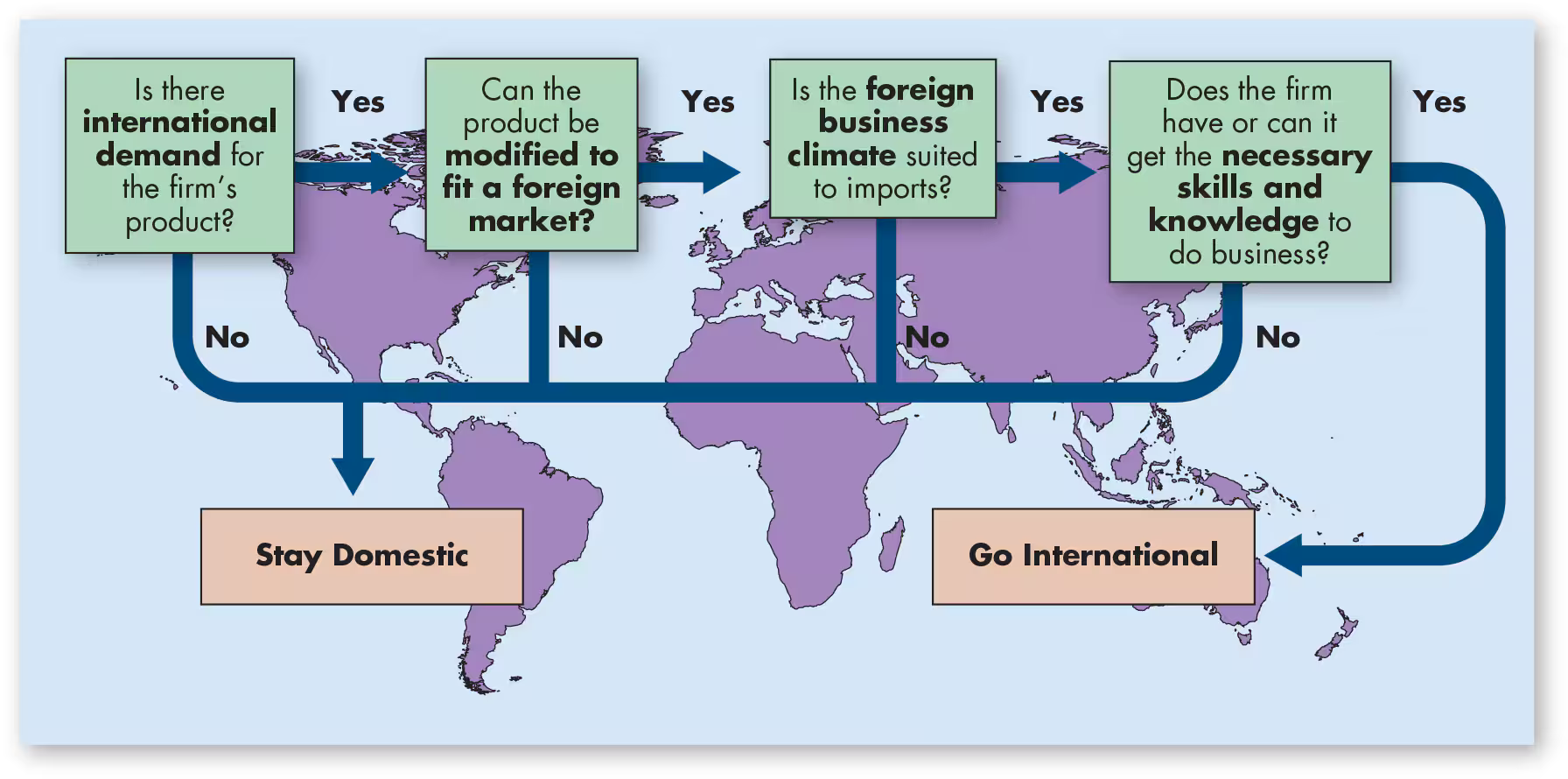
Gauging International Demand
a company must determine whether its products are in demand abroad. Products that are successful in one country may be useless in another. Even when there is demand, advertising and promotion may still need to be adjusted.
Adapting to customer needs
a firm must decide whether and how to adapt it to meet the special demands of foreign customers. For example, to satisfy local tastes, McDonald’s sells wine in France.
Outsourcing
the practice of paying suppliers and distributors to perform certain business processes or to provide needed materials or services, has become a popular option for going international
Offshoring
the practice of outsourcing to foreign countries
outsourcing but internationally
Exporter
firm that distributes and sells products to one or more foreign countries
Importer
firm that buys products in foreign markets and then imports them for resale in its home country
Women Entrepreneurs Grow Global (WEGG)
focused on helping women entrepreneurs expand their businesses internationally
40,000 women business owners and entrepreneurs
International Firms
firm that conducts a significant portion of its business in foreign countries
basically a domestic company with international operations
buys and sells across national boundaries but also generates most of its revenues from its domestic market.
Multi-national firms
firm that designs, produces, and markets products in many nations
Don’t think of themselves as having domestic and international divisions.
Headquarters locations are almost irrelevant,
planning and decision making are geared to international markets.
Independent Agents (Organizational Strategies)
Individual or organization that agrees to represent an exporter’s interests
sell the exporter’s products, collect payment, and make sure that customers are satisfied
don’t usually specialize
Licensing Agreements (Organizational Strategies)
arrangement in which firms choose individuals or organizations to manufacture or market their products in another country
For example, McDonald’s, Pizza Hut, and Hertz Car Rental have franchises around the world.
Branch Offices (Organizational Strategies)
Instead of developing relationships with foreign agents or licensing companies, a firm may send its own managers to overseas branch offices, where the firm has more direct control than it does over agents or license holders
Halliburton, a Houston-based oil field supply and services company, opened a branch office in Dubai to more effectively establish relationships with customers in the Middle East
Strategic Alliances (Organizational Strategies)
company finds a partner in the country in which it wants to do business. Each party agrees to invest resources and capital into a new business or to cooperate in some mutually beneficial way.
dividing of profits
both organizations have their strengths (brand name working together with great manufacturers)
give firms greater control over foreign activities than agents and licensees
sharing of knowledge makes both companies better from the alliance
Foreign Direct Investment
(FDI) arrangement in which a firm buys or establishes tangible assets in another country
Dell Computer, for example, has built assembly plants in Europe and China
Social Orientation
Relative importance of the individual v.s. the interests of the group
Individualism —> individual’s interests take priority
US, UK, Australia, Canada, New Zealand, Netherlands
Collectivism —> group’s interest take priority.
Mexico, Greece, Hong Kong, Taiwan, Peru, Singapore, Colombia, and Pakistan
Power Orientation
the appropriateness of power/authority within organizations
Power Respect —> authority is inherent in a known hierarchy
France, Spain, Mexico, Japan, Brazil, Indonesia, and Singapore
Power Tolerance —> individuals assess power in their own personal perspective or personal interests.
US, Israel, Austria, Denmark, Ireland, Norway, Germany, and New Zealand
Uncertainty Orientation
Emotional response to uncertainty
Uncertainty Acceptance —> positive response to change and opportunities
United States, Denmark, Sweden, Canada, Singapore, Hong Kong, and Australia
Uncertainty Avoidance —> Prefer structure and a consistent routine
Israel, Austria, Japan, Italy, Colombia, France, Peru, and Germany
Goal Orientation
What motivates people to achieve different goals
Aggressive Goal Behavior —> values materials, money, possessions
Japan (extreme), Germany, Mexico, Italy, and the United States (moderate)
Passive Goal Behavior —> values social relevance, quality of life, and welfare of community.
Norway, Sweden, Denmark, and Finland, Netherlands
Time Orientation
extent to which members of a culture adopt a long-term or short-term outlook on work and life.
Long-term outlook —> value dedication, handwork, thrift
Japan, Hong Kong, Taiwan, South Korea
Short-term outlook —> value tradition, social obligation
Pakistan and West Africa
Immediate Outlook —> balance between short and long term
United States, Germany
Quota
restriction on the number of products of a certain type that can be imported into a country
Embargo
government order banning exportation or importation of a particular product or all products from a particular country
Tariffs
tax levied on imported products
Subsidy
government payment to help a domestic business compete with foreign firms
Protectionism
practice of protecting domestic business against foreign competition
Local Content Laws
law requiring that products sold in a particular country be at least partly made there
Business Practice Laws
law or regulation governing business practices in given countries
Cartels
association of producers whose purpose is to control supply and pricespractice of selling a product abroad for less than the cost of production
Dumping
practice of selling a product abroad for less than the cost of production
the low-valued foreign product messes with domestic markets