Mathematical Induction and Partial fractions
 Call Kai
 Learn
Learn Practice Test
 Spaced Repetition
 Match
Match Flashcards
 Knowt Play
1/6

There's no tags or description
Looks like no tags are added yet.
Name | Mastery | Learn | Test | Matching | Spaced | Call with Kai | Chat |
|---|
No analytics yet
Send a link to your students to track their progress
7 Terms
What are the steps of a standard mathematical induction question?
STEP 1: Prove true for n = 1 (LHS and RHS)
STEP 2: Assume true for n = k (Make a 1 line equation)
STEP 3: Prove true for n = k + 1 (LHS = RHS by substituting k + 1 into the equation)
STEP 4: “By the Principle of Mathematical Induction the statement is true for ∀ n ∈ N”
What are the steps of a divisible mathematical induction question?
STEP 1: Prove true for n = 1 (Have to make the statement: “n1 is divisible by n”)
STEP 2: STEP 2: Assume true for n = k: (use r ; “where r ∈ N” )
STEP 3: Prove true for n = k + 1 (Have to make the statement: “n1 is divisible by n” + “Statement is true for n = k + 1”)
STEP 4: “By the Principle of Mathematical Induction the statement is true for ∀ n ∈ N”
In a question about mathematical induction where there is a lowest known value for which the statement is true what should you do?
Use the lowest given value in the first step (where you normally prove true for n=1) and prove true for n=(lowest given number)
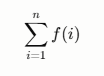
How does sigma notation work?
The variable underneath the sigma (i) is the counter
The number underneath the sigma (1) is the starting value
The number on top of the sigma (n) is the ending value
The f(i) is the expression that you are computing and then adding until the final i value is equal to n
If a partial fraction has repeated linear factors i.e. (X+1)2… what should you do?
treat (X+1) and (X+1)2 as denominators in different terms (and you used the term with the highest power for cover up)
If a partial fraction has irreducible (i.e. (x2 + 3) ) factors, what should you do?
Bx + C on the top and the irreducible factor at the bottom
If a partial fraction has repeated linear factors AND they are irreducible, what should you do?
Ax+B at the top, lowest power irreducible at the bottom, Cx + D at the top… etc