Lecture 2: Neurons & Glia
 Call Kai
 Learn
Learn Practice Test
 Spaced Repetition
 Match
Match Flashcards
 Knowt Play
1/28

There's no tags or description
Looks like no tags are added yet.
Name | Mastery | Learn | Test | Matching | Spaced | Call with Kai | Chat |
|---|
No analytics yet
Send a link to your students to track their progress
29 Terms
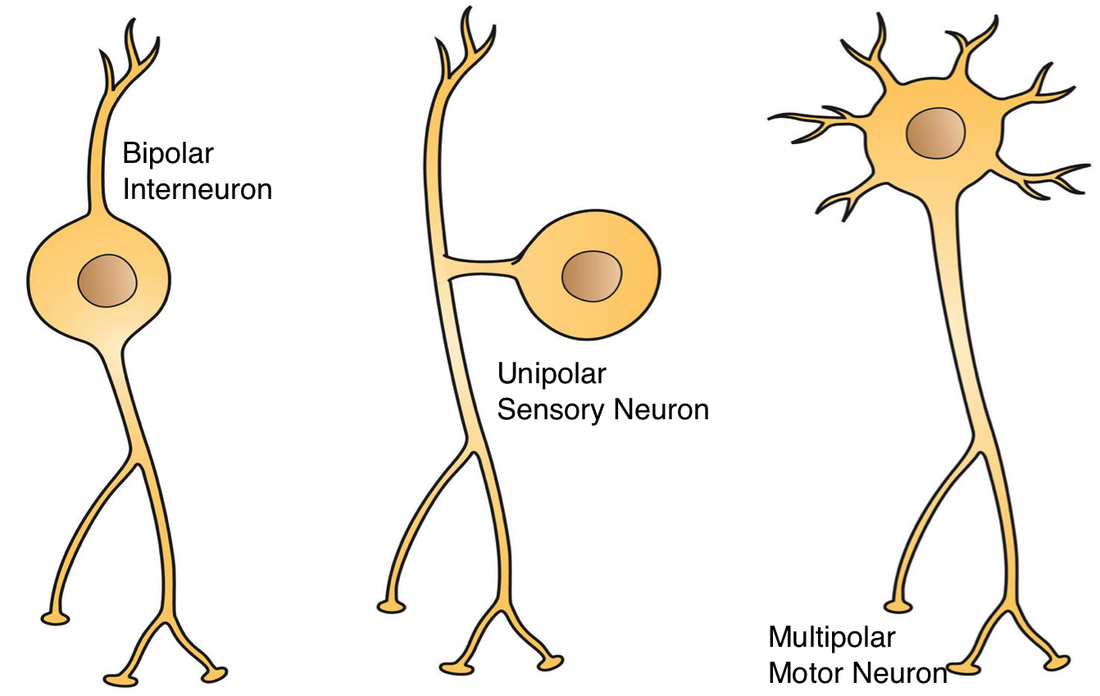
Bipolar, Unipolar, and Multipolar Neurons
Bipolar: one axon, one dendrite
Pseudounipolar Neurons: a single extension branches in two directions, forming an input and output zone (touch & pain senses)
Multipolar Neurons: one axon, many branching dendrites, recieve and integrate large amounts of information.
Dendrites
receive incoming signals from other neurons and carry them toward the cell body
Axons
transmit outgoing electrical signals away from the cell body to other cells
Sensory Neurons
respond to stimuli such as light, odor, or touch)
Motor Neurons
contact muscles or glands
Interneurons
receive input from and sent input to other neurons
Myelin
is a layer of lipid which wraps around axons
Producers of Myeline
Oligodendrocytes (located in CNS)
Schwann cells (located in PNS)
Glial Cells located in CNS
Astrocytes
Oligodendrocytes
Microglia
Ependymal
Glial Cells located in PNS
Schwann Cells
Satellite Glial Cells
The human nervous system is made up of neurons…
… (86 billion in the brain) and glial cells.

Nodes of Ranvier
exposed part of the axon that is not covered my the myelin sheath
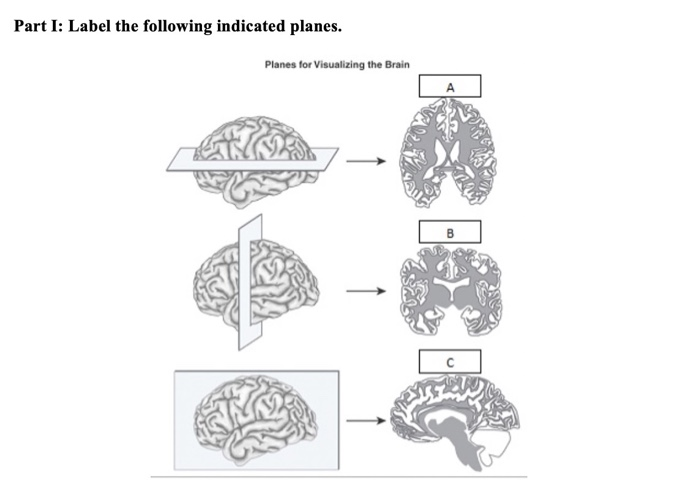
Brain Plane
Coronal: separates front to back, butterfly shape
Sagittal: separates down midline, half brain shape
Horizontal: separates top to bottom, island shape
3 types of studies to test hypotheses for the biological bases of behavior
Somatic Intervention: manipulating the body (IV) causes changes in behavior (DV)
Behavioral Intervention: manipulating the behavior (IV) causes changes in the body and brain (DV)
Correlation Study: measures how closely the body and behavior measures:
Negative Correlation (↑↓), Positive Correlation (↑↑ or ↓↓)
True or False: A Correlation Experiment shows causality between variables, but cannot prove association.
False - A Correlation Experiment shows association between two variables, but cannot prove causality (cause and effect).

The Cerebrum (3)
largest part of brain
left half and right half
controls thinking, speech, and 5 senses
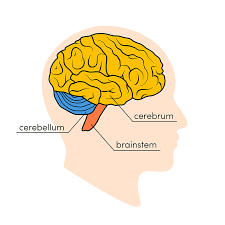
The Cerebellum (2)
small part at back of head
helps with balance, posture and body coordination

The Brainstem
connects brain to spinal cord
controls actions like breathing and heart rate
Central Nervous System (CNS)
made up of the brain and spinal cord which work together to control the body
brain: controls thinking, memory, feelings, and movement
spinal cord: long bundle of nerve tissue inside the spine that sends messages between the brain and body

Input Zone
neurons collect and process information, either from the environment or from other cells
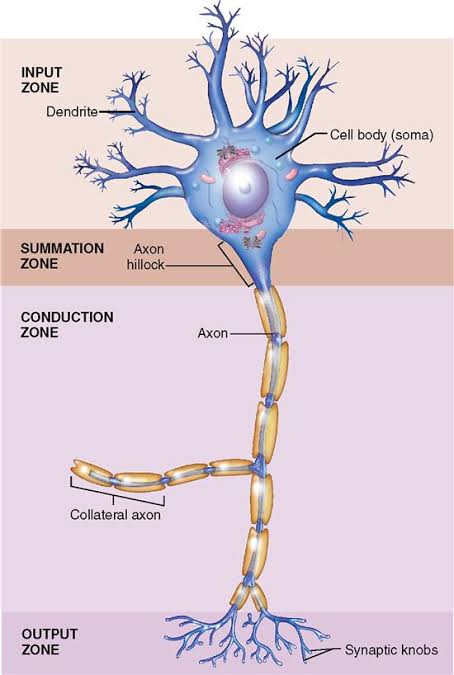
Integration Zone
where the decision to produce a neural signal is made

Conduction Zone
where information can be electrically transmitted over great distances

Output Zone
where the neuron transfers information to other cells

White matter
composed of axon bundles
white color comes from myelin sheath cover the axons
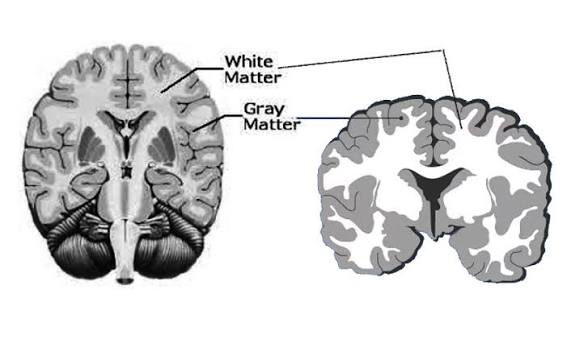
Gray matter
composed of clusters of cell bodies
Peripheral Nervous System (PNS)
made up of all the neural tissue located outside of the body structures of the brain and spinal cord
Cranial Nerves
12 pairs emerging from the brain
Sensory Nerves (3 Pairs): Olfactory, Optic, Vestibulocochlear
Motor Nerves (5 Pairs): Oculomotor, Trochlear, Abducens, Spinal accessory, Hypoglossal
Sensory & Motor (4 Pairs): Trigeminal, Facial, Glossopharyngeal, Vagus
Spinal Nerves
31 pairs emerging from the spinal cord → mixed nerves carrying sensory (incoming) and motor (outgoing) messages
Nerves: 8 Cervical, 12 Thoracic, 5 Lumbar, 5 Sacral, 1 Coccygeal
Each nerve consists of motor axons (project) and sensory axons (enter)
The Neuron Doctrine
nervous system is made up of discrete, individual cells that communicate across tiny gaps called synapses via chemical or electrical signals
proved by Santiago Ramon y Cajal by applying the Golgi Stain