Week 10: Social -Cognitive Development
 Call Kai
 Learn
Learn Practice Test
 Spaced Repetition
 Match
Match Flashcards
 Knowt Play
1/10

There's no tags or description
Looks like no tags are added yet.
Name | Mastery | Learn | Test | Matching | Spaced | Call with Kai | Chat |
|---|
No analytics yet
Send a link to your students to track their progress
11 Terms
Social categories What is the minimal Group effect?
3-5 year olds randomly assigned to groups – Wear red or blue t shirts to preschool every day for 3 weeks – Children evaluated in-group peers more favorably than out group peers
Describe the doll study?
Whether or not you prefer a toy that has the same hair colour or the same shirt colour. Finds that children are sensitive to if categories are inherent to the doll or not Children like things that are more similar.
Are infants sensitive to social categories? (Food preference)
‘Similar to self’ food preferences in toy sheeps –11 month Experiment follows procedure • Preference test – Choose between beans and crackers • Shown two puppet toys – One preference same (crackers) – One preference different (beans) • DV
Are infants sensitive to social categories? (Clothing preference)
Similar to self → looked at clothing preference in monkeys – 11 month olds • Preference test – Infants chooses between two mittens (yellow and orange), infant wears mittens • Shown two puppet toys » One chooses yellow mittens » One chooses orange mittens – DV
Social Actions → do infants understand good and bad people? What information do they use to make judgements about social behaviour
Describe the helper and hinderer studies?
6-month olds and 10-month olds habituated to a climber trying to ascend a hill. On alternating trials a … – “Helper” pushes the climber up OR – “Hinderer” prevents the climber from getting to the top Test trials showed the climber either approaching the helper, or approaching the hinderer DV - DV1
What were the results of the helper or hinder studies?
Found that Looking time → 10 month old look longer at the unexpected event Whereas 6 month olds looked equally at both events. (Looking time measure is not really reliable) Suggests that 10 month olds understand morality Toy Choice → Helper vs. Hinderer , found 12/12 choose helper and in 10 month olds 14/16 choose helper Suggest that 6 and 10 months both understand morality. Neutral comparison → 6-month olds 7/8 chose helper – 10-month olds 7/8 chose helper 6-month olds 7/8 chose neutral – 10-month olds 7/8 chose neutral Suggests that infants like the helper and dislike the hinder, or both. ‘UNIVERSAL’ → too big a claim - population and timeframes
be able to think about alternative explanations for children’s behavior in these tasks
What is the alternative explanation of the helper or hinderer studies?
Both help and hinder trials have collision between the characters (aversive) , Only helper events have a bouncing event (positive) • Perhaps infants choose the helper because it is associated with bouncing and fail to choose the hinderer because it is associated with collision
Explain the first study which addresses the alternative explanation around helper and hinder (Bouncing) ?
E1 - eliminated the bouncing from the helper event → According to the social evaluation explanation → infants SHOULD choose the helper over the neutral character, According to the association explanation → infants SHOULD choose the neutral character because the helper is associated with collision.
They found that In comparing non-bouncer helper vs. neutral chooses ⅞ chose neutrals – suggests infants find collision aversion and choose the toy not associated with the collision. Suggest problems with initial paradigm
Explain the second study which addresses the alternative explanation
Further tested the alternative explanation → wonders if the bouncing is actually positive. Had 3 x comparisons Bounce-at-top helper events vs. hinderer event Helper event vs. bounce-at-bottom hinder Bounce both This allows for a test of both explanations - if associative explanation → should choose an object associated with bouncing - if social evaluation explanation → should choose object associated with helper.
They found that
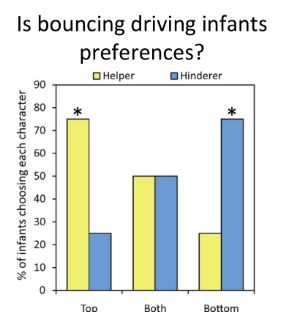
Bouncing explained most of the behavioural, that is, babies choose the bouncing despite social evaluations.
What should you be wary of?
• However, rich interpretation of infant behaviour may be problematic • Always ask… – Is there a more parsimonious explanation? – Can basic perceptual processes explain the infants’ behaviour?
be familiar with the Many Babies movement and attempts to assess reproducibility in infant research
What is the Many Babies project?
Large scale preproductibility project. Aims to test core findings across the world and across different labs. Really detailed paradigms
→ individuals leading the paradigm write a registered report - a new kind of journal article where journal articles (intro, methods, data analysis) are written before publishing the results. If editors believe in you, you get an In Principle Acceptance.
This allows for replication and investigation of possible projects. Has tested → Infants preference for infant directed speeches → replicates!, theory of mind, rule learning and most recently helper vs. hinderer .