Chapter 20: Carboxylic Acids & Nitriles
 Call Kai
 Learn
Learn Practice Test
 Spaced Repetition
 Match
Match Flashcards
 Knowt Play
1/25

There's no tags or description
Looks like no tags are added yet.
Name | Mastery | Learn | Test | Matching | Spaced | Call with Kai | Chat |
|---|
No analytics yet
Send a link to your students to track their progress
26 Terms
Carboxylic Acids
C=O + OH on the same carbon
The functional group is:
–CO₂H or –COOH
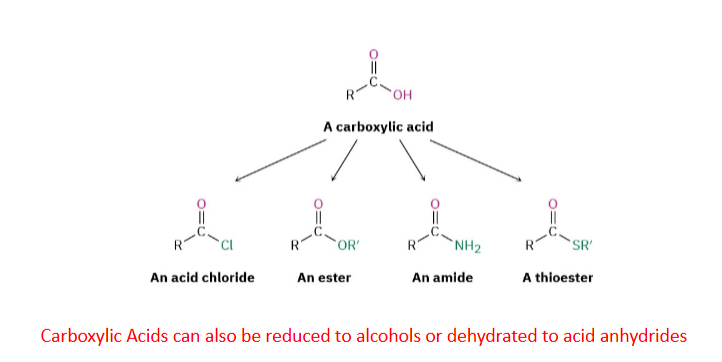
Carboxylic acids can also be:
reduced → alcohols
dehydrated → acid anhydrides
Naming Carboxylic Acids
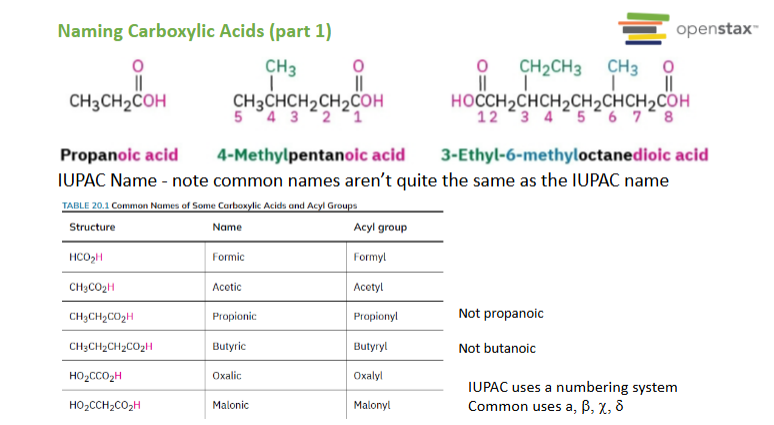
IUPAC Rules
Find longest Carbon chain containing the COOH carbon
The carboxylic acid carbon is automatically Carbon #1
Change -e to -oic acid
The COOH carbon is always Carbon #1
Carboxylic Acid Properties
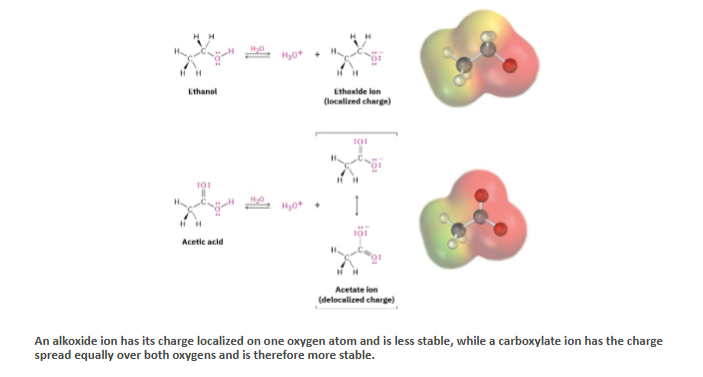
Acidic because they can lose H+, the product is a carboxylate ion
When an acid loses H+, the negative charge can be distributed over both Oxygens. The two resonance structures are equivalent. The negative charge can be distributed over both oxygens. The two resonance structures are equivalent.
Result:
The negative charge is spread out —> more stable conjugate base —> more acidic starting molecule.
Acidity Rule
More stable conjugate base = stronger acid
This means that carboxylic acids are much more acidic than alcohols
Carboxylate:
negative charge delocalized over TWO oxygens
Alcohol conjugate base:
negative charge localized on ONE oxygen
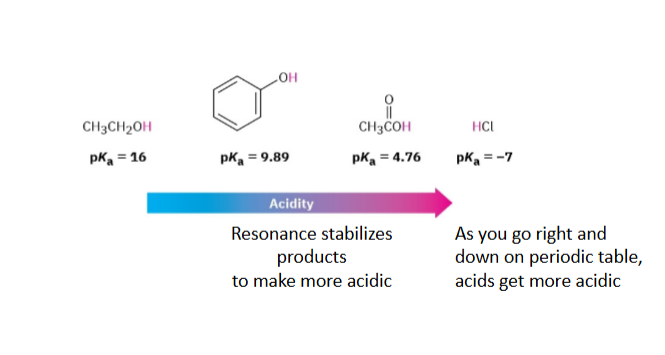
Going RIGHT and DOWN generally increases acidity.
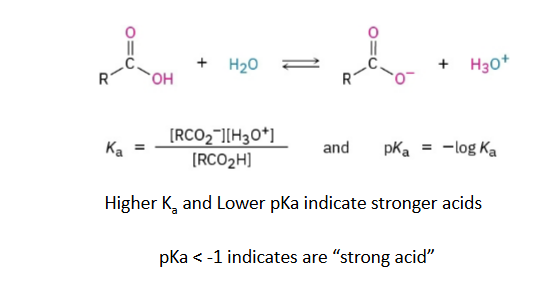
Ka and Pka
Higher Ka = stronger acid
pKa is -log ka, so:
Lower pKa = stronger acid
Higher pKa = weaker acid
Carboxylic acid dimers
Two carboxylic acid molecules interact through two hydrogen bonds. This strong association affects physical properties such as boiling point.
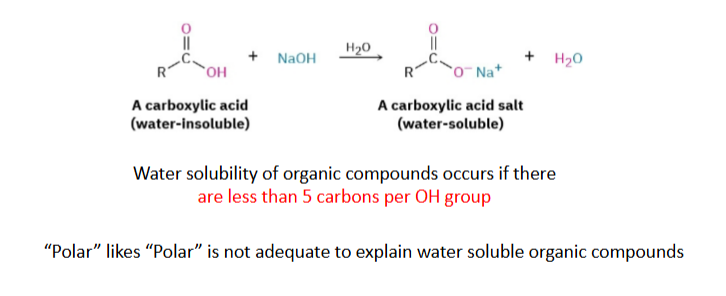
Water Solubility
Carboxylic acids can hydrogen bond with water. Short chain acids are relatively soluble. As the carbon chain becomes longer, solubility decreases.
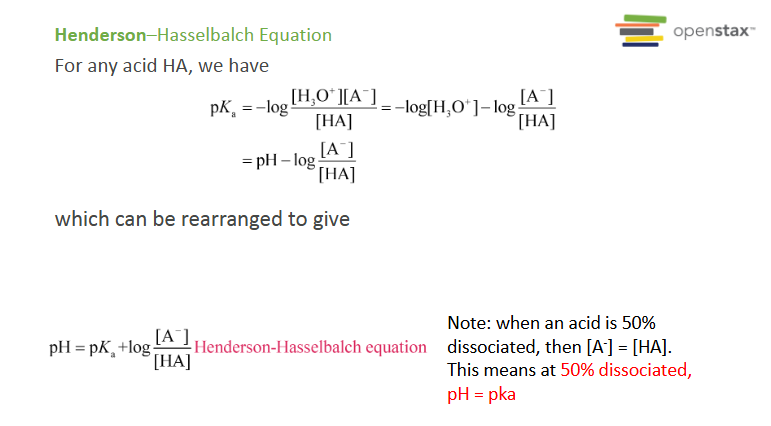
Henderson-HasselBalch Equation
see image
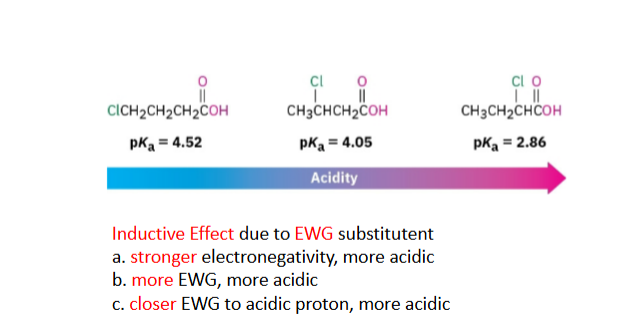
Substituent Effects on Acidity
Substituents can make an acid:
more acidic
less acidic
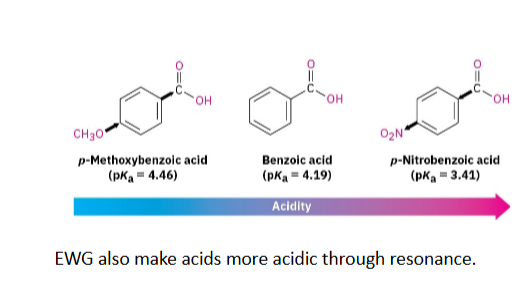
Electron-withdrawing groups (EWGs) increase acidity. (Why?) They pull electron density away and stabilize the negative charge of the conjugate base.
INDUCTIVE EFFECT
EWG → stronger acid
More electronegative substituent → more acidic
More EWGs → more acidic
EWG closer to acidic group → more acidic
An EWG immediately next to COOH has a stronger effect than one farther away.
Resonance Effects of EWG’s
EWGs can also stabilize negative charge through resonance when the structure allows it. This is particularly important with aromatic systems.
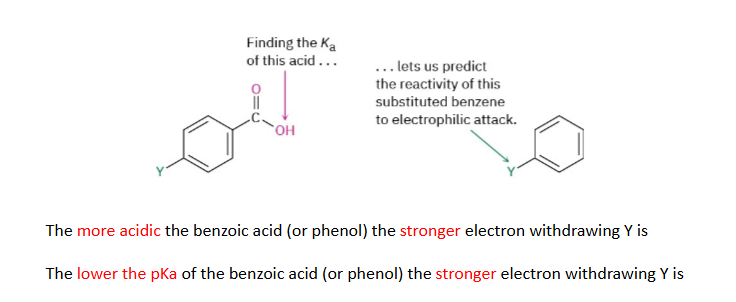
Using pKa to identify EWG/EDG
If a substituted benzoic acid has a: LOWER pKa than benzoic acid
The substituent is likely: Electron withdrawing Because it makes the acid stronger.
If pKa is higher: Electron donating, The substituent makes the acid weaker.
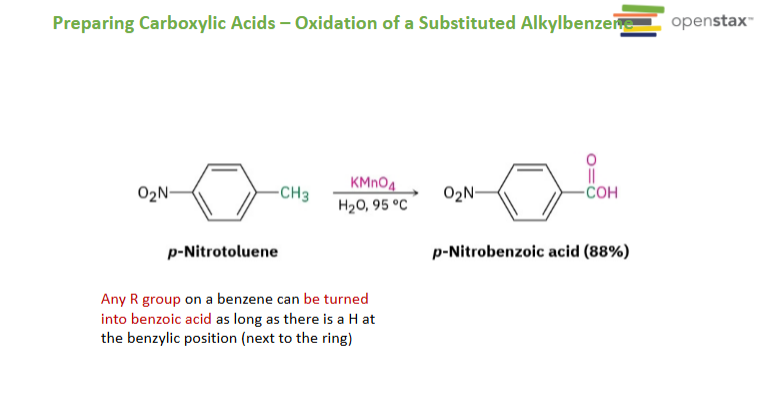
Preparing Carboxylic Acids: Oxidation of alkylbenzenes
If you have:
benzene—R
and the benzylic carbon has:
at least ONE H
Strong oxidation can convert the entire side chain into:
benzene—COOH
So:
Alkylbenzene → benzoic acid
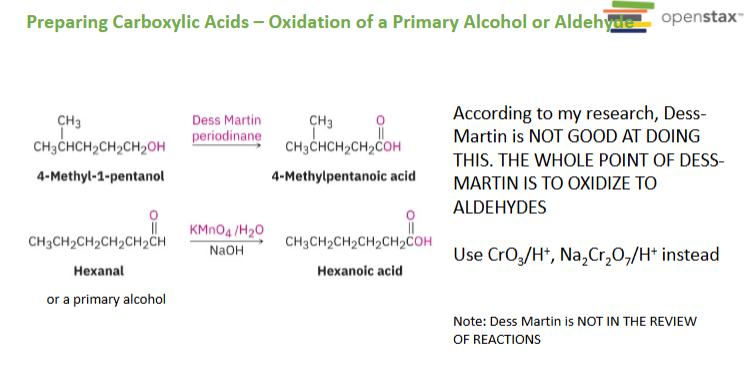
Preparing Carboxylic Acids: Oxidation of Primary Alcohols
Primary alcohol:
RCH₂OH
↓
oxidation
↓
aldehyde
↓
further oxidation
↓
carboxylic acid
Reagents: CrO₃/H⁺ & Na₂Cr₂O₇/H⁺
Dess-Martin is not the reagent to use for this final oxidation; its role is stopping at the aldehyde.
Preparing Carboxylic Acids: Oxidation of Aldehydes
RCHO
↓ oxidation
RCOOH
Same important reagents:
CrO₃/H⁺
Na₂Cr₂O₇/H⁺
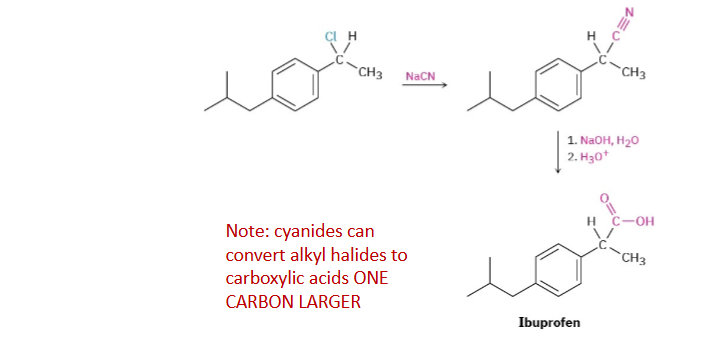
Preparing Carboxylic Acids: Nitrile Hydrolysis
A nitrile:
R—C≡N
can be hydrolyzed into:
R—COOH
Nitrile → carboxylic acid
The carbon skeleton is maintained.
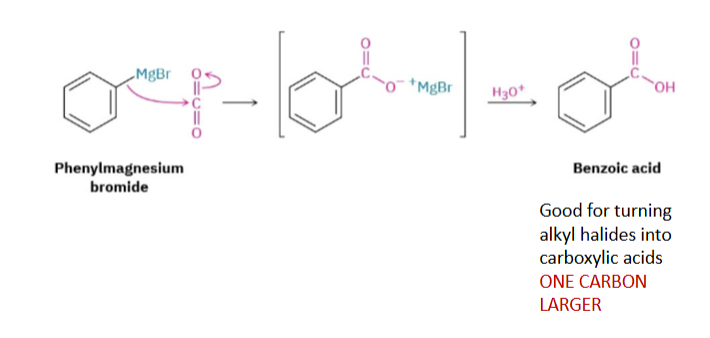
Preparing Carboxylic Acids: Grignard + CO2
Grignard:
RMgX
reacts with:
CO₂
then acid workup.
Product:
RCOOH
Important:
This adds ONE carbon to the carbon skeleton.
Why?
Because the carbon from CO₂ becomes the carboxyl carbon.
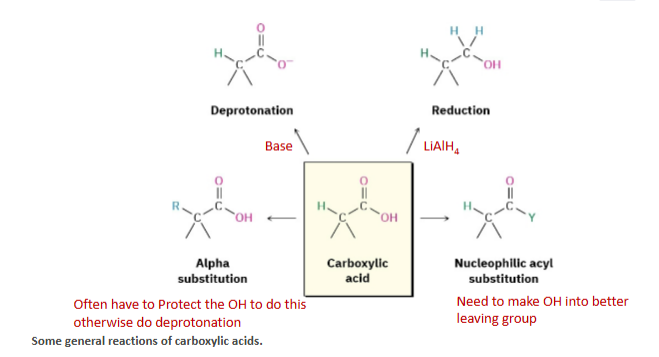
Reactions of Carboxylic Acids
Carboxylic acid → alcohol, using: LiAlH₄
Carboxylic acid → acid anhydride, through dehydration.
Carboxylic acids have: RCOOH
The OH is a: poor leaving group
So you often need to activate the OH or convert it into a better leaving group before substitution-type chemistry can occur.
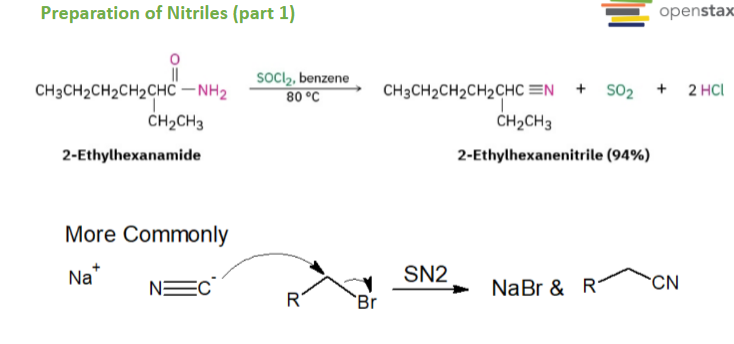
Nitriles
Functional group: –C≡N, Called: Cyano group
The nitrile carbon is electrophilic.
Therefore nitriles can undergo:
Nucleophilic addition
Preparing Nitriles
Alkyl halide → nitrile, Use: CN⁻. This is typically SN2. The carbon from CN becomes part of the molecules, therefore, Nitrile formation adds ONE carbon
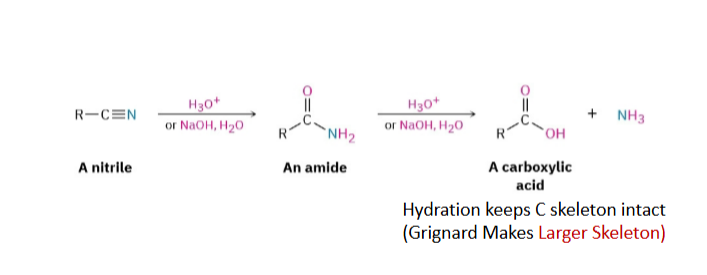
Nitrile Hydrolysis
Nitrile → Amide → Carboxylic acid
Carbon skeleton does not change. The same nitrile carbon becomes the carboxyl carbon
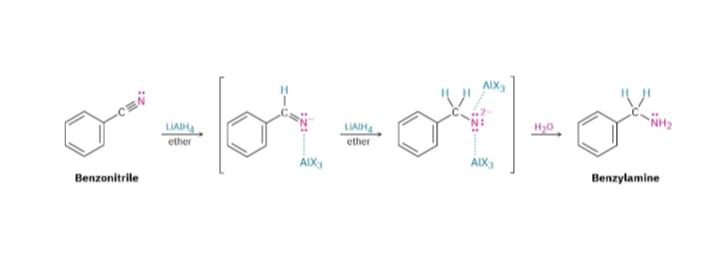
Nitrile Reduction
Nitriles can be reduced. Nitrile → Primary amine. The carbon skeleton stays intact.
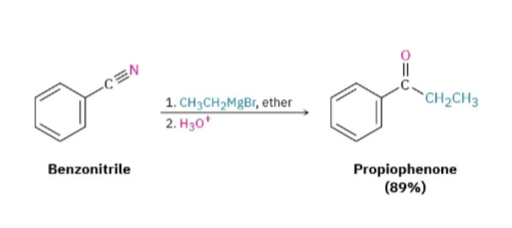
Nitrile + Grignard
Nitrile:
R—C≡N
reacts with:
R'MgX
The Grignard adds an R group.
After workup:
Ketone
Grignard adds a carbon containing group, giving a larger Carbon skeleton
IR Spec
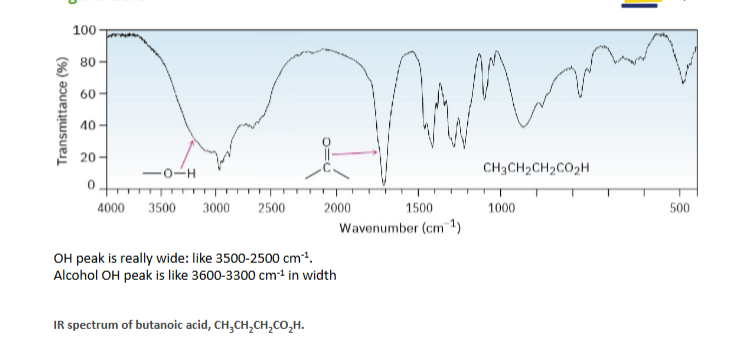
Carboxylic Acid
C=O:
~1700 cm⁻¹
Strong peak.
But the OH is extremely broad.
Carboxylic acid OH:
~2500–3300 cm⁻¹
Alcohol OH:
~3600–3300 cm⁻¹
Usually broad.
Nitrile IR:
C≡N stretch:
~2200–2250 cm⁻¹
Usually a relatively sharp peak.
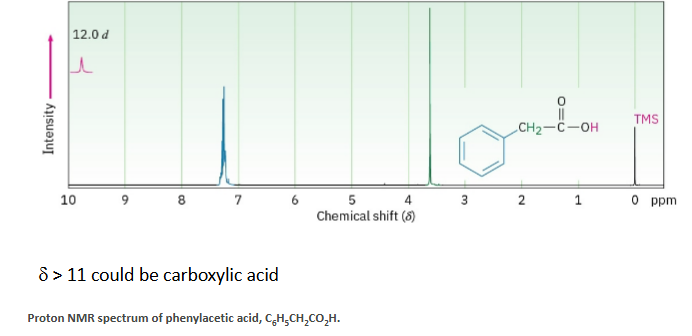
1 H NMR Carboxylic acid proton
The COOH proton appears very far downfield: > 11 ppm
summary (pt 1)
COOH = carboxylic acid
CN = nitrile
Lower pKa = stronger acid
Higher Ka = stronger acid
More stable conjugate base = stronger acid
Resonance stabilizes carboxylate
EWGs increase acidity
Closer EWG = stronger effect
pH = pKa → 50% HA / 50% A⁻
Alkyl halide + CN⁻ → nitrile
Nitrile hydrolysis → carboxylic acid
Nitrile hydrolysis keeps carbon skeleton the same
Grignard + CO₂ → carboxylic acid ONE carbon larger
Nitrile + Grignard → ketone
Nitrile reduction → primary amine
summary (pt 2)
Carboxylic acids = RCOOH.
They are acidic because their conjugate base, RCOO⁻, is resonance-stabilized. Lower pKa = stronger acid. Electron-withdrawing groups increase acidity, especially when they are close to COOH. Henderson–Hasselbalch: pH = pKa + log(A⁻/HA), and when pH = pKa, you have 50% HA and 50% A⁻.
Carboxylic acids can be made by strong oxidation of primary alcohols/aldehydes, oxidation of alkylbenzenes, nitrile hydrolysis, or Grignard + CO₂. Grignard + CO₂ adds one carbon.
Nitriles = R–C≡N. Alkyl halide + CN⁻ makes a nitrile and adds one carbon. Nitrile hydrolysis gives a carboxylic acid with the same carbon skeleton. Nitrile reduction gives a primary amine. Nitrile + Grignard gives a ketone with a larger carbon skeleton.
IR: C=O ~1700 cm⁻¹, carboxylic acid OH is very broad ~2500–3300 cm⁻¹, and C≡N is around 2200 cm⁻¹. In ¹H NMR, a signal >11 ppm strongly suggests a carboxylic acid proton.