ap hug unit 2 test
 Call Kai
 Learn
Learn Practice Test
 Spaced Repetition
 Match
Match Flashcards
 Knowt Play
1/43

There's no tags or description
Looks like no tags are added yet.
Name | Mastery | Learn | Test | Matching | Spaced | Call with Kai | Chat |
|---|
No analytics yet
Send a link to your students to track their progress
44 Terms
what is arithmetic population density? what is it used for?
use: provides broad overview of how crowded an area is
pros: easy to find through census; can be accurate depending on the scale
cons: does not account for uneven distribution of population within each country (distribution is often not uniform)

what is physiological population density? what is it used for?
demonstrates carrying capacity (the maximum population size that can be supported by the available resources without damaging the environment or using natural resources unsustainably)
high physiological distribution indicates resources are maxed out
US has low physiological density—resources not under much strain
Egypt has high physiological density—high strain on food production; has to import much food

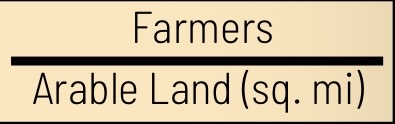
what is agricultural population density? what is it used for?
indicates country’s level of economic development
high agricultural population density: less developed country; low level of technology; farming by hand (more farmers), low output of food
low agricultural population density: more developed countries; high levels of mechanization; less farmers but more output of food
refers to the permanently inhabited and utilized portion of the Earth's land surface; the habitable areas of the world
ecumene
what are the 5 toos?
areas where people do not settle (mostly due to being unable to farm)
too hot
too cold
too wet
too hilly
too dry
where are people more likely to settle?
farmable environments
low elevation
fertile soil
temperate climates
near a body of water
what are the factors that determine a population’s growth and decline?
fertility (cbr and tfr), mortality (life expectancy, cdr, and imr), and migration
what are the factors measure fertility?
crude birth rate (cbr): the number of live births inciting in one year per 1000 people
used to compare numbers across countries
total fertility rate (tfr): average number of children who would be born per woman during her childbearing years
globally has been decreasing over time
what are the effects of development on fertility?
the more developed a country is, the lower the cbr and tfr will be
what are the factors that measure mortality
life expectancy: the average number of years the average person will live
steadily increasing over time
crude death rate (cdr): number of deaths occurring in one year per 1000 people
infant mortality rate (imr): number of children who die before one year of age
when imr goes down, life expectancy goes up leading to higher population growth
what is the natural increase rate/rate of natural increase?
speed at which a country's population grows or shrinks based solely on the difference between its birth rate and death rate, ignoring migration
can be a negative number, indicating population decrease
usually expressed in a percentage

what is population growth rate?
more accurate because it accounts for migration
births - deaths + immigrants - emigrants
what factors influence the distribution of population
economic: job opportunities; access to natural resources
social/cultural: housing availability, safety, access to transportation, a feeling of belonging, community
political: same as social/cultural
what is doubling time?
the number of years in which a population will double assuming the growth rate remains stable
70/NIR
what is the replacement rate?
the average number of children a woman must have to keep a population stable from one generation to the next without counting migration
2.1 children per woman
describe stage 1 of the demographic transition model and the epidemiological transition model
population pyramid has a wide base because CBR is high and a narrow tip because CDR is also high (low amount of old people)
DTM:
high CBR (due to no birth control, many people were farmers and children were assets)
high CDR (due to children not surviving infancy)
low NIR
ETM: pestilence and famine (also led to high CDR)

which countries are in stage 1 of the DTM today?
pre-industrial countries
none today
but every country was stage 1 before Industrial Revolution
describe stage 2 of the demographic transition model and the epidemiological transition model
population pyramid has kind of a square base because children are surviving, but still a narrow tip
DTM:
high CBR (cultural norms staying the same) but drops slightly near the end since kids became economic liability
dropping CDR due to farming innovations and increased access to jobs/money
NIR increases because kids survive
ETM: receding pandemics (slowly solving food problem due to industrialization and transport; medical advances exist but disease is still biggest killer)

which countries are stage 2 of the DTM today?
industrialized countries
was Great Britain in 1750 because it was the only industrialized nation
today includes Sub-Saharan Africa and South Asia
describe stage 3 of the demographic transition model and the epidemiological transition model
population pyramid kind of looks like a house because more people are surviving overall
DTM:
decreasing CBR because of social pressures (children are liabilities and cannot work in factories)
decreasing CDR because of medical innovations
NIR plateaus
ETM: degenerative and human made diseases (those associated with aging and lifestyle choices)

which countries are in stage 3 of the DTM today?
around the 1960s for the US/UK, after WWII
Latin/South America and potentially China
describe stage 4 of the demographic transition model and the epidemiological transition model
population pyramid looks like a house with a narrower base because more older people are surviving
DTM:
CBR continues to decrease
CDR decreases but not as much as previous stages because there are limits to what we can to to prevent death
NIR flattens because CBR and CDR are closer together
ETM: delayed degenerative diseases (diseases associated with aging/lifestyle choices can be delayed with medical advancements)

which countries are in stage 4 of the DTM today?
USA
some parts of Western Europe
describe stage 5 of the demographic transition model and the epidemiological transition model
population pyramid is inverted triangle because there are more older people and less younger people
DTM:
CBR continues to decrease
CDR flattens out
CBR < CDR
NIR becomes negative
ETM: reemergence of infectious diseases (diseases become resistant to medicines; older people have poorer immune systems)

which countries are in stage 5 of the DTM today?
Japan and Germany
some other parts of Western Europe
how does a nation reduce birth rates?
increase development level
increase education level for women
push vs. pull factors?
push: negative circumstances, events, or conditions present in a location that causes people to move away
pull: positive conditions and circumstances of a location that encourages people to move to that place
what are intervening obstacles and intervening opportunities?
prevent migrants from moving to final destination during a migration
intervening obstacles: barriers that hold migrants back (block them) from continuing to travel
ex: mountains, rivers, borders, etc.
intervening opportunities: an opportunity that causes migrants to voluntarily stop traveling
ex: job opportunities
migrants can continue on but they at the moment stopped migration voluntarily due to an opportunity
voluntary vs. involuntary migration
voluntary: people migrate due to own choices
main motivation are pull factors
involuntary: people migrate due to fears of violence or survival
main motivation are push factors like war, violence, oppression, natural disasters
which demographic is most commonly migrants?
young men
what are ravenstein’s laws of migration?
migration is typically short in distance
migration occurs in steps
urban areas attract both long-distance and rural migrants
every migration generates a counter-migration
young, single adult males are more likely to migrate than females, and women will migrate shorter distances
most migration is due to economic factors
examples of voluntary and involuntary migrations?
voluntary: guest worker programs like the bracero program
involuntary: Syrian refugees (most to Turkey), Trail of Tears (IDP), Slave Trade
the further apart two places are, the less likely it is that people will migrate between those two places
distance decay
refugee vs. internally displaced person vs. asylum seeker
refugee: someone who has been forced to flee his or her country (cross a border) because of persecution, war, or violence
someone who has been forced to flee their home but never crosses an international border
asylum seekers: people who flee their country and seek sanctuary in another country and apply for asylum—the right to be recognized as a refugee and receive legal protection and material assistance
what are remittances?
money sent back to migrants’ country of origin
what are guest workers?
migrants who travel internationally in order to find work as temporary laborers, typically for a short period of time because the jobs cannot be filled by a country’s own labor force
ex: Bracero Program, people going to the Middle East to work in oil industry
typically young single men
what are the unintended consequences of anti-natalist policies?
forced sterilization and abortions
abandonment of babies
gender-selective abortions favoring boys over girls
skewed gender ratios which impacts future marriage and reproduction
what is malthusian theory?
population grows exponentially while food output only grows arithmetically, resulting in a food shortage and famine due to exceeding the carrying capacity
hunger incites instability and rebellion
what is carrying capacity?
the amount of population that a location can support without harming the environment
what are some criticisms of malthusian theory?
factors slowing population growth: available and reliable contraceptives and education and advancement of women
increased farming efficiency: mechanized farming, hybrid seeds, chemical fertilizers
new technology: more efficient travel to deliver food; refrigeration and tin cans preserve food for longer and can transport food longer distances
what is boserup’s theory?
food supply is impacted directly by population growth. as population increases, humans will develop new technologies to increase production of food supply
what do neo-malthusians believe?
concerned about sustainable use of the environment—the earth’s resources can only sustain a finite population. and rapid population growth will outpace all finite earth resources (water, energy, clean air), leading to environmental degredation
concerned with strain on natural resources, overconsumption, and famine
scope is broader than malthus’s: includes more than just food supply
what is a dependency ratio?
an economic indicator showing how many non-working dependents rely on every 100 working-age adults
dependency ratios in each stage of DTM?
stage 1: high (low adult population; high amount of children but infant mortality keeps numbers kind of stable)
stage 2: high (still low adult population; higher number of children because many survive infancy)
stage 3: falling (birth rates decline)
stage 4: low to rising (birth and death rates are both low and stable, and family sizes hover around replacement level)
stage 5: very high (many elderly people rely on few working-age people)