Biology II Exam
 Call Kai
 Learn
Learn Practice Test
 Spaced Repetition
 Match
Match Flashcards
 Knowt Play
1/75

There's no tags or description
Looks like no tags are added yet.
Name | Mastery | Learn | Test | Matching | Spaced | Call with Kai | Chat |
|---|
No analytics yet
Send a link to your students to track their progress
76 Terms
DNA and RNA, They replicate, have an outer protein coat, macromolecules, proteins, Acellular (no cells) , much smaller than even most bacteria, can’t reproduce on their own, can’t carry out metabolic functions, don’t process energy
What are the 10 things that viruses have?
Capsid
Protein shell enclosing nucleic acid, built from subunits called capsomers.
Viral Envelope
And some viruses only, common in animal viruses, made mostly from host membranes, wraps virus during exocytosis
Capsid
What is 1?
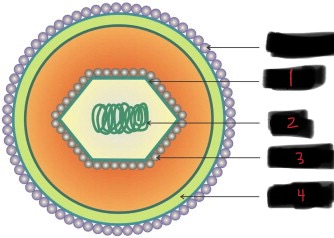
Viral Core
What is 2?
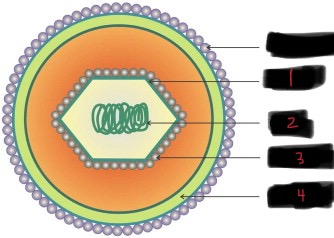
Capsomer
What is 3?

Viral Envelope
What is 4?

Tabacco mosaic virus (TMV)
First confirmed virus, Wendall Stanley, 1935
Phages aka Bacteriophage
Viruses that infect bacteria, have most complex viral capsids, elongated head, enclosed DNA, and tailpiece for attachment and DNA injection
A bacterial cell will divide by binary vision. Each daughter cell will contain a copy of the phage genome known as prophage
What is true of the lysogenic phage replicative lifecycle?
Viral core with DNA, capsule protein coat
From inside to outside the structure of a typical phage would be?
TMV, Wendall Stanley
The first confirmed virus was _______ and was shown to exist by _________
Viruses are typically much larger than bacteria or animals
Choose the incorrect statement
Can evolve, have genetic material
Which of the following characteristics of life do viruses have? choose all that apply
Can evolve, process energy, have cells, carry out metabolic functions, have genetic material
Attachment, replication, transcription, self assembly (release)
What are the four major parts in active replication cycle
Attachment and Lytic
What life cycle is this called and what does 2 represent?

Entry of phages DNA and Degration of DNA
What is 3?

Synthesis of viral genomes and proteins
What is 4?

Assembly
What is 5?

Lysogenic cycle
Viral DNA molecule is Incorporated into host DNA as a prophage segment, every time the host divides it copies the prophage and passes the copies to daughter cells
Kills viruses
What does the lytic cycle do?
Bacteriophage
What virus is this?

Influenza
What virus is this?
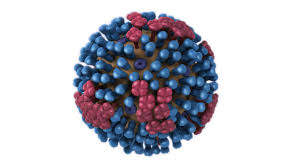
Adenovirus
What virus is this?
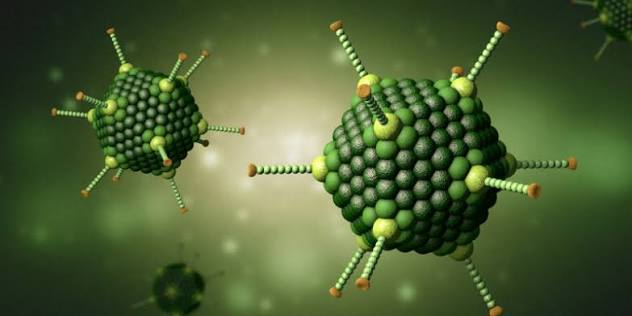
TMV
What virus is this?

DNA or RNA and Single stranded or double
What are the classification methods for animal viruses?
SSRNA Virus
Example of animal viral replication
Transcription
Reverse transcription
DNA → RNA
RNA → DNA
May release lysosome enzymes, virals proteins may be toxic, may cause host cell to make toxins
What 3 things could viral diseases in animals do?
Vaccines
Harmless components of pathogens to stimulate the immune system
Active but weaken viruses, inactivate viruses or viral subcomponents, boost immune system if already infected, increases MRNA is increased so body can make harmless viral subcomponents
What 4 things does vaccines do?
Diseases in plants
72000 known, most have RNA, horizontal and vertical transmission
Vertical transmission
From parent to offspring
Horizontal transmission
Between non- related hosts (of the same species)
Prions
Infectious proteins in animals, converts other proteins to wrong shape, lay latent for decades, cause large vacuoles in brain
Nucleic acid and proteins
What do macromolecules do Viruses contain
Bacteria and archaea.
What types of cells do phages infect
Lytic cycle
Lysogenic cycle
A cycle that kills the wholesale immediately to make copies
A cycle that hides a viral DNA inside the whole cell to replicate silently without killing it
Genetic material and Structural features
How are animal viruses classified?
Yes, in viruses have an envelope because animal cells, lack rigid cell walls, making it easy for viruses to exit
Do animal viruses have a viral envelope?
Non-functional part
A vaccine component in which uses a completely killed virus or a harmless piece of it so it cannot replicate it at all
Viable
A vaccine component in which uses a live virus that has been leaking in a lab, so it multiplies slightly, but cannot cause disease
Single stranded
A viroid contains what type of genetic material
Lynn Marguils in 1960s
Who discovered the endosymbiosis theory
Endosymbiosis
One cell engulfed another cell and live inside each other, the evolved overtime until they could no longer live separately, they shared genetic control of mutualistic pathway to produce ATP
Protists
Not a valid tax or, paraphletic group 37,000 of them
Protozoans
Around for at least 2.7 billion years, most are unicellular but not all, discovered by Leeuwenhook in 1674
Protozoans
Contains nuclei, mitochondria, linear chromosomes, mitosis, sexual reproduction, complex Cytoskeleton, contractile vacuole, extrusomes
Contractile vacuole
Maintains osmotic balance, collects water by tubes, discharges by pore
Vacuoles extrusomes
Organelles, objecting toxins, mucus, adhesive, anchors, or spikes
Cilia, flagella, pseudopdia
What are the three protozoan movement types
flagellum
Whip like projection mid speed
Cilia
oar like projection fastest
Psueudopdia
Looks like a splatter slowest
Mixotrophs, photoautotrophs, chemoheterotrophs
What are the three protozoan nutrition?
Photoautotroph
Organisms that capture light energy via chloroplasts to manufacture their own organic nutrients like sugar from carbon dioxide
Chemo heterotrophs
Organisms that cannot make their own food and must absorb or consume organic nutrients from the environment for both energy and carbon
mixotroph
Organisms that are both Photoautotrophic and heterotrophic they can photosynthesize or consume food, depending on whether light and nutrients are available
conjugation (sexual)
Fusion to exchange DNA
Syngamy (sexual)
Union of gameter
Fission (asexual)
Splitting or breaking something into two or more parts
budding (asexual)
Beginning to develop, grow, or show promise of future success
Photo
Energy source, light
Auto
Carbon source, co2
Troph
Feeder/ eater
Endosymbiosis
A unicellular organism involves another cell, which becomes a endosymbiont
Endosymbiosis theory
Organelles like mitochondria and chloroplasts are atrophied endosymbionts
Mitochondria
Example of endosymbiotic theory
Supergroup Excavata
Has a asymmetric deep feeding groove on one side includes Diplomonads, parabasalids, euglenozoans
Supergroup Chromalveolata
Split into two branches: Alveolates (sacs under membrane) and stramenopiles (one hairy one smooth flagellum)
Viroids
Small, naked circular RNA molecules infecting plants