DENT2155 - Histology of Small and Large Intestines
 Call Kai
 Learn
Learn Practice Test
 Spaced Repetition
 Match
Match Flashcards
 Knowt Play
1/59

There's no tags or description
Looks like no tags are added yet.
Name | Mastery | Learn | Test | Matching | Spaced | Call with Kai | Chat |
|---|
No analytics yet
Send a link to your students to track their progress
60 Terms
What are the 4 layers of the GI Tract?
- Mucosa
- Sub-Mucosa
- Muscularis externa
- Serosa
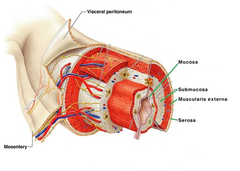
Mucosa
Innermost layer of GI Tract Wall; Consists of...
- Epithelium
- Lamina propria
- Muscularis mucosae

Sub-Mucosa
2nd layer of GI Tract Wall; Dense, irregular connective tissue layer that contains...
- Lymphatics
- Vasculature
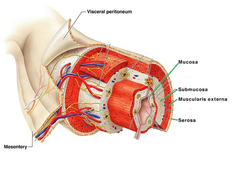
Muscularis externa
3rd layer of GI Tract Wall; Smooth Muscle
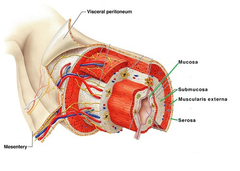
Serosa
Outermost layer of GI Tract Wall consisting of Simple Squamous Epithelium; Contains...
- Large Blood Vessels
- Large Lymphatic Vessels

The Intestines are lined by ____.
Simple, Columnar Epithelia
Have many Villi and Microvilli
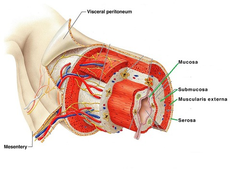
Small Intestine Function
Digestion and Absorption of nutrients (Amino Acids, Carbs, Lipids)
Bile and Pancreatic Enzymes enter the Duodenum via the ____.
Common Bile Duct

SA of the Small Intestine is increased by ____, ____, and ____.
Plicae/Villi/Microvilli

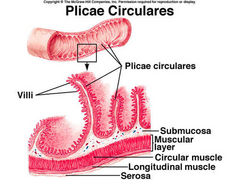
Plicae circulares
Circular folds in the Small Intestine

Plicae circulares involves the ____ and ____.
Mucosa/Sub-Mucosa

Plicae circulares are most prominent in the ____ and ____.
Distal Duodenum/Jejunum

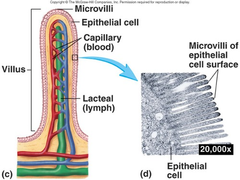
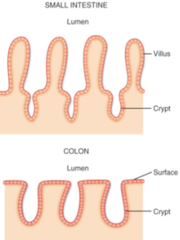
Villi
Fingerlike projections of the Mucosa that completely cover the Small Intestine

Villi contain numerous ____, ____, and ____.
Immune Cells/Capillaries/Lacteals
Crypts of Lieberkuhn
Intestinal Glands
- Small openings between Villi that contain different Absorptive, Goblet, and Enteroendocrine Cells

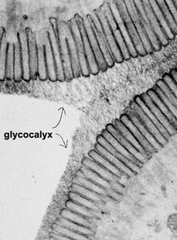
Microvilli
Tiny projections of the Plasma Membrane of Enterocytes

Microvilli contain ____.
Contractile Microfilaments
Actin
The Microvilli of Enterocytes are lined with a ____ layer.
Glycocalyx
What modification increases the SA of the Small Intestine the most?
Microvilli
What 6 Cells are found in the Intestinal Mucosa?
- Enterocytes
- Goblet Cells
- Enteroendocrine Cells
- Paneth Cells
- Stem Cells
- M-Cells

Enterocyte Functions
- Transport Substances from Lumen to Circulation
- Secrete Digestive Enzymes

Enterocytes are held together by ____.
Tight Junctions

How are Lipids absorbed by Enterocytes?
Free Fatty Acids diffuse from Micelles and passively cross the membrane of Enterocytes
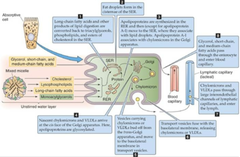
What happens to Lipids within the Enterocyte?
Monoglycerides and LCFAs
(1) Monoglycerides and LCFAs are converted back to Triglycerides and form Fatty Droplets in the Smooth ER
(2) Apolipoproteins (produced by the Rough ER) associate with Fatty Droplets
(3) Apolipoproteins associate with Chylomicrons in the Golgi
(4) Chylomicrons are glycosylated, marking them for export
(5) Vesicles carry Chylomicrons from the Golgi to the Basolateral Surface of the Enterocyte for Exocytosis
SCFAs and MCFAs
Transported across the Enterocyte for Exocytosis

Goblet Cells
Secrete Mucus

Goblet Cells ____ (increase/decrease) as you travel from the Duodenum to the Ileum.
increase
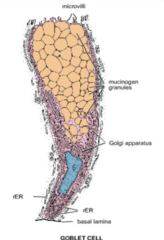
____ accumulates at the Apex of Goblet Cells.
Mucinogen Granules

Paneth Cells
Secrete Antibacterial Enzymes (Lysozymes, Defensins, Glycoproteins) to regulate Bacterial Flora
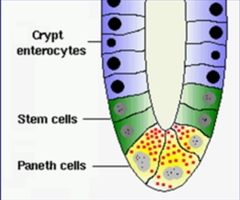
Paneth Cells are found at the ____ of an Intestinal Gland.
base

Paneth Cells increase in number during ____.
infection

Lysozymes
Degrade the Peptidoglycan coat on Bacteria, increasing membrane permeability
Defensins
Increase membrane permeability of harmful organisms
Tumor Necrosis Factor α (TNFα)
Activates Macrophages and promotes Fever (Pyrogen)
Enteroendocrine Cells
Secrete Endocrine and Paracrine Hormones

What are 7 Endocrine GI Hormones?
- Gastrin
- CCK
- Secretin
- VIP
- GIP
- Motilin
- Somatostatin
Gastrin
Stimulates Gastric Secretion and Mucosal Proliferation
CCK
Stimulates...
- Gastric Emptying
- Pancreatic Secretion
- Bile Secretion
Secretin
Stimulates Water and HCO3- Secretion
Motilin
Stimulates motility in the Stomach and Small Intestine
GIP
Gastric Inhibitory Peptide
Inhibits Gastric Secretion and Motility
The Duodenum and Stomach are separated by the ____.
Pyloric Sphincter

The Duodenum receives ____, ____, and ____.
Chyme/Bile/Pancreatic Juice
Bile and Pancreatic Juice enter the Duodenum at the ____.
Major Duodenal Papilla

The Duodenum is distinguished by the presence of ____.
Brunner's Glands in the Sub-Mucosa

Brunner's Glands include ____ and ____ Secreting Cells.
Zymogen/Mucus

Secretions of Brunner's Glands have a pH of ____ to neutralize Chyme from the Stomach.
8.1-9.3

The Jejunum has no ____ or ____.
Brunner's Glands/Peyer's Patches
Peyer's Patches are located in the ____.
Ileum

Peyer's Patches are a part of the ____.
GALT (Gut-Associated Lymphoid Tissue)
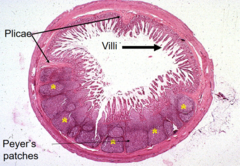
M-Cells
Microfold Cells
- Specialized Epithelial Cells that lie on Peyer's Patches and Lymph Vessels

M-Cells are responsible for ____.
taking up Proteins (via endocytosis) in the Small Intestine

M-Cells present Antigen to ____.
Lymphocytes
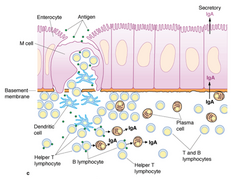
What happens if foreign Antigen is found in the Small Intestine?
Plasma Cells are stimulated and begin releasing IgA

What are the 3 distinct structures of the Large Intestine?
- Taeniae Coli
- Haustra
- Epiploic Appendages

Large Intestine Function
- Absorb Electrolytes and Water
- Move and Store Waste in the Rectum

The Large Intestine possesses ____, but not ____.
Crypts/Villi
Appendix
A small, fingerlike extension of the Cecum; Contains a mass of WBCs that contribute to immunity

The Appendix has a large number of ____ Cells.
Paneth
The Epithelium becomes ____ at the Anal-Rectal Junction.
Stratified, Squamous
Anal Glands are present in the ____.
Sub-Mucosa