BIOLOGY Exam 2023
5.0(2)
Studied by 0 people Call Kai
 Learn
Learn Practice Test
 Spaced Repetition
 Match
Match Flashcards
 Knowt Play
Card Sorting
1/104

Earn XP
Description and Tags
Last updated 2:00 PM on 5/30/23
Name | Mastery | Learn | Test | Matching | Spaced | Call with Kai | Chat |
|---|
No analytics yet
Send a link to your students to track their progress
105 Terms
1
New cards
Nucleus
Contains genetic material (DNA) which controls the activities of the cell
Has the information needed to produce new cells
\
Found in plant and animal cells
Has the information needed to produce new cells
\
Found in plant and animal cells
2
New cards
Cytoplasm
Where most chemical reactions take place
\
Found in plant, animal and bacteria cells
\
Found in plant, animal and bacteria cells
3
New cards
Mitochondria
Respiration(energy is produced) takes place here
The mitochondria provide energy for the cell
\
Found in plant and animal cells
The mitochondria provide energy for the cell
\
Found in plant and animal cells
4
New cards
**Cell membrane**
Creates a barrier between the cell and the outside world
Controls what can flow in and out of the cell
\
Found in plant, animal and bacteria cells
Controls what can flow in and out of the cell
\
Found in plant, animal and bacteria cells
5
New cards
Ribosomes
Found in the cytoplasm are the site of protein synthesis
They read dna from the nucleus and build protein using these instructions
\
Found in plant and animal cells
They read dna from the nucleus and build protein using these instructions
\
Found in plant and animal cells
6
New cards
Chloroplasts
Absorb light and energy for photosynthesis
Contains the pigment chlorophyll
Only found in some parts of the plant (green parts)
\
Found in plant cells
Contains the pigment chlorophyll
Only found in some parts of the plant (green parts)
\
Found in plant cells
7
New cards
Vacuole
Filled with cell sap
Keeps the cell turgid
A permanent element of plant cells
\
Found in plant cells
Keeps the cell turgid
A permanent element of plant cells
\
Found in plant cells
8
New cards
**Cell wall**
Provides extra support to the plant
Helps the cell maintain its square/ rectangular shape
\
Found in plant and bacteria cells
Helps the cell maintain its square/ rectangular shape
\
Found in plant and bacteria cells
9
New cards
**Genetic material**
Free to move around the cell, not contained by the nucleus
Loop of dna
\
Found in bacteria cells
Loop of dna
\
Found in bacteria cells
10
New cards
Plasmid
Small loop of dna
It often codes for traits to do with protection
E.g. resisting against drugs
\
Found in bacteria cells
It often codes for traits to do with protection
E.g. resisting against drugs
\
Found in bacteria cells
11
New cards
**Slime capsule**
Provides protection
Sits outside of the cell wall
\
Found in bacteria cells
Sits outside of the cell wall
\
Found in bacteria cells
12
New cards
Flagella
Provides movement to get food and move away from danger
\
Found in bacteria cells
\
Found in bacteria cells
13
New cards
Prokaryotes
They have no nucleus and mitochondria
\
Bacteria cells
\
Bacteria cells
14
New cards
Eukaryotes
Any cell with a clearly defined nucleus
\
Animal and plant cells
\
Animal and plant cells
15
New cards
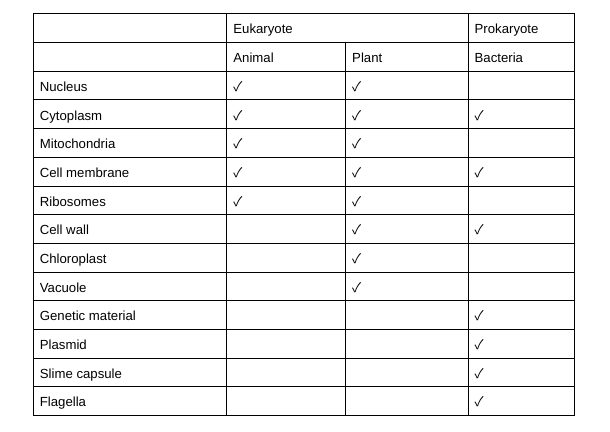
Procaryote or Eukaryote
open picture to see
16
New cards
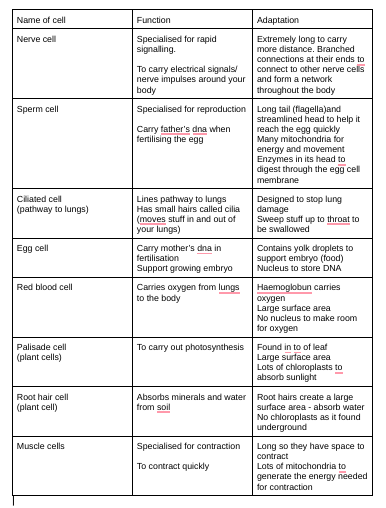
specialised cells
open picture to see
17
New cards
Respiration
\
Oxygen + Glucose = Carbon Dioxide + Water + Energy
\
\* muscle cells need energy to contract, have lots of mitochondria
Oxygen + Glucose = Carbon Dioxide + Water + Energy
\
\* muscle cells need energy to contract, have lots of mitochondria
18
New cards
Oxygen for respiration
1. Breathe O2 in air
2. O2 fills lungs, alveoli
3. Diffusion across alveoli to blood (down conc gradient)
4. O2 travels in red blood cells to respiring cells
19
New cards
Glucose for respiration
1. Get from food
2. Goes to small intestine
3. Diffuses from villi
4. Transported to respiring cells
20
New cards
CO2 for respiration
1. Released from respiration
2. Travels in blood to lungs
3. Diffuses from blood to lungs
4. Breathe it out
21
New cards
Diffusion
the net movement of particles from an area of high concentration to an area of low concentration down a concentration gradient
22
New cards
**Factors affecting diffusion**
1. Concentration gradient
steeper = faster
\
2. Temperature
An increase in temperature means the particles in a gas or a solution have more kinetic energy so move around faster and speeds up diffusion
23
New cards
**Surface area**
Large active organisms cannot reply upon their body surface
Surface area relative to volume is insufficient for exchange - the distances are too great
Large organisms have special surfaces to allow exchange of substances
Surface area relative to volume is insufficient for exchange - the distances are too great
Large organisms have special surfaces to allow exchange of substances
24
New cards
**SA:V ratio**
As the organism size increases, the SA:V ratio decreases
\
**Surface area**
Length x width x number of sides
= 4πr2
\
**Volume**
Length x width x height
= 3/4πr3
\
The bigger the sa:v ratio, the faster the diffusion
\
Folded membrane = larger SA
\
**Surface area**
Length x width x number of sides
= 4πr2
\
**Volume**
Length x width x height
= 3/4πr3
\
The bigger the sa:v ratio, the faster the diffusion
\
Folded membrane = larger SA
25
New cards
**Exchanging materials**
Cells need O2 + glucose for respiration
Cells don't need CO2
These substances diffuse across the cell membrane
Cells don't need CO2
These substances diffuse across the cell membrane
26
New cards
**Exchange surfaces**
* Large SA allows more gas exchange
* Thin (1 cell thick) walls give a short diffusion pathway
* Rich blood supply maintains a steep conc gradient
* Ventilation maintains a steep conc gradient
* Thin (1 cell thick) walls give a short diffusion pathway
* Rich blood supply maintains a steep conc gradient
* Ventilation maintains a steep conc gradient
27
New cards
**Alveoli - lungs**
* Enormous surface area
* One cell thick flattened surface
* Rich blood supply
* Maintains steep concentration gradient
CO2 and O2 is exchanged
CO2 out, O2 into bloodstream
* One cell thick flattened surface
* Rich blood supply
* Maintains steep concentration gradient
CO2 and O2 is exchanged
CO2 out, O2 into bloodstream
28
New cards
**Small intestine - digestive system**
* Has villi with large surface area (small hairs)
* Microvilli (also increase surface area)
* Rich blood supply
Glucose is diffused for respiration
Glucose goes from villi to blood supply
* Microvilli (also increase surface area)
* Rich blood supply
Glucose is diffused for respiration
Glucose goes from villi to blood supply
29
New cards
**Root hair cell - roots of plant**
* Large surface area (root hair)
* Steep concentration gradient
Water, mineral ions, oxygen are taken in so that the plant can respire
\
1. Minerals dissolve on the plant water
2. The water takes the minerals up to the leaves
* Steep concentration gradient
Water, mineral ions, oxygen are taken in so that the plant can respire
\
1. Minerals dissolve on the plant water
2. The water takes the minerals up to the leaves
30
New cards
**Osmosis**
The movement of water molecules across a partially permeable membrane, from an area of high water concentration (dilute solution) to an area of low water concentration (concentrated solution)
31
New cards
other things about osmosis
Partially permeable membranes only let certain substances through
Substances dissolved in water are called solutes
Cytoplasm has a high concentration of solutes and a low concentration of water. This means water tends to move into the cell by osmosis. If too much water moves into the cell, it might burst
Plant cells have a cell wall which prevents it from bursting. Instead, we say that the cell is turgid
If too much water leaves the cell, it may become dehydrated, which we call flaccid
( water = high → low concentration)
( solutes = low → high concentration)
Substances dissolved in water are called solutes
Cytoplasm has a high concentration of solutes and a low concentration of water. This means water tends to move into the cell by osmosis. If too much water moves into the cell, it might burst
Plant cells have a cell wall which prevents it from bursting. Instead, we say that the cell is turgid
If too much water leaves the cell, it may become dehydrated, which we call flaccid
( water = high → low concentration)
( solutes = low → high concentration)
32
New cards
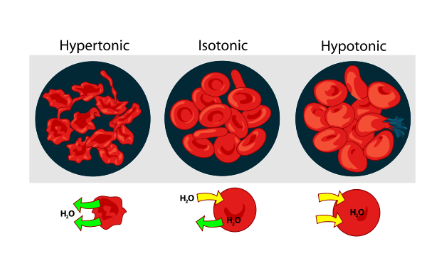
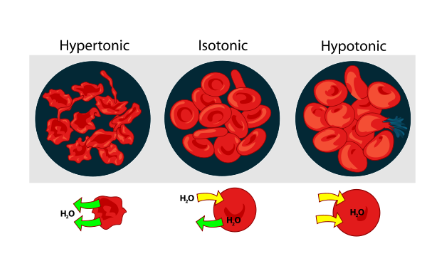
Hypertonic
If a solution will make the cell lose water, because the solution has a higher concentration of solute and a lower concentration of water
High solute, loses water
R for raisin, shrivelled
\
\* hypertonic - plant cell becomes PLASMOLYSED \*
High solute, loses water
R for raisin, shrivelled
\
\* hypertonic - plant cell becomes PLASMOLYSED \*
33
New cards
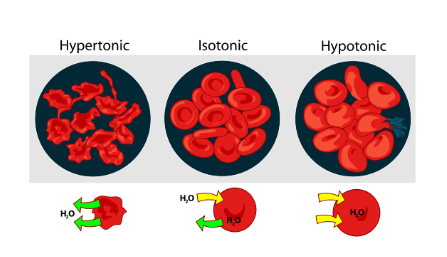
Hypotonic
If a solution will make a cell take on water (because it has a lower concentration of solute)
Low solute, takes on water
\
O for balloon blown up, full of water
Low solute, takes on water
\
O for balloon blown up, full of water
34
New cards
Isotonic
Solution will not make the cell gain or lose any water because the solution has the same concentration of solute as the cell
\
Neutral
\
Neutral
35
New cards
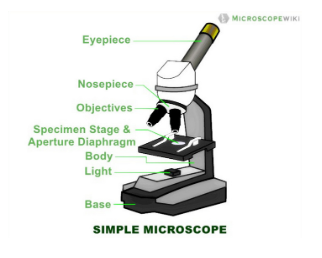
microscopy
labelled diagram
36
New cards
Magnification
How much bigger the image you see is that the actual specimen
37
New cards
Resolution
The smallest distance you can see between two separate points
\
(how clear the image is)
\
(how clear the image is)
38
New cards
**Light microscopes**
* Small, cheap
* Used in schools
* Magnification of up to x2000
* Used in schools
* Magnification of up to x2000
39
New cards
**Electron microscopes**
Large, expensive
Kept in special rooms to control temperature, pressure and humidity
Uses a beam of electrons to form an image
Magnification of up to x2000000
Kept in special rooms to control temperature, pressure and humidity
Uses a beam of electrons to form an image
Magnification of up to x2000000
40
New cards
**Onion microscope experiment**
1. Peel a thin layer of onion off the cut onion
2. Place the layer of onion carefully on the glass slide, and cover with a cover slip
3. Stain the layer of onion with Iodine
4. View your onion cells.
41
New cards
**Onion microscope experiment - How do you avoid air bubbles?**
Place the coverslip onto the onion from the corner and gently lower it down
42
New cards
**Onion microscope experiment - What do you do if you put too much Iodine on your onion?**
Dab the excess off with a tissue
43
New cards
**Onion microscope experiment - Why do you start at the lowest magnification?**
To locate the cells on the slide, then magnify further
44
New cards
**Active transport**
The movement of molecules across a cell membrane, from a region of low concentration to a region of high concentration, requiring energy from respiration
45
New cards
**Osmosis potato experiment**
1. Cut potato pieces to similar size, weight
2. Fill beakers with solutions, ranging from 0 to 0.8 grams of sugar dissolved in
3. Leave the potato in the beakers
4. Measure the masses again
\
Lots of salt solution take water from potato through osmosis, decreasing the mass
\
No salt solution gives water to potato through osmosis, increasing the mass
46
New cards
Organelles
A subcellular structure that has a specific job to perform in the cell
\
* Nucleus
* Mitochondria
* Ribosomes
* Cell membrane
* Cytoplasm
\
* Nucleus
* Mitochondria
* Ribosomes
* Cell membrane
* Cytoplasm
47
New cards
Cells
The fundamental unit that makes up living things
\
* Red blood cells
* White blood cells
* Nerve cells
* Epithelial cells
* Muscle cells
* Glandular cells
\
* Red blood cells
* White blood cells
* Nerve cells
* Epithelial cells
* Muscle cells
* Glandular cells
48
New cards
Tissues
A group of similar cells that work together to perform a particular function
\
* Epithelial tissue
* Muscle tissue
* Glandular tissue
* Nerve tissue
\
* Epithelial tissue
* Muscle tissue
* Glandular tissue
* Nerve tissue
49
New cards
Organs
A group of different tissues that work together to perform a particular function
\
* Heart
* Lungs
* Stomach
* Pancreas
* Liver
* Skin
* Testes/ ovaries
\
* Heart
* Lungs
* Stomach
* Pancreas
* Liver
* Skin
* Testes/ ovaries
50
New cards
**Organ system**
A group of organs that work together to perform a particular function
\
* Digestive system
* Cardiovascular system
* Reproductive system
* Circulatory system
\
* Digestive system
* Cardiovascular system
* Reproductive system
* Circulatory system
51
New cards
Organisms
Multiple organ systems working together to form the organisms
\
* Human
\
* Human
52
New cards
**Circulatory system**
* Heart
* Blood vessels
* Blood
* Blood vessels
* Blood
53
New cards
**Blood vessels**
* Veins
* Arteries
* Capillaries
* Arteries
* Capillaries
54
New cards
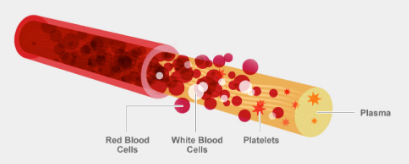
Blood
* White blood cells
* Red blood cells
* Plasmid
* Platelets
* Red blood cells
* Plasmid
* Platelets
55
New cards
Plasma
Plasma is the liquid that all the other things are suspended in
Most substances are carried in the plasma
When plasma leaves your capillaries it becomes tissue fluid
It carries many things such as:
\
* Carbon dioxide back to the lungs
* Waste products to your kidneys
* Hormones
* Dissolved food (glucose)
Most substances are carried in the plasma
When plasma leaves your capillaries it becomes tissue fluid
It carries many things such as:
\
* Carbon dioxide back to the lungs
* Waste products to your kidneys
* Hormones
* Dissolved food (glucose)
56
New cards
**Red blood cells**
There are more red blood cells than any other type of cell in your body
They pick up oxygen from the air in your lungs and carry it to where it is needed
They are adapted to this because:
* They are biconcave discs (increased surface area to volume ratio for diffusion)
* Packed with red pigment protein haemoglobin that binds to oxygen
* No nucleus for more space for haemoglobin
When haemoglobin is full of oxygen, it is called oxyhaemoglobin and is bright red
When it doesn't have much oxygen in it is a darker purple colour (why the blood in our veins is purple and arteries red)
They pick up oxygen from the air in your lungs and carry it to where it is needed
They are adapted to this because:
* They are biconcave discs (increased surface area to volume ratio for diffusion)
* Packed with red pigment protein haemoglobin that binds to oxygen
* No nucleus for more space for haemoglobin
When haemoglobin is full of oxygen, it is called oxyhaemoglobin and is bright red
When it doesn't have much oxygen in it is a darker purple colour (why the blood in our veins is purple and arteries red)
57
New cards
**White blood cells**
They destroy pathogens
Under a microscope, they are purple with darker purple blobs inside (the nucleus)
Bigger than red blood cells and there are fewer of them
They do have a nucleus and form part of the body’s defence system against harmful microorganisms
Lymphocytes form antibodies against harmful microorganisms
Phagocytes engulf (surround) and digest invading bacteria and viruses
The rest form antitoxins against poisons made by microorganisms
Under a microscope, they are purple with darker purple blobs inside (the nucleus)
Bigger than red blood cells and there are fewer of them
They do have a nucleus and form part of the body’s defence system against harmful microorganisms
Lymphocytes form antibodies against harmful microorganisms
Phagocytes engulf (surround) and digest invading bacteria and viruses
The rest form antitoxins against poisons made by microorganisms
58
New cards
Platelets
Small fragments of cells
No nucleus
Important in helping the blood clot at the site of a wound
No nucleus
Important in helping the blood clot at the site of a wound
59
New cards
**Blood clotting**
A series of enzyme controlled reactions that result in converting fibrinogen into fibrin
This produces a network of protein fibres that capture lots of red blood cells and more platelets to form a jelly
This stops you bleeding to death
This protects new skin as it grows and stops bad bacteria entering through the wound
This produces a network of protein fibres that capture lots of red blood cells and more platelets to form a jelly
This stops you bleeding to death
This protects new skin as it grows and stops bad bacteria entering through the wound
60
New cards
**Respiration equation**
Glucose + Oxygen = Carbon Dioxide + Water (+ energy)
61
New cards
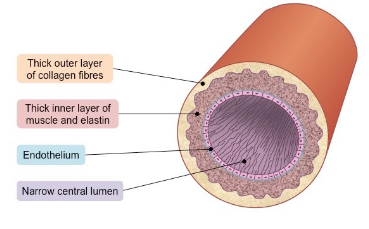
Arteries
* oxyenated
* Carry blood away from heart
* Carries blood at high pressure
* Carries oxygen - rich blood from the heart to the body’s cells
* Has thick elastic and muscular wall
* Carry blood away from heart
* Carries blood at high pressure
* Carries oxygen - rich blood from the heart to the body’s cells
* Has thick elastic and muscular wall
62
New cards
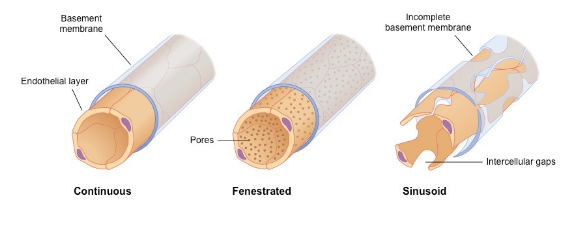
**Capillaries**
* Carries blood TO AND FROM the body’s cells
* Connects an artery to a vein
* Has a very thin wall made up of a single layer of cells
* Has a thin wall so that substances can be exchanged between the blood and body cells
* Connects an artery to a vein
* Has a very thin wall made up of a single layer of cells
* Has a thin wall so that substances can be exchanged between the blood and body cells
63
New cards
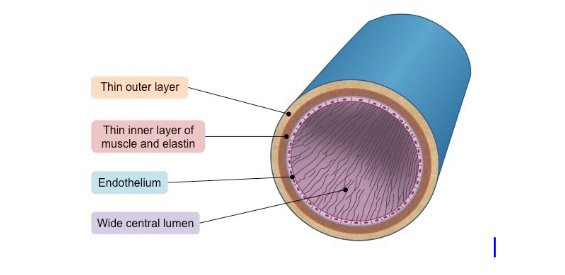
Veins
* Carry blood back to heart
* Carries blood at low pressure
* Carries oxygen - poor blood from the body’s cells to the heart
* Has a thin wall and contains valves
* Carries blood at low pressure
* Carries oxygen - poor blood from the body’s cells to the heart
* Has a thin wall and contains valves
64
New cards
lumen
hole that blood flows through - like the cardboard of a toilet - roll
65
New cards
how to remember which way arteries and veins go
__A__rteries go __away__ from the heart and so start with __A__
Veins move blood into the heart and have an in
Veins move blood into the heart and have an in
66
New cards
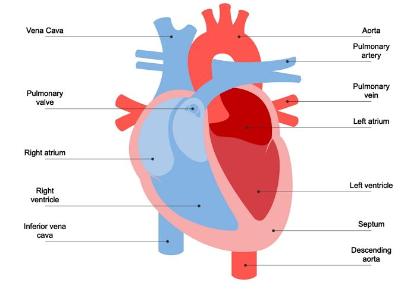
**What is a double circulatory system?**
* Two separate pumps
* Left pump = deals with oxygenated blood from the lungs to the body
* Right pump = deals with deoxygenated blood from the body, taking it back to the heart
* Left pump = deals with oxygenated blood from the lungs to the body
* Right pump = deals with deoxygenated blood from the body, taking it back to the heart
67
New cards
Pulmonary artery
carries blood to lungs
68
New cards
vena cava
blood into heart from body
69
New cards
right atrium
has thin walls
low pressure
low pressure
70
New cards
tricuspid valve
stops backflow to atrium
71
New cards
right ventricle
thick wall
pumps blood to lungs
high pressure
pumps blood to lungs
high pressure
72
New cards
aorta
carries blood around the whole body
73
New cards
pulmonary vein
carries blood into heart from veins
74
New cards
left atrium
has thin walls
low pressure
low pressure
75
New cards
bicuspid valve
stops backflow to atrium
76
New cards
left ventricle
VERY thick walls
pumps blood to the body except lungs
high pressure
pumps blood to the body except lungs
high pressure
77
New cards
ventilation
ventilation moves air in and out of the lungs and maintains a steep concentration gradient
78
New cards
the passage of air in and out of the lungs
1. nose
2. trachea
3. bronchi
4. bronchioles
5. alveoli
6. bronchioles
7. bronchi
8. trachea
9. nose
79
New cards
inhilation
1. intercostal muscles contract
2. ribs move upwards and outwards
3. diaphragm flattens
4. volume of chest increase
5. pressure inside the chest decreases
6. air is drawn into the lungs
80
New cards
exhilation
1. intercostal muscles relax
2. ribs move downwards and in
3. diaphragm becomes a more curved shape
4. volume of chest decreases
5. pressure inside the chest increases
6. air is forced out of the lungs
81
New cards
cardiovascular disease
a general term which refers to conditions affecting the heart and/or blood vessels
82
New cards
risk factors for CVD
* unhealthy diet
* no physical activity
* smoking
* harmful use of alcohol
* obesity
* second hand exposure to smoking
* high blood pressure
* high cholesterol
* gender (men have more bad cholesterol than women)
* no physical activity
* smoking
* harmful use of alcohol
* obesity
* second hand exposure to smoking
* high blood pressure
* high cholesterol
* gender (men have more bad cholesterol than women)
83
New cards
coronary heart disease
a condition where the blood vessels supplying the heart (coronary artery) are narrowed or blocked
84
New cards
stents
a mesh that opens up the artery back to the right shape. it is inserted in the leg and is inflated when in the correct position
85
New cards
stents - benefits
surgery is quick
lasts a long time
lasts a long time
86
New cards
stents risks
surgery so has the risk of infection
could get blood clots near the stent
could get blood clots near the stent
87
New cards
abiotic factor
non-living elements of an ecosystem
EG =
* climate
* temperature
* water
* soil type
EG =
* climate
* temperature
* water
* soil type
88
New cards
biotic factor
living elements of an ecosystem
EG =
* plants
* animals
EG =
* plants
* animals
89
New cards
abiotic factors and how they are measured
light intensity - light meter
temperature - thermometer
moisture levels - probe
soil Ph - probe
wind and speed direction - anemometer
CO2 levels for plants - probe
O2 levels for aquatic animals - probe
temperature - thermometer
moisture levels - probe
soil Ph - probe
wind and speed direction - anemometer
CO2 levels for plants - probe
O2 levels for aquatic animals - probe
90
New cards
examples of biotic factors
plants, animals, fungi or protists
availability of food
new predators arriving
new pathogens
one species outcompeting another so the numbers are no longer sufficient to breed
availability of food
new predators arriving
new pathogens
one species outcompeting another so the numbers are no longer sufficient to breed
91
New cards
random sampling
1. draw a grid in your area and use a random number generator to select th coordinates
2. use quadrats to do your experiment
92
New cards
stomata
The stomata allow carbon dioxide into the air spaces in the leaf and allow water and oxygen to leave.
\
1. Sensitive to light
* Close at night. No photosynthesis. No need for CO2
* Open during the day. Photosynthesis takes place. Need O2
\
2. Conserve water vapour
* Leaf has lots of water Guard cells are turgid. Stomata open
* Can afford to lose water
* Leaf has little water. Guard cells are flaccid. Stomata closed
* Can’t afford to lose water
\
1. Sensitive to light
* Close at night. No photosynthesis. No need for CO2
* Open during the day. Photosynthesis takes place. Need O2
\
2. Conserve water vapour
* Leaf has lots of water Guard cells are turgid. Stomata open
* Can afford to lose water
* Leaf has little water. Guard cells are flaccid. Stomata closed
* Can’t afford to lose water
93
New cards
waxy cuticle
Waterproof layer to prevent water loss
Transparent to let light in
Protect the leaf without blocking the sunlight
Transparent to let light in
Protect the leaf without blocking the sunlight
94
New cards
palisade cells
Lots of chloroplasts for photosynthesis
Ordered, tightly packed to maximise this
Ordered, tightly packed to maximise this
95
New cards
air spaces
Allow the movement of gases (CO2 + O2)
Increase surface area
Increase surface area
96
New cards
cells not tightly packed
Have a large surface area available for gas exchange
97
New cards
guard cells
Open and close the stomata depending on the water content of the leaf (control water loss)
98
New cards
transpiration
Plants continually lose water to the air
99
New cards
more about transpiration
* Transpiration happens more quickly in hot, dry and windy conditions
* Most plants have a waxy layer called the waxy cuticle on their leaves which prevent water loss
* Water lost through transpiration is normally lost through the stomata
* The guard cells control the size of the stomata, so can regulate the amount of water lost by transpiration
* If plants are losing water faster than they are gaining it, the stomata close
* If this didn’t happen, the plants would wilt and die
* Most plants have a waxy layer called the waxy cuticle on their leaves which prevent water loss
* Water lost through transpiration is normally lost through the stomata
* The guard cells control the size of the stomata, so can regulate the amount of water lost by transpiration
* If plants are losing water faster than they are gaining it, the stomata close
* If this didn’t happen, the plants would wilt and die
100
New cards
upper epidermis
Thin and transparent
Allows more light to reach the palisade cells
Allows more light to reach the palisade cells