L7 Cognitive Development: Information Processing Perspectives and Connectionism
 Call Kai
 Learn
Learn Practice Test
 Spaced Repetition
 Match
Match Flashcards
 Knowt Play
1/26

There's no tags or description
Looks like no tags are added yet.
Name | Mastery | Learn | Test | Matching | Spaced | Call with Kai | Chat |
|---|
No analytics yet
Send a link to your students to track their progress
27 Terms
Intro
Piaget + Vygostky's left us with questions, especially when it comes to how learning happens exactly
Do human brains function in same way as PC (processor, hardware, memory) → NS + sensory receptors play some role
Today’s lectrue → How do children’s brain change with memory, attentiion, etc.
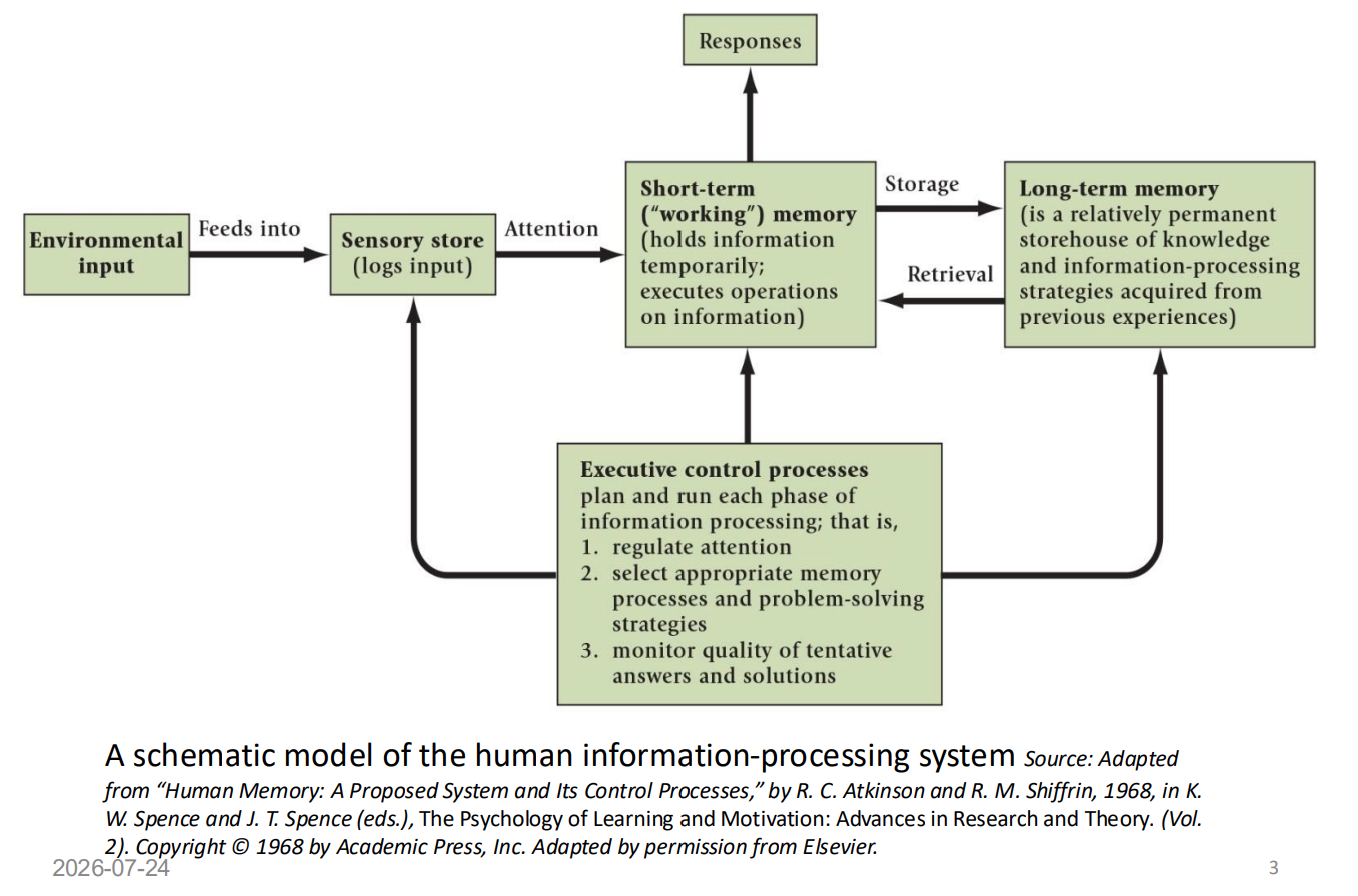
Multistore Model
Shows the flow of information in thinking (Atkinson and Shiffrin 1968)
Information flows through 3 processing units.
Sensory store: briefly holds raw sensory information from senses (raw data = things we feel, hear, see) → processed in seconds
Short-term store (STS): also called “working memory”
stimuli retained for several seconds
if we don’t rehearse/process info → it will go away
Long-term store (LTS): processed information stored for future use
where knowledge + experiences retained for longer period of time
diagram - env input that enters sensory store, where all info is briefly locked in → if paying attention to input → enters STWM where we can temporarily hold + manipulate → if info is processed in meaningful way it = LTM so info can be easily retrievable later on
WM manages flow and is in control
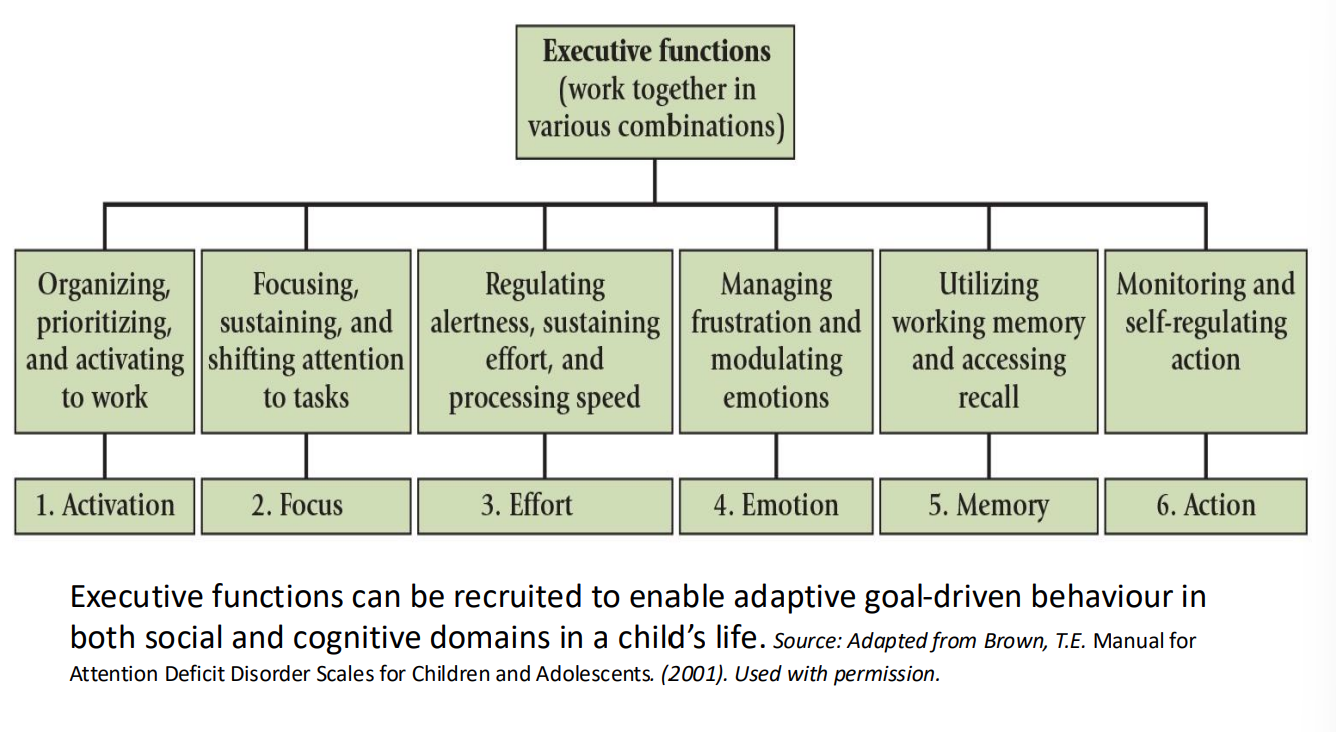
Working Memory & Executive Function
Term “working memory” allows us to actively work with information rather than just storing it (Alan Baddeley 1992)
We actively channel information input
Executive function
1. Planning, monitoring, and executing strategies
select best possible strategy
2. Attention: Focusing on selected stimuli & Inhibitory control: Choosing not to focus on certain stimuli
focus on important stimuli + block distractions
3. Set-shifting: Moving between strategies (or tasks) when circumstances + goals change (e.g., multi-tasking)
exec functions mostly engaged when working toward specific goal
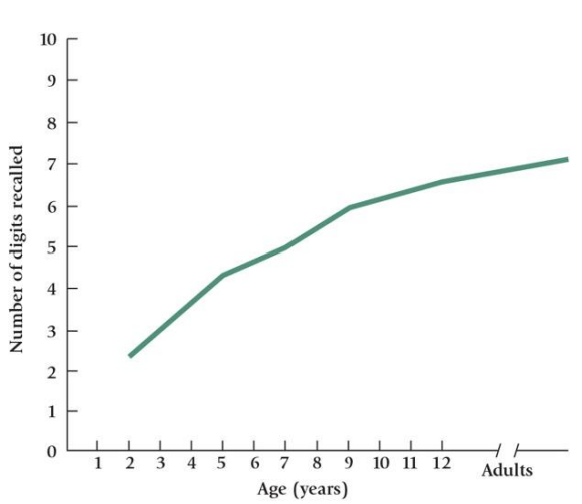
Development of Short-Term Memory
Development of the short-term store
Memory span: Refers to the number of items can hold in short-term memory (and recall in same order), which increases with age. Tested efficiency using tasks like the forward digit span task.
Span of apprehension: Refers to how many items can be attended to at once (w/o deliberate memorization) → amount of info that can be taken in in brief snap, improves w age. Assessed using tasks where participants recall digits they weren't explicitly focusing on.
Domain specificity: Specialized learning mechanisms in different areas of learning. → reminds us that memory performance does not rely just on memory capacity but also knowledge & exp (new vs experiences chess players)
Diagram: shows Children’s memory span for digits (digit span) shows regular increases with age.
Knowledge Base and Memory Development
why do some children perform better at memory tasks?
Domain-specific knowledge: Older children, with more experience and knowledge, tend to perform better in tasks related to familiar subjects (e.g., chess experts recall more about chess pieces than novices).
children w extensive knowledge in specific domain performs just as well or even better on memory tasks than older individuals w/in that domain → doesn’t relate to memory capacity but rather knowledge (time to store it in brain for easier recall)
Familiarity and memory: Children develop specialized strategies for processing familiar material more effectively, which makes it easier to learn and remember new information in familiar areas.
making patterns, connecting info together for easier retrieval
Transfer between domains: Mixed results; while domain-specific knowledge helps in related areas, transferring strategies between unrelated domains is often challenging, particularly for younger children.
domain specificity
children memory more easily distracted than adults
Strategies & Mnemonics
Goal-directed actions to improve task performance.
intentional behaviours that help us perform task more effectively (instead of doing everything at once, moving through a topic at a time)
Strategic memory: Actively attempting to retain or retrieve information.
recalling phone number, you would use strategic memory
to make strategic memory = Mnemonics: Techniques such as rehearsal, organization, and elaboration that enhance memory.
rehearsal = repetition, flashcards, etc.
organization = group related items together into meaningful categories
elaboration = connecting info to something already known to create meaningful story
as children grow older, they become better at selecting these strategies → memory improves due to improvements in strategies
Production and Utilization Deficiencies
these are phased when memory improvement:
Production Deficiency: Younger children often fail to use strategies they know could improve performance.
may group similar items together for easier retrieval → but won’t use this unless someone else reminds them (non-spontaneous)
Utilization Deficiency: Even when children use a strategy, they may not benefit from it immediately.
new strategy requires lots of mental effort → so much WM devoted into using it, leaving them w little cognitive resources to complete the task (wasted on process instead of outcome)
Strategies become more effective with age as children’s cognitive resources increase and strategies become automatized. (after time + practice)
Production deficiencies are most common in early childhood, while utilization deficiencies often appear when children first adopt more complex strategies
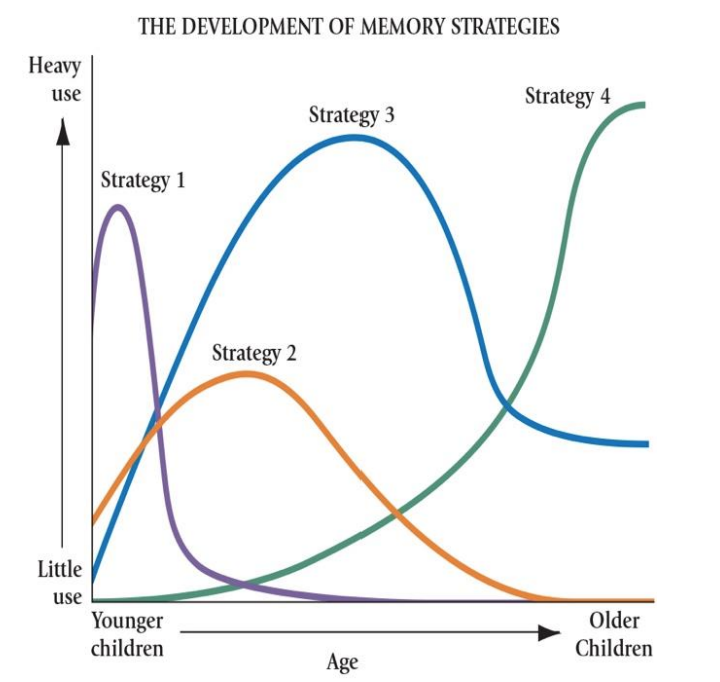
Siegler’s Adaptive Strategy Choice Model
Strategy development is not step-by-step or linear. Instead, children have multiple strategies available at any given time, and these strategies compete for use
Diagram: Siegler’s Adaptive Strategy Model depicts the development of strategies over time, showing how different strategies dominate at different ages
First then choose simplest of strategies → later on Children don’t abandon simpler strategies as they grow; they add new, more effective ones.
simpler ones for simpler tasks
advanced strategies for more difficult tasks
what control which strategies are used:
Executive Functions: Switching strategies requires skills like inhibition, metacognition, and working memory.
children need to abandon old strategies and switch to new one to hold memory
Dimensional Change Card Sort Task (Zelazo) = child asked to sort cards by colour + asked to sort cards by shape (and won’t be able to do it correctly even if they understand the rule) but at 5 years, they can inhibit old strategy and use the new one → this tests exec functions + cognitive flexibility (how they switch b/w tasks), not inhibiting (perservation? after the video of card sort review.)
Transfer Utilization Deficiency: Children struggle when trying to apply learned strategies to new tasks.
Siegler’s Adaptive Strategy Choice Model: Multiple strategies compete for use, and older, simpler strategies can still be employed in familiar tasks. → over time, more effective strategies are selected more often but older strategies don’t disappear
lines overlap instead of replacing (some dominate more than the other) → depends on how frequent new strategies are used
Development of Metacognition and Executive Control
Children’s awareness of the distinction between conscious and unconscious thought develops gradually.
Example: Most infant thoughts are implicit or unconscious.
Implicit cognition: thought processes that occurs without awareness that one is thinking; is unconscious
Explicit cognition: thinking and thought processes of which we are consciously aware; is conscious (can reflect on thinking)
Metacognition: Knowledge about one’s own cognitive processes and the ability to regulate them. (thinking about how mind works + starting to think about regulation of thinking)
creative thinking higher than metacognition
e.g., rereading a paragraph, thinking of how to memorize
false belief task → when children start to understand that others have thoughts + beliefs differ from their own → this provides foundations for metacognition development
Executive control processes: Higher-level processes that regulate attention, working memory, and problem-solving
like a brain management system - help for focus, attention, holding of WM, distraction inhibition, strategy switching, monitor effectiveness of strategies
Retention and the Development of Attention: Attention Span
Changes in attention span
1 month old doesn’t decide to look at face, it naturally grabs their attention; preschooler switches to activity that is more interesting
Attention span: capacity for sustaining attention to a particular stimulus or activity over time (increase with age due to elimination of distractions + putting effort into specific goal)
1. Biological Maturation
Increases with age, partly due to myelination of the central nervous system, including the reticular formation (communication b/w brain regions become faster + more efficient)
Reticular formation: area of the brain that activates the organism and is thought to be important in regulating attention (arousal as well) - to resist distractions (e.g., background noise)
Biological maturation provides the foundation for attention, but it does not fully explain how children learn to control and direct their attention intentionally.
2. Development of planful attentional strategies
With age, attention becomes more planful, selective, and goal-directed.
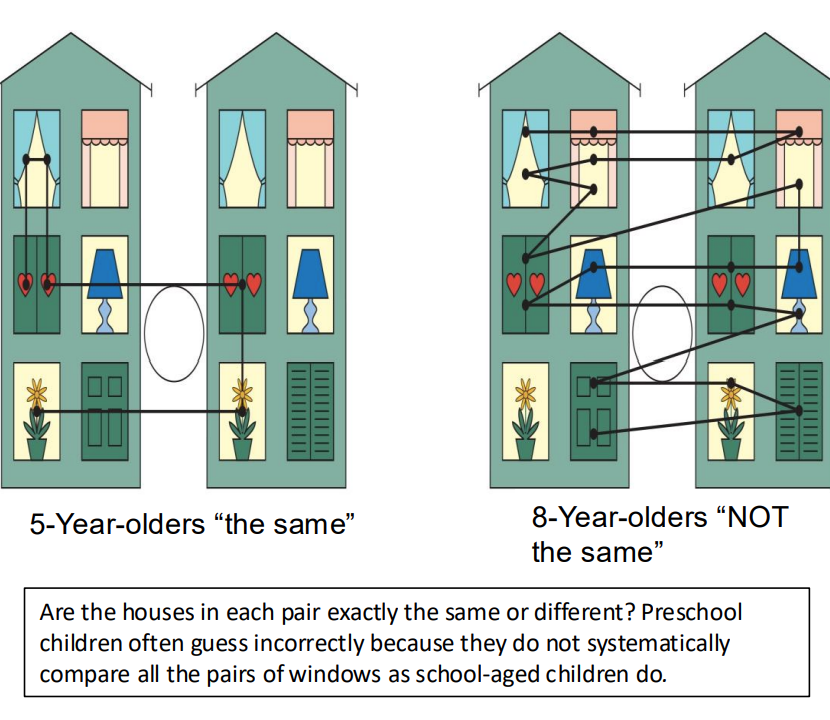
House Task: Planful Attentional Strategies
to study planful attentional strategies - shown 2 houses and children asked if both are the same/different
w age, the search for differences are difffernet
5 yr old would only look at few parts of houses to conclude (search is unsystematic)
older kids would respons in more systematic
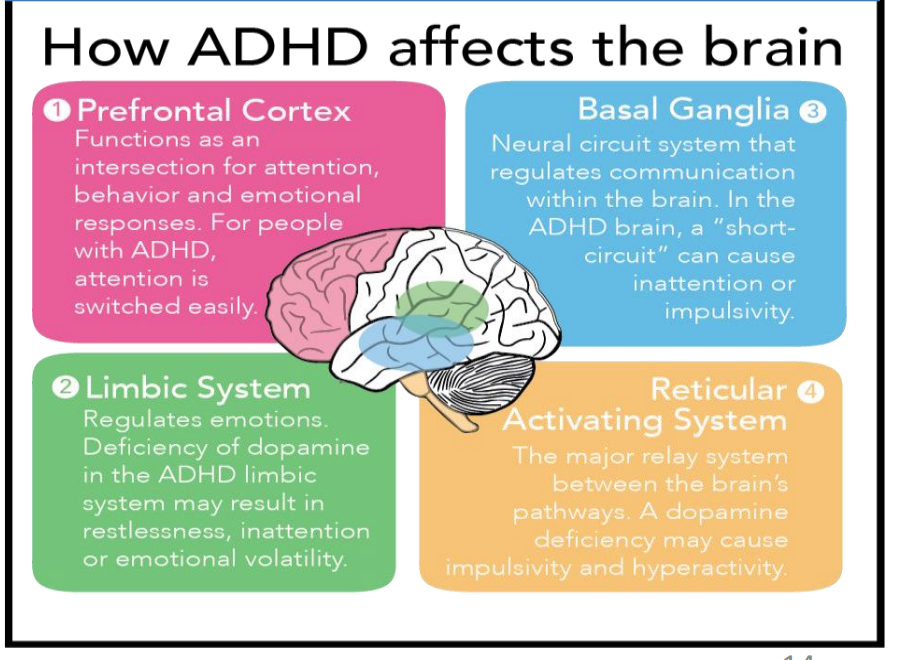
Think of the biological foundations of ToM → PFC + reticular formation
Children with ADHD:
Selective Attention
Selective attention: capacity to focus on task-relevant aspects of experience while ignoring irrelevant or distracting information.
Older children are much better than younger ones at concentrating on relevant information and filtering out extraneous input that may interfere with task performance.
Example: In memory tasks, younger children (3-4years old) tend to remember both relevant and irrelevant information, while older children (5 years old and above) focus better on the task and filter out distractions
Cognitive Inhibition & Meta-Attention
Cognitive inhibition: dismissing irrelevant information
Inhibition: the ability to prevent ourselves from executing some cognitive or behavioral response.
Example: Young children have difficulty inhibiting automatic or preferred responses, which improves with age as cognitive control develops
Meta-attention: What do children know about attention?
Knowledge about attentional processes increases with age, though it starts in infancy (ex., joint attention).
Even 5-year-olds understand that they should focus on task-relevant stimuli.
By 7-9 years old, children understand the importance of ignoring distractions for better performance.
Fuzzy-Trace Theory
offers an alternative to the multistore model proposed by Brainerd and Reyna (2015)
Information is processed at 2 levels:
Level 1, Gist: fuzzy representation of information that preserves the central content but few precise details
Easily accessed
Requires relatively little effort
Level 2, Verbatim traces: Detailed memory representations
More susceptible to interference and decay
More easily forgotten
Children’s reliance on verbatim or gist traces shifts with age: Younger children (before age 6-7) tend to encode and recall verbatim details.
Older children and adults rely more on gist-like representations
Schema Theory + Scripts and Event Memory
Schema theory emphasizes how memories of events are organized and manipulated.
A script of routine actions is extracted with slot fillers for details from a specific event.
Script: a generalized representation of a familiar sequence (what occurs and when) of events
Slot-filling: specific details are filled into predefined roles
Young children rely on scripts because they reduce cognitive load
Development of Event Memory
Personal, social, and cultural circumstances influence how memories are organized.
Event memory: long-term memory for events
Children from individualistic cultures tend to recall events from their own perspective and retrieve information related to their personal goals.
Children from collectivist cultures encode, retain, and retrieve more social aspects of events.
Autobiographical memory improves during the preschool years.
Parents strengthen it by discussing past events.
Infantile Amnesia: Why Early Memories Fade
Limited language at encoding
Developing sense of self
Immature source monitoring
Children as Eyewitnesses → how do they recall information?
Children use the following strategies to recall info:
Retrieval: actions and strategies aimed at getting information out of the long-term store
Free recall: recollection that is not prompted by specific cues or prompts
Cued recall: recollection that is prompted by a cue associated with the setting in which the recalled event originally occurred
accuracy of children’s eyewitness memory increases with age
Eyewitness Interviewing: What Improves Accuracy?
Free recall → fewer errors, fewer details
Cued recall → more detail, if cues are neutral
Start with generic recall, then probe specifics
Use open-ended questions
Suggestibility & Legal Testimony
Suggestibility: the likelihood that false information that is suggested is incorporated into one’s memory
All ages susceptible to false memories
Children younger than 8 to 9 years more suggestible than older children and adults
Implications for legal testimony
Steps to increase the accuracy of children’s eyewitness testimony in legal proceedings include the following:
Maximizing the completeness and accuracy of children’s narratives
Probing with open-ended questions tied to cues provided by children
Development of Analogical Reasoning
Reasoning: a particular type of problem solving that involves making inferences
Analogical reasoning: reasoning that involves using something you already know to help reason about something not known yet
Relational similarity: the relation between two analogues (e.g., a parent feeding a child is relationally similar to an adult bird feeding its chicks)
Using knowledge of relational similarity improves along with improvements in executive control processes such as working memory, inhibition, and cognitive flexibility
Number and Arithmetic Development
Even infants are capable of processing and using quantitative information.
Counting begins once children begin to talk.
Preschoolers gradually construct such basic mathematical understandings as the principle of cardinality.
Cardinality: The principle that the last number in a counting sequence represents the total number of items in a set.
Early arithmetic strategies typically involve counting out loud. With development, arithmetic becomes internalized and more strategy-based.
Development of Arithmetic Strategies
Children of any age use a variety of strategies to solve math problems, adapting based on their age and skill.
Robert Siegler’s adaptive strategy choice model: children have multiple strategies available to them that compete with one another for use.
Counting on fingers is an early strategy for solving arithmetic problems.
As children’s knowledge grows, this strategy is used less frequently.
Children’s arithmetic development reflects non-stage-like strategy change, meaning multiple strategies coexist and are used flexibly rather than replacing one another in fixed stages.
Cultural Differences In Math
Unschooled children develop arithmetic strategies that they apply quite skillfully to practical, everyday problems
They may perform well in real-life contexts but struggle with paper-and-pencil mathematics.
For example, street vendors can quickly and accurately add and subtract currency values mentally.
context-embedded math Versus decontextualized math
Culture, Language, and Mathematics - Vygotsky’s socialcultural theory
Cultural variations influence mathematics performance, as emphasized in Vygotsky’s sociocultural theory
East Asian children often outperform North American children in mathematics.
Differences are partly due to language structure and instructional practices.
These cultural tools support math fact retrieval, computational efficiency, and conceptual understanding.
From a Vygotskian perspective, language functions as a tool of intellectual adaptation, shaping higher-order thinking.
Evaluating the Information-Processing Perspective
Despite its many strengths, the information-processing perspective has been criticized:
Underemphasizes neurological, evolutionary, and sociocultural influences on cognitive development
Does not offer a single, integrative theory of intelligence
May underestimate the richness, flexibility, and diversity of human cognition