proteins and AA's structure, nomenclature, properties
 Call Kai
 Learn
Learn Practice Test
 Spaced Repetition
 Match
Match Flashcards
 Knowt Play
1/179

There's no tags or description
Looks like no tags are added yet.
Name | Mastery | Learn | Test | Matching | Spaced | Call with Kai | Chat |
|---|
No analytics yet
Send a link to your students to track their progress
180 Terms
proteins are involved in
every cellular process
what are the functions for proteins (8)
Enzymes
Transcription factors
Binding proteins
Transmembrane proteins
Hormones
Immunoglobulins (key to our immune system; help kill foreign invaders)
Signaling molecules (ex: insulin)
Structural proteins (ex: collagen)
amino acids are linked via
peptide bonds
amino acids are the building blocks of
polypeptides and proteins
proteins make up how much of human dry mass
½
what are the common components of AA
carboxyl group
amino group
chiral carbon
Hydrogen group
side chain (R group)
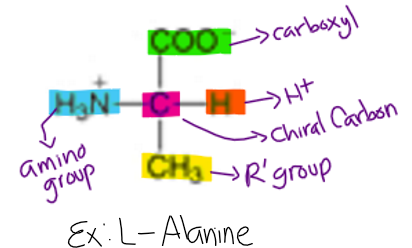
chiral center allows for
optical properties
related to stereochemistry
what AA does not have chiral central carbon?
glycine
has 2 H functional groups
how many AA’s are there
20
amino acids are characterized by their
side chains
all amino acids are in what formation?
L formation
what are the 20 amino acids (names)
alanine
valine
leucine
isoleucine
lysine
glycine
phenylalanine
serine
proline
cysteine
glutamine
asparagine
arginine
glutamate
aspartate
threonine
methionine
tryptophan
tyrosine
histidine
which are the essential AA’s (9)
valine- Val
leucine - Leu
isoleucine - Ile
phenylalanine- phe
methionine- Met
histidine- His
Threonine- Thr
tryptophan- Trp
lysine- Lys

what are the nonessential amino acids (11)
alanine- Ala
glycine- Gly
arginine- arg
serine- Ser
cysteine- Cys
Proline- pro
asparagine- Asn
glutamine- gln
aspartate- asp
glutamate- Glu
Tyrosine- tyr
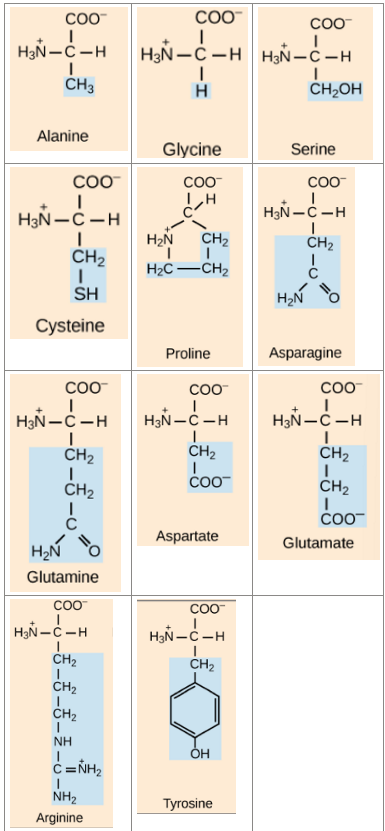
what are the branched chain amino acids
valine (val), leucine (leu), isoleucine (ile)
which are the aromatic amino acids
phenylalanine (phe)
tyrosine (tyr)
tryptophan (trp)
which amino acids contain sulfur
cysteine and selenocysteine*
the side chain of amino acids is important why?
make side differences amongst AA's and give them their specific characteristics
differ by shape, size, chemical and physical properties
what can occur to proteins post-traslationally?
chemical changes through addition of carb, lipid, protein, chemical group to the specific amino acid side chain
the optical activity of an amino acids comes from what?
chiral center (α-carbon)
what amino acids lack optical activity?
glycine (does not have chiral carbon)
what are stereoisomers?
mirror images of each other

amino acids can are present as what 2 formations?
L or D
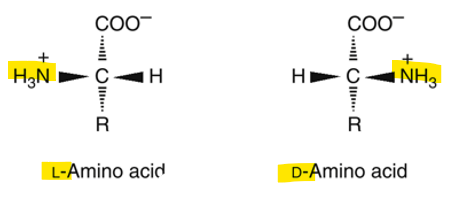
L formation of amino acid means what?
amino group is on the left

D formation of amino acid means what?
amino group will be on right side

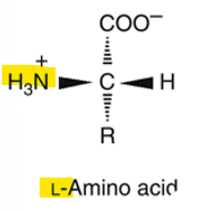
which is the formation of all proteins and peptides in humans
L-formation
amino acids have what property?
acid-base properties
how do amino acids have acid-base properties?
Can function as a buffer when added to a solution (which could be acidic or basic in nature)
what is titration (AAs)
ab method where you slowly add a strong acid or base to amino acid solution and measure how the pH changes
what is a titration curve?
a graphical representation of the pH of a solution in a titratio
titration curve y and x axis?
Y axis is the pH
X axis is the moles of OH per mole of AA
the more basic, the more moles of OH per mole of AA
what is pKa
is the pH which the protonated and unprotonated groups are present in equimolar amounts
define protonated
amino acid functional group has gained an H+
define deprotonated
amino acid functional group has lost an H+
which functional groups can be protonated/deprotonated in amino acid?
amine group, carboxyl group, and/or R group (side chain)
what is the isoelectric point (pI)?
the pH at which the average charge on the molecule is zero (when at zwitterion)
titration of histidine explained
Start with histidine at a net charge of +2 (fully protonated) and a pH 0
At pka1 (1.82), we have a 1:1 ratio of histidine (+2) and histidine (+1)
At pKa2 (6), we have a 1:1 ratio of histidine (+1) and histidine (0)
At pKa3 (9.17), we have a 1:1 ratio of histidine (0) and histidine (-1)
Becomes more basic because histidine loses its H's (to form water with OH group)
1st to be removed in the COOH ----> becomes COO- (+1)
2nd is the H from its functional group which includes NH+ --> becomes N (0)
3rd is the H from the amine group (NH3+) --> NH2 (-1)

nonpolar amino acids will be incorporated into what area of the membrane
nonpolar
Aka, hydrophobic proteins reigns reside in lipid bilayer of the membrane
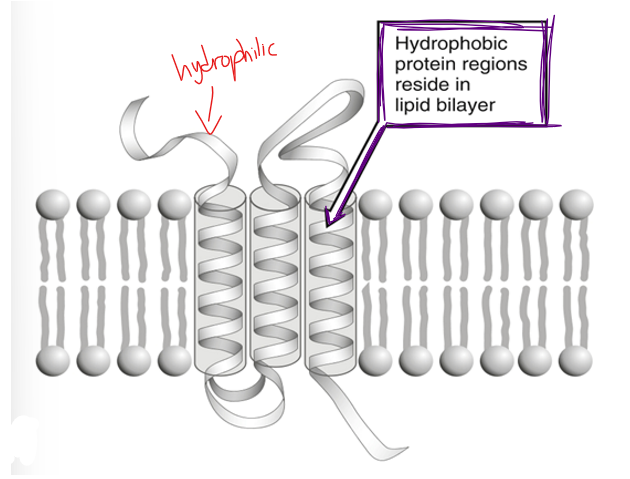
hydrophillic amino acids will be where on the membrane?
outside of the membrane
Aka in the aqueous solution (polar)
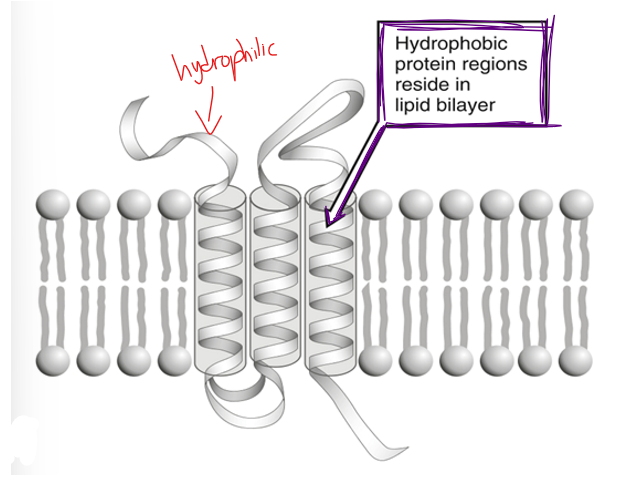
what determines whether AA is hydrophobic or hydrophilic?
the R groups of the amino acid
what is a major force in folding of proteins?
Hydrophobicity/Philicity
what is post-translational modification?
when an AA can be modified by altering the R group
post-translational modifications of AA can occur _______ or ________
enzymatically or nonenzymatically
post-translational modifications of AA reversibility?
Can be reversive or irreversible
what do post-translation modifications do?
changes properties of the side chains and gives them a specific function
what are 5 examples of AA that have been modified post-translation?
trimethyllysine
methyllysine
acetylcholine
hydroxylysine
gamma-carboxyglutamate
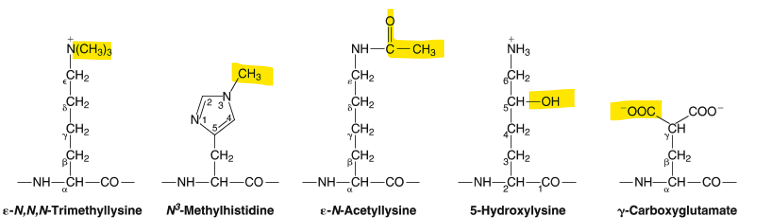
hydroxylysine function
post-translation modification
effects (2)
-hydroxylated via lysyl hydroxylase
-effects:
allows chromatin to go through transcription
help in the maturation of collagen
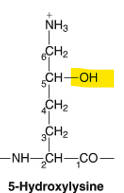
carboxyglutamate
post-translation modification
effects
gains carboxyl group (a - charge)
can now have calcium (2+) bind to it which will help in the blood cascade by stabilizing the charges (Helps stabilize the 2 negative charges (2 COO- groups) since it is Ca2+)
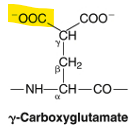
citrulline and ornithine play a role in the
urea cycle

homocysteine is important to
folate cycle

y-Aminobutyric acid (GABA) is what?
a neurotransmitter
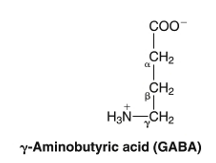
what is a peptide bond?
bond that forms when combining the carboxyl end on one amino acid with the amino end of another (C-N bond) and removing a water molecule
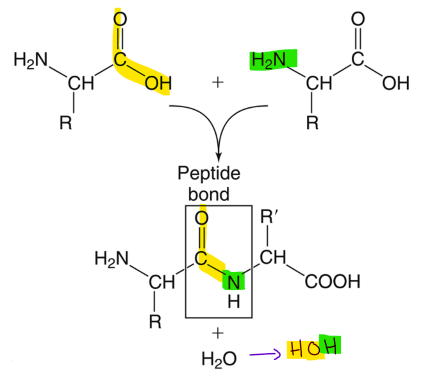
peptide bond looks how (letters)
C-N

a peptide bond is what type of bond
amide bond

peptide bond forms via what reaction
condensation

peptide bond is an ______ reaction
endergonic reaction
what is an endergonic reaction
reaction that requires energy input and will do by coupling to another reaction to get that energy
absorbs energy from surroundings
what is a peptide
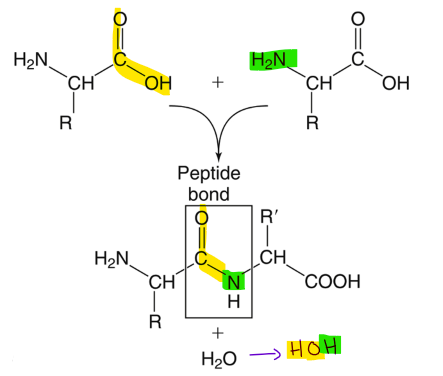
30 amino acid residues or less linked togetherw
what is a polypeptide
several amino acids linked together but does not have a defined confirmation of structure
what is a protein
stable molecule that is in a specific 3D conformation
how does a peptide bond form (like what is it)
Between the carbon of the carboxylic group (C-terminus) and the Nitrogen on the amino group (N-terminus)
what is a key characteristic of a peptide bond
it is very stable and does not allow for rotation (acts like a double bond)

why does a peptide bond act like a double bond
the length is shorter than a normal single bond and slightly bigger than a double bond, so these forces give it greater stability

peptide backbone rotations
Rotation in peptide backbone occurs (C-C and N-C bonds) but NOT the C-N (peptide) bonds

peptide backbone rotations depend of
the R group (charge, size, hydrophobic or philic)

when naming a polypeptide, what order do you name it?
start with N-terminus and end with C-terminus
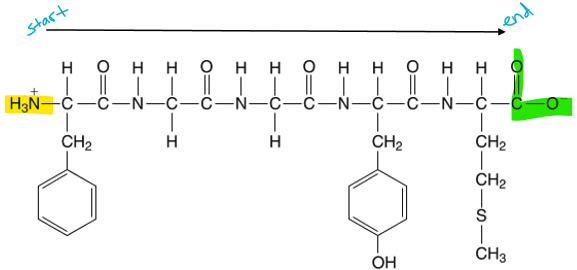
in this class we will name polypeptides using what name?
3-letter abbreviations for amino acids

how do you know where a amino acid ends on a chain?
Amino acids end at the C-N bonds

how do you know how many peptide bonds are in a polypeptide
# of AA’s - 1
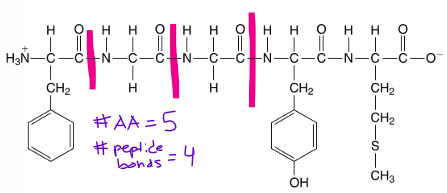
what are 3 examples of common polypeptides?
glucagon
neuropeptides
antidiuretic hormone (ADH)
polypeptides often need to be _________ to become active
altered
how are polypeptides often altered to become active?
via cleavage or hydrolysis
what is a zymogen
inactive protein that needs to be activated via cleavage
seen in many vitamins and enzymes
what was one of the first proteins to be sequenced?
insulin
how does insulin become active?
insulin exists as preproinsulin (110 residues) —→ modified and becomes proinsulin (86 residues) —> modified and becomes insulin (51 residues)
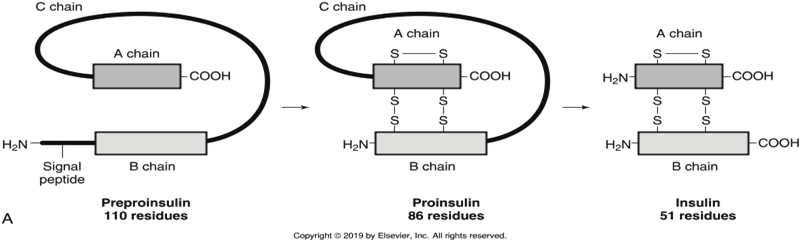
what is the structure of insulin (components)
made up of 2 polypeptides attached via 2 disulfide bridges
alpha chain has 21 AAs and beta chain has 30 AA’s
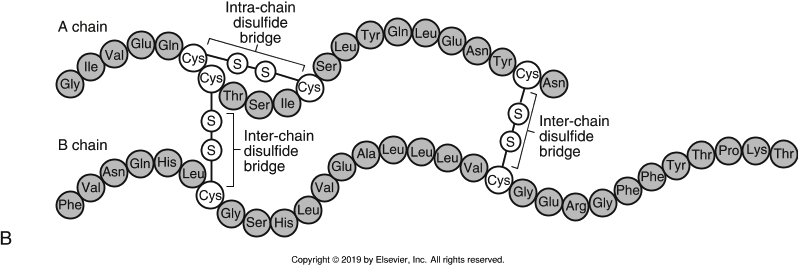
stability of disulfide bonds
are very stable covalent bonds
what is the genetic code?
used to sequence out amino acids which ultimately get incorporated into proteins
how are proteins built? (starting with genetic code)
DNA is transcribed into mRNA
DNA has 4 deoxyribonucleotides: cytosine, guanine, adenine, thymine
mRNA Contains 4 ribonucleotides: cytosine, guanine, uracil, thymine
mRNA leaved nucleus and goes into cytoplasm
mRNA code is carried to tRNA anticodons (3 letter)
the tRNA anticodons have corresponding amino acids attach
Continues process until it forms the polypeptide and then the protein

what is a single-point mutation?
A base letter could be swapped, added, or deleted which could result in the coding for a different AA
what is the result of a single point mutation?
Can alter structure or function of protein, stop the protein from being products, prevent the production entirely
example of a single point mutation?
PKU (phenylketonuria)
what is PKU
what is it
diet needed
A genetic mutation that can be caused by a single-point mutation where one does not have the conversion of Phe --> Tyr
Phenylalanine hydroxylase is missing or defective (due to mutation)
Results in buildup of Phe
Must consume a low Phe diet + Tyr added to diet
PKU is the disease that prevents the conversion of what amino acid from becoming what?
phenylalanine conversion to tyrosine
what is primary structure
specific, linear sequence of amino acids that make up the polypeptide chain (so order of AA on the chain)
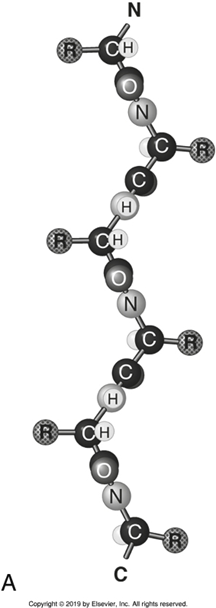
primary structure directs what
the folding of the protein into the 3D shape to make it functional
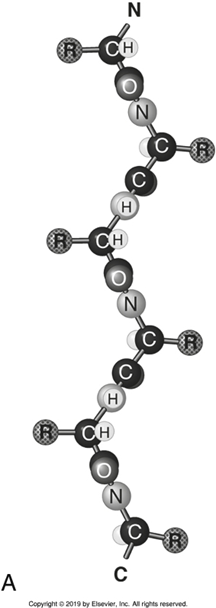
small sequences on the primary structure can do what(4)
act as signals
determine where protein goes (protein trafficking)
determine where protein is inserted into the membrane
allow for additional protein modifications that will impact biological regulation
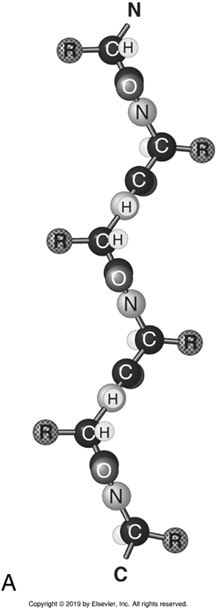
what is secondary structure?
3D folding related to the hydrogen bonds that occur on the backbone
what are the 2 types of secondary structure?
alpha helixes and beta sheets
what is an alpha helix?
coiled secondary structure created by H bonds within backbone

in alpha helixes, where do R groups go?
project outwards

the alpha helix shape is held together via
H bonds
O from carboxyl and H from amine group (O-H)

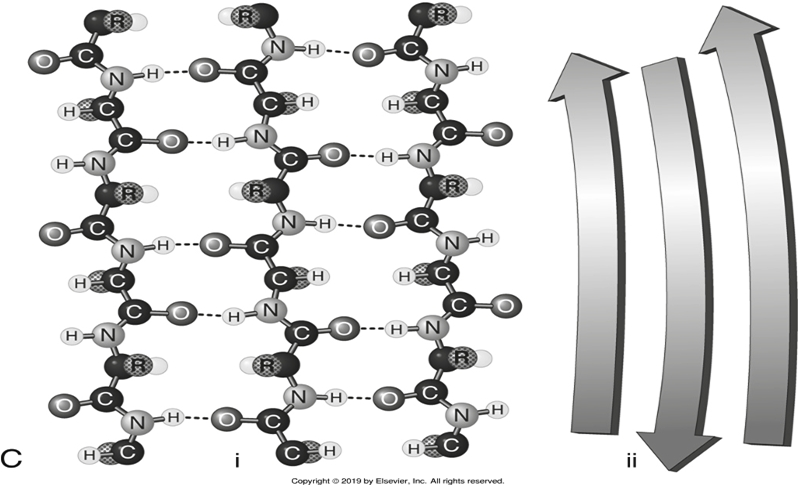
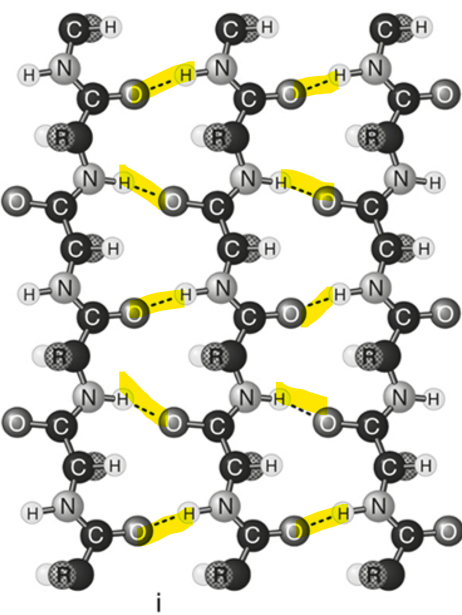
what are beta sheets?
folded/zizag pattern formed formed via H bonds
some side chains will do what that contributes to the formation of beta sheets?
somewhat restrict rotation
what are the 2 types of beta sheets?
parallel and antiparallel
what are antiparallel beta sheets
2 parts of the peptide chain are going in opposite directions which results in a perfectly lined up hydrogen bonds between amino group (H) attaches to carboxyl group (O)

stability of antiparallel beta sheets
very stable because the hydrogen bond is linear due to the O and H lining up

what are parallel beta sheets
beta sheets that form via “bent” hydrogen bonds when strands are running in the same direction

strength of parallel beta sheet
weaker because the O and H do not line up, so the H bonds is “bent”
tertiary and quaternary structures are both
functional