DOCANA FULL
 Call Kai
 Learn
Learn Practice Test
 Spaced Repetition
 Match
Match Flashcards
 Knowt Play
1/245

There's no tags or description
Looks like no tags are added yet.
Name | Mastery | Learn | Test | Matching | Spaced | Call with Kai | Chat |
|---|
No analytics yet
Send a link to your students to track their progress
246 Terms
Why is NLP difficult?
Language is social communication that computers cannot mimic
Emergent Complexity:Turning a simple sentence to a whole story
Subltelty of Word order
Anaphora resolution: which requires semantic understanding
Use of World knowledge and Interpretation
Hetronyms:different pronunciations of words indicate diff meanings
Resolcing Linguistic Challenges
Rule Based
Statisticsa based
Rule based NLP
use of linguistic rules
-doesnt sclae well
-diminishing returns
Stats based NLP
combine word memorizing coocurences with the rules
Use large collections of text and compute stats of words over it.
Use thes to learn rules
Distributional Semantics
You shall know a word by the company it keeps
ALGO: keep track of cooccuring words with the diff spellings and predict best spelling by surrounding wordxs
-doesnt cover all words
Zipfs Law
freq of words is inversly prop to its rank in the freq table
Deep Learning for NLP
feed web-scale corpora of unlabeled text into (deep) neural networks with billions of parameters to learn word cooccurrence patterns.
Current deep neural language models:
can solve some NLP tasks better than humans
can solve tasks for which they have not or barely been trained (transfer learning, zero-shot learning)
can be quite biased (garbage in, garbage out)
Morphology
The study of the way in which words are constructed from smaller units of meaning
Morpheme
The smallest meaningful unit in the grammar of a language.
Inflectional Morphology
Variation in the form of a word, typically by means of an affix, that expresses a grammatical contrast.
Does not change the word class
no change of meaning.
Modifies words to serve a new grammatical role
Adds morphemes that encode: tense, number, person, mood, aspect, etc.
Derivational Morphology
The formation of a new word or inflectable stem from another word or stem
Nominalization: formation of nouns from other parts of speech
Formation of ADJECTIVES
irregular process
Stem
The common part to all inflected words.
Is not necessarily a proper word from the dictionary
Lemma
The base form of a word
Root
is common to a set of derived or inflected forms, if any, when all affixes are removed
cannot be split further into meaningful components
carries the principal portion of meaning of the words
Affix
A bound morpheme that is joined before, after, or within a root or stem.
Clitic
A morpheme that functions syntactically like a word, but does not appear as an
independent phonological word
Segments of a text
● Volumes
● Books
● Chapters
● Paragraphs
● Sentences
● Tokens (and punctuation)
● Characters
Sentence Splitting
NAIVE: with whitespaces and punctions(doesnt work for all languages)
Binary Classifier
● Sequentially iterate over all tokens and punctuation
● Decide whether the sentence ends here.
Token
The occurrence of a word in a text
Tokenization
Segmentation of an input stream into an ordered sequence of tokens
Tokenizer
A system that splits texts into word tokens
Naïve approach: Split tokens at whitespace characters
Problems with naive tokenization
periods and whitespace are ambigious
irregular cases and spelling variations
Agglutinative Languages(compunds nouns in german)
Sinitic Languages (where moving of a character can change the meaning )
Tokenization Algorithm: Maximum Matching
Consider the input sentence as a simple word sequence
● Use a dictionary
● Start at the beginning of the sentence
● Search for the longest matching string in the dictionary and cut
● Start matching against the dictionary again
However it does not work well in English
Token Normalization
To make these words comparable, we want to normalize them by grouping them into equivalence classes.
Lemmatization, Stemmatization
Porter Stemmer
● We effectively chop off the end of the word!
● Only suffixes are considered for removal
● Frequently used algorithm (especially for Information Retrieval)
● Results are pretty ugly from a linguistic perspective
Idea behind Porter Stemmer
● Consecutively remove / replace suffixes
● The number of iterations depends on the “syllables” of the word
● In each step, one rule from a fixed set of rules is applied
● No rule may be applied twice
● Once no rule can be applied, the algorithm stops
Measure of a word for porter stemmer
● V denote a sequence of vowels and
● C denote a sequence of consonants.
Then each word can be modeled as: [C](VC)m[V] and m is called the measure of the word,
use m to approximate the number of syllables.
Problems with Porter stemmer
Overstemming
Understemming
Overstemming
Two words are stemmed to the same root when they should have been treated as separate
Understemming
Two separate inflected words should be stemmed to the same root but are stemmed to different roots
Lemmatization problem
complexity and need for knowledge and understanding of the context
Lemmatization approach
refers to doing things properly with the use of a vocabulary and morphological analysis of words, normally aiming to remove inflectional endings only and to return the base or dictionary form of a word, which is known as the lemma
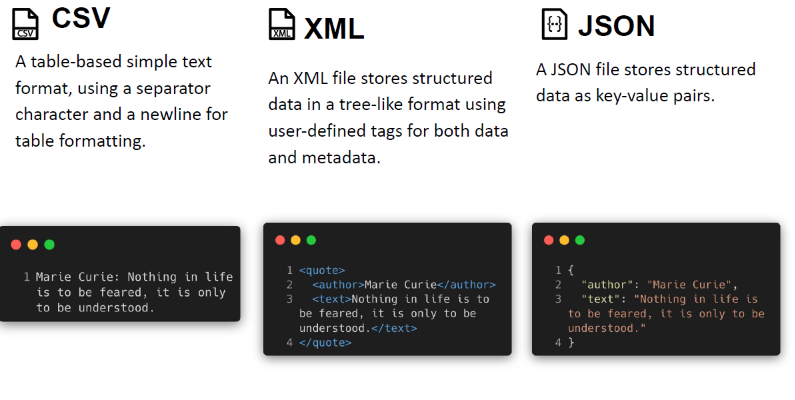
Data Formats
POS Tagging
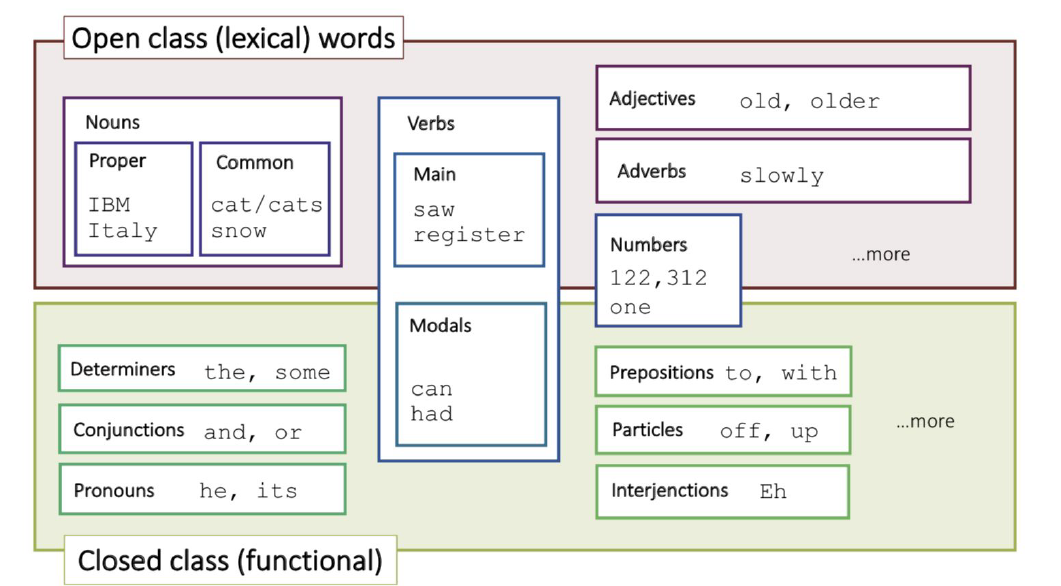
The process of classifying words into their parts of speech and labeling them accordingly.
Parts of speech are also known as word classes or lexical categories.
The collection of tags used for a particular task is known as a tagset.
Purpose of Tagging
Collapsing distinctions into equivalence classes
Introducing distinctions to resolve ambiguities
Helpful features in classification and prediction tasks
Tagging
The process of associating labels with each token in a text
Tag Set
● The collection of tags that is used for a particular task
● Tag sets are defined by linguists and not unambiguous.
● Different languages require different language-specific tag sets
● It is difficult to compare tags between different languages
Requirements for Tagsets
Informativeness: degree of ambiguity
Specifiability: inter-annotator (inter-judge) agreement should be good
Frequently Used Tagset
English:
● Brown corpus
● Penn Treebank
● Lancaster UCREL C5
● Lancaster C7
German:
● Stuttgart-Tübingen Tagset (STTS)
Feature based Tagging
Knowledge of tag combinations for neighbouring words enables us to leverage syntactic rules to make decisions.
Using word level and tag sequence features: 93.7% accuracy
NLP Pipeline

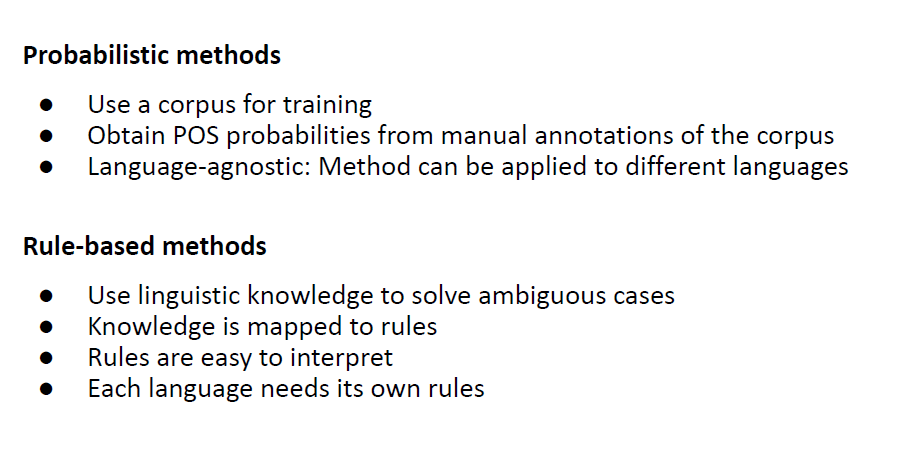
Probabilistic Tagging
Count POS tag frequencies for a given token in the annotated corpus
Select the most probable (= frequent) POS tag in new, unseen data
Naive Unigram issue
Problem: many words might never be seen in the training data (out-of-vocabulary)
Solution: specify a default tag as “backoff
The most frequent tag is obviously not always correct, it depends on context
POS Tagging Approaches
Unigram Tagger bayes
We use bayes formula instead
The most frequent tag is obviously not always correct, it depends on context
n gram
An n-gram is a contiguous sequence of n tokens from a given sample of text. The n stands for how many tokens are used. (n-1) is the order
using n > 5 is rare.
N-grams can encode different types of contexts, e.g.
● Character based n-grams
● Token-based n-grams
● POS-based n-grams
● Combinations of the above
Use of n gram
○ Words before and after a period to determine if it is the end of a sentence
○ Detecting open compound nouns
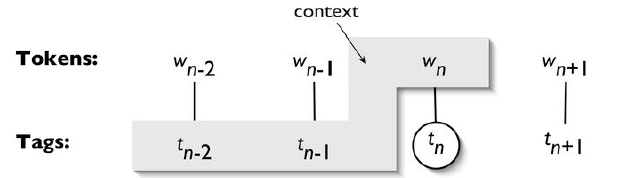
n gram idea
● Use the unigram probability for the current token (→ unigram tagger)
● Use the predicted preceding n-1 tags
The tagger picks the tag which is most likely, given that context
Backoff
● Attempt to tag the token with the 1st order tagger (e.g., bigram tagger)
● If the 1st order tagger is unable to find a tag for the token, fall back tousing a 0th order tagger (e.g., unigram tagger)
● If the 0th order tagger is also unable to find a tag, use the default taggerto find a tag (e.g., feature based tagger)
Bigram and trigram taggers need the previous tag context to assign new tags. If they see a [na] tag in the previous context, they will also output [na]. → Error propagation
Rule based Tagging
handcrafted sets of rules to tag input sentences
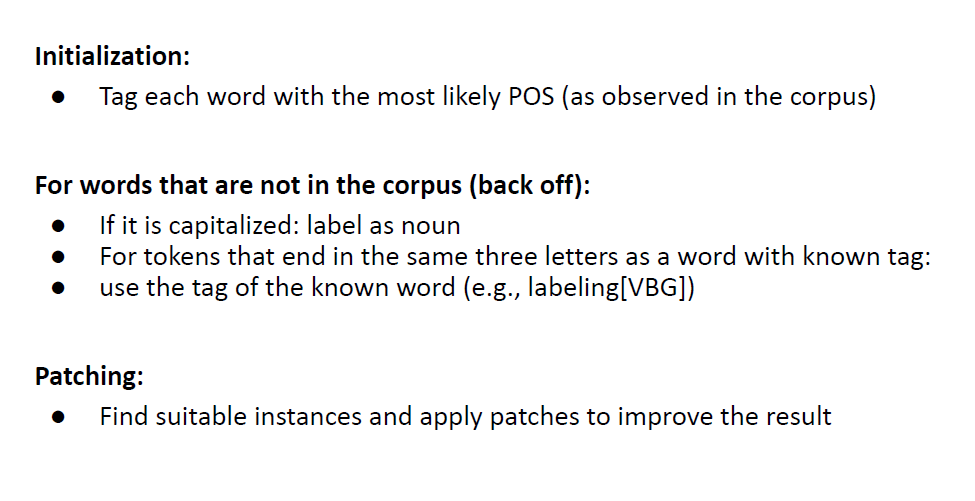
Brill Tagger
Core idea:
○ Use a probabilistic approach first
○ Then revise and correct it using contextual rules
supervised method and requires tagged corpus
Parsing
process of determining syntactical structure of a sentence using grammar
Syntactical corecctness =! meaningful semantic
Formal Grammar
A formal grammar G = (N,T,P,S) provides a schema for generating a formal language. It consists of:
A finite set of non-terminal symbols N (for natural language: constituents)
A finite set of terminal symbols T (for natural language: words)
A start symbol S (for natural language: a sentence)
A finite set of production rules P of the form: left hand side → right hand side
Grammar’s Language
The grammar’s language L(G) is the set of all sequences of terminal symbols that can be generated with the grammar.
To generate a sentence from the language:
Beginning with the start symbol, consecutively apply rules (“derivation”)
Applying a rule replaces all symbols on the left hand side with the right hand side.
Once only terminal symbols remain, the derivation is complete
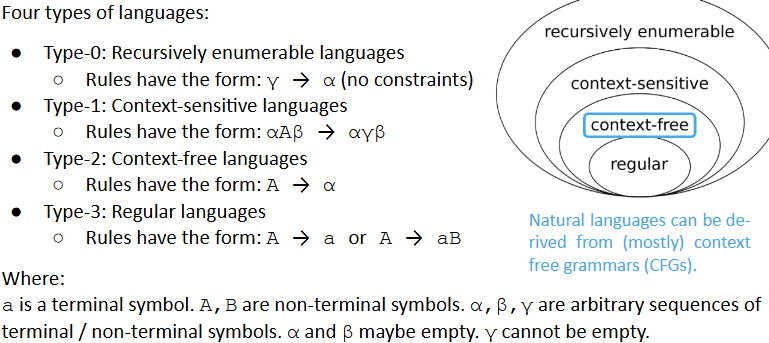
Chomsky Hierachy
Chomsky Normal Form
A context-free grammar (CFG), is said to be in Chomsky normal form if all of its production rules are in one of the following three forms:
A → BC
A → a
S → ε
where:
A,B,C are nonterminal symbols
a is a terminal symbol
S is the start symbol
ε denotes the empty string
Neither B nor C can be S
Constituent
A word or a group of words that function as a single unit
within a hierarchical structure.
A sentence has a Noun Phrase and Verb Phrase.
Parse Tree
a parse tree (or derivation tree) is an ordered rooted tree that graphically represents the syntactic information of a string derived from a (context-free) grammar
Purpose of Parsing
●Grammar Checking & Translation:Identify syntax errors and preserve grammatical structure across languages.
● Information Extraction: Reveal who did what to whom using sentence structure.
● Question Answering Systems: Understand question structure to extract accurate answers
Parsing Issues
Synatctic Ambiguities
Prepositional phrase attachment(unsure where prep belong)
Coordination scope(who adj refers to)
Particles vs. prepositions(diff meanings of a word)
Gerund vs. adjectives
Agreement
Approaches to generate parse trees
Top-down approach
Bottom-up approach
Leftmost derivation approach
It is designed for restricted context free grammars (e.g., programming languages) and does not work perfectly on natural language.
Leftmost derivation is an example of top-down parsing.
Algorithm outline:
Start with S
In each step, apply a production rule to the
leftmost non-terminal symbolProduce the observed terminal symbols
(= tokens)Terminates once all observed words
have been created.
Shift Reduce Parser
A shift reduce parser is effectively a pushdown automaton that uses a stack for recognizing a context free language. It is an example of bottom-up parsing.
Algorithm outline:
SHIFT operation:
Push a word from the input sentence onto the stackREDUCE operation:
If the top n words on the top of the stack match the right hand side of a production rule, then they are popped and replaced by the left hand side of the production.
STOPPING condition:
The process stops when the input sentence has been processed and S has been popped from the stack
CKY Parser
The Cocke-Kasami-Younger parser (CKY parser, sometimes CYK parser) uses dynamic programming. It is an example of a bottom-up parser.
Core idea:
Cache intermediate results (dynamic programming)
For building a parse for a sequence [i,j], keep track of all parses of
subsequences [i,k] and [k,j] that are included in it (i ≤ k ≤ j).
CYK Pros and Cons
Advantage:
Backtracking: if the parser gets stuck, we can easily go back to a previous alternative
Downside:
Requires a binarized grammar
The grammar must be in Chomsky Normal Form
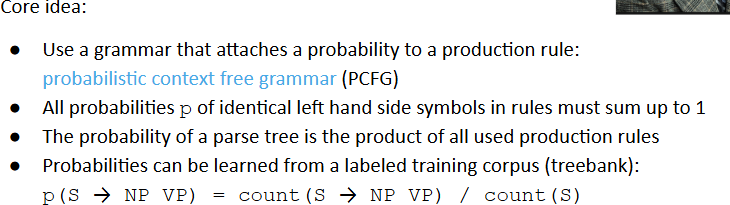
Statistical Parsing
resolves ambiguous parse trees
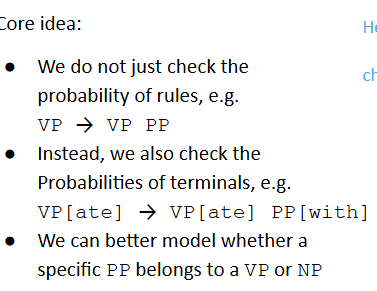
Lexicalized Parsing
Using corpus statistics, we can go even further and construct a parser that takes lexical relations into account to compute probabilities.
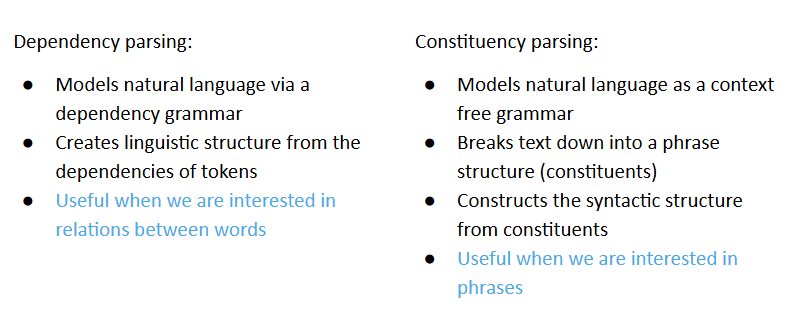
Dependency Grammar
Dependency grammar assumes that syntactic structure consists only of dependencies between tokens.
Dependencies are (labeled) asymmetric
binary relations between two tokens.Dependencies typically form a tree with
a single head (the root).
Dependency Parsing vs constituency Parsing
Event
Linguistic: verb
Information Retrieval: a relation of entities
Named Entity
A unique entity that is identified by its name. Can be of form:
Persons
Locations
Organizations
Dates
Times
Numeric expressions
Or domain specific
Information Extraction Systems Goals
Identify and understand relevant parts of texts
Gather, collate, and link information within and between documents in the corpus
Produce a structured representation of relevant information
Organize information so that it is useful to people
Store information in a semantically precise format that is usable by algorithms
IE Pipeline
Recognition of named entities
Extraction of relations between entities
Knowledge base population
Name Entity Recognition
The goal:Identify named entities in a document and tag them with a type
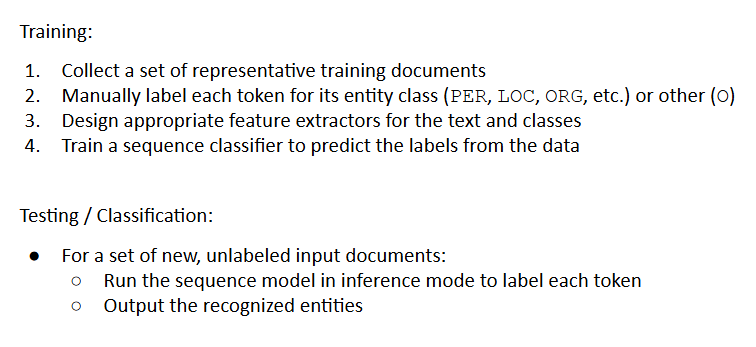
Encoding Classes for NER
Inside-Outside (IO) encoding is less precise
Inside-Outside-Beginning (IOB) encoding is more precise but requires
a larger tagset
the benefit is limited in practice, so IO is often used
Features for NER
Token level:current/prev/next
Tag level:Inferred linguistic classification
Label Level:Previous (and perhaps next) named entity label in the current sequence
Substrings in NER
we can detect patterns of substrings in certain domains however there are exceptions
Token Shape
Some named entity names tend to follow patterns that can be mapped to a simplified representation based on attributes such as:
Token length,
Capitalization,
Numerals,
Greek letters,
Internal punctuation,
etc.
NER models
Markov Models
Conditional Markov Models make a single decision at a time,
conditioned on evidence from observations and previous decisions
Conditional Random Fields
A whole-sequence conditional model, rather than a chain of local models
Deep learning models
Bidirectional Long Short Term Memory models (LSTMs)
Transformers
Handling Ambiguity: Normalization
reducing or rewriting something to a common (normal) form.
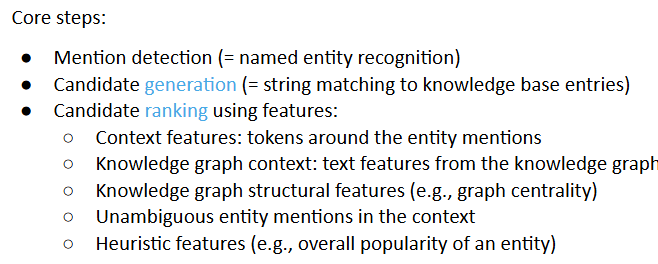
NE disambiguation
The task of deciding whether two entity mentions refer to the same entity.
NE linking
The task of linking an entity mention to a unique identifier.
Linking with knowledge graph
For persons, organizations, and locations, we typically link to an entry in a knowledge graph. The most commonly used resource is Wikidata.
Entities have
A unique Q-identifier
Properties that connect them to other entities
Validity times for properties
A ranking mechanism for statements
Drawbacks of knowledge graph
Engineering the structure of a knowledge graph (an ontology) is difficult and subjective,
Normalizing Temporal Entities
it is a rule based approach.
Absolute temporal expressions
Relative temporal expression
Domain Dependence for Relative Temporal Expression
For relative temporal expressions, a reference time is necessary, which requires domain knowledge to retrieve.
News-style texts: Use publication metadata
Narrative texts: use preceding information in paragraph
Implicit Networks
Relations to entities have scores associated to them
Networks are aggregated
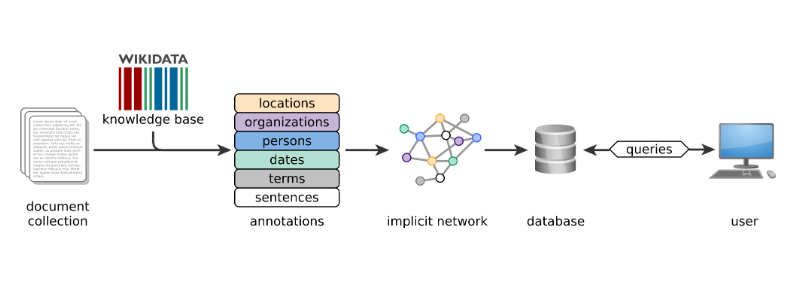
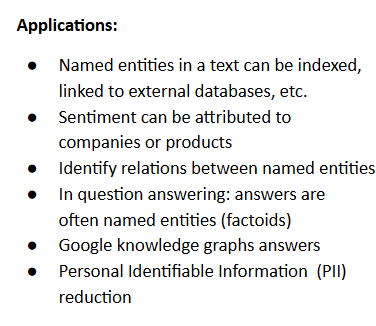
NER Applications
Types of similarity
Surface form similarity:
Phonological similarity (e.g., brake | break)
Morphological similarity (e.g., respect | respectful)
Spelling similarity (e.g. theater | theatre)
Semantic similarity:
Synonymy (e.g. verbose | wordy)
Hypernymy, Hyponymy (e.g., color | red)
Content similarity:
Sentence similarity (e.g., paraphrases)
Document similarity (e.g., two news stories on the same event)
Phonological Similarity
Uniform spelling is a (relatively) modern phenomenon.
Names tend to have high spelling variation
Variation is even higher across languages
This is problematic for statistical approaches
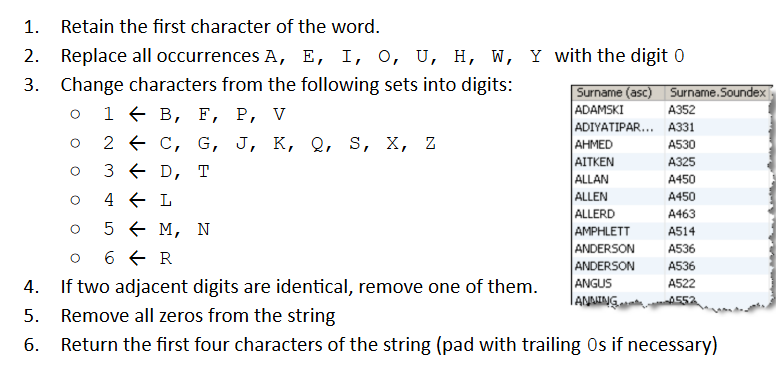
Soundex
Soundex is a class of heuristics for expanding a query into phonetic equivalence classes. It is mainly used for names and is language-specific.
IDEA:Turn every token into a 4-character reduced form
Build an index on the reduced forms
Apply the same encoding to query terms (= tokens in the query)
Search the index for phonetically similar tokens that have the same encoding
Soundex ALGO
Soundex Cons
Language specificness: originally developed for English
Homophonous names starting with a different character
Unable to discriminate between long words (4-character limit)
Conflation of unrelated family names:
Morphological Similarity
We can consider words to be similar if they share a root
We can use stemming or lemmatization to measure similarity
Spelling Similarity: Spell Checking
There are two flavors of spell checking:
Isolated words
Context Sensitive
Isolated Word Correction
Word similarity for word correction:
Given a lexicon and a word w, return the words in the lexicon that are closest to w (Edit Distance)
Levenshtein Distance
Given two strings S1 and S2, count the minimum number of basic operations to convert one string to the other.
Basic operations are typically character-level:
Insert
Delete
Replace (i.e., substitute)
Levenshtein (Wagner Fischer ALGO)
Step 1: Setup and parameters
Set n to be the length of string s
Set m to be the length of string t
If n=0, return m and exit.
In m=0, return n and exit.
Construct a matrix containing 0…m rows and 0…n columns.
Step 2: Initialization
Initialize the zeroth row to 0…n
Initialize the zeroth column to 0…m
Step 3: Iteration
For i from 1…m // iterate over rows
For j from 1…n // iterate over columns
if s[i] = t[j] then subCost := 0 // retain character
if s[i] ≠ t[j] then subCost := 1 // replace character
d[i, j] := minimum(d[i-1, j] + 1, // deletion
d[i, j-1] + 1, // insertion
d[i-1, j-1] + subCost) // substitution
return d[m, n]
Weighted Edit Distance
Different costs for insert / delete operations
Cost matrices to encode individual cost for replace operations
Can use domain-specific knowledge