3001 - Lipid Intro and Lipoproteins
 Call Kai
 Learn
Learn Practice Test
 Spaced Repetition
 Match
Match Flashcards
 Knowt Play
1/132

There's no tags or description
Looks like no tags are added yet.
Name | Mastery | Learn | Test | Matching | Spaced | Call with Kai | Chat |
|---|
No analytics yet
Send a link to your students to track their progress
133 Terms
What is a typical phospholipid composed of?
Glycerol, 2 fatty acids, phosphate, and a polar head group.

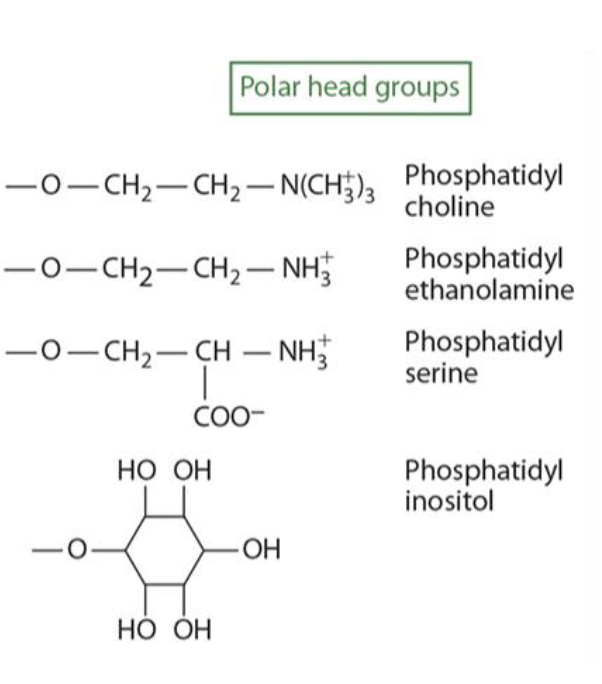
What are examples of phospholipid polar head groups shown in the lecture?
Choline, ethanolamine, serine, and inositol-containing groups.
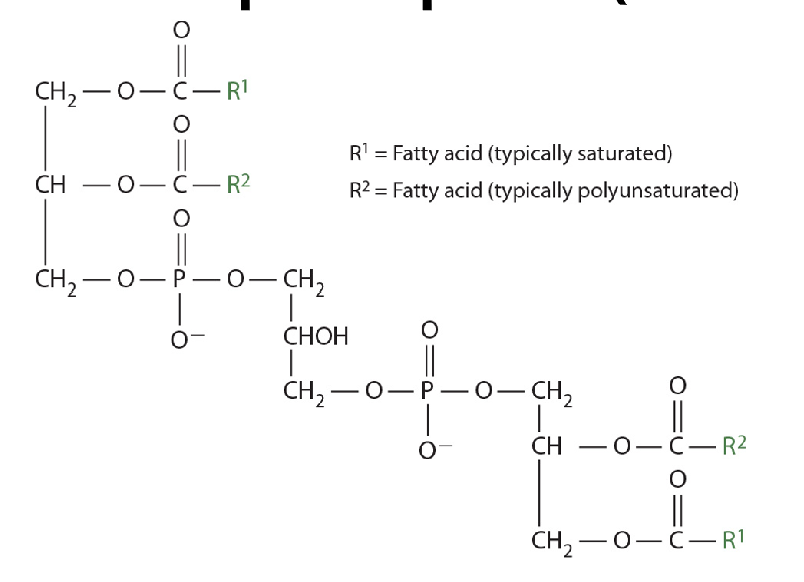
How many fatty-acid chains are present in cardiolipin?
Four.
How can different phosphatidylinositol (Phosphoinositide) derivatives be generated?
By phosphorylating different positions on the inositol ring.

What is the structural backbone of sphingolipids? Describe its structure
Sphingosine.

Describe the R1 and R2 of the four types of sphingolipids

What structural feature characterizes sterols?
A fused four-ring steroid nucleus.

What major sterol is shown in the lecture?
Cholesterol.

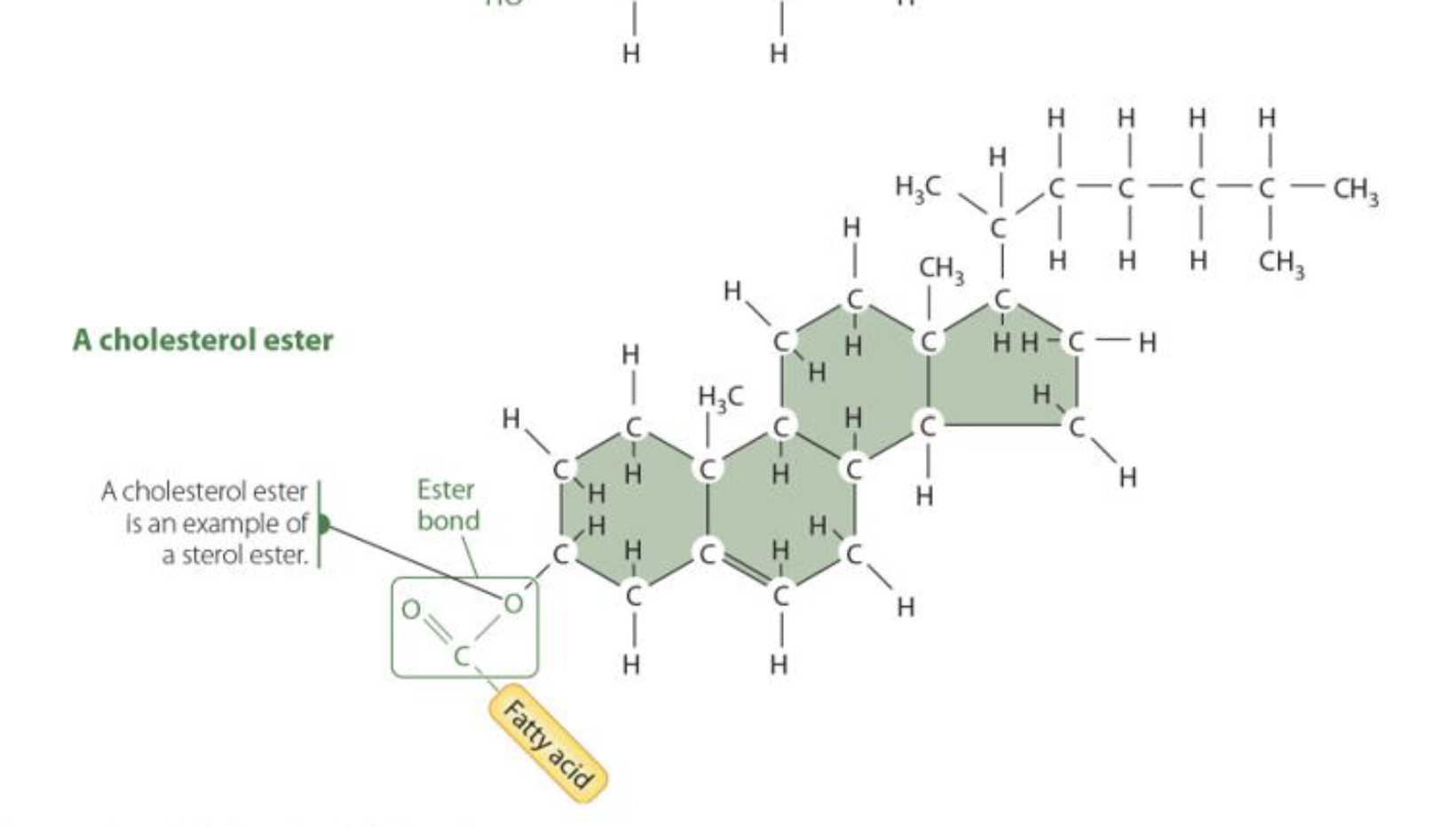
What is a cholesteryl ester?
Cholesterol whose hydroxyl group has been esterified to a fatty acid.
What defines a saturated, monounsaturated, polyunsaturated (PUFA) fatty acid?
Saturated: It contains no carbon-carbon double bonds.
Monosaturated: It contains one carbon-carbon double bond.
Polyunsaturated: It contains two or more carbon-carbon double bonds.
Where is lingual lipase secreted, what substrate does it digest, and its primary site of action?
Secreted in the mouth.
It digests Triacylglycerol.
Its primary site of action is the mouth and stomach
Where is gastric lipase secreted, what substrate does it digest, and its primary site of action?
Secreted in the mouth.
It digests Triacylglycerols, particularly those containing medium-chain fatty acids..
Its primary site of action is the stomach
What effect does lipid in the stomach have on gastric emptying?
It delays gastric emptying. It contributes to the relatively high satiety value of dietary fat.
What happens to triacylglycerols in the mouth?
Lingual lipase begins a small amount of digestion, breaking some triacylglycerols into diacylglycerol (DAG) and free fatty acids.
What happens to triacylglycerols in the stomach?
Gastric lipase continues digestion, especially removing short- and medium-chain fatty acids by hydrolyzing them from the sn-3 position, producing more diacylglycerol (DAG) and free fatty acids
What happens when lipids enter the small intestine?
Triacylglycerols, diacylglycerols, cholesterol, cholesterol esters, and phospholipids enter the small intestine, where most lipid digestion occurs.
What is the role of bile in triacylglycerol digestion (which occurs in the small intestine)?
Bile emulsifies fat into smaller droplets. It does not digest fat directly, but it increases the surface area available for digestive enzymes.
What is the main enzyme that digests triacylglycerols in the small intestine? What exactly does it do to digest TAG
Pancreatic lipase, which is produced by the pancreas.
It removes two fatty acids from triacylglycerol, producing monoacylglycerol (MAG) and two free fatty acids.
Monoacylglycerol and free fatty acids are the final products of TAG digestion
What do micelles do during lipid absorption?
They transport lipid digestion products through the intestinal lumen toward the brush-border membrane.
Lipid contents leave the micelle and move into enterocytes.
How are the products of lipid digestion absorbed after being transported by micelles? Do short- and medium-chain fatty acids get incorporated micelles for absorption?
They can move across the brush border membrane into enterocytes. Transport proteins and diffusion can both be involved.
No. According to the figure, short- and medium-chain free fatty acids can be absorbed without first being incorporated into micelles. They are small enough to just diffuse across the membrane
What happens to lipids after they enter the enterocyte?
They are reassembled. Monoacylglycerol and diacylglycerol are converted back into triacylglycerol, lysophospholipids are re-esterified into phospholipids, and cholesterol is esterified.
What happens to the re-formed triacylglycerols inside the enterocyte?
They are packaged with other lipids and apo-B48 to form chylomicrons.
How do chylomicrons leave the intestine?
They leave the enterocyte by exocytosis, enter the lymphatic system, and later enter the blood circulation.
What are the three portions of the small intestine? Into which region of the intestine are bile and pancreatic secretions delivered?
Duodenum, jejunum, and ileum.
The duodenum is where bile and pancreatic secretions are delivered
How do bile and pancreatic secretions enter the duodenum, and what regulates their flow?
The gallbladder releases bile through the common bile duct, while the pancreas releases its secretions through the pancreatic duct, which joins the common bile duct.
The sphincter of Oddi regulates the flow of these secretions into the duodenum.
What intestinal structures increase absorptive surface area?
Folds: In the small intestine, the mucosa and submucosa are arranged in folds
Villi: folds are covered with tiny, finger-like projections that line the inside of your small intestine to help your body absorb nutrients from the food you eat
Enterocytes: An absorptive epithelial cell lining the small intestine. Each villus contains one.
Microvilli: enterocytes are covered with microvilli, which make up the brush boarder.
What is the exocrine role of pancreatic acinar cells and duct cells?
Acinar: Secretion of digestive enzymes.
Duct: Secretes An aqueous sodium bicarbonate, NaHCO₃, solution, which helps neutralize acidic material entering the duodenum from the stomach.
What is an important endocrine function of the pancreas
Production of hormones such as insulin and glucagon.
Where are pancreatic lipase and colipase secreted, what do they digest, and where do they primarily act?
Secreted in he pancreas.
It digests Triacylglycerols
Its primary site of action is the small intestine
Fat digestion enzymes: Where is phospholipase secreted, what does it digest, and where does it primarily act?
Secreted in the pancreas.
It digests Lecithin and other phospholipids
Its primary site of action is the small intestine
Fat digestion enzymes: Where is Cholesterol esterase secreted, what does it digest, and where does it primarily act?
Secreted in he pancreas.
It digests cholesterol esters
Its primary site of action is the small intestine
Fat digestion enzymes: Where is Retinyl ester hydrolase secreted, what does it digest, and where does it primarily act?
Secreted in he pancreas.
It digests retinyl esters
Its primary site of action is the small intestine
Fat digestion enzymes: Where is Monoglyceride lipase secreted, what does it digest, and where does it primarily act?
Secreted in he small intestine.
It digests monoglycerides
Its primary site of action is the small intestine
How is MAG → DAG → TAG in the enterocyte? Which enzymes are involved? What happens to TAG at the end?
MGAT, monoacylglycerol acyltransferase helps MAG to DAG
DGAT, diacylglycerol acyltransferase helps DAG to TAG
TAG is then packaged into chylomicrons in the enterocyte, which are delivered into the lymph, and move to peripheral tissues (circulation)
What is the key difference between a micelle and a chylomicron?
A micelle delivers digested lipid through the intestinal lumen, whereas a chylomicron transports reassembled lipid from the enterocyte through lymph and blood.

In what form is colipase secreted, What secretes this inactive form, and what activates it to colipase??
it is secreted by the pancreas as inactive procolipase, and is activated by trypsin
What is the main purpose of colipase?
Anchors the Enzyme: Colipase acts as a bridge. It binds to both the bile salts and the pancreatic lipase, anchoring the enzyme firmly to the surface of the fat droplet (the lipid-water interface) so it can break down fats before entering the enterocytes.
Stabilizes Structure: By attaching to the non-catalytic domain of lipase, colipase helps maintain the enzyme in an active, stable shape.
Which enzyme initially hydrolyzes dietary phospholipids? Which fatty acid position does phospholipase A₂ cleave? What are the products of phospholipase A₂ activity?
Phospholipase A₂ (secreted by the pancreas)
Cleaves the sn-2 fatty acid.
Products are a lysophospholipid and 1 free fatty acid.
Where is lysophospholipase produced, and what does it further hydrolyze?
Enterocytes found at the brush-border membrane.
It further hydrolyzes lysophospholipid at the sn-1 position to a glycerophosphoryl base and a free fatty acid.
What is the enzyme required and the products of cholesterol ester digestion?
Hydrolyzed to free cholesterol and free fatty acid by cholesterol esterase
What is passive diffusion across a membrane?
Short-, medium-, and long-chain FA.
Diffuse directly across the enterocyte membrane due to their lipophilic nature, moving down their concentration gradient from the lumen into the enterocyte.
What is active transport across a membrane?
Fatty Acid Transport Proteins
Located in the enterocyte membrane, facilitate the uptake of long-chain fatty acids by actively transporting them into the enterocyte.
CD36
Scavenger receptor
Plays a key role in the active uptake of long-chain fatty acids, facilitating their movement across the enterocyte membrane.
What is endogenous vs exogenous cholesterol?
Endogenous: Cholesterol delivered to the intestine through biliary secretions.
Exogenous: Cholesterol derived from the diet.
What happens to cholesterol that is not absorbed? What happens to much of the cholesterol that enters enterocytes?
Not absorbed: It is excreted.
Too much cholesterol: It is esterified before being transported in chylomicrons.
Which transporter moves cholesterol and phytosterols into the intestinal cell?
Niemann-Pick C1 Like 1 (NPC1L1)
What do ABCG5/G8 do?
Transport phytosterols and excess cholesterol from the enterocyte back into the intestinal lumen.
Foods and supplements enriched with phytosterols effective at reducing blood cholesterol concentration by 10% or more
How are bile acids synthesized, recycled, and excreted in the body?
The liver synthesizes about 0.5 g of bile acids per day from cholesterol. The body maintains a bile acid pool of about 4.0 g, which is repeatedly recycled between the liver and intestine, with most bile acids reabsorbed in the ileum. About 0.5 g of bile acids are excreted per day in the feces.

Where is bile produced and stored?
Produced in the liver by cholesterol and stored in the gallbladder
What happens when the gallbladder contracts? What happens to bile acids after they help with lipid digestion?
Bile is released into the cystic duct, which joins the common bile duct, and then enters the duodenum.
Most bile acids are reabsorbed in the ileum and returned to the liver through the hepatic portal vein.

What happens to dietary lipids in the intestinal lumen before absorption
They are emulsified (by bile) and digested by lipases, phospholipase, and colipase, producing molecules such as DAG, MAG, free fatty acids (FA), and lysophosphatidic acid (LPA) that can be incorporated into mixed micelles.

What does AGPAT (1-acylglycerol-3-phosphate O-acyltransferase) do inside the enterocyte?
AGPAT (1-acylglycerol-3-phosphate O-acyltransferase) converts lysophosphatidic acid (LPA) into phosphatidic acid (PA).
What does ACAT (Acyl-CoA:cholesterol acyltransferase) do during lipid absorption?
ACAT (acyl-CoA:cholesterol acyltransferase) converts free cholesterol into cholesteryl ester (CE)..
What is the role of MTP?
MTP (microsomal triglyceride transfer protein) helps assemble lipids with ApoB to form chylomicrons in the enterocyte.
Chylomicrons then leave the enterocyte and enter the lymphatic system.
Like most lipoproteins, they allow hydrophobic dietary lipids to travel through aqueous lymph and blood.
What carries medium-chain fatty acids in portal blood that have passed from the enterocyte directly into the portal blood (no chylomicron formation)?
They bind to albumin and are transported directly to the liver
A lipoprotein is a spherical particle with a surface made of apolipoproteins and a phospholipid monolayer, while the interior contains mainly triglycerides, cholesterol, and cholesteryl esters.

Which lipoprotein has the highest vs lowest density and protein?
Highest: HDL
Lowest: Chylomicrons (because most TAG)
Which lipoprotein has the highest vs lowest free cholesterol?
Highest: LDL
Lowest: Chylomicrons (because most TAG)
Which lipoprotein has the highest vs lowest cholesterol esters?
Highest: LDL
Lowest: Chylomicrons
Which lipoprotein has the highest vs lowest cholesterol esters?
Highest: Chylomicrons
Lowest: HDL
Exogenous lipid transport system: Transports dietary triacylglycerols from the intestine to peripheral tissues for storage or energy use.
Endogenous lipid transport system: Transports fats and cholesterol made inside the body—primarily by the liver—out to peripheral tissues and cells
Describe the exogenous lipid transport pathway from chylomicron formation to liver uptake.
Dietary TAG is absorbed in the small intestine and packaged into chylomicrons containing ApoB-48 and ApoA-1, which enter the lymphatics and then the circulation.
Chylomicrons acquire ApoE and ApoC-II from HDL. They deliver TAG mainly to adipose tissue and muscle, where lipoprotein lipase (LPL) hydrolyzes TAG, releasing fatty acids and monoacylglycerols to tissues and glycerol into the blood.
Because adipose tissue and muscle cannot phosphorylate glycerol, it is taken up by the liver or kidney. As much of the TAG is removed, the chylomicron becomes a chylomicron remnant.
The remnant returns ApoA and ApoC to HDL, then binds to the liver through a site involving LRP and hepatic lipase, allowing its remaining fatty acids, cholesterol, and cholesteryl esters to be transferred to the liver.

A chylomicron containing ApoB-48 (One ApoB-48 molecule per chylomicron).
CM are secreted by enterocytes, transporting around 90 g of dietary TG/day.
Describe the structure of chylomicrons
Chylomicrons have a core of mainly nonpolar lipids, especially triacylglycerols and cholesteryl esters (cholesterol+FA), surrounded by a monolayer of mainly polar lipids.
The outer surface contains amphipathic phospholipids and free cholesterol, along with apoproteins such as peripheral apoC and integral apoB.

How does dietary fat intake affect chylomicron size? Can the cholesterol content of chylomicrons vary?
A high-fat meal produces larger chylomicrons, while fasting produces smaller chylomicrons carrying less triglyceride.
Yes. The amount of cholesterol carried by chylomicrons varies depending on dietary cholesterol intake.
Which apolipoproteins are on circulating chylomicrons and what are their functions?
ApoB-48: serves as the essential structural and core protein required for the assembly, stability, and secretion of chylomicrons in the small intestine
ApoC-II: Transferred from HDL to chylomicrons, ApoC-II activates lipoprotein lipase (LPL), which hydrolyzes triglycerides (TAG) in chylomicrons, releasing glycerol and fatty acids (FA). FA are then transported to the muscle/heart/adipose tissues
ApoE: Transferred from HDL to chylomicrons, ApoE helps the chylomicron remnant interact with receptors for uptake by the liver.
ApoA-1
Where is LPL synthesized, what does LPL convert triglycerides into, and what happens to fatty acids released by LPL in adipose tissue?
LPL is synthesized by cells in skeletal muscle, myocardium, adipose tissue, and the mammary gland, and it requires heparan sulfate proteoglycans (HSPG) on the cell surface.
Converts TAG into Glycerol and free fatty acids.
FA from LPL can be stored in adipocytes.

What happens to the fatty acids and glycerol released by LPL?
Free fatty acids can be stored in adipocytes. Glycerol is taken up by the liver, where it can support gluconeogenesis during fasting or triglyceride synthesis for VLDL production in the fed state.
What happens to a chylomicron after much of its triglyceride (and phospholipids) has been removed?
It becomes a chylomicron remnant, which can return to the liver, where its remaining fatty acids, cholesterol, and cholesteryl esters are taken up
Chylomicron remnants can also remain in circulation, which can lead to atherosclerosis, know as spill over FAs
How can chylomicron remnants be taken up by the liver?
Through receptors including the LDL receptor, LDL receptor-related protein 1, scavenger receptor B1, and syndecan 1. Fat soluble vitamins (ADEK) and cholesterol also reach the liver.
Uptake of CM remnant is stimulated by apoAV (working with ApoC-II), and inhibited by apoCIII.
Delays in CM metabolism result in the transfer of CM remnants into the arterial intima. CM remnants contain more cholesterol esters and are more atherogenic.
What factors regulate LPL activity in the enterocytes?
Insulin is a negative modulator of chylomicron secretion in enterocytes
Insulin resistance promote chylomicron production.
Insulin reduces flux of free fatty acids to the intestine, and inhibits MTP
CM acquire apoCII (main activator) and apoCIII (main inhibitor) of LPL, and apoE which is crucial for liver reuptake of CM remnants.
How is the insulin effect opposite in adipose vs enterocyte
Insulin is a negative modulator of chylomicron secretion in enterocytes
In adipocytes, insulin promotes fat storage. It supports the uptake and storage of fatty acids released from circulating chylomicrons, and it stimulates adipose-tissue handling of triglyceride-derived fatty acids.
What does chylomicrons exchange with HDL?
CM exchange peripheral proteins and lipids with HDL (key support of CM
intravascular metabolism)
Proteins: ApoC-II, ApoC-III, and ApoE.
What factors inhibit and increase ApoC-III production? What type of diet can increase ApoC-III production?
Inhibit: Insulin and polyunsaturated fatty acids.
Increase: Glucose, fructose, and saturated fatty acids.
Diets very high in sugar or saturated fat increase ApoC-III
Which circulating lipoproteins are acted on by LPL?
LPL hydrolyzes triglycerides carried by ApoB-48-containing chylomicrons and ApoB-100-containing VLDL.
It becomes a smaller, denser lipoprotein, ultimately leading to LDL formation.