Nervous system
 Call Kai
 Learn
Learn Practice Test
 Spaced Repetition
 Match
Match Flashcards
 Knowt Play
1/8

There's no tags or description
Looks like no tags are added yet.
Name | Mastery | Learn | Test | Matching | Spaced | Call with Kai | Chat |
|---|
No analytics yet
Send a link to your students to track their progress
9 Terms
What is the nervous system?
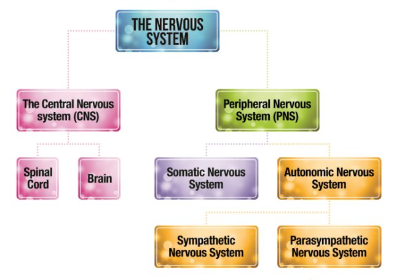
The nervous system helps all parts of the body communicate with each other - it is divided into two main components
the central nervous system (CNS)
the peripheral nervous system (PNS)
What is the central nervous system?
Includes the spinal cord and the brain
Main function - processing sensory information
It synthesizes sensory input to compute an appropriate motor response, or output
What does the brain do (CNS)?
The brain provides conscious awareness and is involved in all psychological processes. The brain consists of many regions, which are responsible for different functions
Frontal lobe - associated with higher-order functions, including planning, abstract reasoning and logic
Parietal lobe - integrates sensory information and therefore plays an important role in spatial navigation
Temporal lobe - auditory information processing
Occipital lobe - visual information proessing
The brain stem connects the brain and spinal cord and controls involuntary processes, including our heartbeat, breathing and consciousness
What does the spinal cord do (CNS)?
Role of spinal cord is to transfer messages to and from the brain and the rest of the body
spinal cord is responsible for simple reflex actions that do not involve the brain e.g. jumping out you chair if you sit on a pin
What is the Peripheral Nervous System?
Role of the PNS is to relay messages (nerve impulses) from the CNS to the rest of the body
Consists of two main components
somatic nervous system
autonomic nervous system
What is the role of the Somatic Nervous System (PNS)?
Connects the CNS and the senses
made of sensory receptors that carry information to the spinal cord and brain
made of motor pathways that allow the brain to control movement - under conscious control/voluntary
Provides muscle responses via the motor pathways
What is the role of the Autonomic Nervous System (PNS)?
Plays an important role in homeostasis (e.g. regulating body temperature) which maintains internal processes - it is involuntary/not under conscious control
Only consists of motor pathways and has two components
sympathetic nervous system
parasympathetic nervous system
What is the role of the Parasympathetic Nervous System (PNS)?
To relax the body and return us to our normal resting state
e.g. slows down our heart rate and breathing rate and reduces our blood pressure
any functions that were previously slowed down during a fight or flight reaction are started again (e.g. digestion)
brings the body back to its normal, resting state
What is the role of the Sympathetic Nervous System (PNS)?
Involved in responses that prepare the body for fight or flight response
impulses travel from the sympathetic nervous system to organs in the body to help us prepare for action when we are faced with a dangerous situation
e.g. our heart rate, blood pressure and breathing rate increase
less important functions functions like digestion, salivation are suppressed