A-Level Biology - 3.4.3 Genetic diversity can arise as a result of mutation or during meiosis
 Call Kai
 Learn
Learn Practice Test
 Spaced Repetition
 Match
Match Flashcards
 Knowt Play
1/29

There's no tags or description
Looks like no tags are added yet.
Name | Mastery | Learn | Test | Matching | Spaced | Call with Kai | Chat |
|---|
No analytics yet
Send a link to your students to track their progress
30 Terms
How could a mutation lead to a non-functioning enzyme?
changes the sequence of amino acids (primary structure of the polypeptide)
this would affect ionic/hydrogen/disulphide bonds formed, changing the tertiary structure
therefore the shape of the active site is different so the enzyme can't bind to the substrate
What do gene mutations involve?
a change in the DNA base sequence of chromosomes

How do gene mutations occur?
they arise spontaneously during DNA replication
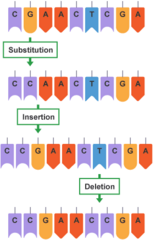
Name two types of gene mutations
base deletion
base substitution
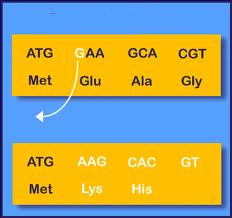
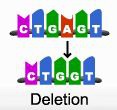
What is base deletion?
Where one or more bases are removed
What is base substitution?
Where a base is replaced by another type of base
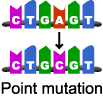
Why do not all base substitutions cause a change in the sequence of encoded amino acids?
due to the degenerate nature of the genetic code
a different triplet of bases may code for the same amino acid
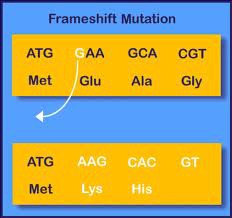
What is frame shift?
the genetic code is non-overlapping
so deletion mutations will always lead to a change in the sequence of amino acids, as the entire reading frame will shift to the left
What do mutagenic agents do?
Increase the rate of gene mutation
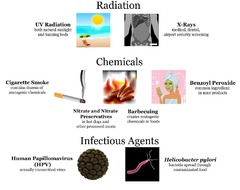
Give three examples of mutagens
radiation such as UV
certain chemicals
certain viruses
How do chromosome mutations occur?
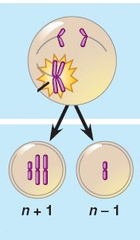
arise spontaneously by chromosome non-disjunction during meiosis
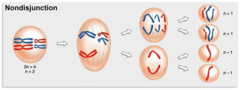
What is chromosome non-disjunction?
chromosomes fail to separate correctly in meiosis
results in gametes with one more or less chromosome than normal
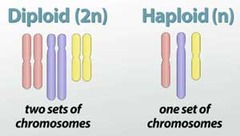
What is a diploid cell?
a cell with two sets of chromosomes
(46 in total)
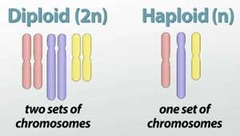
What is a haploid cell?
a cell with one set of chromosomes
(23 in total)
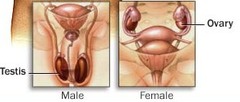
Where does meiosis occur?
reproductive organs (ovaries and testes)
How many nuclear divisions occur during meiosis?
two nuclear divisions
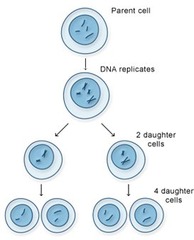
What does meiosis produce?
four genetically different haploid daughter cells
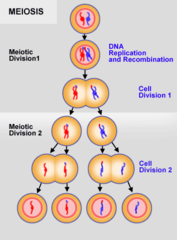
Describe the parent cell in meiosis
a single diploid parent cell
Give two ways in which meiosis produces genetic variation
independent segregation of homologous chromosomes
crossing over between homologous chromosomes
Name the eight steps involved in meiosis
MEIOSIS I:
-prophase I
-metaphase I
-anaphase I
-telophase I (+ cytokinesis)
MEIOSIS II:
-prophase II
-metaphase II
-anaphase II
-telophase II (+ cytokinesis)
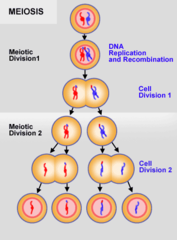
Describe the process of meiosis I
Prophase I:
-chromosomes condense (become visible) and align themselves in pairs of homologous chromosomes (2x2n)
-nuclear membrane breaks down
-crossing over can occur between homologous chromosomes
Metaphase I:
-homologous pairs line up next to each other and move to the equator of the cell
-spindle forms and attach to centromeres
Anaphase I:
-spindle fibres contract, separating homologous pairs and pulling them towards opposite poles of the cell
Telophase I and cytokinesis I:
-nuclei reform
-cell divides
Describe the process of meiosis II
Prophase II:
-nuclei break down
Metaphase II:
-chromosomes line up at equator
-spindle forms and attaches to centromeres
Anaphase II:
-centromeres divide
-chromatids are separated and pulled to opposite poles of the cell
Telophase II and cytokinesis II:
-nuclei reform
-cells divide
Describe how the process of meiosis results in haploid cells
DNA replication creates two identical chromatids
two nuclear divisions
first division: homologous pairs separated
second division: sister chromatids separated
produces 4 haploid daughter cells
When does crossing over occur?
occurs during prophase I
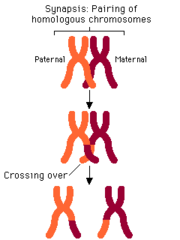
Describe the process of crossing over and explain how it increases genetic diversity
Homologous pairs of chromosomes associate
Chiasmata form
Equal lengths of non-sister chromatids (alleles) are exchanged
Producing new combinations of alleles
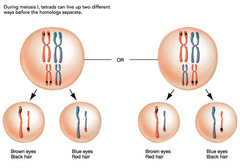
What is independent segregation?
The random division of homologous chromosomes into separate daughter cells during meiosis
in human body cells there are 23 homologous pairs, so 2^23 possible combinations of chromosomes
What expression is used to calculate the possible number of different combinations of chromosomes following meiosis?
2^n
where n is the number of homologous chromosome pairs
Apart from mutation, explain one other way genetic variation within a species is increased
Random fusion of gametes which produces new allele combinations.
Explain how the chromosome number is halved during meiosis
homologous chromosomes pair separates, one of each pair goes to each daughter cell
Explain why all cells of the body will have a chromosome mutation
The mutation occurred in a gamete that formed the zygote
All cells derived form that zygote by mitosis
Mitosis produces genetically identical cells