Healthcare Supply Chain - Chapters 1-4
 Call Kai
 Learn
Learn Practice Test
 Spaced Repetition
 Match
Match Flashcards
 Knowt Play
1/75

There's no tags or description
Looks like no tags are added yet.
Name | Mastery | Learn | Test | Matching | Spaced | Call with Kai | Chat |
|---|
No analytics yet
Send a link to your students to track their progress
76 Terms
What is suppy chain management
SCM encompasses the planning and
management of all activities involved in
sourcing and procurement, conversion, and all
logistics management activities
What Does Supply Chain Management Include?
Intra- and inter-organizational integration
and coordination
• Consists of the flow of products and
services from:
• Raw materials manufacturers
• Component and intermediate
manufacturers
• Final product manufacturers
• Wholesalers, distributors and retailers
Origins of Supply Chain Management
2000s and Beyond
Evolution along 2 parallel paths:
1. Supply management emphasis from
industrial buyer
2. Logistics and customer service
emphasis from wholesalers and
retailers
• Third-party service providers (3PLs)
• Integrating logistics
• Client/server SCM software -
Enterprise Resource Planning
Origins of Supply Chain Management Today
Emphasis is being placed on the environmental and social impacts of supply chains
• Sustainability - ability to meet the needs of current supply chain members without hindering the ability to meet the needs of future generations
• Triple bottom line – taking care of people, planet and profits
Gross Domestic Product (GDP)
• Generally, logistics costs as a % of GDP have declined since the early-1980s
• Logistics has an impact on interest rates, inflation, productivity, energy costs and availability, employment, and other aspects of the economy
Infrastructure
Infrastructure often does not keep up with increases in freight traffic
• In many countries, spending on infrastructure as a percentage of GDP has declined
• The Panama Canal expansion completed in 2016 doubled throughput as larger ships were able to pass through it
Regulatory Issues
Many aspects of supply chain management
are subject to some type of regulation (local,
state, federal, and/or international)
• In the United States, the Sarbanes-Oxley Act
has impacted both legal and ethical issues
relating to supply chain management
• Environmental and sustainability regulations
are increasing
Security and Risk
5 general categories of risk
facing supply chain executives: economic;
environmental; geopolitical; societal; and
technological
• Risk mitigation strategies are important in
supply chains
• Cyber security has become a very important
risk issue in domestic and global commerce
Supply Chain Disruptions
As firms become leaner and more
technology dependent, disruptions can
cause more serious problems than ever
before
Disaster Preparedness and Relief
Examples include natural
disasters, pandemics, financial
market collapses, power
outages and blackouts, and
transportation accidents
• Organizations such as the
American Logistics Aid Network
(ALAN) have formed to post-
disaster humanitarian relief
Business-Related Issues Impacting Supply Chains
CUSTOMER
SERVICE AND
SATISFACTION
HUMAN
RESOURCES
ORGANIZATIONAL
ISSUES
TECHNOLOGY FINANCIAL
ASPECTS AND
METRICS
CUSTOMER SERVICE
Activities between the buyer and seller that enhance or facilitate the sale or use of the seller’s products or services
Customer service and marketing exchanges
• Pre-transaction elements: all service aspects that
must be completed prior to any transaction taking place
• Transaction elements: service aspects that occur
during the transaction
• Post-transaction elements: all service aspects that
must occur after a transaction or sales has occurred
Three components of customer satisfaction
• Activity or process: activities and processes that must be
managed such as product delivery, reverse logistics, order
processing, sourcing and procurement
• Performance measures: metrics that measure specific aspects of customer satisfaction (e.g., market share percentage, on-time
delivery, net profit margins)
• Corporate philosophy: incorporates the first two perspectives and is a philosophy that treats customer satisfaction as an integral part of a firm’s total supply chain activities
Customer satisfaction and the scor model
Balance human and physical resources of the organization and
supply chain with customer service requirements and
establish/communicate customer satisfaction plans and strategies
for the whole supply chain.
Measures and metrics
The management adage is correct: You can’t manage what
you don’t measure.
• Companies must have defined metrics in order to
determine if service and satisfaction goals and objectives
are being met.
• The most important metrics are referred to as key
performance indicators (KPIs). There are usually less than
20 KPIs that are important.
The perfect order
The optimization of customer satisfaction through supply
chain management
• At the right time (100% on-time delivery)
• In the right quantity (100% fill rate)
• In the right condition and packaging (100% quality related to
fulfillment)
• With the right documentation (increasingly electronic)
Strategic profit model
Return on net worth (RONW) is the most important
financial factor and is a measure of the return on
shareholders’ investment plus retained earnings
• RONW is impacted by three major factors:
• Net profit
• Asset turnover
• Financial leverage
Balanced scorecard
• Financial performance: traditional financial measures such as ROI, ROA, cost reduction, asset utilization, and productivity levels
• Internal business process: focuses on company metrics such as waste reduction, product quality, and order cycle time variability
• Customer service: measures that focus on customer requirements and satisfaction such as order response time, customer retention, customer profitability, and customer satisfaction ratings
• Education and learning: measures concerned with employees, systems and procedures
Why do companies lose customers?
The Disconnect:
• Customers say it is primarily due to poor customer
service
• Companies say it is primarily due to price and not being
the lowest-cost provider
Data versus information
Non-metric:
nominal
ordinal
metric data
internval
ratio
Product stock-outs
Most of the time when a customer experiences a
product stock-out, it is due to a customer service
failure
Cost-service trade-offs
Activity-based costing can be useful in in capturing the
actual costs related to serving customers: within cost
centers; and between cost centers
Gap analysis in customer satisfaction
Exceeding the service requirements of customers can result in
mis-allocating resources on the wrong things and lower the ROI
associated with various satisfaction strategies
Customer relationship management (CRM)
CRM is an approach to managing customer relationships
and serving customers using various types of information
systems technology
The Uses of Information in Supply Chains
Information is the lifeline of a supply chain and as such has several uses:
• To maintain asset visibility
• Manage daily operations
• Make planning and
strategic decisions
Asset visibility
A supply chain manager controls assets belonging to firms in the supply chain
• This includes items such as trucks, inventory, pallets, containers, and lift trucks
Managing Daily Operations
Managing daily operations requires timely
information
• Information sharing is critical both within individual
firms and among firms in the supply chain
• Internally, information is needed to coordinate
activities within and among functions
Supply Chain Planning
refers to decision making
related to future operations in the supply chain
• The objective is to meet service and quality
requirements with the lowest possible use of
resources
• Some of the key supply chain planning areas are:
• Demand Planning
• Transportation
• Production
• Warehousing
• Inventory
• Collaborative Planning
Applying Information Technology to Supply Chain Management: Data Capture
Data capture is the process by which data
enters an information system.
• This may be accomplished by manual or
automated processes
• Automation is the only way to quickly
capture large volumes of data.
• The book describes two main forms of
automated data capture:
• Bar codes
• Radio frequency identification (RFID)
Data transmission: EDI
Electronic Data Interchange (EDI) was created in 1948
• It is a one way communication standard designed to
exchange structured computer-to-computer messages
Benefits of EDI
Less costly because minimal human interaction
is required
• Fewer human errors
• Speeds up supply chain processes
Data Transmission: Extensible Markup Language (XML)
is an alternate technology to exchange data among firms in the
supply chain
Data Transmission: The Need
Firms with the capability of transmitting EDI or XML
messages benefit most by exchanging messages with
multiple partners
Value Added Networks (VANS)
means that firms must have the
capability of exchanging messages in multiple
standards, which is costly
API
Application Programming Interface (APIs) are a clearly defined
means of communicating between various software programs
ERP
Enterprise Resource Planning (ERP) refers to the systems and software packages used by organizations to manage day- to-day business activities, such as accounting, procurement, project management and manufacturing
SC Collaboration Support
Information technology tools are also needed to
support supply chain collaboration
upply chain collaboration whereby a supplier
manages its customer’s inventory using data
supplied by the customer
• Collaborative Planning, Forecasting and
Replenishment (CPFR) works across
organizational boundaries to develop a single
forecast
Order Management: Beyond Understanding
The role of a supply chain manager goes beyond
understanding the steps in the order management
process
• The process needs to be actively managed to
reduce cost and support customer service
• An order is a key contact point between customer
and supplier
Process Map
is a visual representation of a process
• It represents the path of the information
throughout the supply chain, decisions and
activities that occur at each point in the
process, as well as the related timeline
What is Sales Forecasting?
is the process of gathering and analyzing
information to estimate future sales
Reasons to Forecast Sales
determine the level of production needed to support sales
• Too much production leads to excess
inventory
• Too little production leads to stockouts
and lost sales
• Both outcomes lead to higher costs
Two Basic Forecasting Methods
qualitative - based on judgement of one or more knowledgable forecasters
quantitive - based on projections of historical sales data
Consensus Panel
formed by a group of experts who jointly decide on a sales
forecast
• Experts communicate with each other in the search for a consensus
Delphi Method
a variation of the consensus panel where experts work
independently an anonymously to arrive at a consensus
Sales Force Estimate
draw forecasts from the expert judgment of salespersons
• The sales force is closest to customers and thus is in the best position to anticipate customer needs and detect changes in market trends
Moving Average
a simple and easy to use forecasting method
• It uses the average sales of a pre-
specified number of past periods as a
forecast of the next period in the future
Moving Average Example
For example, if a firm wants to predict October sales using a MA of the past three
months, then it needs actual sales data for July, August and September
• Assuming that sales for those three months were respectively 130, 170 and 120,
the forecast for October will be average of the three numbers, or 140
• The equation to compute the MA is:
SMA = p1 + p2 + … + pn / n
p: The data point or price for a given period
n: The total number of periods or window size
Exponential Smoothing
• It is easy to use and requires little data
• Through the use of a smoothing parameter the ES method
enables the forecaster to consider a longer sales history than
the Moving Average Method, which is limited to the number of
periods included in the computation of the moving average
Exponential Smoothing
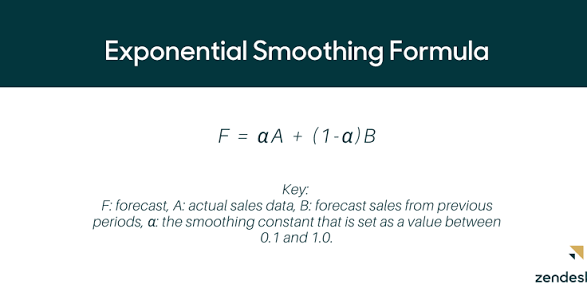
Exponential Smoothing WITH TREND
CORRECTION

S&OP
Sales & Operations Planning is an integrative process that encourages firm to integrate multiple functions in the organization to share information in order to develop more accurate forecasts in order to align resources to a single demand plan.
• S&OP focuses on three primary components:
• People
• Process
• Technology
CPFR
Collaborative planning, forecasting and replenishment
(CPFR) is a cohesive bundle of business processes
whereby supply chain trading partners share
information, synchronized forecast, risks, costs and
benefits with the intent of improving supply chain
performance through joint planning and decision
making
• Strategy and planning
• Demand and supply management,
• Execution
• Analysis
Measuring Forecasting Error
Every forecast contains a level of error
There are three main purposes for measuring
forecast error
• To assess the level of confidence managers
should have in a particular forecast.
• The smaller the error, the greater the
confidence in the forecast.
• Second, measuring forecast error is key to
improve forecasts.
• Third, when forecasting sales for a large
number of items, the forecast error works as a
flag directing management to focus on the
items with the largest forecast error
Measuring Forecasting Error
• Time horizon
• The farther in the future is the period being forecasted,
the larger the error that should be expected
• Level of aggregation
• Forecast error is relatively larger when forecasting at
greater level of detail.
Mean Absolute Deviation (MAD)
is simply a measure of the absolute average error for all time periods considered

Mean Absolute Percent Error (MAPE)
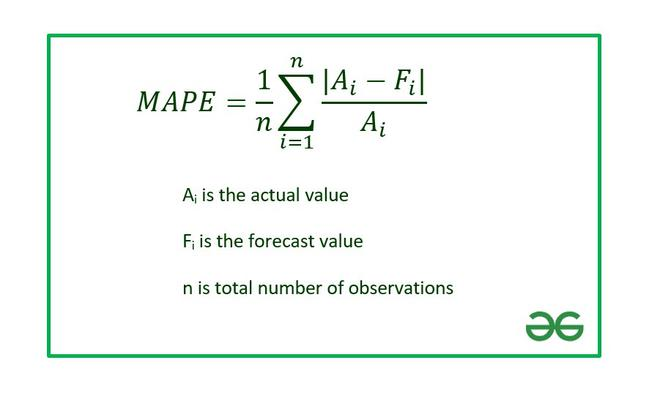
Mean Square Error (MSE)

Why is Inventory Management important
supply chain manager must
decide on the level of inventory to be
maintained for each individual item
stocked by the company, as well as
the size and frequency of inventory
replenishments
• The goal is to achieve minimum cost
at a predetermined level of service
Reasons to hold inventory
Transportation economies of scale
• Production economies of scale
• Economies of scale in purchasing
• Prepare for seasonal demand
• New product introduction
How much inventory?
In order to support a predetermined customer service policy,
supply chain managers need to determine:
• How much inventory to keep
• How often to reorder its inventory
• This involves a series of trade-offs
• How much does it cost to order the inventory
• Administrative costs to issue the order
• Related transportation and warehousing
When to order inventory: The Economic
order quantity (EOQ)
Total costs are minimized
when ordering costs and
inventory carrying costs
intersect

EOQ Assumptions
• No uncertainty
• Demand is known and constant
• Lead times are constant
• Shipments are never late
• Transportation costs per unit are fixed
lead time demand quantity

Why use the ltd?
minimizes the risk of related to holding inventory
is the declining cost of placing an order
Sizing inventory and the impact of uncertainty
EOQ and LTD assume no uncertainty, which
is not realistic
• Trucks will be late
• Demand is not constant
• Prices vary based on quantity
INV (avg. total inventory) = base stock + safety stock
Base stock
The inventory needed to support daily operations is known as base stock or cycle stock
BS = OQ (order quantity) / 2
Safety stock
Safety stock, or buffer stock, is an inventory quantity maintained
in addition to the base stock in order to protect the firm from the
uncertainties of demand and replenishment lead time
SS = k (safety factor) x Sc (combined SD of demand and replenishment lead time)
Safety factor: demand and supplier lead
time uncertainties
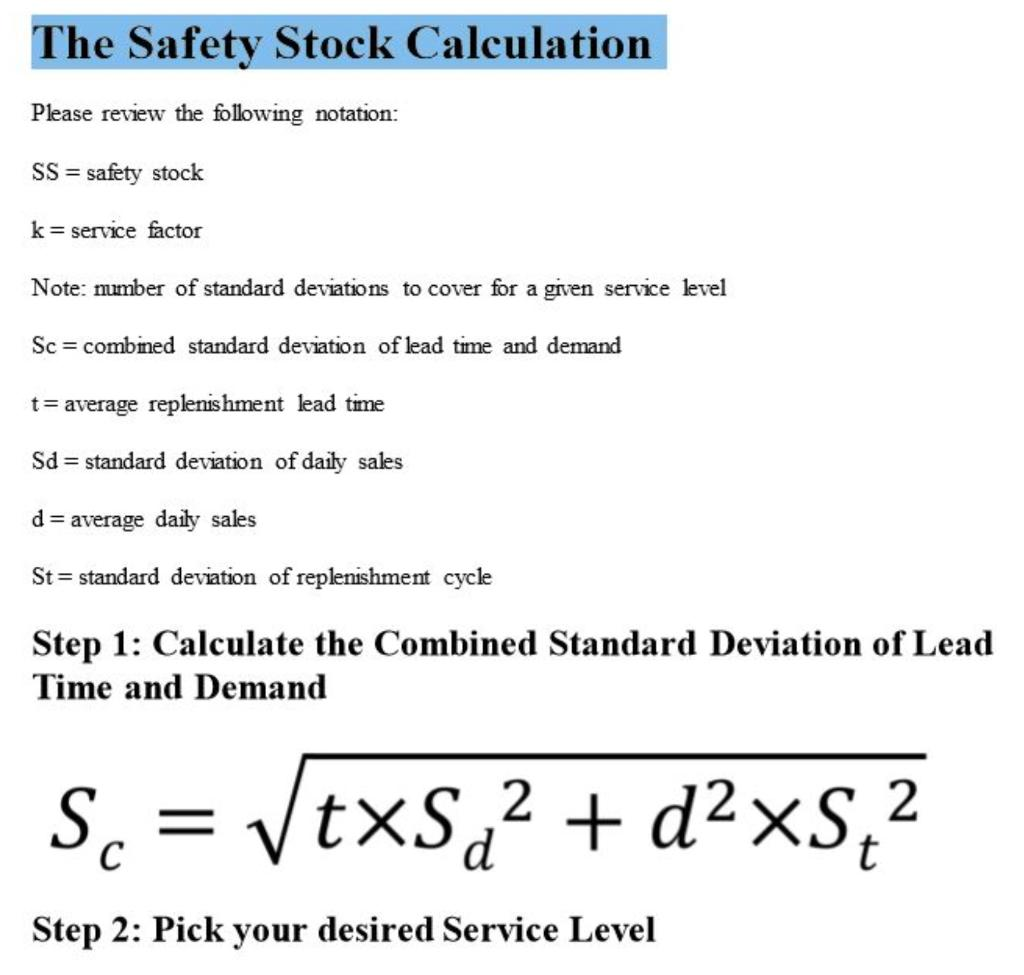
Safety factor: measures of customer
service
f(k) = (1-fr(fillrate)) x sc/ OQ
the portfolio effect
There is a relationship between the level of inventory needed to support
a target level of inventory availability and the number of locations
where the inventory is stored
• More locations, more inventory
• Fewer locations, less inventory
quantifies the percent decrease in safety stock
that is achieved with inventory centralization
form postponement
This principle states that demand uncertainty can be managed by delaying a product’s final form until the exact nature of the demand is known
Safety stock management extensions: form postponement
• Labeling postponement
• Packaging postponement
• Assembly postponement
• Manufacturing postponement