BBB - lecture 6 - Smell
 Studied by 0 people
 Call Kai
 Learn
Learn Practice Test
 Spaced Repetition
 Match
Match Flashcards
 Knowt Play
1/15

There's no tags or description
Looks like no tags are added yet.
Name | Mastery | Learn | Test | Matching | Spaced |
|---|
No study sessions yet.
16 Terms
what is chemoreception?
it is the oldest sensory system, detects presence of specific chemicals → this includes both taste and olfaction (smell) working together to analyse stimuli
properties of olfaction (our sense of smell)?
hardest sense to describe, seems to be about familiarity recognition → chemosignals similar to other senses in those chemicals are translated into nerve impulses
What are olfactory receptors?
receptors related to smell - large, diverse set coded in 350 genes, allowing differentiation of 10,000+ smells → receptors very hard-worked, must be replaced every 60 days → sensitivity of olfactory receptors differs between substances
What 2 segments does the nasal cavity consist of?
respiratory segment, olfactory segment
location and structure of the olfactory segment?
along roof of the nasal cavity, lined with the olfactory epithelium (olfactory mucous membrane - tiny hairs), contains receptors for the sense of smell
Function of the olfactory segment (olfactory epithelium)
the epithelium is a receptor surface where different molecules bind to different receptors → area 2-4cm, dogs/cats have 10x more receptor area, each receptor has short thick dendrite ending in 10-20 cilia that projects into a mucous layer (olfactory mucosa) → chemicals in air dissolve in mucosa to interact with cilia, bipolar cells, size/number varies across species
what is the pathway to brain (olfaction)?
olfactory receptors → olfactory bulbs → range of forebrain areas
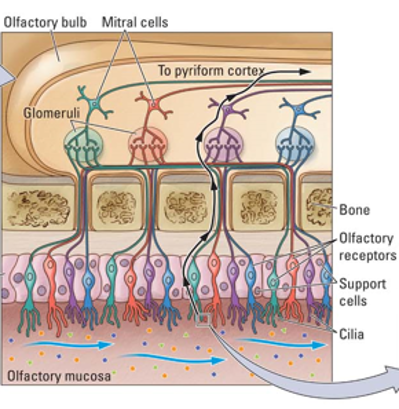
How do the olfactory receptors project to the olfactory bulb?
olfactory nerves from the brain are non-myelinated and consists of bundles of slim fibres held together by thin strips of connective tissue, forming the olfactory cranial nerve → receptors form synapses with dendrites of mitral cells at glomeruli → these mitral cells send axons from the bulb to forebrain areas
what kind of forebrain areas do the mitral cells send axons to from the olfactory bulb?
primary olfactory cortex (including pyriform cortex), amygdala, hypothalamus, thalamus, orbitofrontal cortex (secondary olfactory cortex), entorhinal cortex, hippocampus
What are the 3 types of abnormalities regarding olfaction?
anosmia, hyposmia, dysosmia
What is anosmia?
absence of smell - can be anosmic for certain odours, can be temporary or permanent
What is hyposmia?
diminished olfactory sensitivity - this could be a very early sign of Parkinson’s disease
What is dysosmia?
distorted sense of smell - misinterpreted smells or hallucination of smells
more than ___% of humans over the age of 80 have an impaired ability to identify smells
75%
What is another term for the sense of taste?
gustation - allows perception of taste through chemical stimuli
What is the name of the muscular organ which is the primary organ of gustation?
the tongue