Nucleotide Metabolism
 Call Kai
 Learn
Learn Practice Test
 Spaced Repetition
 Match
Match Flashcards
 Knowt Play
1/103

There's no tags or description
Looks like no tags are added yet.
Name | Mastery | Learn | Test | Matching | Spaced | Call with Kai | Chat |
|---|
No analytics yet
Send a link to your students to track their progress
104 Terms
Nucleotide
1. nitrogenous base
2. pentose sugar
3. one or more phosphates
Nucleoside
1. Nitrogenous base
2. Pentose sugar
Nucleobase
Nitrogenous base
(Purine or pyrimidine)
Hypoxanthine
constituent of nucleic acids (tRNA) in form of its nucleotide, inosinate
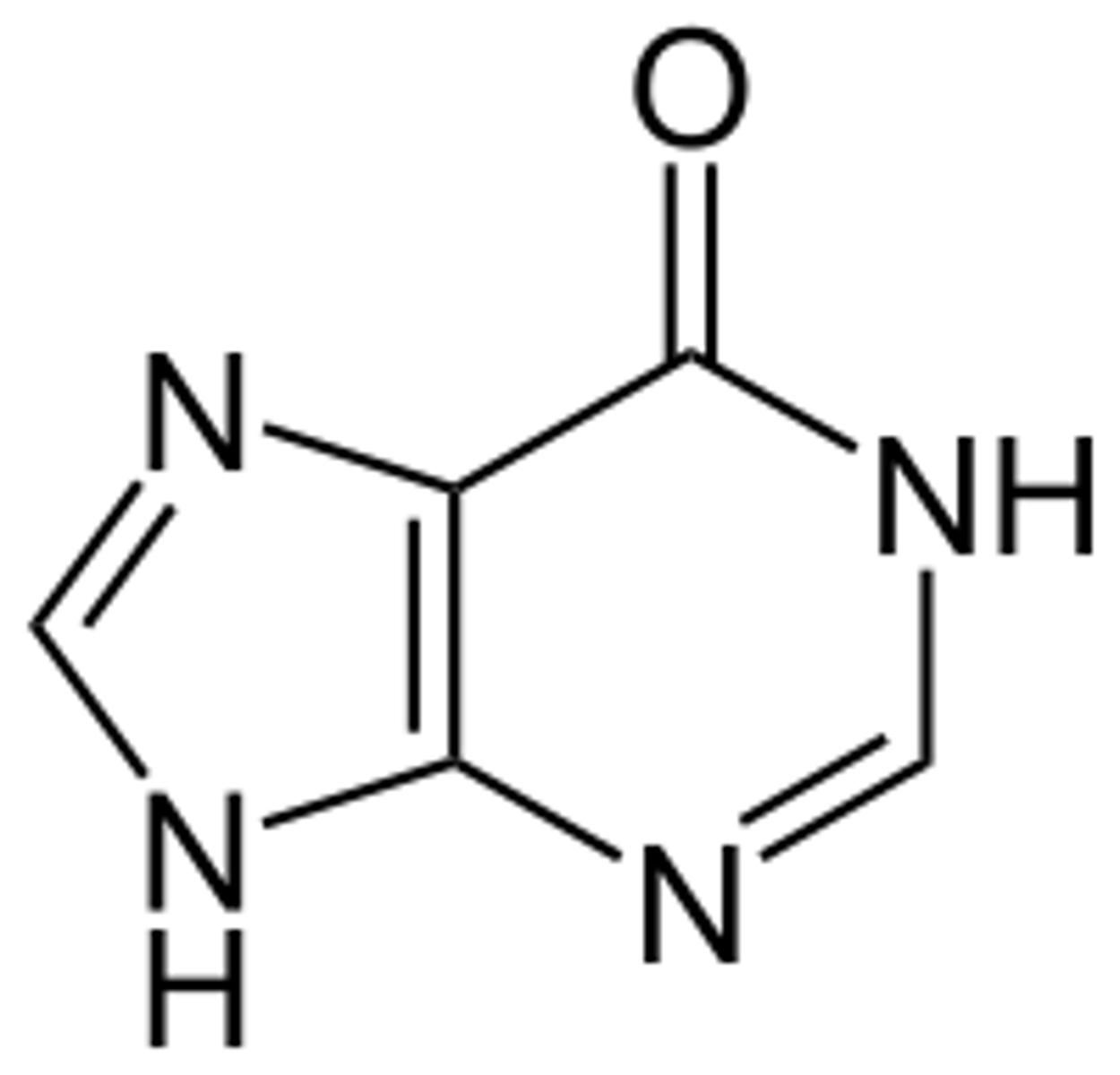
Xanthine
produced during purine synthesis and degradation
What are the attachment points between the nitrogenous base and pentose sugar in a nucleoside?
N-9 of purine
N-1 of pyrimidine
C-1' of sugar
T/F: phosphates are attached to the base in nucleotides
False. NEVER. Phosphate attaches to the pentose sugar, to either C-2', C-3', or C-5'
Nucleobases
Adenine, guanine, uracil, cytosine, thymine
RNA ribonucleosides
adenosine, guanosine, uridine, cytidine
Deoxyribonucleosides (DNA)
deoxyadenosine, deoxyguanosine, thymidine, deoxycytidine
Ribonucleotides
AMP, GMP, UMP, CMP
Deoxyribonucleotides
dAMP, dGMP, TMP, dCMP
purines
adenine, guanine
pryimidines
cytosine, thymine, uracil
Nucleoside nomenclature
replace -ine of purine with -osine (ex: guanosine)
replace end of pyrimidine with -idine (ex: deoxythymidine)
use deoxy- but omit ribo-
How to name 5'-monophosphates (acid salts)
add -ylate or -ate
adenylate, guanylate, cytidylate, thymidylate, uridylate
inosinate, orotate
Describe the structure of 2'-deoxycytidine 5'-triphosphate
cytosine base added to C-1' of sugar, H (not OH) bound to C-2', and 3 phosphate added to C-5'
2 methods of biosynthesis of nucleotides
1. de novo
2. salvage
What is the de novo pathway?
from new; synthesis from metabolic precursors and requires ATP
What is the salvage pathway?
Recycle free bases and nucleosides released from nucleic acid breakdown and does not require much energy
T/F: nucleotide pools are kept low in de novo biosynthesis
True. Most cells continually synthesize them because of that.
T/F: De novo synthesis may limit rates of transcription and replication
True
Where does ribose-5-phosphate come from?
Pentose phosphate pathway, breaking down glucose-6-phosphate
PRPP synthetase
converts Ribose 5-phosphate into PRPP
PRPP
phosphoribosyl pyrophosphate
required for de novo synthesis
T/F: Pyrimidine bases are built directly of PRPP
FALSE. Purine !!!! Purine bases are built directly of PRPP
purine de novo step 1
Formation of 5-phosphoribosyl-1-amine
Committed step (irreversible)
Glutamine-PRPP amidotransferase combines glutamine with PRPP
Step 10 of purine de novo
Formation of inosine 5'-monophosphate (IMP) aka inosinate
Catalyzed by IMP synthase
IMP structure
hypoxanthine nucleobase + ribose sugar + phosphate
What is the application of inosinate in translation?
Allows one tRNA to recognize multiple codons at the wobble position
What nucleotides can inosinate form hydrogen bonds with?
A, U, C
T/F: IMP is a purine intermediate
True. Branches to be converted either to GMP or AMP
IMP dehydrogenase
IMP -> XMP
then XMP -> GMP
Adenylosuccinate synthetase
IMP -> Adenylosuccinate
-> AMP
GMP kinase
GMP -> GDP
Adenylate Kinase
AMP -> ADP
T/F: synthesis of common nucleotides does not proceed via their free bases
True. PRPP is needed
What does purine de novo synthesis accomplish?
Purine ring precursor hypoxanthine is synthesized stepwise directly on the ribose C-1'
Feedback inhibition in purine de novo
end products inhibit
1. PRPP synthetase
2. glutamine-PRPP amidotransferase
3. branches (adenylosuccinate or IMP dehydrogenase)
Committed step feedback for Purine
AMP, GMP, or IMP inhibit glutamine-PRPP aminotransferase
What does too much GTP promote in the purine de novo pathway?
IMP -> AMP
What does too much ATP promote in the de purine novo pathway?
IMP -> GMP
How is pyrimidine de novo synthesis different from purine de novo?
Pyrimidine synthesis proceeds first by making pyrimidine ring and then attaching to PRPP, rather than attaching base to PRPP first
What is the committed step in pyrimidine de novo?
reaction between aspartate and N-carbamoylphosphate
Aspartate transcarbamoylase (ATCase)
enzyme that catalyzes formation of carbamoyl aspartate in the committed step of pyrimidine de novo synthesis
Steps of pyrimidine de novo synthesis
1. formation of carbomoyl phosphate
2. N-carbamoylasparate
3. dihydroorotate
4. orotate
5. OMP
6. UMP
Carbamoyl phosphate synthetase II
converts glutamine, ATP, and bicarbonate to carbamoyl phosphate in step 1 of pyrimidine de novo
What step forms the pyrimidine ring in pyrimidine de novo synthesis
Step 3: Dihydroorotate
Which step is the redox reaction in pyrimidine de novo synthesis?
Step 4: Orotate
Formation of OMP
Orotate added to PRPP
Step 5 of pyrimidine de novo synthesis
How does OMP convert to UMP?
Loss of CO2 and enzyme orotidylate decarboxylase
UMP kinase
convert UMP -> UDP
nucleoside monophosphate kinase
NDPK
converts UDP -> UTP
nucleoside diphosphate kinases
CTP synthetase
converts UTP -> CTP
Feedback inhibition in pyrimidine de novo
Allosteric inhibition of aspartate transcarbamoylase (committed step) by end-product CTP
How do CTP and ATP affect aspartate transcarbamoylase?
CTP inhibits and ATP restores activity
How is Km affected by CTP?
increases (almost doubles)
How do NDPKs work?
They use ATP as a source of phosphate to convert nucleosides
ATP is usually in excess
Nucleoside monophosphate kinase
UMP + ATP <--> UDP + ADP
Nucleoside diphosphate kinase
XDP + ATP <--> XTP + ADP
Adenylate kinase
AMP + ATP <--> 2ADP
Ribonucleotide reductase
Enzyme converting ribonucleosides to deoxyribonucleosides.
What are the substrates for ribonucleotide reductase
ADP, GDP, CDP, UDP
What kind of reaction is ribonucleotide reductase
Redox to remove the 2'-OH from ribose ring of nucleoside diphosphates
Hydroxyurea
inhibits ribonucleotide reductase
What happens as a result of hydroxyurea inhibiting ribonucleotide reductase?
reduces deoxyribonucleotide pool needed for DNA replication
What diseases is hydroxyurea an agent against?
Cancer like chronic myeloid leukemia and squamous cell cancer of head and neck
dUTP
can replace dTTP in DNA which is bad! comes from dUDP becoming phosphorylated
dUTPase
removes dUTP from DNA pool by removing phosphates and creating dUMP
Why is dUMP converted to DTMP?
to become a methyl group donor
What enzyme converts dUMP -> dTMP?
thymidylate synthase
(and THF)
FdUMP
Suicide inhibitor of thymidylate synthase
designed to look like dUMP but cannot be converted to dTMP due to fluorine on C-5'
Fluorouracil
base in FdUMP
Cofactors of nucleotides
NAD, NADP, FAD
Nicotinamide Adenine Dinucleotide (NAD)
a nucleotide whose synthesis involves Niacin combining with PRPP and ATP
Niacin (Vitamin B3) sources
Diet or Trp
Primary pellagra
deficiency of Trp and Niacin due to diet
Secondary pellagra
deficiency of Trp and Niacin when Niacin is not absorbed properly
Which 2 diseases are examples of secondary pellagra?
Chron's disease and alcoholism
Symptoms of pellagra
dermatitis, dementia, soreness and inflammation of tongue and mouth
NADPH
NAD + phosphate on C-2'
Flavin adenine dinucleotide (FAD)
nucleotide whose synthesis involves Riboflavin
Riboflavin
Vitamin B2
found in liver, almonds, soy nuts, shellfish, milk/dairy, eggs
used to make FAD
Cheilosis
fissuring at corners of mouth caused by deficiency in riboflavin
How are purines degraded?
Dephosphorylation, converting nucleotides to nucleosides and nucleobases
5'-nucleotidase
Removes charge of phosphate groups on purines
Deamination of AMP
AMP -> adenosine -> inosine -> hypoxanthine -> xanthine -> urate
Deamination of GMP
GMP -> guanosine -> guanine -> xanthine -> urate
What is the purpose of xanthine -> urate
This oxidation reaction allows for excretion of uric acid
Salvage pathway
Hypoxanthine -> IMP -> GMP
via recycling and enzyme HGPRT, involves PRPP
HGPRT
Enzyme in purine metabolism that function to salvage purines from degraded DNA to renewed purine synthesis. In this role, it acts as a catalyst in the reaction between guanine and PRPP to form GMP
Diseases from defective purine metabolism
Gout
Lesch-Nyhan Syndrome
Adenosine deaminase (ADA) immunodeficiency
Gout attributed to...
1. hyperactive PRPP synthase. Excess PRPP accelerates purine biosynthesis
2. impaired excretion of uric acid
3. deficiencies in HGPRT, such that hypoxanthine cannot be converted to IMP
T/F: urate has high solubility
False. Urate has low solubility so excess urate leads to precipitations of sodium urate crystals in tissues, causing inflammation and pain
Lesch-Nyhan Syndrome
deficiency of HGPRT
elevated uric acid in blood due to increased de novo purine synthesis
Why is Lesch-Nyhan syndrome thought to occur?
Lack of PRPP consumption by HGPRT increases the availability of PRPP for glutamine-PRPP amidotransferase, enhancing purine de novo synthesis
leads to uric acid production
Symptoms of Lesch-Nyhan syndrome
Biting of fingers, toes, and lips
Gouty arthritis, severe neurological malfunctions
Adenosine deaminase (ADA) immunodeficiency
ADA deficiency causes deoxyadenosine and dATP accumulation. High dATP inhibits ribonucleotide reductase, reducing dNTP production and DNA synthesis
dATP
inhibits ribonucleotide reductase, thereby inhibiting synthesis of dNTPs
leads to immune problems
What immune problems come from ADA immunodeficiency?
T and B lymphocytes do not develop properly