Moles and Solutions parts per million
 Call Kai
 Learn
Learn Practice Test
 Spaced Repetition
 Match
Match Flashcards
 Knowt Play
1/13

There's no tags or description
Looks like no tags are added yet.
Name | Mastery | Learn | Test | Matching | Spaced | Call with Kai | Chat |
|---|
No analytics yet
Send a link to your students to track their progress
14 Terms
Which of these are solutions?
A: A beaker with sand that hasn’t dissolved into water
B: Potassium iodide that has dissolved into water
C: A piece of gold that hasn’t dissolved in water
D: Nitric acid that has dissolved in water
E: Pure CO2 gas
F: Nail polish that has dissolved in acetone
A solution is formed when one substance…
Give 2 reasons why chemists use solutions?
Identify the solute in each of these examples:
A: Sucrose is dissolved into water to form a solution.B: Silicon dioxide is added to water but sinks to the bottom.
Identify the solvent in each of these examples:
A:Chloric acid is dissolved into water to form a solution.B: Calcium is dissolved into liquid ammonia to form a solution.
The substance that dissolves is known as the ..6?. The substance that it dissolves into is known as the …7?. Generally, in chemistry, substances are dissolved in water and are therefore known as …8? solutions.
Info : Conc = mass or moles / volume
There are two solutions of the exact same volume. Solution 1 contains 5 moles of dissolved hydrofluoric acid. Solution 2 contains 4 moles of dissolved hydrofluoric acid. Which of these has a stronger concentration?
There are two solutions containing the exact same amount of solute. Solution 1 has a volume of 1.5litres. Solution 2 has a volume of 0.5litres. Which solution has a stronger concentration?
Concentration is a measure of how much …11? is dissolved per volume of …12?
B,D,F
Dissolves in a solvent
* working with them is safer than working with pure substances.
they’re easier to store and measure (compared to gases)
A: Sucrose B: neither
A: water. B: ammonia
Solute. 7. Solvent. 8. Aqueous
Solution 1
Solution 2
Solute 12. Solvent
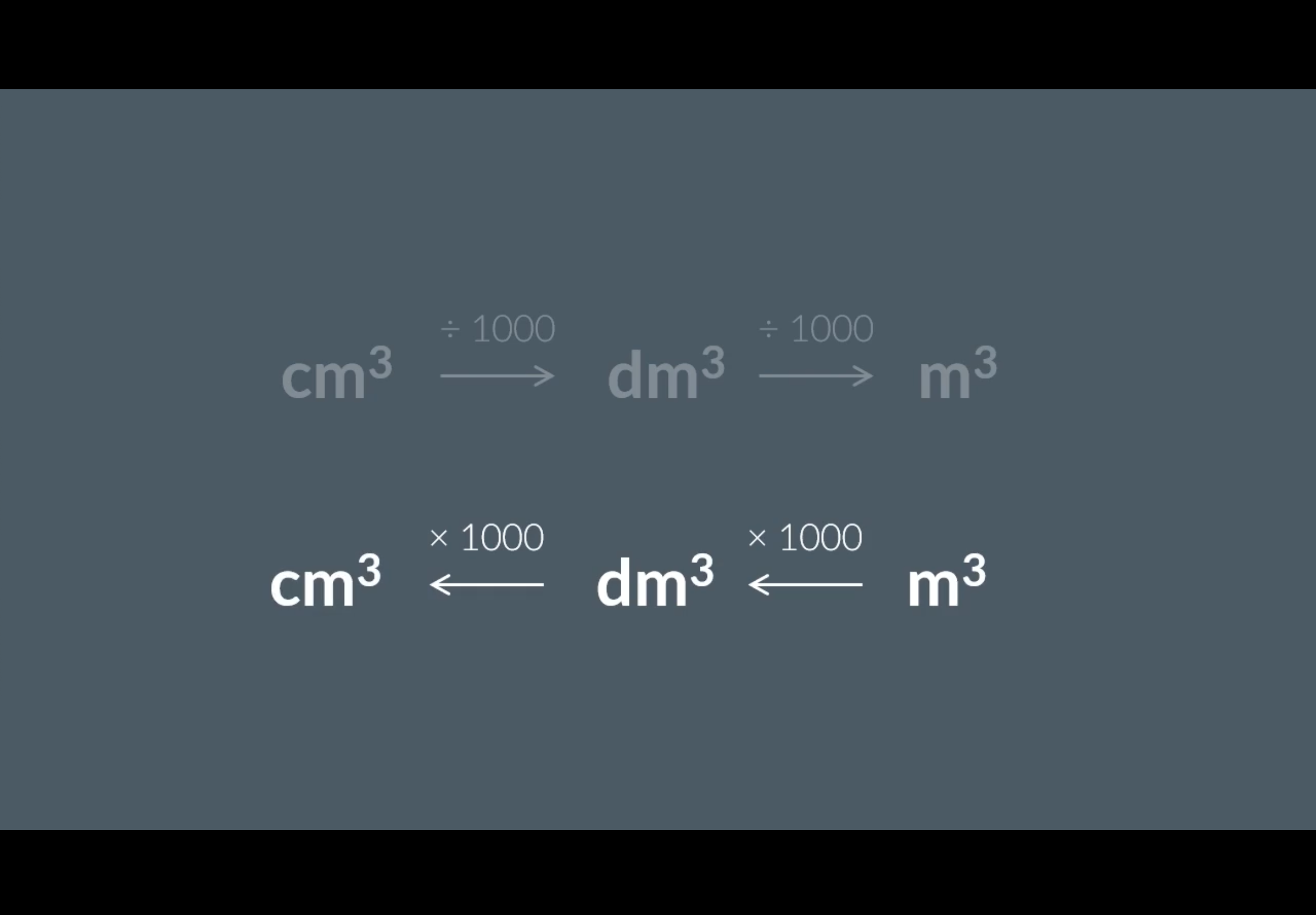
Info: 10cm*3 of liquid = 10 ml of liquid. 1000mL in 1 Litre. 1000cm*3 in 1dm*3. 1000dm*3 in 1M3
Info: For water 1cm3 =1 g. 1g =1,000 mg
In chemistry, instead of using litres to measure volume, we use …1?
Calculate the number of moles present in 0.028dm3 of a 3.5mol dm−3 solution of phosphoric acid, H3PO4?
Calculate the volume of a 0.227mol dm−3 solution of ethanol which contains 0.0184moles.
Give your answer in cm3 to 3 significant figures.
Calculate the concentration of the solution formed when 1.6g of copper sulfate, CuSO4,is fully dissolved in 0.40dm3 of water.
Relative atomic masses: Cu=63.5, S=32.1, O=16.0
Give your answer to 2 significant figures and give the units.Calculate the mass of sodium chloride required to make 150cm3 of a 1.80mol dm−3solution.
Relative atomic masses: Na=23.0, Cl=35.5
Give your answer to 3 significant figuresHow many ions are present in 0.65dm3 of a 0.30mol dm−3 solution of barium chloride, BaCl2? Give your answer to 2 significant figures.
Avogadro’s constant=6.022×10*230.0140 M*3 of a 0.850mol dm−3 solution of sulfuric acid reacts with excess potassium hydroxide. Calculate the number of moles of potassium sulfate formed in the reaction.
2KOH (aq)+H2SO4(aq)→K2SO4(aq)+2H2O (l)Sodium carbonate solution is reacted with nitric acid.
Na2CO3(aq)+HNO3(aq)→NaNO3(aq)+H2O (l)+CO2(g)
a) Balance the equation and use state symbols. B)How many moles of sodium carbonate react with exactly 126.5cm3 of 0.982moldm−3 nitric acid? Give your answer to a suitable degree of accuracy.
Dm*3. 2. 0.098mol. 3. 81.1 (3sf). 4. 0.025 Mol dm-3. 5. (15.8g)
moles=concentration×volume
Moles of BaCl2=0.30mol dm−3 × 0.65dm*3= 0.195mol
Number of particles=Avogadro’s constant×moles
Number of BaCl2units=(6.022×10*23)× 0.195 = 1.174…×10*23
There are 3 ions in each unit of BaCl2: 1 Ba2+ ion and 2 Cl− ions.
So, number of ions= 3 × (1.174×10*23) =3.5×10*23 (2 significant figures).11.9mol (answer should be the same signicant figures as the least precise quantity used in the question.)
A:
Na2CO3(aq)+2HNO3(aq)→2NaNO3(aq)+H2O(l)+CO2(g)
B: 0.0621mol
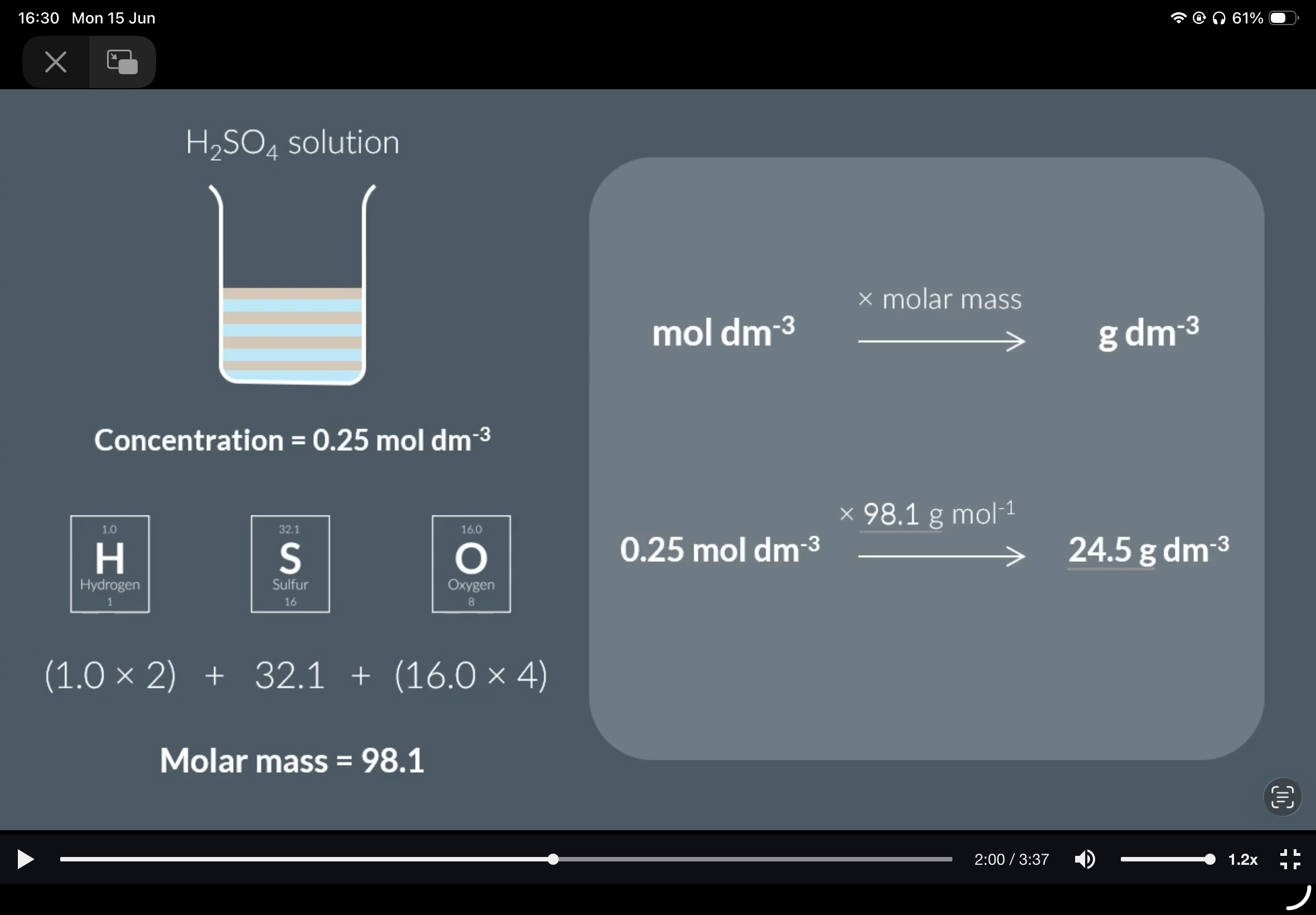
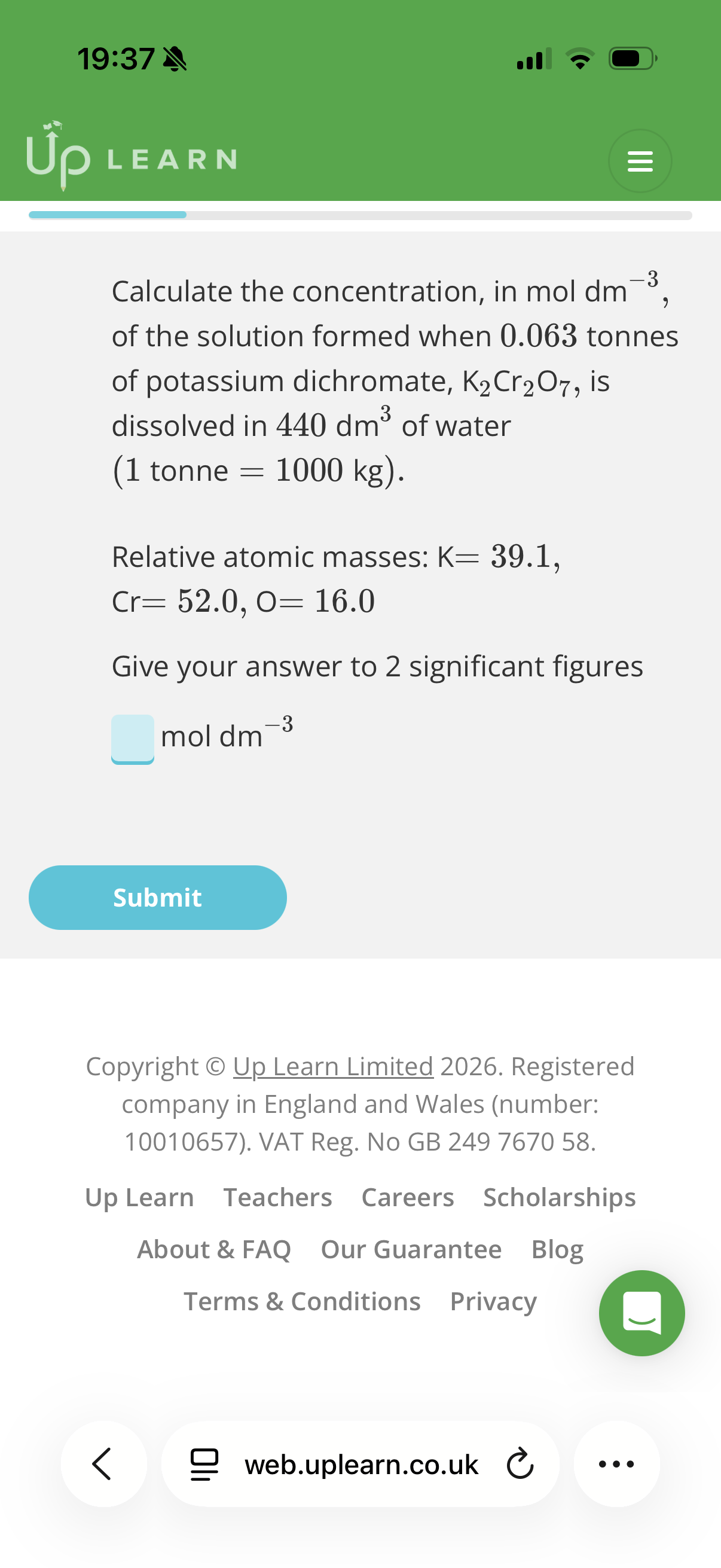
7.5g of boric acid is added to 1.25dm3 of water. What is the concentration of the solution in g dm−3?
Images contain info you need to know
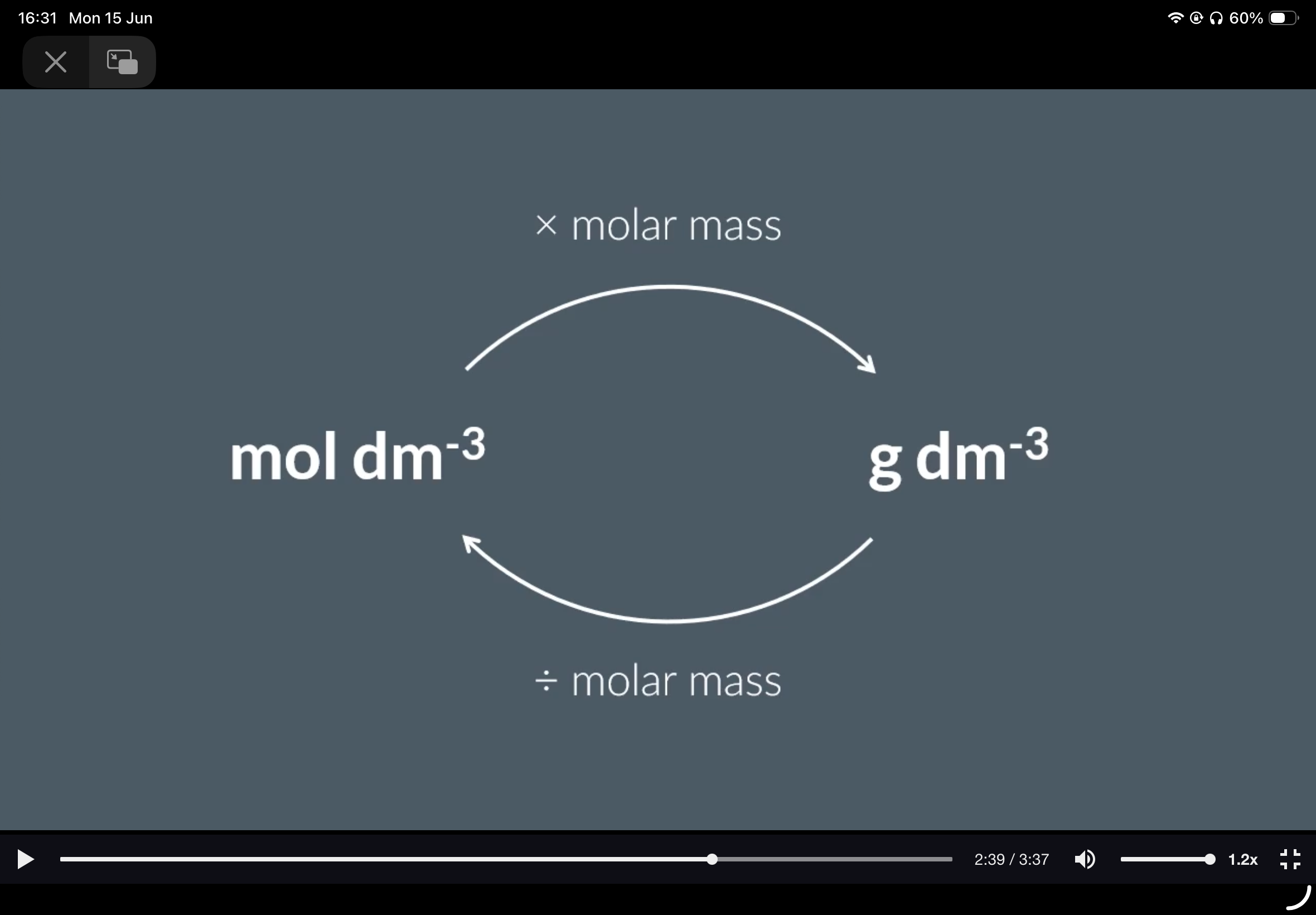
To go from mol dm−3 and g dm−3 we …2? by the …3?. And, to go from g dm−3 and mol dm−3 we …4? by the ..5?.
What is the concentration in mol dm−3 of a CaCl2 aqueous solution with a concentration of 388.6g dm−3?
Give your answer to 2 significant figures. Ca=40.1. Cl=35.5
6 g dm*-3. 2. Multiply 3. Molar mass 4. Divide. 5. Molar mass
2. 3.5 Mol dm-3
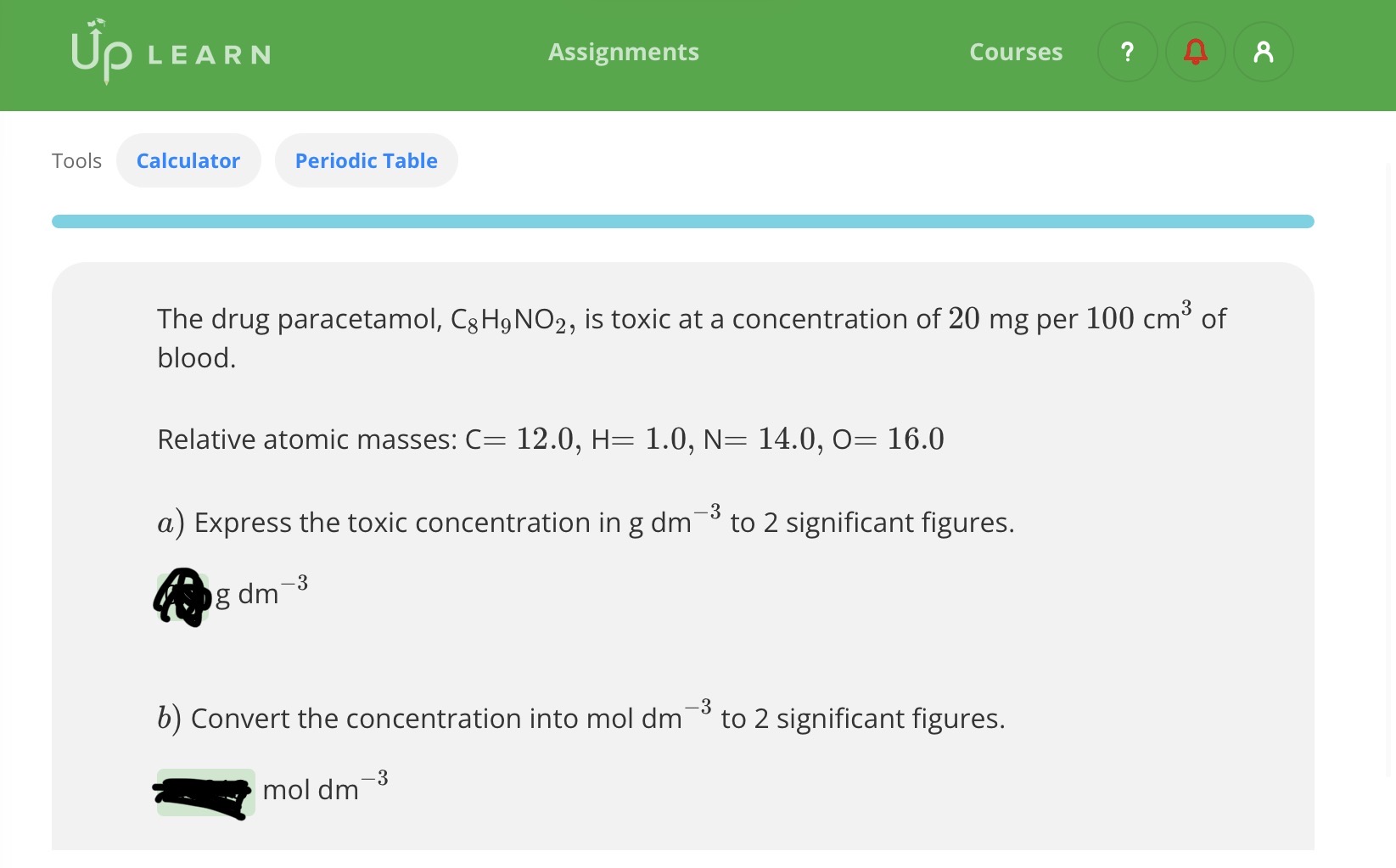
Answer image question?
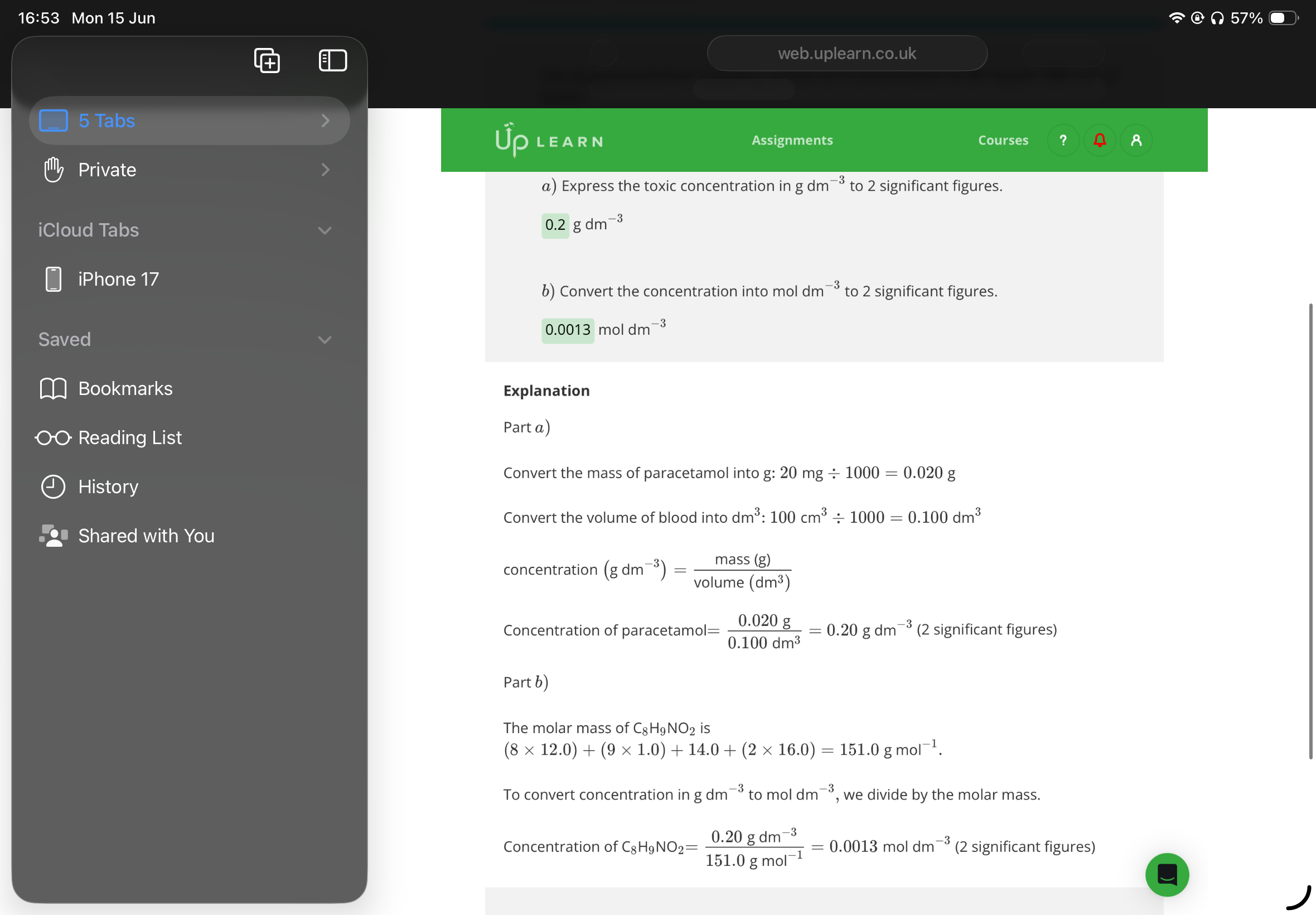
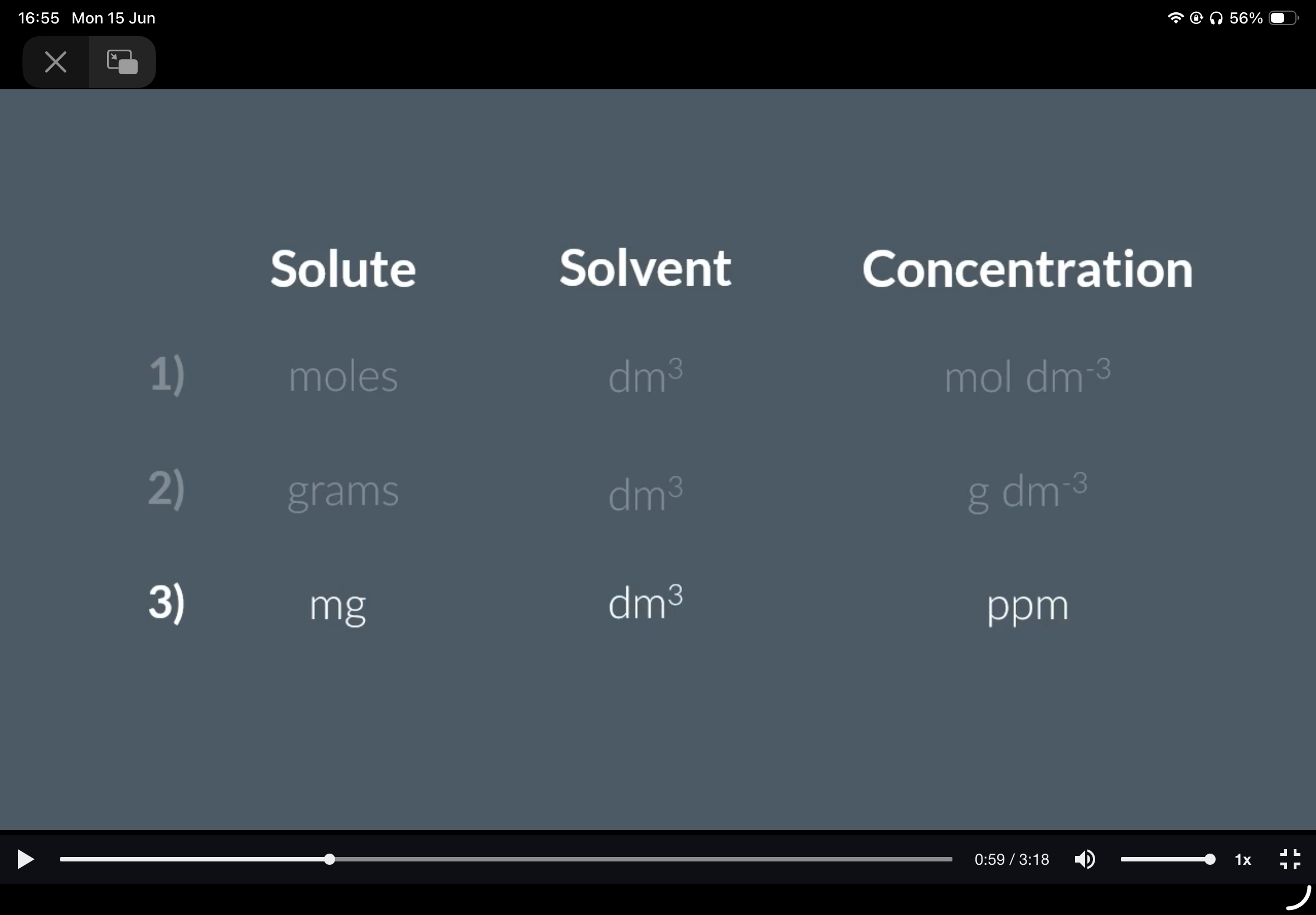
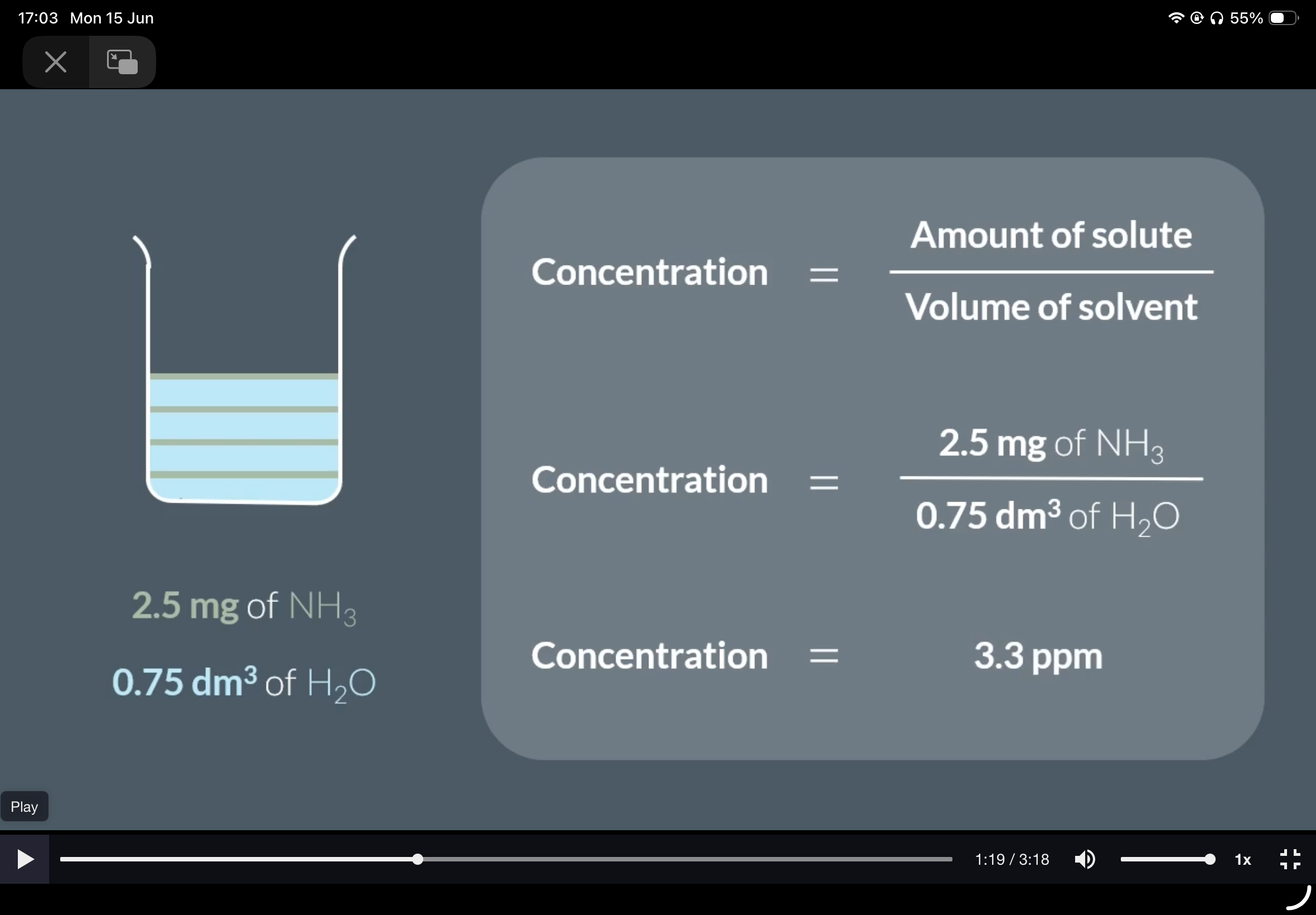
Parts per Million
Conc= amount of solute/ amount of solvent
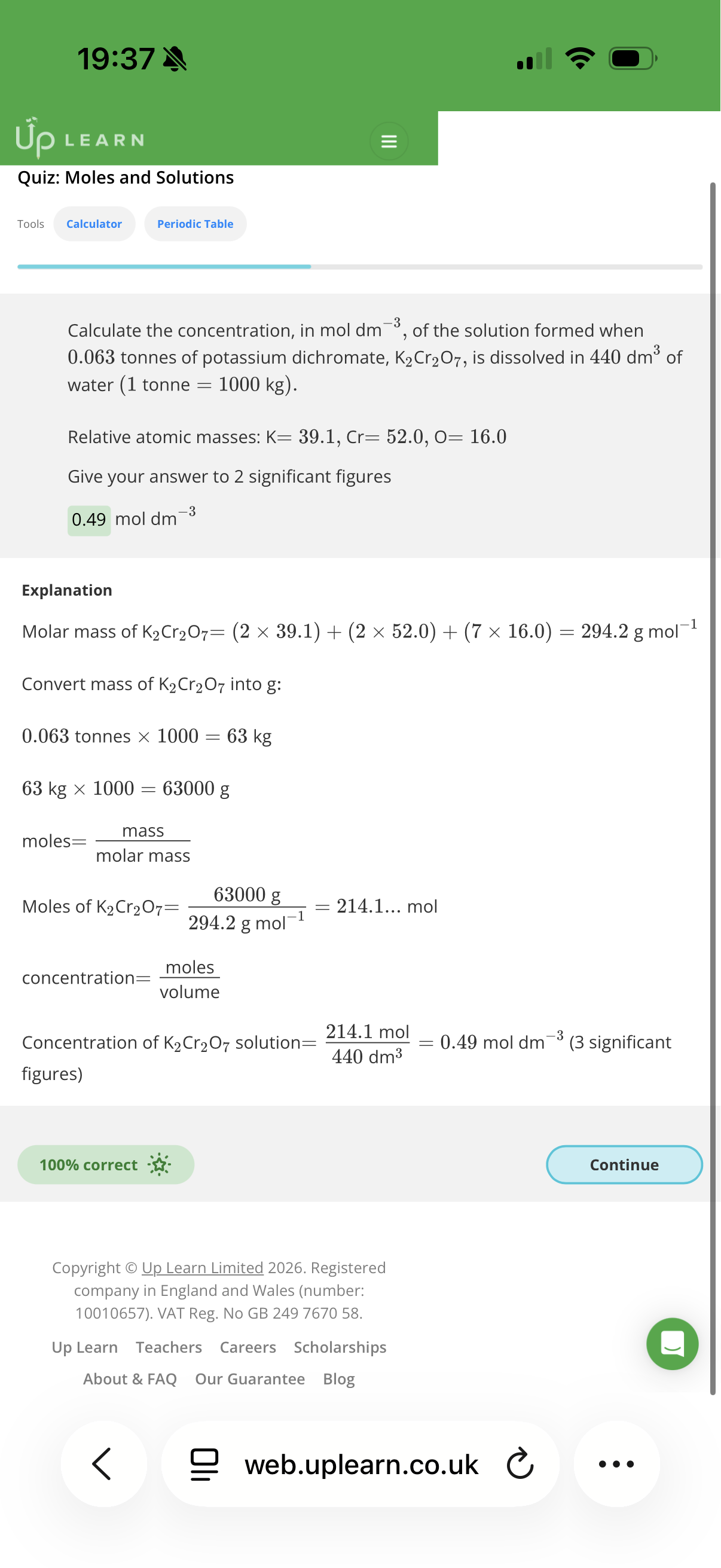
Images contain important info you need to learn. Ppm is mg/dm*-3
15mg of ethanol is dissolved in 1.65dm3 of water. What’s the concentration of the solution in parts per million?
Give your answer to two significant figures.What is the mass in mg of a solute that has a mass of 0.0082grams?
A solute has a mass of 0.32g and is added to a solvent with a volume of 1.28dm3. What is the concentration of the solution in parts per million?
When reporting concentration in parts per million, the amount of solute is reported in …4?and the amount of solvent is measured in …5?.
A solution of sodium nitrate, NaNO3, has a concentration of 221 parts per million. Calculate the mass in mg of sodium nitrate present in 85.0cm3 of the solution?
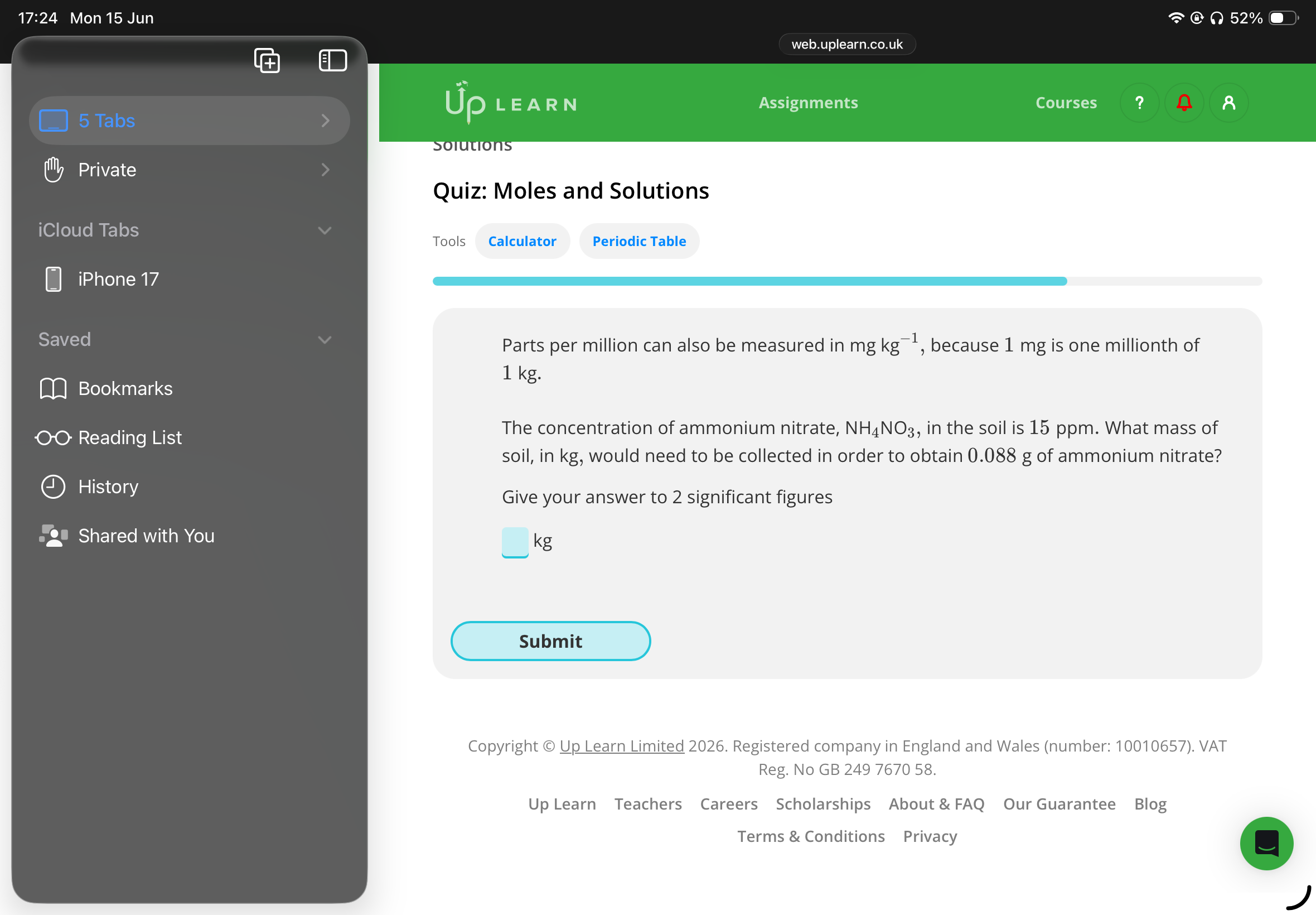
Give your answer to a suitable degree of accuracyA 20.0cm3 sample of blood contains 1.08×10⁻⁷moles of iron (Ar=55.8). Express the concentration of iron in parts per million.
Give your answer to 3 significant figures
9.1 ppm. 2. (8.2mg). 3. (250ppm). 4. Mg. 5.dm*-3. 6. (18.8 mg)
Explanation
Step 1: Find mass of iron
mass=moles×molar mass
Mass of Fe=(1.08×10−7) × 55.8 =6.0264×10⁻⁶g
Convert mass of Fe into mg: 6.0264×10−6g×1000=0.0060264mg
Step 2: Find concentration in ppm
Convert volume of blood into dm3: 20.0cm3 ÷ 1000= 0.02dm3
concentration (ppm)=mass (mg) / volume (dm3)
Concentration of Fe=0.0060264mg / 0.02dm3=0.301ppm (3 significant figures)
Answer image question?
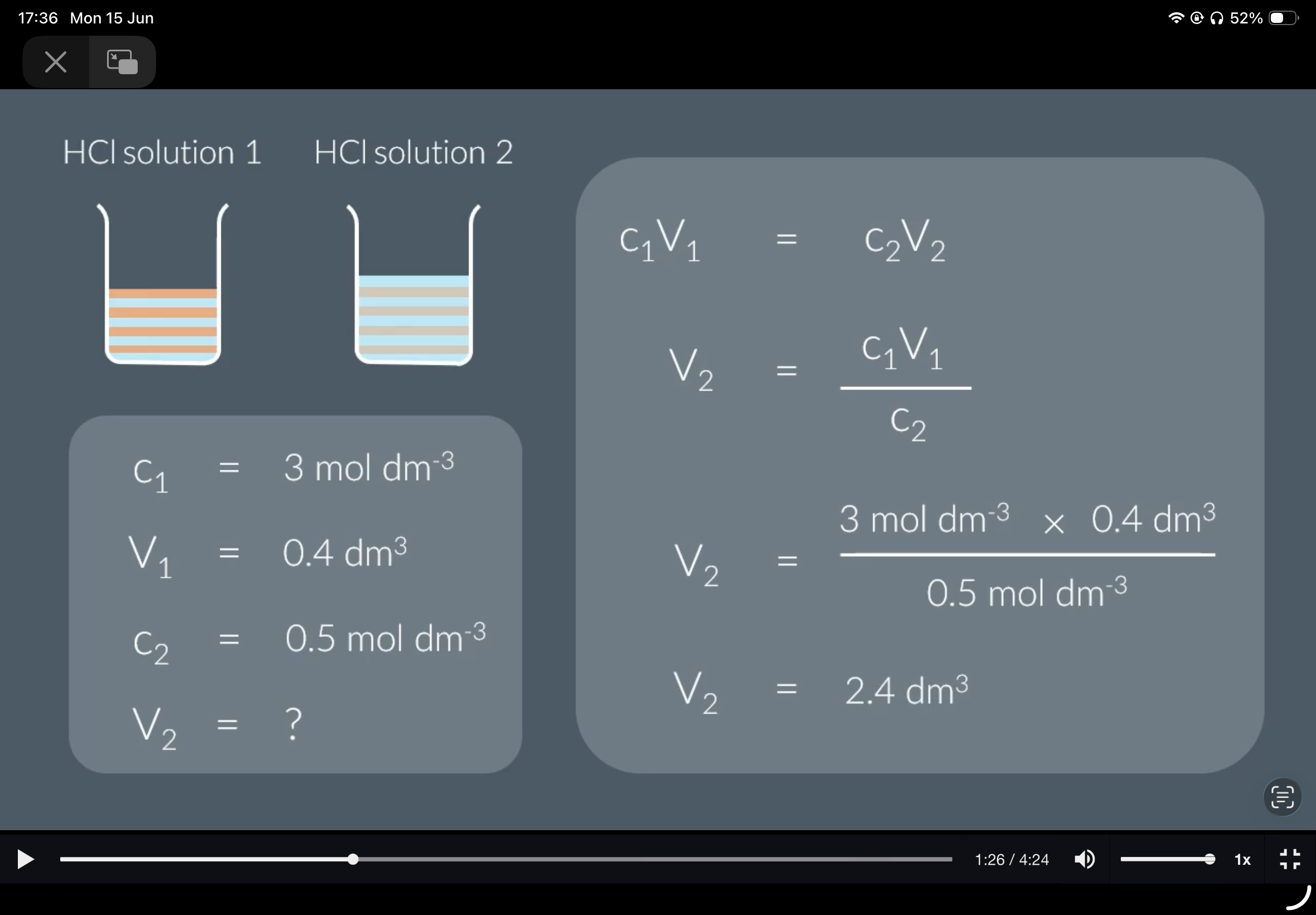
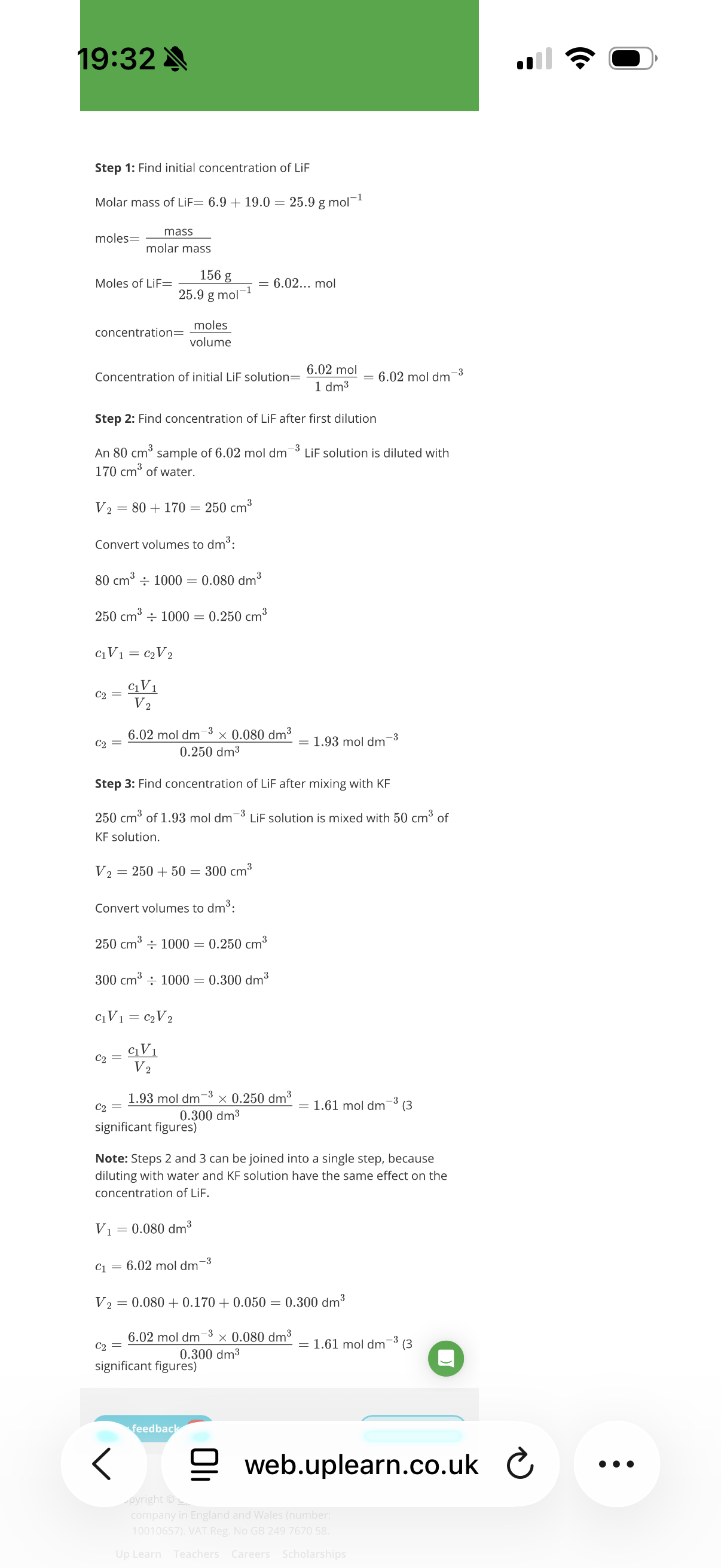
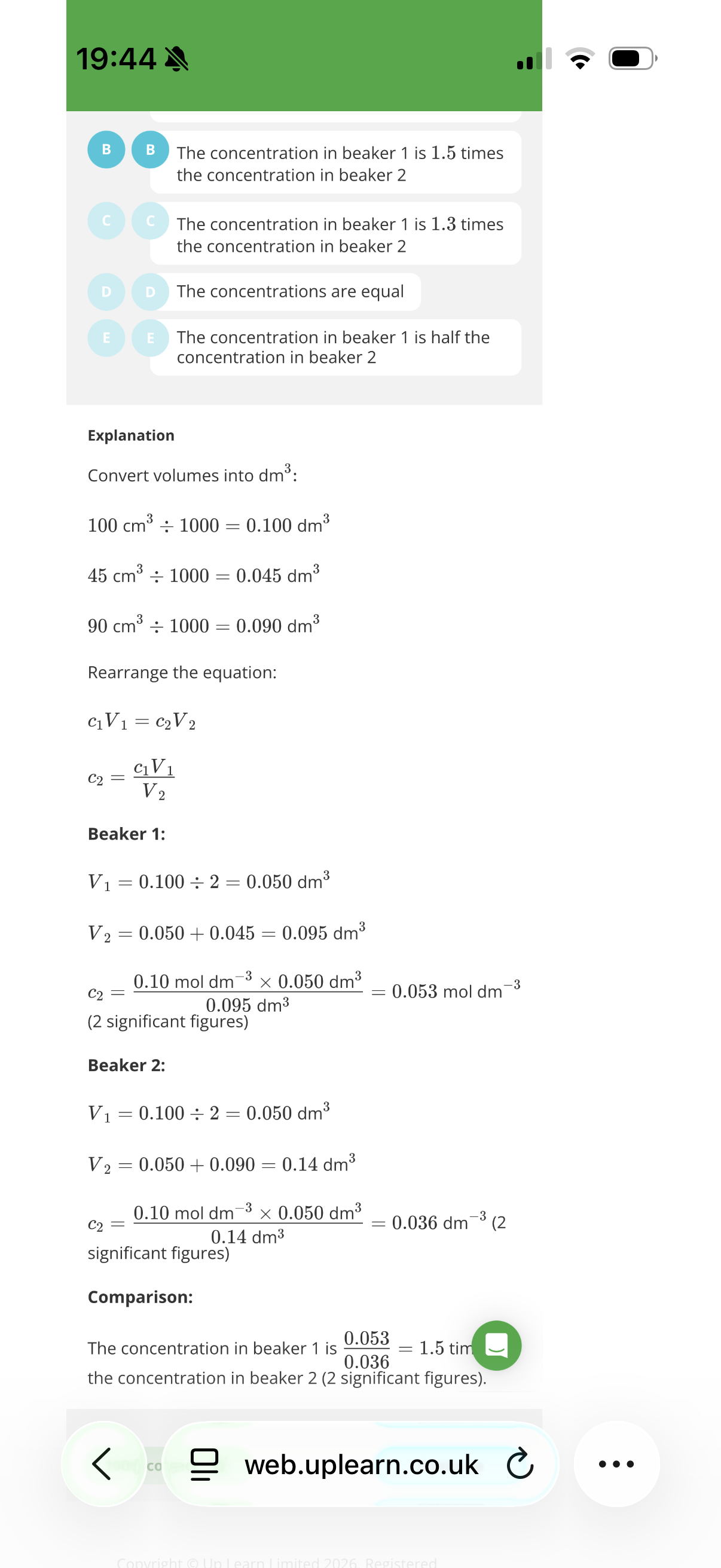
Image contains info on how to use C1V1 = C2V2 (conc x volume of solution 1 = conc X volume of solution 2)
0.63dm*3 of water was added to a 0.42dm3 solution of barium hydroxide with a concentration of 3.08mol dm−3. The final volume is…
What is the final concentration? Give your answer to 3 significant figures.
Increasing the amount of solvent in a solution...
A: changes both the concentration of the solution and the amount of solute
B: changes the concentration of the solution but not the amount of solute
When we increase the amount of solvent in the solution but keep the amount of solute the same then it is known as…
Which solution can we use to calculate the change in volume or concentration of a solution?
Select all that applyA: c1V1=c2V2
B: c1V2=c2V1
A sample of 3.0mol dm−3 magnesium hydroxide solution is diluted with an equal volume of water. What happens to the concentration of the solution?
Choose either : Stays the same,Doubles,Halves
16.5dm3 of a 0.825mol dm−3 solution of methanoic acid is diluted with water and made up to 100dm3. What is the concentration of the diluted solution?
Give your answer to 3 s.f.A 10cm3 sample of hydrogen peroxide solution is diluted to a concentration of 7.50×10⁻³mol dm−3 with 50cm3water.
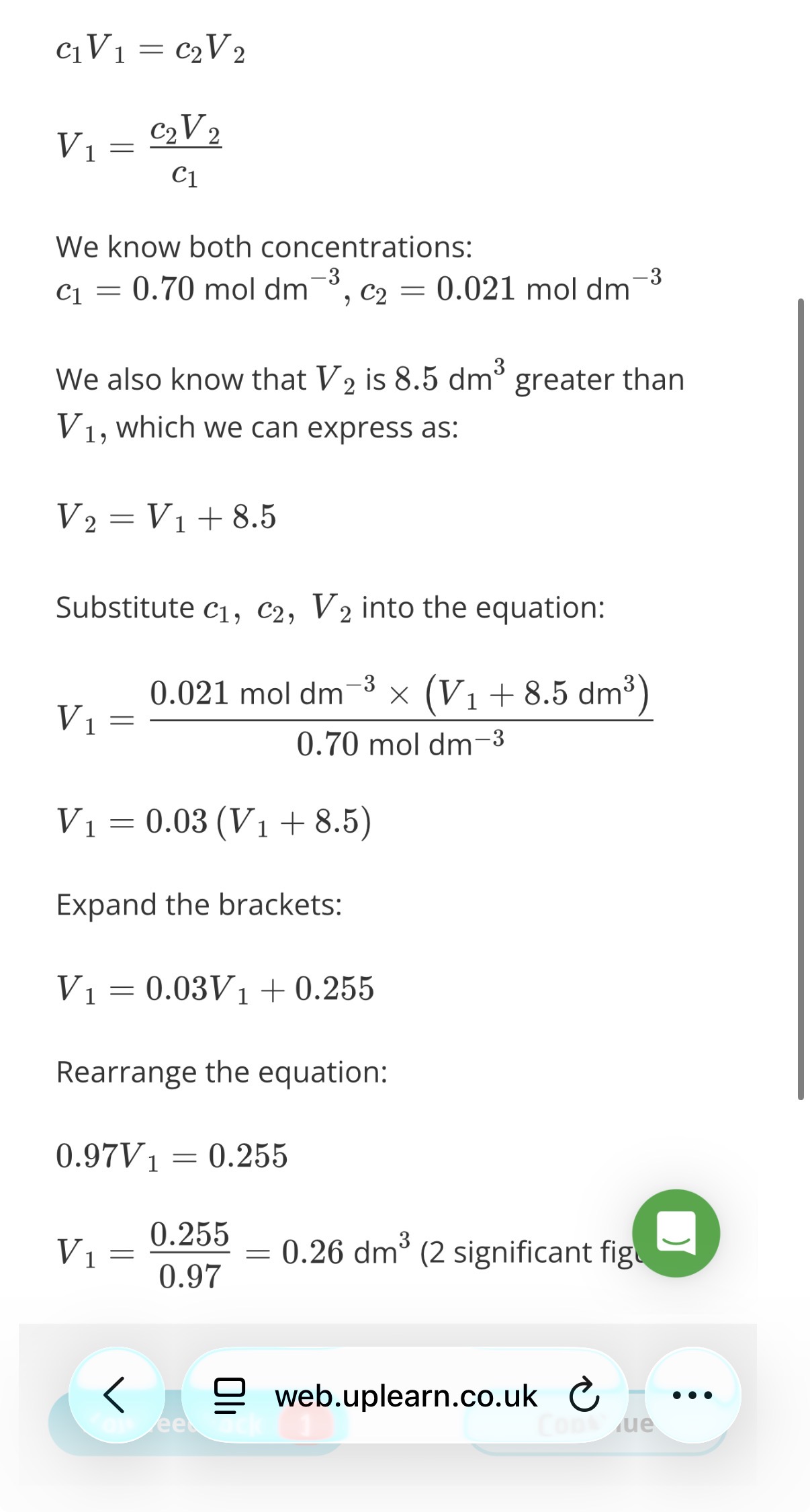
What was the original concentration of the hydrogen peroxide solution?8.5dm3 of water is added to a 0.70mol dm−3 solution of aluminium nitrate. The new solution has a concentration of 0.021mol dm−3.
Calculate the original volume of the aluminium nitrate solution in dm3.
Give your answer to 2 significant figures.
1.05 dm*3. 2. (1.23)mol dm-3 explanation:C1V1/V2 = C2. → (3.08 X 0.42 ) / 1.05 =1.23
B. 4. Dilution. 5. A. 6. Halves. 7. (0.136 mol dm-3)
0.045 mol dm-3
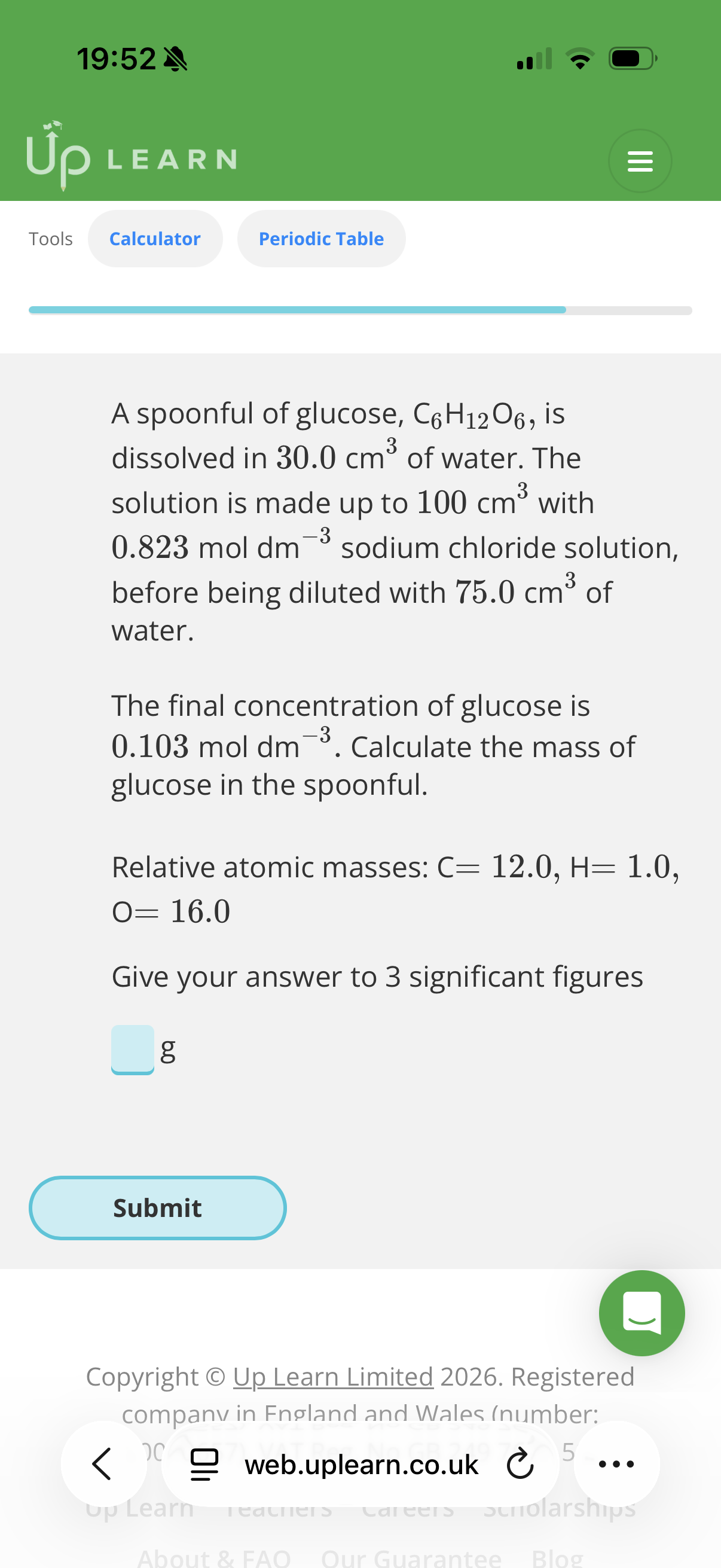
0.26dm3 Explanation in image
• You can also just write X instead of V1 and you do not have to simplify the way in the image, you can do it the same way as finding x of isotopes.
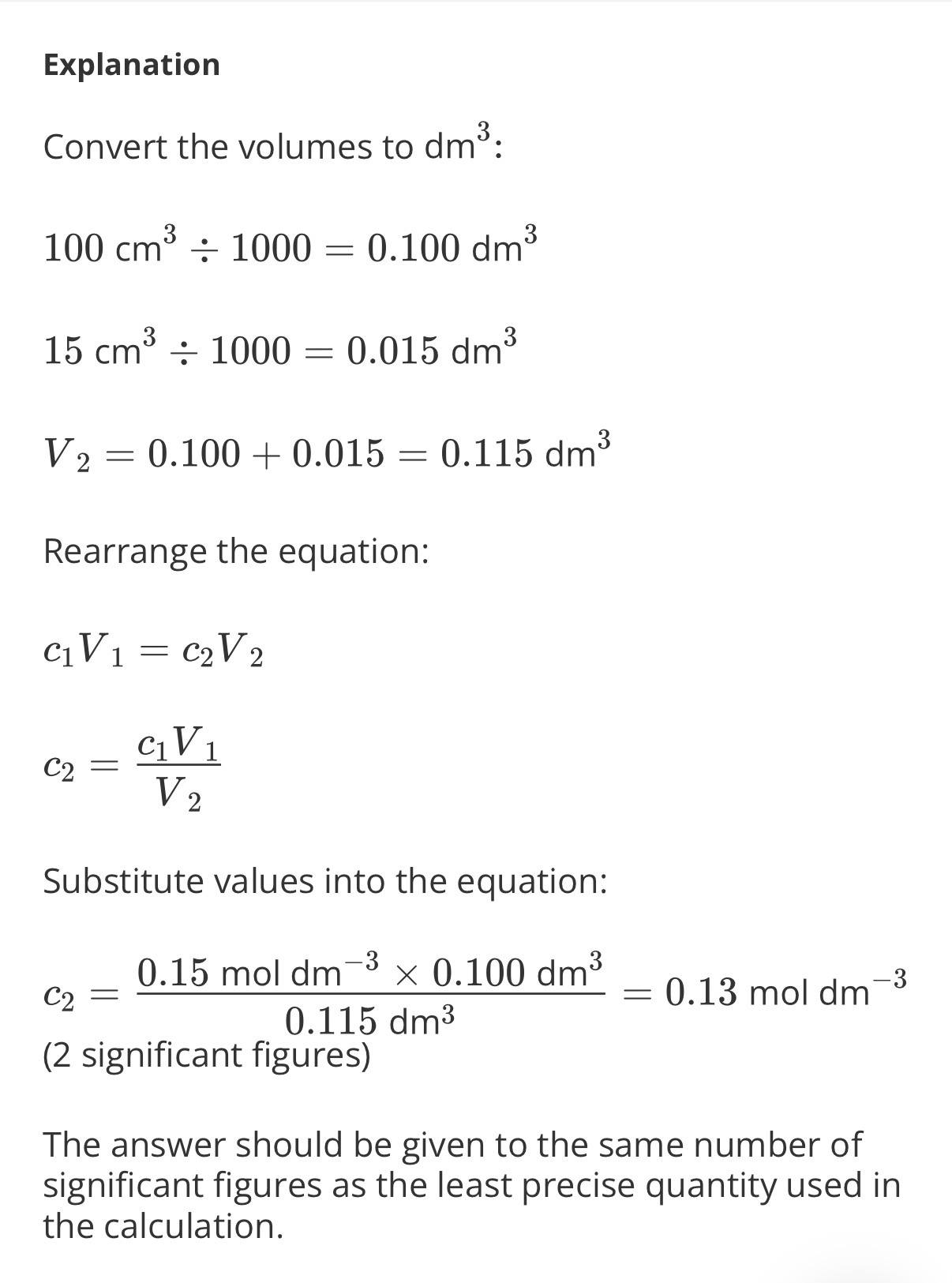
0.02dm3 of a sodium chloride solution with a concentration of 0.15mol dm−3 is added to 0.02dm3 of a potassium bromide solution with a concentration of 0.04mol dm−3. What is the total volume of the new solution?
What is the concentration of sodium chloride in the new solution?
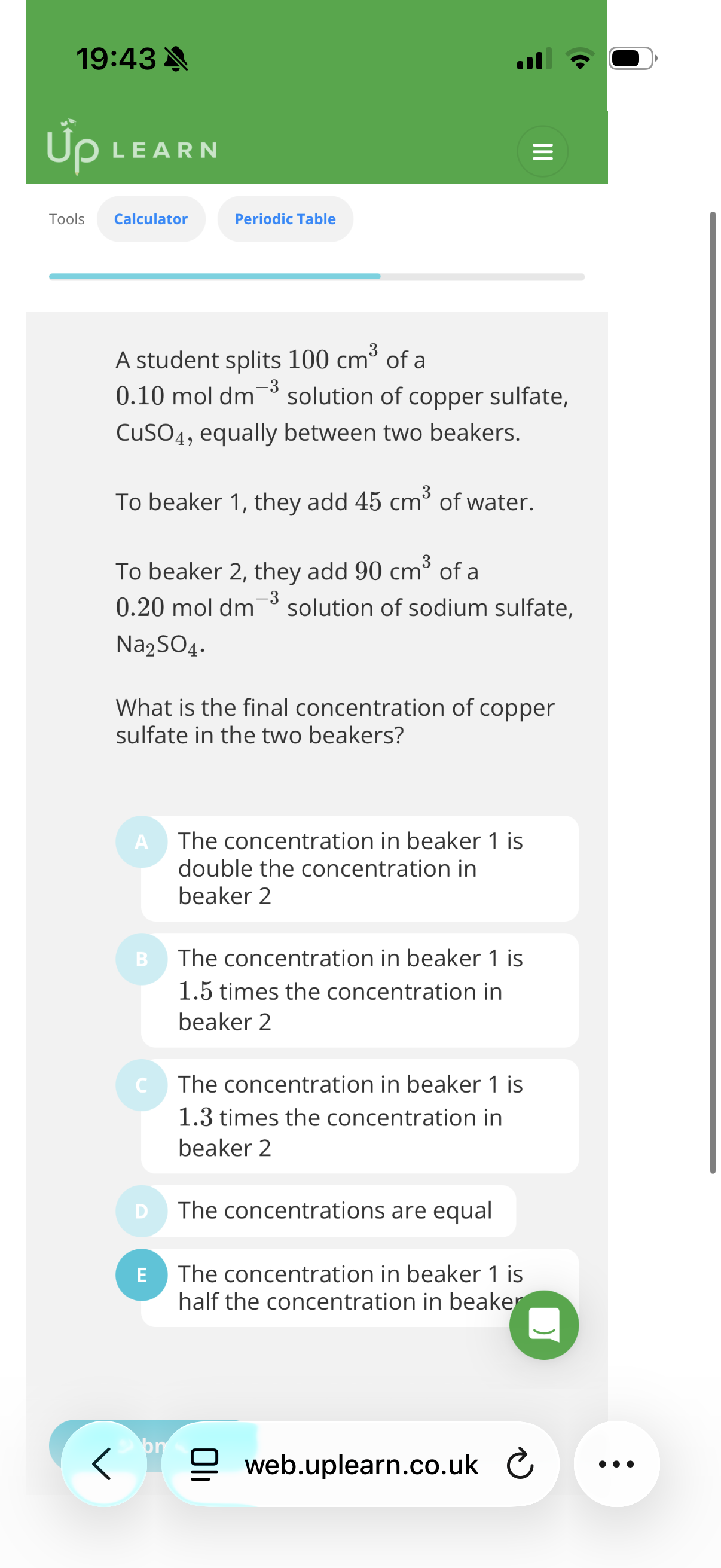
100cm3 of a solution of sodium chloride with a concentration of 0.15mol dm−3 is added to 15cm3 of potassium bromide solution with a concentration of 0.040mol dm−3 to make a new solution.
What is the concentration of sodium chloride in the new solution?The procedure for calculating the concentration of a solution diluted with another solution is the same as calculating the concentration of a solution diluted with…
0.04 dm-*3 Q2. 0.075 mol dm-3(C1V1/V2)
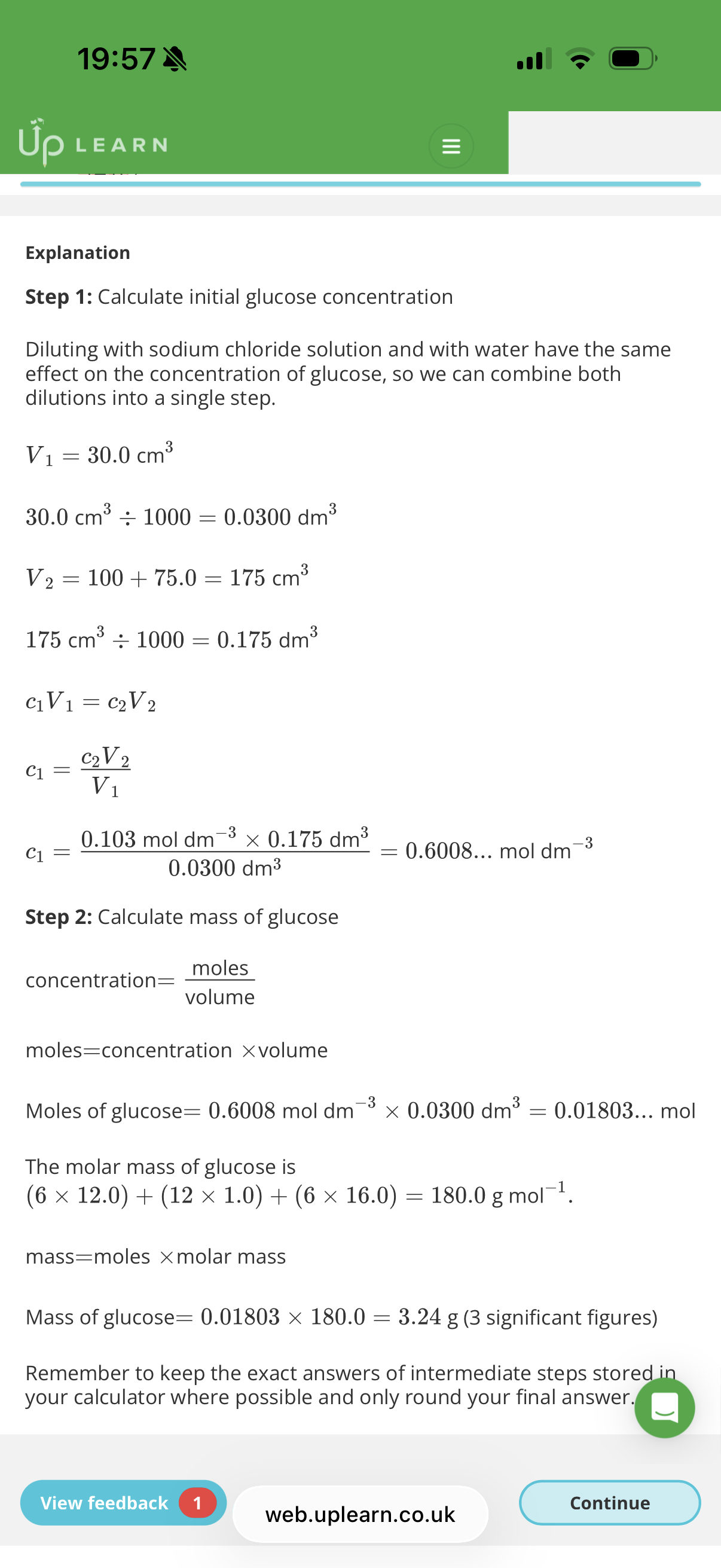
answer is in image
Water
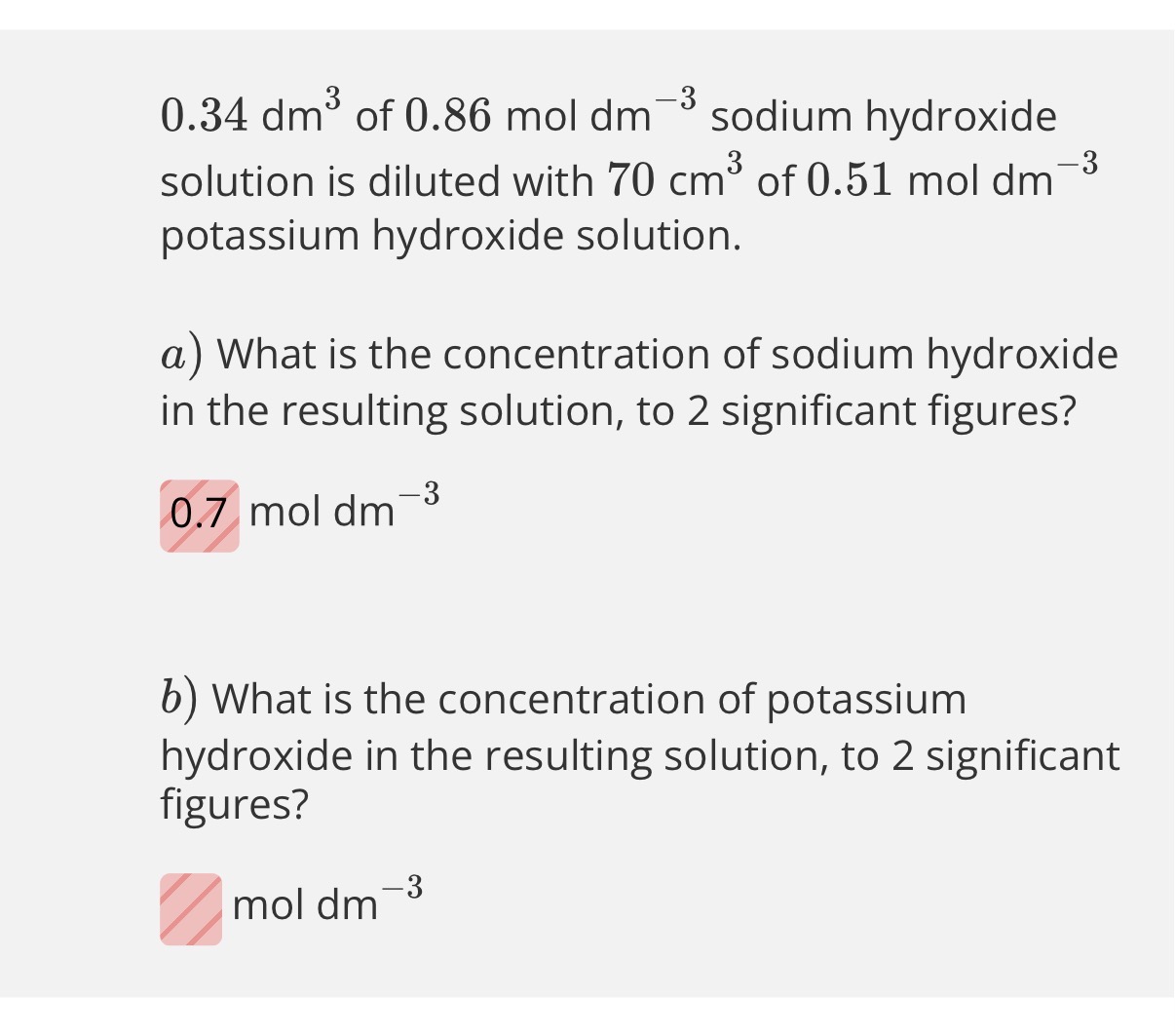
Answer all questions?
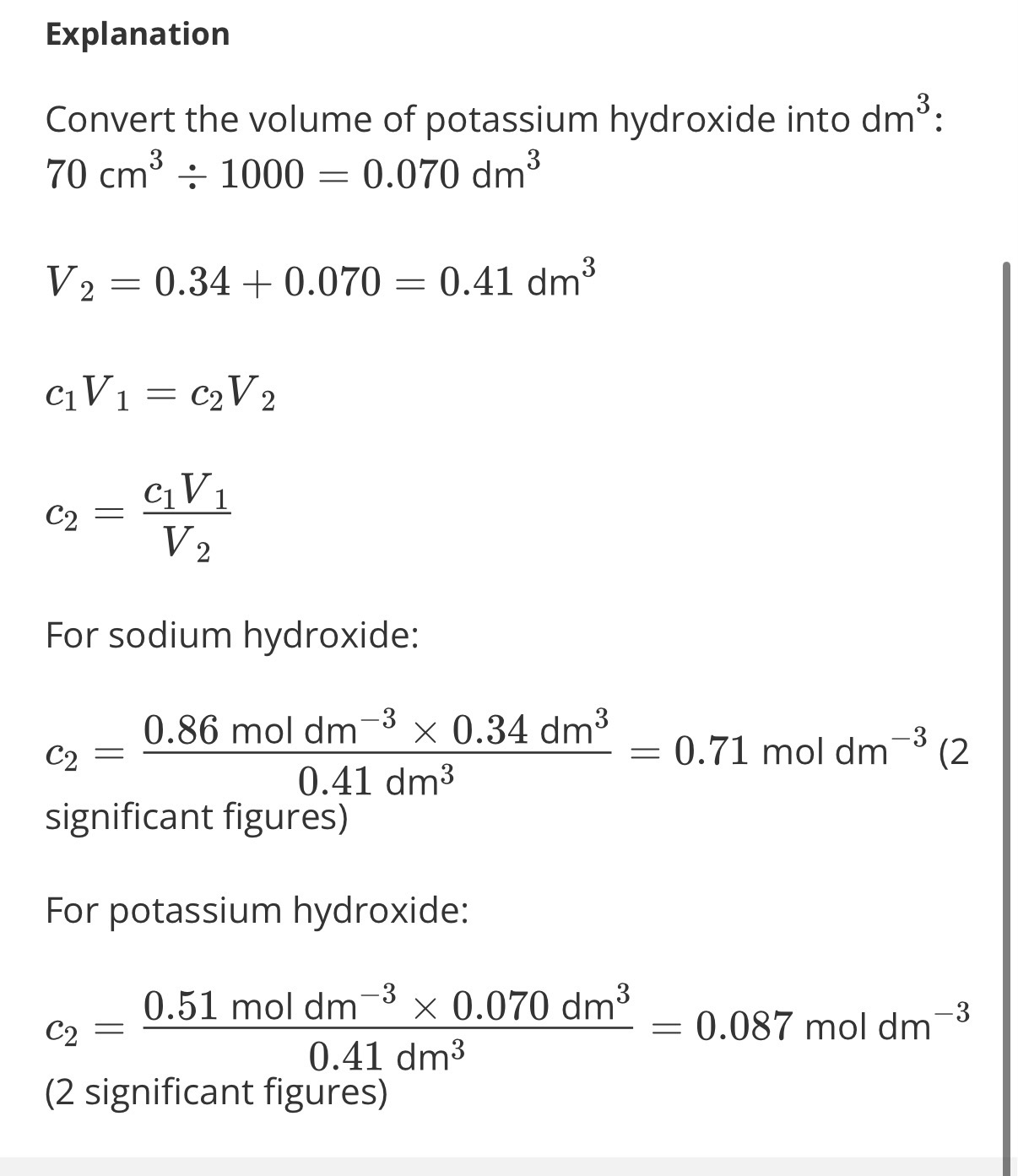
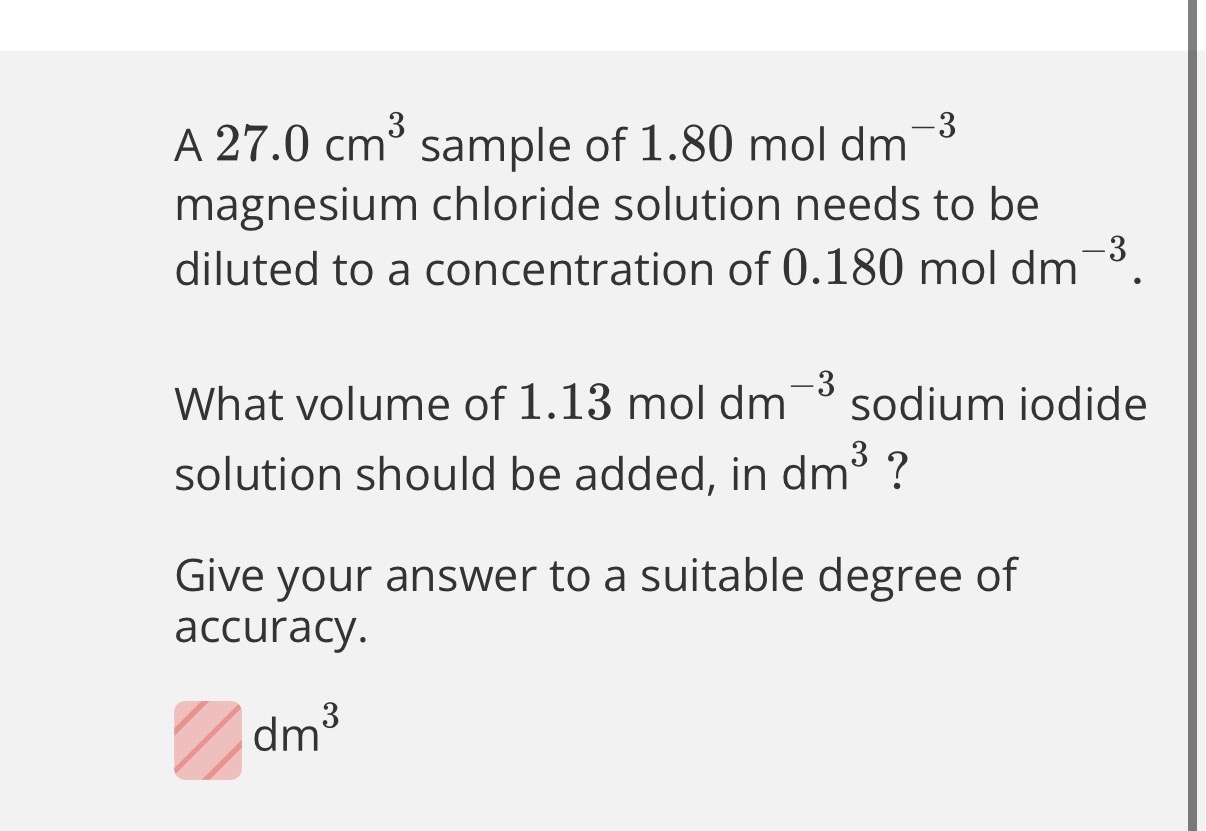
Answer image question?
0.243 extra explanation: V2= Final total volume
Notice that 1.80 divided by 0.180 is exactly 10. This means you want to dilute the solution by a factor of 10.
Step 3: Calculate how much solution needs to be added
You started with 27.0cm3 and you need to end up with 270cm^3.
The volume of the sodium iodide solution you need to add is:
270-27 =243cm3 then divide by 1000 to get 0.243dm3
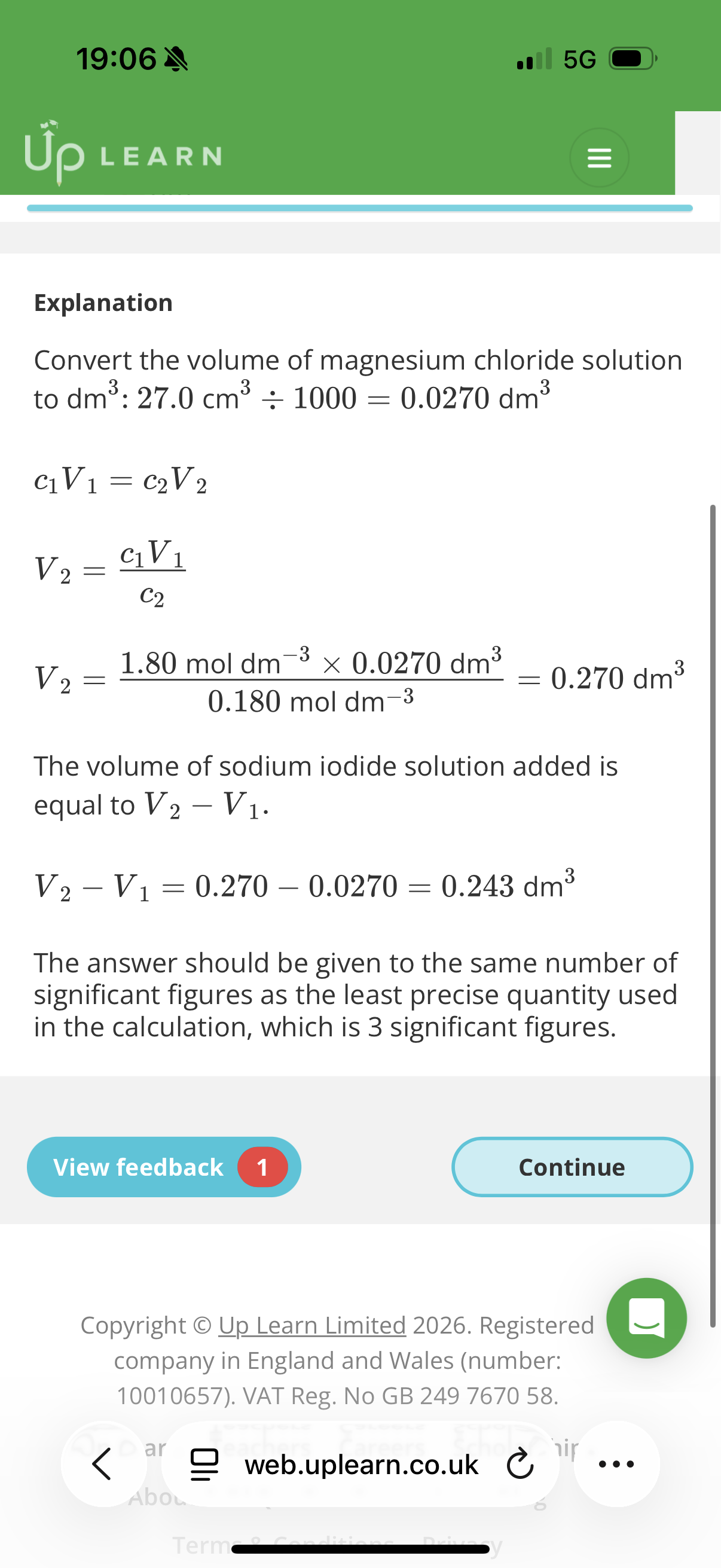
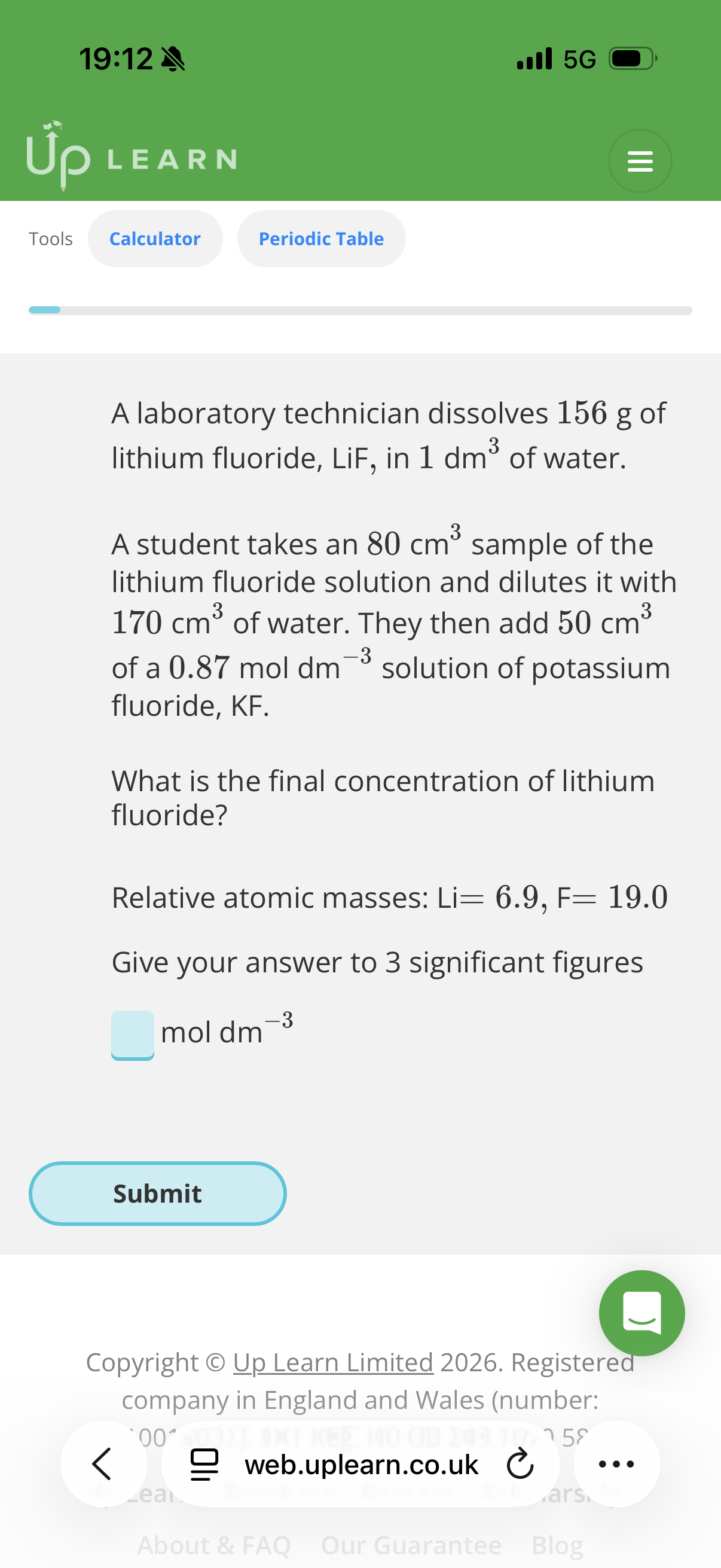
Answer image question?
Another way is you can do the calculation with g cm-3 but at the end, you need to do 41.6/ molar mass of LiF to convert it to mol dm-3