Sea Turtles/ Service animal
 Call Kai
 Learn
Learn Practice Test
 Spaced Repetition
 Match
Match Flashcards
 Knowt Play
1/25

There's no tags or description
Looks like no tags are added yet.
Name | Mastery | Learn | Test | Matching | Spaced | Call with Kai | Chat |
|---|
No analytics yet
Send a link to your students to track their progress
26 Terms
How are green sea turtle hatchlings identified?
A: They are dark olive green or nearly black, with a contrasting white underbelly.
How are loggerhead sea turtle hatchlings identified?
A: They are typically dark brown, with a pale-brown border on their flippers.
How are leatherback sea turtle hatchlings identified?
A: They are approximately 3–4 inches long and have white striping along their backs.
Why is artificial lighting dangerous to sea turtle hatchlings?
A: Hatchlings are instinctively attracted to bright lights, which can disorient them and lead them away from the ocean.

How is the green sea turtle identified?
A: By a unique pair of scales in front of its eyes, a small blunt head, a serrated jaw, and an oval shell.
What are the key nesting facts and conservation status of the green sea turtle?
A: Each female nests 3–5 times every other year, lays an average of 115 eggs per nest, and the eggs incubate for about 60 days. Its status is endangered.
Status: Endangered
How is the loggerhead sea turtle identified?
A: By its distinctive large head, strong heavy jaws, and heart-shaped, ridgeless, reddish-brown shell.
Status: Threatened
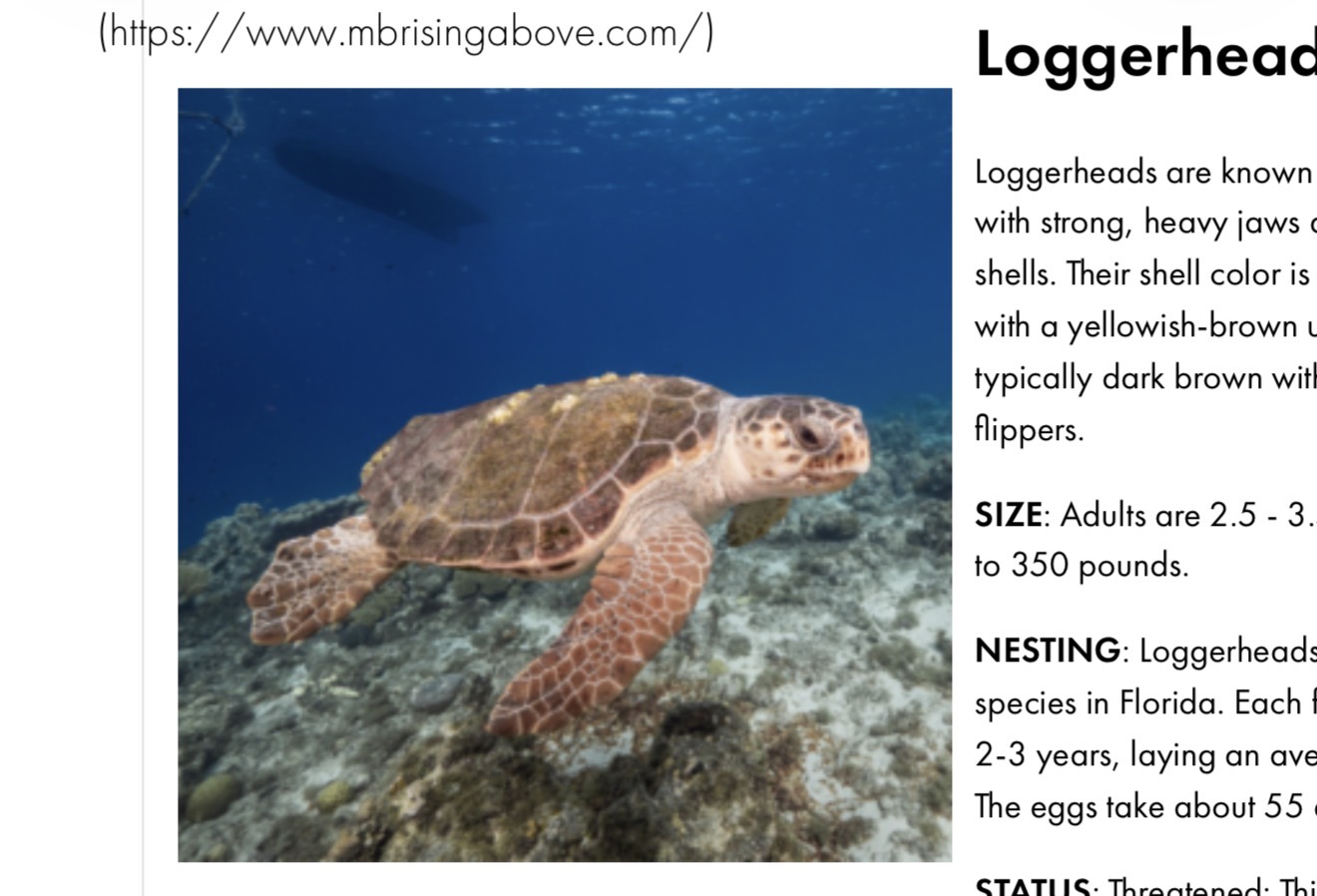
How is the loggerhead sea turtle identified?
A: By its distinctive large head, strong heavy jaws, and heart-shaped, ridgeless, reddish-brown shell.
Status: Threatened
What are the key nesting facts and conservation status of the loggerhead sea turtle?
A: It is Florida’s most common nesting sea turtle. Each female nests 5–7 times every 2–3 years, lays an average of 80–120 eggs per nest, and the eggs incubate for about 55 days. Its status is threatened.
Status: Threatened
Which of the three species is the largest, and what is its adult size?
A: The leatherback is the largest, reaching 6–6.5 feet and approximately 1,500–2,000 pounds.

What conservation-status distinction should be memorized?
A: The green and leatherback sea turtles are endangered; the loggerhead sea turtle is threatened.
What is the official sea turtle nesting season in Miami Beach?
A: April 1 through October 31. Miami Beach begins the season earlier than the rest of Florida to account for early leatherback nesting.
Which three protected sea turtle species nest in Miami Beach, and why must artificial lighting be controlled?
A: Loggerhead, green, and leatherback sea turtles. Artificial lighting must be controlled because hatchlings are instinctively attracted to bright lights, which can lead them away from the ocean.
When it is not obvious that a dog is a service animal, what two questions may staff ask?
A:
Is the dog a service animal required because of a disability?
What work or task has the dog been trained to perform?
When may staff ask questions to determine whether a dog is a service animal?
A: Only when it is not obvious that the dog is a service animal.
Must a service animal wear a vest, patch, identification tag, or special harness?
A: No. The ADA does not require service animals to wear any special identification or harness.
Who is responsible for the care and supervision of a service animal?
A: The handler is responsible for caring for and supervising the animal, including toileting, feeding, grooming, and veterinary care.
Must a covered entity supervise or otherwise care for a service animal?
A: No. Covered entities are not obligated to supervise or provide care for a service animal.
May a city require a dog to be registered specifically as a service animal?
A: No. Mandatory registration of service animals is not permitted under the ADA. However, service animals must follow the same licensing and vaccination rules that apply to all dogs.
Can service animals be any breed of dog?
Yes, the ADA does not restrict the type of dog breeds that can be service animals.
How must a jurisdiction determine whether a service animal poses a direct threat?
A: It must make a case-by-case determination based on the particular animal’s actual behavior or history.
Can a service animal be excluded because of fears or generalizations about its breed?
A: No. Exclusion cannot be based on assumptions about how the animal or breed might behave.
Are religious institutions required by the ADA to allow service animals inside their facilities?
A: No. Religious institutions and organizations are specifically exempt from the ADA. However, applicable state laws may still require access.
Do federal agencies, such as the Department of Veterans Affairs, have to comply with the ADA?
A: No. Federal programs and services are governed by Section 504 of the Rehabilitation Act of 1973.
What federal law protects the rights of people with disabilities participating in federal programs and services?
A: Section 504 of the Rehabilitation Act of 1973. Complaints should be directed to the federal agency’s Equal Opportunity Office.
Do commercial airlines have to comply with the ADA?
A: No. Disability rights in air travel are protected by the Air Carrier Access Act. Complaints are handled by the U.S. Department of Transportation’s Aviation Consumer Protection Division.