Lecture 1 - Intro
 Call Kai
 Learn
Learn Practice Test
 Spaced Repetition
 Match
Match Flashcards
 Knowt Play
1/114

There's no tags or description
Looks like no tags are added yet.
Name | Mastery | Learn | Test | Matching | Spaced | Call with Kai | Chat |
|---|
No analytics yet
Send a link to your students to track their progress
115 Terms
What are the roots of biochemistry?
Ancient ideas of humors/mystical forces, invention of the microscope, and the formalization of chemistry (Lavoisier: respiration is combustion)
Define biochemistry
The study of the chemistry of life; how life works at the chemical level
List the 6 issues that define the study of biochemistry
1) Chemical/3D structure of biomolecules 2) How biomolecules interact 3) How the cell synthesizes/degrades biomolecules 4) How energy is conserved and used in the cell 5) Mechanisms for organizing biomolecules and coordinating activities 6) How genetic information is stored, transmitted, and expressed
Difference between prokaryote and eukaryote
Prokaryotes lack a nucleus and membrane-bound organelles (e.g., bacteria); eukaryotes have a nucleus and membrane-bound organelles
Define evolution (biochemistry lecture)
Nature's selection of the most fit molecules/organisms to carry out the life process; not goal-directed, ongoing, constrained by past changes
What are polymers built from?
Monomers (building blocks of polymer biochemistry)
Why learn about biochemistry? (4 reasons)
Foundational for life sciences, medical/health relevance, sharpens critical thinking/problem solving, opens career opportunities (healthcare, pharma, forensics, agriculture)
What is biochemistry central to, and what does it combine?
Central to biology; combines chemistry, mathematics, and physics with biology
Why is chemistry called the central science?
Its concepts are at the core of other sciences and applied sciences (biology, physics, astronomy, nuclear science, geology, environmental science)

In the "Relation to Other Science Courses" diagram, what does Chemistry provide to Biochemistry?
Methods and molecular perspective
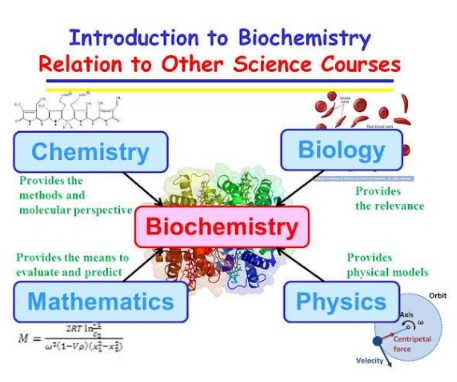
In the "Relation to Other Science Courses" diagram, what does Biology provide to Biochemistry?
Relevance
In the "Relation to Other Science Courses" diagram, what does Mathematics provide to Biochemistry?
Means to evaluate and predict

In the "Relation to Other Science Courses" diagram, what does Physics provide to Biochemistry?
Physical models

In the scale-of-life diagram (atoms to systems), what is the order of increasing complexity?
Sub-atomic particles → Atoms (Chemistry/Physics) → Small molecules → Large molecules → Organelles → Cells (Biochemistry) → Tissues → Organs → Systems (Physiology/Anatomy)
Name the 10 fields shown in the "Biochemistry" wheel diagram
Biological Sciences, Chemistry, Structural Biology, Microbiology & Immunology, Pathology, Neurobiology, Molecular Pharmacology, Molecular & Cellular Physiology, Developmental Biology, Genetics
Name the 6 biochemistry application areas shown in the bubble diagram
Medicine, Genetic Cloning, Forensics, Biochemistry Applications, Genetic Engineering, Nutrition, Cleaning Products
Why do biologists take biochemistry? (main idea)
Biology explains what happens in living organisms; biochemistry explains how it happens at the chemical level
What 4 molecule classes does biochemistry focus on to understand life at the molecular level?
Proteins, DNA/RNA, Lipids & Carbohydrates, Metabolism
Give 3 example questions biologists answer using biochemistry
How do cells produce energy? How is DNA copied and expressed as proteins? What causes a genetic mutation to affect an organism?
Mechanisms Behind Biological Processes: Name 5 biological processes whose mechanisms biochemistry explains
Cell division, photosynthesis, respiration, muscle contraction, hormone action
Biochemistry explains how these happen:
•What enzymes are involved?
•What pathways and intermediates are formed?
•How are signals transmitted at the molecular level?
Molecular Biology and Genetics: What modern biology fields are built on biochemistry?
Molecular biology, genetics, and biotechnology (e.g., CRISPR, DNA replication/transcription/translation, protein engineering, PCR, sequencing)
Medical and Health Applications: Give 4 medical/health applications of biochemistry
Understanding disease mechanisms (cancer, diabetes, infections), drug development/pharmacology, immunology/vaccine design, nutritional science/metabolism
How does biochemistry relate to ecology and evolution?
Explains how enzymes adapt to extreme environments, what biochemical traits are selected in evolution, and how organisms interact chemically (pheromones, toxins, allelopathy)

Who is Cheddar Man?
The remains of a Mesolithic man who lived ~10,000 years ago (circa 7150 BCE) during the Stone Age in Britain; skeleton discovered in 1903 in Gough's Cave, Cheddar Gorge, Somerset, England
Dark man that lived in England thousands of years ago. Closest ancestor is a white british man
When and by whom was Cheddar Man's DNA sequenced?
In 2018, by scientists from the Natural History Museum and University College London
What did Cheddar Man's DNA analysis reveal?
He likely had dark to black skin, blue eyes, and curly dark hair, challenging assumptions that ancient Britons were light-skinned
What population did Cheddar Man belong to?
Western Hunter-Gatherers, who migrated into Britain from Europe after the last Ice Age
Why is Cheddar Man culturally/scientifically important?
He is the oldest nearly complete human skeleton found in Britain and iconic in the study of human ancestry in the British Isles
What modern connection was found related to Cheddar Man?
A local schoolteacher living near Cheddar today shares a maternal mitochondrial DNA lineage with Cheddar Man, suggesting direct ancestry over ~10,000 years
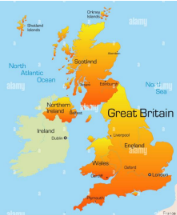
Migration 1 into Britain: Mesolithic Hunter-Gatherers
c. 12,000–6,000 BCE; repopulated Britain after the last Ice Age via Doggerland; included Cheddar Man (7100 BCE); dark skin, blue eyes, Western Hunter-Gatherers genetically

Migration 2 into Britain: Neolithic Farmers
c. 4000 BCE; from Anatolia and the Near East via Mediterranean/Western Europe; brought farming; replaced/assimilated hunter-gatherers; built megaliths like Stonehenge

Migration 3 into Britain: Beaker People/Bronze Age
c. 2500–1800 BCE; from Central Europe; replaced up to 90% of Britain's population within a few centuries; brought bronze metalworking, new burial practices, Indo-European languages
Migration 4 into Britain: Celtic Migrations
Iron Age, c. 800 BCE onward; from Central Europe (Hallstatt/La Tène cultures); may be more cultural shift than mass migration; became the Britons, Gaels, and related tribes

Migration 5 into Britain: Roman Invasion
43–410 CE; soldiers/settlers/administrators from across the Roman Empire; built roads, towns, baths, introduced Latin; limited genetic impact but strong cultural/urban influence
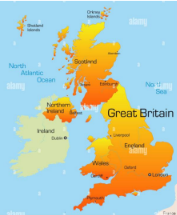
Migration 6 into Britain: Anglo-Saxon Migrations
c. 410–800 CE; Germanic tribes (Angles, Saxons, Jutes, Frisians) from Germany, Denmark, Netherlands; significant genetic/linguistic impact; Old English formed basis of modern English

Migration 7 into Britain: Viking Invasions
c. 800–1100 CE; Norse Vikings from Denmark, Norway, Sweden; established the Danelaw; founded York (Jórvik); significant cultural, moderate genetic contribution

Migration 8 into Britain: Norman Conquest
1066 CE; Normans (descendants of Vikings in Normandy, France) led by William the Conqueror; introduced French-Norman aristocracy/language; minor genetic but huge linguistic/legal/governance influence
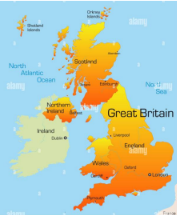
What later migrations (post-1066) contributed to modern British diversity?
Flemish, Huguenots, Irish, Jewish, Caribbean, South Asian, African, and Eastern European populations
Why are population migration studies important (per lecture)?
Migrations bring new species that replace old ones and change the ecological landscape, similar to how you can study animal migration
Question posed: important nonhuman migration in 13th century Europe crucial to world history?
Referring to the spread of the Black Death/plague (posed as a discussion question in the lecture)
Ancient DNA (aDNA) Analysis: How does ancient DNA (aDNA) analysis connect migrations to biochemistry?
Biochemistry provides tools (PCR, next-generation sequencing) to extract/sequence DNA from ancient bones/teeth (e.g., petrous temporal bone), enabling recovery of genetic profiles, as used for Cheddar Man
How does isotope biochemistry help study migration?
Stable isotope analysis of carbon, nitrogen, oxygen, and strontium in ancient teeth/bones reveals diet, geographic origin, and mobility/migration patterns
figure out where people came from and how they lived — crucial to migration studies
Proteomics (Ancient Proteins): How does proteomics help when DNA is too degraded?
Analysis of ancient proteins (especially collagen) using mass spectrometry can determine species, health conditions, and ancestry
Population Genetics & Biochemical Markers: How do biochemical markers (SNPs) track population migrations?
Single nucleotide polymorphisms (SNPs) are biochemical markers used to identify shared genetic variants across populations, tracking who migrated where and when (e.g., Beaker culture tracked via Y-DNA/mtDNA haplogroups)
Health and Evolutionary Traits: What evolutionary/health traits have biochemists traced through ancient genomes?
Lactase persistence, skin pigmentation, and disease resistance genes, tied to migratory mixing and natural selection
Name 2 other large island landmasses that could be studied like Britain (per lecture)
Japan (off East Asia) and Madagascar (off East Africa)
What happened to ancient horse populations in the Americas?
Ancient horses went extinct in the Americas (likely originated there) and were not present until Europeans reintroduced them
Give 2 other notable isolated-landmass evolutionary examples
Large flightless predatory birds that survived/evolved in South America long after going extinct elsewhere; Australia's marsupials and monotremes
How can protein families relate to species differences across isolated landmasses?
Looking at protein families and their variations gives insight into how species differed and are similar (biochemistry linking to culture as well)
Pre-19th century roots of biochemistry
Ancient "humors"/mystical ideas of disease; 1600s microscope (Antonie van Leeuwenhoek) allowed viewing cells/microorganisms; late 1700s Lavoisier described respiration as combustion
1828 biochemistry milestone
Friedrich Wöhler synthesized urea (an organic compound) from an inorganic chemical, disproving the "vital force" idea and bridging chemistry and biology
Mid-1800s biochemistry milestones
Louis Pasteur showed fermentation is caused by living cells (yeast); early (not fully understood) discovery of enzymes as catalysts
1897 biochemistry milestone
Eduard Buchner demonstrated fermentation could occur in cell-free extracts, proving enzymes could work outside living cells
Early 20th century biochemistry milestones
Term "biochemistry" becomes common; discovery of vitamins, hormones, metabolic pathways (1910s-1930s); Hans Krebs described the Krebs cycle (1937); biochemical genetics emerged, connecting genes to enzymes (Beadle & Tatum, 1940s)
Mid-late 20th century biochemistry milestones
1953 Watson and Crick discovered DNA structure; decoding of the genetic code; recombinant DNA technology (Genentech, 1976) leading to biotechnology; biochemistry merges with molecular biology
21st century biochemistry milestones
Completion of the Human Genome Project (2003); advances in proteomics, metabolomics, systems biology; applications in personalized medicine, CRISPR, synthetic biology
What is the age of the universe and how did it begin?
15-20 billion years old, beginning with the Big Bang
Foundational chemical sequence leading to life (per lecture)
H2 formed then condensed to He; stars formed and died; supernovas created higher atomic number elements; over billions of years complex molecules and carbon-based chemistry developed, giving rise to LIFE
What physical laws do living organisms operate within?
Conservation of Mass and Energy, Laws of Thermodynamics, Laws of Chemical Kinetics, Principles of Chemical Reactions
What do these physical laws define (the "Molecular Logic of Life")?
Energy converted to work; catalytic chemical transformations; assembly of complex molecules from simple subunits; assembly into supramolecular components, organelles, and cells; storage/transmission of instructions for future generations
How are biomolecules selected according to evolution?
The fit are kept, the not fit are discarded; the more fit remain and continue to evolve
How do biomolecule bonds compare to inanimate matter?
Biomolecules have the same bond types, bond lengths, bond strengths, 3D structures, and chemical reactivity as inanimate matter
What can therefore completely define life, according to the lecture?
Physics and Chemistry
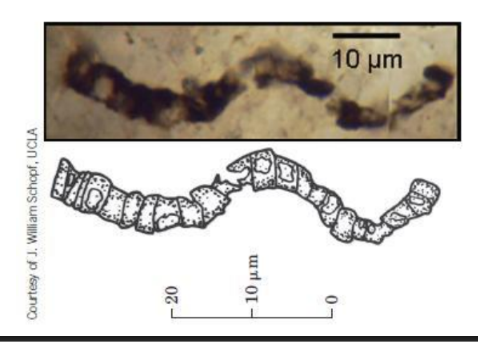
Age and location of oldest known fossil (stromatolite)
3.5 billion years old, from Western Australia
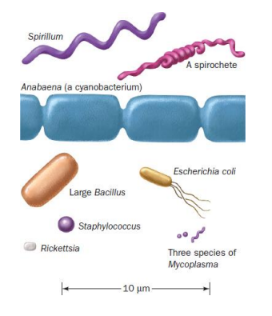
Give examples of prokaryote shapes shown in the scale drawing
Spirillum, spirochete, Anabaena (cyanobacterium), large Bacillus, Escherichia coli, Staphylococcus, Rickettsia, three species of Mycoplasma (scale bar 10 μm)

What structures are shown in the E. coli bacteria drawing?
Ribosome, mRNA, tRNA, DNA, Proteins, Lipopolysaccharide, Phospholipid, Lipoprotein, Peptidoglycan, Flagellum

What does the "man to protein" scale drawing show?
Organism (human, 1 m) → Organ: skin (1 mm) → Tissue: epidermis (100 μm) → Cell: basal cell (5 μm) → Organelle: mitochondrion (1 μm) → Supramolecular assembly: inner mitochondrial membrane (100 Å) → Macromolecule: cytochrome c with heme (10 Å)
Why is water key to life?
It is the solvent of life; all living transformations occur in an aqueous medium; life is thought to arise from the sea
Covalent bond = strongest bond
How do water-insoluble compounds like lipid membranes relate to water?
They derive their nature and function from their interactions with H2O

What organelles/structures are labeled in the eukaryotic animal cell diagram?
Nuclear membrane, Nucleolus, Chromatin, Nucleus, Smooth endoplasmic reticulum, Rough endoplasmic reticulum, Vacuole, Centrioles, Mitochondrion, Free ribosomes, Ribosomes bound to RER, Cell membrane, Lysosome, Golgi apparatus
What was the philosophical idea rejected by modern science regarding life?
Vitalism (the idea that life contains a "vital force")
What environments show the range of life on Earth?
Hot springs, subduction zones, arctic tundra, Antarctic dry fields, animal intestines, college dormitories
What distinguishes living organisms? (Point 1)
Structurally complicated and highly organized (intricate internal structures; many complex molecule types like proteins, DNA, RNA, starches, lipids), unlike simple mixtures like sand or clay
What distinguishes living organisms? (Point 2)
They extract, transform, store, and use ENERGY
Give an example of chemoautotrophs/lithoautotrophs extracting chemical energy
H2S → 2H+ + S + 2e-
2NH3 + 4O2 → 2HNO3 + 2H2O
4FeCO3 + O2 + 6H2O → 4Fe(OH)3 + 4CO2
Give the photoautotroph energy equation
nCO2 + nH2O → (CH2O) + nO2 (using sunlight)
List 4 forms energy takes to build/maintain structures
Mechanical energy (muscles), chemical energy (electric eel), osmotic energy (plant turgor), light energy (bioluminescence)
What distinguishes living organisms? (Point 3)
Self-replication and self-assembly — the quintessence of the living state (e.g., 1 bacterium → 10^9 in 24 hr) with near-perfect fidelity
What is the difference between a crystal at equilibrium and life at equilibrium?
A crystal at equilibrium grows, but life at equilibrium is death
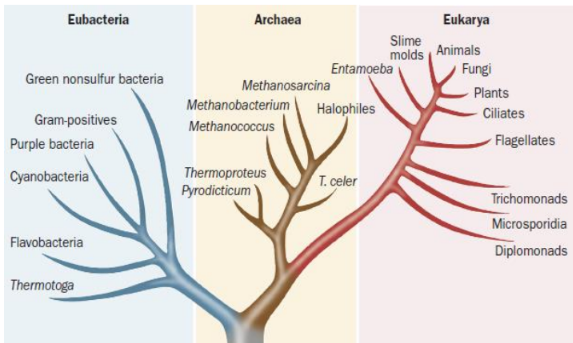
What are the three domains of life?
Eubacteria, Archaea, Eukarya
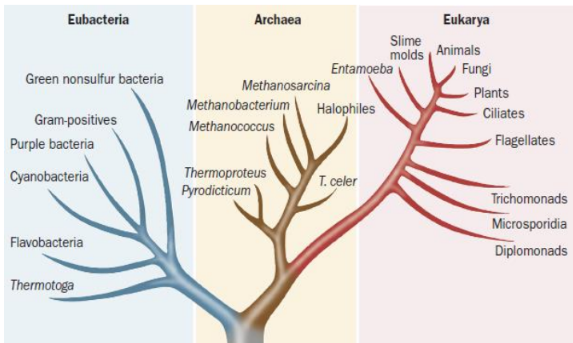
Give examples of Eubacteria
Green nonsulfur bacteria, Gram-positives, Purple bacteria, Cyanobacteria, Flavobacteria, Thermotoga
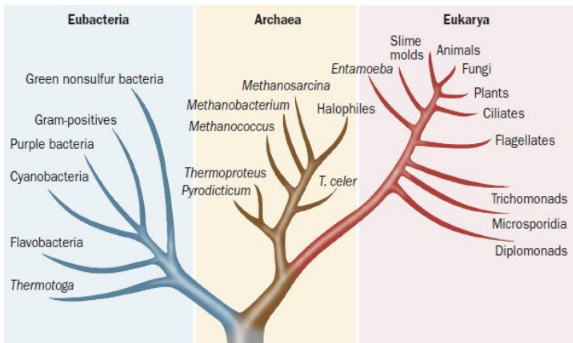
Give examples of Archaea
Methanosarcina, Methanobacterium, Methanococcus, Halophiles, Thermoproteus, Pyrodicticum, T. celer
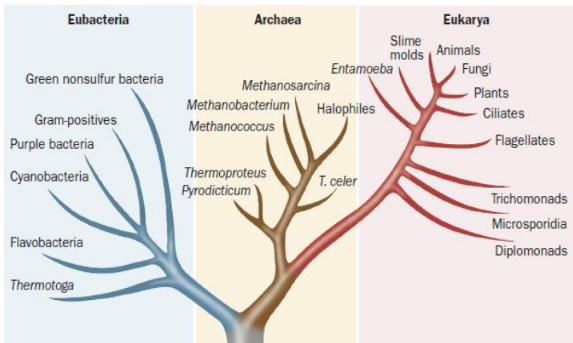
Give examples of Eukarya
Slime molds, Animals, Fungi, Plants, Ciliates, Flagellates, Entamoeba, Trichomonads, Microsporidia, Diplomonads
What is chemical evolution?
Nature's selection of the most fit molecules to carry out the life process, from simple inorganic/organic molecules to complex proteins and macromolecules
Tenet of Evolution 1 - Evolution is not directed toward a particular goal
only changes producing better fitness continue
Tenet of Evolution 2 - Evolution requires some built-in sloppiness
natural populations have genetic variability to allow adaptation to sudden environmental changes
Tenet of Evolution 3 - Evolution is constrained by its past
new structures/pathways appear via small changes over long times for better fitness
Tenet of Evolution 4 - Evolution is ongoing
all life is changing, but diversity has not decreased and simpler species continue to reproduce and survive

What are the monomers of a protein?
Amino acids (e.g., Alanine, Tyrosine, Leucine, Serine, Proline)

What are the monomers of a nucleic acid?
Nucleotides (e.g., Adenine, Guanine, Thymine, Adenine, Cytosine)

What are the monomers of a polysaccharide?
Sugar residues (e.g., Glucose, Galactose, Mannose, Fructose)
What holds the two strands of DNA together?
Complementary base pairing (A-T, C-G) between sugar-phosphate backbones

Length of a C-C bond
1.54 Å

Approximate size of hemoglobin
65 Å

Approximate size of ribosomes
300 Å

Approximate size of viruses
100–1000 Å

Approximate size of cells
7 μm, or 7 x 10^4 Å
Limit of resolution of a light microscope
2000 Å or 0.2 μm
What tools give resolution from 1 Å to 10,000 Å?
X-ray crystallography, electron microscopy, or atomic force microscopy

Time scale: femtoseconds (fs) example
Excitation of chlorophyll