A and P Lab 3
 Call Kai
 Learn
Learn Practice Test
 Spaced Repetition
 Match
Match Flashcards
 Knowt Play
1/31

There's no tags or description
Looks like no tags are added yet.
Name | Mastery | Learn | Test | Matching | Spaced | Call with Kai | Chat |
|---|
No analytics yet
Send a link to your students to track their progress
32 Terms
Try to know this stuff.

Epithelial Tissue
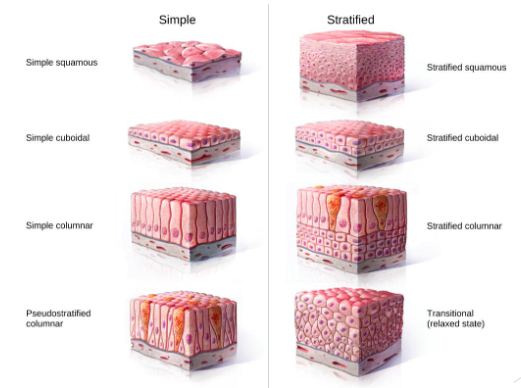
Simple or Stratified
Simple
One layer of cells, which facilitate absorption and filtration. Cell shapes include squamous, columnar, cuboidal, or pseudostratified columnar (example: in capillaries)
Stratified
Has multiple layers of cells, which allow it to protect underlying tissues from abrasion (example: in esophagus)
Make sure you know this.
Connective Tissue: composed of cells in an
extracellular matrix of
amorphous ______ substance and
______, ______, or ______fibers
Proper
ground, collagen, elastic, reticular
______: areolar, adipose, and reticular
tissue
Characterized by its ______arranged
fibers and abundant ground
substances
Loose, loosely
______: regular and irregular
Characterized by ______arranged
fibers
Dense, densely
Connective Tissue: Bone
Hardest
connective tissue
______ fibers and
______salts
______tissue
Made up of _
Collagen, calcium
Vascular
Osteocytes
Need to know spongy vs compact, and trabecula vs osteon

Elastic Cartilage
Most flexible, found in ear.
Hyaline Cartilage
Second most flexible, found in nose and ribs.
Fibro-Carilage
Least flexible, found in knees and vertebrae.
Muscle Tissue
Skeletal
Smooth
Cardiac
Skeletal
Striated and voluntary. Striated and response to voluntary command from the nervous system.
Smooth
Non-striated, involuntary. Non-striated and contracts involuntarily in peristaltic waves that move substances through the body’s digestive, respiratory, urinary, and reproductive tracts.
Cardiac
A special type of striated muscle found only in the myocardium of the heart, has branching fibers connected by intercalated discs that allow for synchronized involuntary contraction to maintain a constant heart rate.
Skeletal System
Axial vs Appendicular
Functions - Support, Movement, Protection, Production of red blood cells.
Flat Bones
Cranial bones, scapular, sternum, ribs.
Long Bones
Tibia, fibula, femur, humerus, ulna, radius.
Short Bones
Carpals and tarsals.
Irregular Bones
Vertebrae and pelvic bones.
Sesamoid Bones
Patella (kneecap).
Bone Tissue
Yellow Marrow
Red Marrow
Yellow Marrow
Fatty bone marrow found in the medullary cavity of long bones.
Red Marrow
Found in spongy bone (often flat bones) produces red blood cells, also in the ends of long bones.
Anatomy of a Long Bone
Make sure to know Diaphysis and Epiphysis.

Bone Histology
Make sure you know it again.

Bone Cells
Osteocytes
Osteoblasts
Osteoclasts
Osteocytes
Maintain bone tissue structure.
Osteoblasts
Build. Synthesize bone matrix.
Osteoclasts
Break down. Break down bone matrix.
Growth Plate Histology
Zone of _______ cartilage
Zone of cell _________
Zone of cell ________
Zone of _________
Zone of bone ___________
reserve cartilage
cell proliferation
cell hypertrophy
calcification
bone deposition
